INT. STADIUM CONCERT
Lights flash and the crowd goes crazy for HUNTRIX.
.1 CROWD
Huntrix, Huntrix, Huntrix!
The crowd holds their light sticks, screaming loudly for
Huntrix as an images of the girls light up a jumbo screen.
.2 CELINE (V.O.)
The world will know you as pop
stars.
Close up of Zoey’s image.
The Huntrix KPOP group-RUMI, ZOEY, and MIRA appear one by one
on the stage.
.3 CELINE (V.O.)
But you will be much more than
that.
CUT TO BLACK:
.4 CELINE (V.O.)
You will be hunters.
CUT TO:
INT. ANCIENT KOREA - MANY YEARS EARLIER
Demon patterns spread over a small village, while the
villagers watch helplessly.
9 CELINE
Demons have always haunted our
world.
Demons begin to emerge through tears in the earth and attack
villagers.
10 CELINE (V.O.)
Stealing our souls and channeling
strength back to their king, Gwi-
Ma.
Their souls channeled into a glorious kingdom, consumed by a
menacing mouth.
KPOP FULL SCRIPT - BUILD CONFORM 10/31/24 2.
Demons chase after villagers- but a voice cuts through the
attack.
11 CELINE (V.O.)
Until heroes arose to defend our
world.
The demons stop and turn around to see three women with
weapons atop a roof. They draw their weapons and begin to
sing, jumping off to save the villagers. They slay each demon
with ease.
11.3 CELINE (V.O.)
Born with voices that could drive
back the darkness.
The Hunters continue to sing, an energy forming between them
that spreads throughout the village, forming a barrier.
Demons try to push through but this barrier keeps them out.
11.4 CELINE (V.O.)
Singing songs of courage and hope.
ANCIENT KOREA - MANY YEARS EARLIER
The villagers who the Hunters have saved from the demons are
gathering together to hear their song.
5 CELINE (V.O.)
But, hunters are more than
warriors. Our music ignites the
soul, and brings people together.
The Hunters continue to sing, an energy forming between them
that spreads throughout the village, forming a barrier.
Demons try to push through but this barrier keeps them out.
A villager approaches a Hunter, who extends her hand.
6 CELINE (V.O.)
With this connection, the first
hunters created a shield to protect
our world. The Honmoon.
As the villagers gather together, the Honmoon shimmers all
around them, growing stronger and expanding outward.
Shots of different Hunters from every generation.
KPOP FULL SCRIPT - BUILD CONFORM 10/31/24 3.
18.1 CELINE (V.O.)
Every generation, a new trio of
Hunters is chosen to fulfill our
ultimate duty– to keep a barrier so
strong it is impenetrable, keeping
demons, and Gwi-Ma, from our world
forever: The Golden Honmoon.
A shot of the Golden Honmoon shining around the world.
EXT. JEJUDO FOREST - DAY
Our narrator, Celine, now speaks to three new Hunters before
her. She has now become the mentor.
19 CELINE
And now, that duty falls to you.
That victory is within your reach.
It is your voices, your song, that
will create the Golden Honmoon.
19.1 RUMI/MIRA/ZOEY
Yes, Celine.
CUT TO:
0150 BSS
Scene Objective: Introduce the main characters and their dual roles as pop stars and hunters while establishing the threat of demons.
Setting: Stadium concert, present day.
POV: Celine's perspective as a mentor and narrator.
Emotional Arc: + excitement → + urgency
Score Overview
Group
Category
Score
Overall
Overall Score
8.3
Core Elements
Purpose
9
Goal vs Obstacle
8
Stakes
7
Progression
8
Turn Potency
9
Supporting
Exposition
8
Subtext
7
Setups & Payoffs
8
Beat Clarity
8
Quality
Scene Necessity
9
Thematic Resonance
8
Core Story Elements
9
Purpose
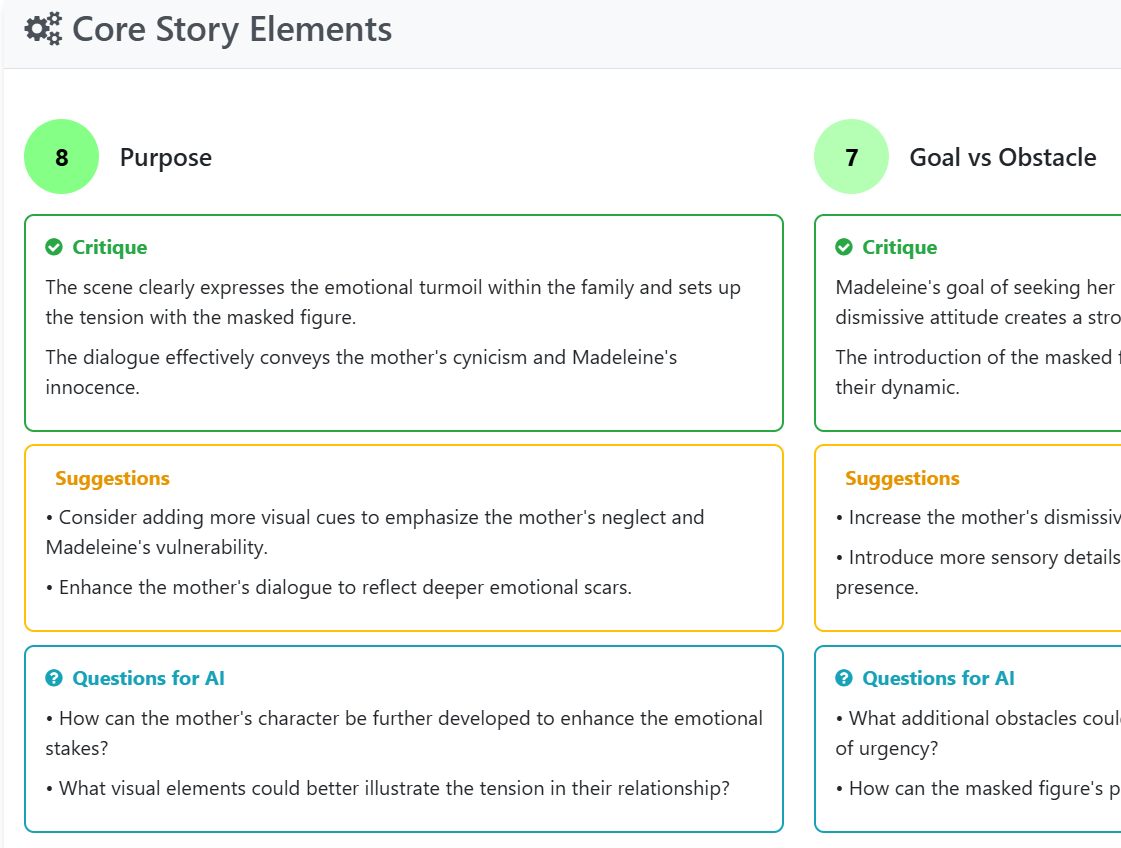
Critique
The scene clearly establishes the characters' identities and the stakes involved in their roles as hunters.
The transition from the concert to the historical context of the hunters is smooth and impactful.
Suggestions
• Consider adding a brief moment of interaction between the characters to deepen their connection before the transition.
• Enhance the emotional weight of the concert by showing a fan's reaction to the performance.
Questions for AI
• How can we further emphasize the emotional stakes for the characters during the concert?
• What additional elements could highlight the contrast between their pop star image and their hunter duties?
8
Goal vs Obstacle
Critique
The characters' goal of becoming successful hunters is clear, but the immediate obstacle of Gwi-Ma's threat is introduced more subtly.
The scene effectively sets up the internal conflict of balancing fame with their responsibilities.
Suggestions
• Clarify the immediate threat posed by Gwi-Ma to create a stronger sense of urgency.
• Introduce a visual cue or symbol that represents the demons' influence during the concert.
Questions for AI
• What specific obstacles can we introduce to heighten the tension during the concert?
• How can we visually represent the looming threat of Gwi-Ma more effectively?
7
Stakes
Critique
The stakes are established through the introduction of the Honmoon and the demons, but they could be made more personal for the characters.
The connection between their performance and the fight against demons is implied but not fully realized.
Suggestions
• Incorporate a moment where the characters reflect on what failure would mean for them personally.
• Highlight the consequences of failing to protect the Honmoon during the concert.
Questions for AI
• How can we make the stakes feel more immediate and personal for the characters?
• What specific consequences can we introduce to emphasize the importance of their mission?
8
Progression
Critique
The scene transitions effectively from the excitement of the concert to the historical context, showing a clear progression.
The shift from celebration to the introduction of danger is well executed.
Suggestions
• Consider adding a moment of doubt or hesitation from the characters before the transition to heighten the emotional impact.
• Make the transition to the historical context more visually distinct to emphasize the shift.
Questions for AI
• What additional elements can we include to enhance the emotional progression of the scene?
• How can we visually differentiate the concert from the historical flashback more clearly?
9
Turn Potency
Critique
The turn from the concert to the historical context is impactful and sets the stage for the characters' journey.
The reveal of the hunters' purpose is well-timed and resonates with the audience.
Suggestions
• Consider adding a dramatic pause or visual cue to heighten the impact of the transition.
• Explore ways to foreshadow the challenges the characters will face as hunters.
Questions for AI
• How can we make the transition more surprising or impactful?
• What foreshadowing elements can we introduce to hint at future challenges?
Supporting Elements
8
Exposition
Critique
The exposition is woven into the narrative effectively, providing necessary background without feeling forced.
The historical context enhances the audience's understanding of the characters' roles.
Suggestions
• Consider integrating more visual storytelling elements to convey the history of the hunters.
• Streamline any dialogue that feels redundant in explaining the hunters' purpose.
Questions for AI
• What visual elements can we add to enhance the exposition without relying on dialogue?
• How can we ensure the exposition feels organic and engaging?
7
Subtext
Critique
The subtext of identity and duty is present but could be more pronounced through character interactions.
The contrast between their public personas and hidden struggles is implied but not fully explored.
Suggestions
• Incorporate subtle hints of the characters' internal conflicts during the concert.
• Explore moments of vulnerability that reveal their fears about their dual identities.
Questions for AI
• How can we deepen the subtext of identity and duty in this scene?
• What specific moments can we create to highlight the characters' internal struggles?
8
Setups & Payoffs
Critique
The scene sets up the characters' roles effectively, creating anticipation for their journey.
The introduction of the Honmoon serves as a strong payoff for the historical context.
Suggestions
• Consider adding a visual motif that recurs throughout the story to reinforce the setup.
• Explore ways to foreshadow the challenges they will face in their roles as hunters.
Questions for AI
• What recurring motifs can we introduce to enhance the setup and payoff dynamics?
• How can we better foreshadow the challenges the characters will encounter?
8
Beat Clarity
Critique
The beats within the scene flow well, with a clear escalation from excitement to urgency.
The rhythm of the scene supports the emotional journey of the characters.
Suggestions
• Consider tightening the pacing in certain areas to enhance the urgency.
• Explore ways to create more dynamic shifts between beats.
Questions for AI
• How can we refine the pacing to enhance the urgency of the scene?
• What specific beat-level changes can we make to improve flow?
Scene Transitions
Next Scene
9
Hook Out: The transition to the next scene is clear as the historical context sets up the characters' journey.
Energy DOWN
The scene hands off momentum effectively, leading into the next sequence. The shift from excitement to urgency is well executed.
Suggestions
• Consider adding a cliffhanger or visual cue to enhance the transition.
• Explore ways to create a more dramatic shift in energy.
Questions for AI
• What elements can we introduce to strengthen the transition to the next scene?
• How can we create a more impactful exit from this scene?
Scene Necessity
9
MUST HAVE
This scene is essential for establishing the characters' identities and the overarching conflict.
Suggestions
Ensure that the emotional stakes are clear to reinforce the scene's necessity.
Questions for AI
• What elements can we add to emphasize the scene's importance in the overall narrative?
• How can we ensure that this scene is indispensable to the character arcs?
Enhancement Tags
#identity#duality#duty#sacrifice
Character Delta: Rumi begins to embrace her dual identity as a hunter and pop star.
Improvement Recommendations
Add a moment of vulnerability for the characters during the concert.
Introduce a visual motif that represents the demons' influence.
Explore ways to foreshadow the challenges they will face as hunters.
The #1 Rule of Screenwriting: Make your reader or audience compelled to keep reading.
“Grab ‘em by the throat and never let ‘em go.”
The scene level score is the impact on the reader or audience to continue reading.
The Script score is how compelled they are to keep reading based on the rest of the script so far.
Compelled to keep Reading Score: 8/10
This scene masterfully sets up the core mythology and stakes of the story. The juxtaposition of the K-pop concert and the ancient demon invasion immediately grabs attention and establishes the unique premise. Celine's narration effectively explains the threat of Gwi-Ma, the role of the Hunters, and the ultimate goal of the Golden Honmoon. The direct address to the new Huntrix members at the end creates a clear call to action and a sense of destiny, making the reader eager to see how they will fulfill this ancient duty.
Script Continuation Score: 9/10
The script has begun with a bang, establishing a compelling and unique premise. The introduction of the K-pop group Huntrix as destined demon hunters, fighting to create the Golden Honmoon, is a strong hook. The historical context provided by Celine's narration grounds the fantastical element in a larger, generational struggle. This scene leaves the reader with many questions: Who are these demons? What is the true power of their songs? And how will Huntrix, as modern pop stars, possibly fulfill this ancient, epic destiny? The potential for conflict and grand adventure is immense.
Expert Critiques
Expert Suggestions
View Analysis
View Script
2 -
Fan Frenzy: Celebrating Huntrix - Overall Grade:
8.2
EXT. CONCERT VENUE
Fans file in to a packed concert stadium.
1 FANS
Huntrix! Huntrix! Huntrix!
Fans chant excitedly while entering the venue.
2 FANS (CONT’D)
We love Huntrix!
Cut away to fans as they tailgate outside.
3 MIRA FAN 1
Mira’s my favorite! She's the
visual and lead dancer of Huntrix.
Nobody can move like Mira.
4 MIRA FAN 2
Apparently she was the black sheep
of her family.
KPOP FULL SCRIPT - BUILD CONFORM 10/31/24 4.
5 MIRA FAN 3
I don’t know why because she’s so
cool. Who else can wear a sleeping
bag to the Met Gala?
Shots of Mira family photos, where she is very much the
outlier in an otherwise perfectly normal family.
6 MIRA FAN 1
Yeah, she’s our role model.
7 MIRA FAN 2/FAN 3
She’s the best. Love her.
Three “Mira Fans”, dressed just like her, talk straight to
camera.
EXT. CONCERT VENUE
Now it’s Zoey’s fans turn to gush.
8 FANS
We’re here for ZOEY!
9 ZOEY FAN 1
She's the rapper and lyricist.
Shots of Zoey in school, headphones on, writing lyrics in her
notebook.
10 ZOEY FAN 2
She grew up in America, somewhere
called Burbank, USA?
Shot of a map of California.
11 ZOEY FAN 1
She's the cutest maknae.
12 ZOEY FAN 2
– but when she raps– she goes HARD.
Shot of nerdy young Zoey doing rap battles.
13 ZOEY FAN 3
She gets real scary, like, so scary
you better WATCH OUT!
Genres:
Musical, Drama Tone:
Excitement, Admiration, Playful
Ratings
Scene Objective: To establish the fervent fan culture surrounding Huntrix and introduce the characters through their admirers.
Setting: EXT. CONCERT VENUE - DAY
POV: The perspective of the fans and the excitement surrounding the concert.
Emotional Arc: + excitement → + admiration
Score Overview
Group
Category
Score
Overall
Overall Score
7.2
Core Elements
Purpose
8
Goal vs Obstacle
7
Stakes
6
Progression
7
Turn Potency
5
Supporting
Exposition
8
Subtext
6
Setups & Payoffs
7
Beat Clarity
8
Quality
Scene Necessity
8
Thematic Resonance
7
Core Story Elements
8
Purpose
Critique
The scene clearly expresses the purpose of showcasing the fan culture and the individual appeal of each Huntrix member.
The excitement of the fans effectively sets the stage for the upcoming concert.
Suggestions
• Incorporate more direct interactions between fans and the band to deepen the connection.
• Add a moment where a fan's personal story highlights their connection to a specific member.
Questions for AI
• How can we further illustrate the emotional impact of Huntrix on their fans?
• What specific fan interactions could enhance the sense of community among the audience?
7
Goal vs Obstacle
Critique
The goals of the fans to support their idols are clear, but the obstacles they face are less defined in this scene.
The excitement is palpable, but there is little tension or conflict introduced.
Suggestions
• Introduce a minor conflict, such as a fan being unable to get into the venue, to create stakes.
• Highlight any potential challenges the band might face during the concert.
Questions for AI
• What obstacles could be introduced to heighten the stakes for the fans?
• How can we show the fans' dedication in a way that suggests they might face challenges?
6
Stakes
Critique
The stakes are primarily emotional, centered around the fans' desire to see their idols succeed.
However, the urgency of these stakes is not fully realized in this scene.
Suggestions
• Introduce a countdown to the concert to create a sense of urgency.
• Show fans discussing their hopes for the concert's outcome to raise emotional stakes.
Questions for AI
• How can we make the fans' stakes feel more immediate and pressing?
• What specific outcomes do the fans hope for that could be jeopardized?
7
Progression
Critique
The scene progresses smoothly from the excitement of fans entering the venue to their admiration for the members.
However, it lacks a clear before-and-after shift that indicates a change in the narrative.
Suggestions
• End the scene with a moment that hints at the upcoming challenges the band will face.
• Introduce a fan's realization that something might go wrong during the concert.
Questions for AI
• What moment could serve as a turning point to indicate a shift in the narrative?
• How can we foreshadow future challenges for the band within this scene?
5
Turn Potency
Critique
The scene lacks a significant turning point that alters the trajectory of the narrative.
While it builds excitement, it does not introduce any unexpected developments.
Suggestions
• Include a surprising announcement or event that disrupts the fans' excitement.
• Foreshadow a conflict that will arise during the concert to create a more impactful turn.
Questions for AI
• What unexpected event could occur to heighten the tension in this scene?
• How can we create a moment that shifts the fans' excitement to concern?
Supporting Elements
8
Exposition
Critique
The scene effectively conveys necessary background information about the characters through fan dialogue.
Exposition feels natural and integrated into the excitement of the moment.
Suggestions
• Consider adding a brief mention of the band's recent achievements to enhance context.
• Weave in more personal anecdotes from fans to deepen character backgrounds.
Questions for AI
• What additional background information could enhance the fans' connection to the band?
• How can we further integrate exposition without disrupting the flow of excitement?
6
Subtext
Critique
While the surface excitement is clear, deeper themes of identity and belonging are not yet explored.
The fans' admiration hints at their own desires for connection, but this is not fully developed.
Suggestions
• Introduce moments where fans reflect on their personal struggles in relation to the band.
• Highlight how the fans' identities are intertwined with their admiration for Huntrix.
Questions for AI
• What deeper emotional connections can we explore between the fans and the band?
• How can we hint at the fans' personal struggles through their interactions?
7
Setups & Payoffs
Critique
The scene sets up the excitement for the concert well, but it lacks clear payoffs.
Fans' admiration is established, but the consequences of their support are not yet evident.
Suggestions
• Introduce a moment that pays off the fans' excitement, such as a surprise appearance by the band.
• Foreshadow future events that will challenge the fans' loyalty.
Questions for AI
• What moments could serve as payoffs for the fans' excitement later in the story?
• How can we create setups that lead to significant developments in the narrative?
8
Beat Clarity
Critique
The beats within the scene are clear and maintain a lively rhythm.
However, the lack of conflict reduces the overall tension and engagement.
Suggestions
• Introduce a beat that hints at potential conflict to maintain audience engagement.
• Ensure each beat builds on the previous one to enhance momentum.
Questions for AI
• What beats could be added to increase tension and engagement?
• How can we ensure that each beat contributes to the overall narrative flow?
Scene Transitions
Previous Scene
8
Hook In: The transition from Celine's mentorship to the excitement of the fans is smooth and engaging.
Energy UP
The tone shifts effectively from the serious nature of the previous scene to the lively atmosphere of the concert. The excitement builds naturally from the previous scene's setup.
Suggestions
• Consider adding a moment that directly connects Celine's teachings to the fans' excitement.
Questions for AI
• How can we further enhance the transition from mentorship to fan excitement?
• What elements could create a stronger link between the previous scene and this one?
Next Scene
7
Hook Out: The scene ends with fans eagerly anticipating the concert, setting up the next scene.
Energy UP
The scene hands off momentum well, but it could benefit from a more dramatic exit. The excitement is palpable, but a hint of conflict could enhance the transition.
Suggestions
• Introduce a cliffhanger or unexpected moment to heighten anticipation for the next scene.
• Foreshadow potential challenges that will arise during the concert.
Questions for AI
• What moments could serve as a stronger exit to build anticipation for the next scene?
• How can we create a more dramatic transition that hints at upcoming conflicts?
Scene Necessity
8
MUST HAVE
This scene is essential for establishing the fan culture and setting the tone for the concert, which is pivotal for the story.
Suggestions
Enhance the scene's emotional stakes to make it feel even more integral to the narrative.
Questions for AI
• What elements could make this scene feel even more crucial to the overall story?
• How can we deepen the emotional impact of this scene to ensure it feels necessary?
Enhancement Tags
#fanCulture#identity#belonging
Character Delta: Rumi, Zoey, and Mira are celebrated by their fans, reinforcing their identities as pop stars.
Improvement Recommendations
Introduce a minor conflict among fans to create stakes.
Foreshadow challenges the band will face during the concert.
Add personal anecdotes from fans to deepen character backgrounds.
The #1 Rule of Screenwriting: Make your reader or audience compelled to keep reading.
“Grab ‘em by the throat and never let ‘em go.”
The scene level score is the impact on the reader or audience to continue reading.
The Script score is how compelled they are to keep reading based on the rest of the script so far.
Compelled to keep Reading Score: 8/10
This scene immediately dives into the fervent fandom surrounding Huntrix, focusing on individual members Mira and Zoey. By showcasing dedicated fans discussing their idols' backstories and personalities, it builds anticipation for the members' performances and humanizes them beyond their stage personas. This fan-centric approach offers a glimpse into the pressures and unique aspects of their lives, making the reader curious to see how these traits manifest during their hunt.
Script Continuation Score: 7/10
Following the introductory scene establishing the demon threat and Huntrix's role, this scene deepens the audience's connection with two of the members, Mira and Zoey, by exploring their fan bases and personal backgrounds. This builds investment in the characters, making their future struggles and triumphs more impactful. However, it doesn't directly advance the overarching demon plot, relying on earlier hooks to maintain momentum.
EXT. CONCERT VENUE
Rumi’s fans gather around her for autographs.
KPOP FULL SCRIPT - BUILD CONFORM 10/31/24 5.
14 FANS
We love RUMI!
15 RUMI FAN 1
She’s pop star royalty.
16 RUMI FAN 2
Her mom was a Sunlight Sister but
passed away when she was an infant.
Shots of young Celine as a pop star.
17 RUMI FAN 3
But Celine raised her and built
Huntrix around her.
Shot of Celine with Baby Rumi. Shot of Celine with debuting
Huntrix.
18 RUMI FAN 1
Rumi’s voice is just incredible.
Like-
A bunch of sobbing fans cry into the mic.
19 CRYING FANS
-it brings us to tears!
Fans gush, now in their seats and ready for show.
20 RUMI FAN 2
They’re taking a break after this
concert and they totally need it
but we’re gonna miss them so much—
21 FANS
OMG IT’S STARTING!!!
They start freaking out as the concert lights dim.
Genres:
Drama, Music Tone:
Emotional, Excited, Admiring
Ratings
Scene Objective: To showcase Rumi's popularity and the emotional connection her fans have with her, while subtly introducing her backstory.
Setting: Outside a concert venue during the day.
POV: The perspective of Rumi's fans, highlighting their admiration and emotional investment.
Emotional Arc: - insecurity → + belonging
Score Overview
Group
Category
Score
Overall
Overall Score
7.7
Core Elements
Purpose
8
Goal vs Obstacle
7
Stakes
6
Progression
7
Turn Potency
8
Supporting
Exposition
7
Subtext
6
Setups & Payoffs
7
Beat Clarity
8
Quality
Scene Necessity
9
Thematic Resonance
8
Core Story Elements
8
Purpose
Critique
The scene clearly expresses Rumi's significance to her fans and establishes her as a central character in the narrative.
The emotional connection between Rumi and her fans is palpable, enhancing the stakes for her character.
Suggestions
• Incorporate more direct quotes from fans that reflect their personal stories related to Rumi.
• Add visual elements that show fans' reactions to Rumi's past, deepening the emotional impact.
Questions for AI
• How can we further illustrate Rumi's impact on her fans through their personal anecdotes?
• What additional visual cues can enhance the emotional connection between Rumi and her fans?
7
Goal vs Obstacle
Critique
Rumi's goal of connecting with her fans is clear, but the obstacles related to her hidden past are only hinted at.
The scene effectively sets up the admiration but lacks tension regarding Rumi's internal struggles.
Suggestions
• Introduce subtle hints of Rumi's insecurities through her reactions to fan praise.
• Create a moment where Rumi reflects on her mother's legacy, adding depth to her character's conflict.
Questions for AI
• What internal conflicts can we highlight in Rumi's reactions to her fans' admiration?
• How can we introduce hints of Rumi's past that create tension in this moment?
6
Stakes
Critique
The stakes are present in the fans' emotional investment, but Rumi's personal stakes are not fully articulated.
The scene lacks a sense of urgency or immediate consequence for Rumi's character.
Suggestions
• Introduce a moment where Rumi feels overwhelmed by the pressure of her fans' expectations.
• Highlight the potential fallout if Rumi fails to meet her fans' hopes, increasing the stakes.
Questions for AI
• What specific fears does Rumi have about disappointing her fans that we can showcase?
• How can we create a sense of urgency in this scene that reflects the stakes for Rumi?
7
Progression
Critique
The scene shows a clear progression from fan admiration to the anticipation of the concert, but Rumi's internal journey is less defined.
The transition from fan excitement to the concert's start is effective but could be more emotionally resonant.
Suggestions
• Include a moment where Rumi reflects on her journey before stepping on stage, enhancing her character arc.
• Create a more dramatic shift in energy as the concert begins, contrasting fan excitement with Rumi's internal conflict.
Questions for AI
• How can we better illustrate Rumi's emotional journey as she prepares to perform?
• What moments can we add to heighten the contrast between fan excitement and Rumi's internal struggles?
8
Turn Potency
Critique
The scene's pivotal moment occurs when the fans express their love for Rumi, solidifying her status as a beloved figure.
The transition to the concert's start is impactful, setting the stage for the upcoming performance.
Suggestions
• Enhance the moment of transition to the concert with a dramatic visual or auditory cue that signifies a shift.
• Consider adding a moment of doubt for Rumi just before the concert begins to heighten the emotional stakes.
Questions for AI
• What visual or auditory elements can we use to amplify the transition to the concert?
• How can we create a moment of doubt for Rumi that makes her eventual performance more impactful?
Supporting Elements
7
Exposition
Critique
The scene provides necessary background on Rumi's family and her connection to Celine, but it could be more seamlessly integrated.
Exposition feels a bit heavy-handed at times, interrupting the flow of fan interactions.
Suggestions
• Weave exposition into fan dialogue more naturally, allowing it to emerge through their admiration.
• Use visual storytelling to show Rumi's past rather than relying solely on dialogue.
Questions for AI
• How can we integrate Rumi's backstory into fan interactions without feeling forced?
• What visual elements can we use to convey Rumi's history more organically?
6
Subtext
Critique
The subtext of Rumi's hidden struggles is present but not fully explored in this scene.
Fans' admiration contrasts with Rumi's internal conflict, but this tension could be more pronounced.
Suggestions
• Introduce subtle hints of Rumi's insecurities through her reactions to fan praise.
• Create moments where Rumi's thoughts drift to her past, adding depth to her character.
Questions for AI
• What subtle cues can we add to highlight Rumi's internal conflict amidst fan admiration?
• How can we deepen the contrast between Rumi's public persona and her private struggles?
7
Setups & Payoffs
Critique
The scene sets up Rumi's popularity effectively, but the payoff regarding her internal struggles is not yet realized.
Hints of her past create anticipation for future revelations but lack immediate payoff.
Suggestions
• Foreshadow future conflicts by hinting at Rumi's insecurities in her interactions with fans.
• Create a moment where a fan's comment triggers a memory for Rumi, setting up future emotional arcs.
Questions for AI
• What foreshadowing can we include to hint at Rumi's future conflicts?
• How can we create a moment that triggers Rumi's memories and sets up future emotional arcs?
8
Beat Clarity
Critique
The beats within the scene are clear, with a strong rhythm that captures the excitement of the fans.
Transitions between fan interactions and Rumi's reflections are generally smooth.
Suggestions
• Consider tightening the pacing of fan interactions to maintain momentum.
• Add a moment of silence or pause to heighten the anticipation before the concert begins.
Questions for AI
• How can we tighten the pacing of fan interactions to enhance momentum?
• What moments of silence or pause can we introduce to build anticipation?
Scene Transitions
Previous Scene
8
Hook In: Fans chanting 'Huntrix! Huntrix!' as they enter the venue.
Energy UP
The transition from the previous scene to this one is energetic and engaging, effectively capturing the excitement of the fans. The flow from fan excitement to Rumi's interactions is smooth, maintaining momentum.
Suggestions
• Consider adding a moment of silence or anticipation before the fan interactions to heighten the energy.
• Introduce a visual cue that connects the previous scene's excitement to Rumi's personal stakes.
Questions for AI
• How can we create a moment of anticipation before the fan interactions to heighten energy?
• What visual cues can we use to connect the previous scene's excitement to Rumi's personal stakes?
Next Scene
9
Hook Out: Fans freaking out as the concert lights dim.
Energy UP
The scene hands off momentum effectively, transitioning from fan excitement to the anticipation of the concert. The energy builds nicely, setting the stage for the upcoming performance.
Suggestions
• Consider adding a dramatic visual or auditory cue that signifies the transition to the concert.
• Create a moment of doubt for Rumi just before the concert begins to heighten the emotional stakes.
Questions for AI
• What dramatic visual or auditory elements can we use to amplify the transition to the concert?
• How can we create a moment of doubt for Rumi that makes her eventual performance more impactful?
Scene Necessity
9
MUST HAVE
This scene is essential for establishing Rumi's character and her relationship with her fans, setting the emotional stakes for her journey.
Suggestions
Ensure that the emotional weight of Rumi's legacy is felt throughout the scene to reinforce its necessity.
Questions for AI
• What elements can we add to ensure this scene's emotional weight is felt throughout?
• How can we make Rumi's relationship with her fans more integral to the overall narrative?
Enhancement Tags
#identity#belonging#legacy
Character Delta: Rumi begins to grapple with her identity as both a beloved star and a person with hidden struggles.
Improvement Recommendations
Add more direct quotes from fans that reflect their personal stories related to Rumi.
Introduce subtle hints of Rumi's insecurities through her reactions to fan praise.
Create a moment where Rumi reflects on her journey before stepping on stage.
The #1 Rule of Screenwriting: Make your reader or audience compelled to keep reading.
“Grab ‘em by the throat and never let ‘em go.”
The scene level score is the impact on the reader or audience to continue reading.
The Script score is how compelled they are to keep reading based on the rest of the script so far.
Compelled to keep Reading Score: 8/10
This scene effectively builds anticipation for the concert itself and subtly introduces emotional depth to Rumi's character through her fans' dialogue. The shift from the energetic fan chants of Huntrix to the specific focus on Rumi and her backstory, mentioning her deceased mother and Celine's role, adds a layer of personal narrative that makes the reader curious about Rumi's internal state and her connection to the group's mission. The ending, with fans freaking out as the concert starts, creates an immediate push to see the performance and how Rumi will handle it.
Script Continuation Score: 8/10
The script continues to build the world of Huntrix by focusing on their fandom and individual members. Scene 2 highlighted Mira and Zoey, and this scene now deepens our understanding of Rumi. The introduction of Rumi's past, her mother's legacy, and Celine's involvement hints at larger narrative threads related to the group's destiny as hunters. The fans' mention of the group taking a break also subtly sets up future plot points or potential conflicts.
EXT. OLYMPIC STADIUM - NIGHT
An incredible light show plays for a packed stadium audience.
The fans go wild as video plays of HUNTRIX. We see slides of
ZOEY, MIRA, and RUMI. The crowd CHANTS their names. The crowd
has heart glow sticks and signs for each girl. The energy is
unmatched.
An excited man BOBBY, late 30s, manager, a human golden
retriever, weaves around backstage on a head mic.
.1 BOBBY
Everyone look alive!
KPOP FULL SCRIPT - BUILD CONFORM 10/31/24 6.
A group of people working on the sound levels give him a
thumbs up.
.2 BOBBY (CONT’D)
Alright, lookin’ good over there!
A man up in the rafters next to a spotlight gives him a
thumbs up.
.3 BOBBY (CONT’D)
Okay. Ready? Ready!
Bobby smiles to himself, but then checks his watch and
immediately looks worried.
.4 BOBBY (CONT’D)
But where are the girls??
He checks his flight tracker app and sees they have flown
PAST the stadium.
.5 BOBBY (CONT’D)
What?! Where are they going??
0200 PLN
Genres:
Musical, Drama Tone:
Excitement, Urgency, Confusion
Ratings
Scene Objective: To establish the high-energy atmosphere of the concert while introducing a looming conflict regarding the girls' whereabouts.
Setting: Olympic Stadium at night
POV: Bobby, the manager, whose perspective highlights the backstage chaos and concern.
Emotional Arc: − excitement → + anxiety
Score Overview
Group
Category
Score
Overall
Overall Score
7.7
Core Elements
Purpose
8
Goal vs Obstacle
7
Stakes
6
Progression
7
Turn Potency
8
Supporting
Exposition
7
Subtext
6
Setups & Payoffs
7
Beat Clarity
8
Quality
Scene Necessity
9
Thematic Resonance
8
Core Story Elements
8
Purpose
Critique
The scene clearly establishes the excitement of the concert while simultaneously introducing tension through Bobby's worry about the girls.
The contrast between the audience's joy and Bobby's anxiety effectively sets up the impending conflict.
Suggestions
• Consider adding a brief moment of audience reaction to Bobby's concern to heighten the tension.
• Incorporate a visual cue that hints at the girls' absence earlier in the scene.
Questions for AI
• How can we visually represent the audience's excitement while contrasting it with Bobby's anxiety?
• What specific actions can Bobby take to further emphasize his concern for the girls?
7
Goal vs Obstacle
Critique
Bobby's goal of ensuring a successful concert is clear, but the obstacle of the girls' absence is introduced somewhat abruptly.
The tension builds effectively, but the stakes could be more explicitly tied to the concert's success.
Suggestions
• Clarify the stakes by showing how the concert's success is directly linked to the girls' performance.
• Introduce a countdown or timer element to heighten the urgency of the situation.
Questions for AI
• What specific consequences could arise from the girls' absence that would heighten the stakes for Bobby?
• How can we better illustrate the connection between Bobby's anxiety and the concert's success?
6
Stakes
Critique
The stakes are present but could be more tangible; the audience's excitement contrasts with Bobby's worry, but the implications of the girls' absence are not fully explored.
The urgency is felt, but the emotional weight of the stakes could be deepened.
Suggestions
• Include a moment where Bobby reflects on the potential fallout if the girls do not arrive.
• Show audience reactions to the delay to emphasize the stakes for both the fans and the group.
Questions for AI
• What specific fears does Bobby have about the girls' absence that could be highlighted?
• How can we illustrate the potential impact on the fans if the concert does not go as planned?
7
Progression
Critique
The scene progresses from excitement to anxiety effectively, but the transition could be more pronounced.
Bobby's initial confidence shifts to worry, but the pacing could be tightened to enhance this progression.
Suggestions
• Add a moment where Bobby's confidence is visibly shaken to emphasize the shift.
• Consider pacing the dialogue to reflect the increasing urgency of the situation.
Questions for AI
• How can we better illustrate the moment Bobby's confidence shifts to anxiety?
• What pacing techniques can we use to enhance the progression from excitement to worry?
8
Turn Potency
Critique
The pivotal moment of Bobby realizing the girls are missing is impactful, but could be foreshadowed more effectively.
The turn from excitement to concern is well-timed, creating a strong emotional shift.
Suggestions
• Foreshadow the girls' absence earlier in the scene to enhance the impact of the turn.
• Consider adding a visual cue that hints at the girls' delay before Bobby checks the flight tracker.
Questions for AI
• What earlier hints can we include to foreshadow the girls' absence?
• How can we make the moment of realization more dramatic or surprising?
Supporting Elements
7
Exposition
Critique
The scene provides necessary context about the concert and Bobby's role, but could benefit from more organic exposition.
Some information feels a bit forced, particularly regarding Bobby's character.
Suggestions
• Integrate exposition through Bobby's interactions with the crew rather than direct statements.
• Show Bobby's relationship with the girls through brief flashbacks or memories.
Questions for AI
• How can we weave in Bobby's backstory more naturally during the scene?
• What interactions can we create to reveal more about the concert's significance?
6
Subtext
Critique
The subtext of Bobby's anxiety about the girls' performance is present but could be more layered.
The contrast between the audience's joy and Bobby's worry hints at deeper themes of pressure and responsibility.
Suggestions
• Introduce subtle hints of Bobby's past experiences with similar situations to deepen the subtext.
• Explore Bobby's internal conflict regarding his role as a manager versus his concern for the girls.
Questions for AI
• What past experiences can we reference to add depth to Bobby's character?
• How can we enhance the contrast between the audience's excitement and Bobby's anxiety?
7
Setups & Payoffs
Critique
The scene sets up the tension effectively, but the payoff regarding the girls' absence is not fully realized.
The audience is left with a sense of anticipation, but the connection to the larger narrative could be clearer.
Suggestions
• Create a more direct link between Bobby's concerns and the upcoming conflict with the girls.
• Foreshadow the girls' absence earlier in the narrative to enhance the payoff.
Questions for AI
• What earlier setups can we include to strengthen the payoff regarding the girls' absence?
• How can we create a more direct connection between Bobby's anxiety and the larger narrative?
8
Beat Clarity
Critique
The beats within the scene are clear and escalate effectively, creating a sense of urgency.
The rhythm of Bobby's dialogue and actions contributes to the overall tension.
Suggestions
• Consider tightening the dialogue to enhance the rhythm and flow.
• Add pauses or reactions from Bobby to emphasize key moments.
Questions for AI
• What specific beats can we enhance to improve the scene's rhythm?
• How can we better highlight Bobby's emotional journey through beat adjustments?
Scene Transitions
Previous Scene
8
Hook In: Fans are excitedly anticipating the concert, creating a stark contrast with Bobby's anxiety.
Energy FLAT
The transition from the previous scene is smooth, but the emotional shift could be more pronounced. The excitement of the fans sets a strong backdrop for Bobby's concerns.
Suggestions
• Consider adding a moment where Bobby reflects on the fans' excitement to enhance the emotional contrast.
• Use visual cues to emphasize the shift from joy to anxiety.
Questions for AI
• How can we better highlight the emotional contrast between the fans and Bobby?
• What visual elements can we incorporate to enhance the transition?
Next Scene
9
Hook Out: Bobby's realization of the girls' absence sets up the next scene's conflict.
Energy UP
The scene effectively hands off momentum to the next conflict, creating anticipation. Bobby's growing anxiety propels the narrative forward.
Suggestions
• Consider adding a cliffhanger moment to heighten the urgency as the scene ends.
• Use a visual cue to signal the transition to the next scene.
Questions for AI
• What specific elements can we add to enhance the cliffhanger effect?
• How can we visually signal the transition to the next scene more effectively?
Scene Necessity
9
MUST HAVE
This scene is crucial for establishing the stakes and tension leading into the next conflict.
Suggestions
Ensure that the emotional weight of Bobby's concerns is felt throughout the scene.
Questions for AI
• What elements can we add to make this scene feel even more essential to the narrative?
• How can we deepen the emotional stakes to ensure this scene's necessity is clear?
Enhancement Tags
#tension#urgency#performance
Character Delta: Bobby transitions from confident manager to anxious leader.
Improvement Recommendations
Add a moment of audience reaction to Bobby's concern to heighten the tension.
Introduce a countdown or timer element to heighten the urgency of the situation.
Foreshadow the girls' absence earlier in the scene to enhance the impact of the turn.
The #1 Rule of Screenwriting: Make your reader or audience compelled to keep reading.
“Grab ‘em by the throat and never let ‘em go.”
The scene level score is the impact on the reader or audience to continue reading.
The Script score is how compelled they are to keep reading based on the rest of the script so far.
Compelled to keep Reading Score: 9/10
This scene immediately throws the reader into a high-stakes, visually dynamic situation. The contrast between the ecstatic concert energy and Bobby's growing panic creates immediate tension. The abrupt reveal that the girls have flown *past* the stadium, coupled with Bobby's panicked questions, creates a strong hook, making the reader desperate to know *why* they're going the wrong way and *what* this means for the concert.
Script Continuation Score: 8/10
The script has established the world of Huntrix as pop stars with a hidden destiny tied to demon hunting and the Honmoon. The previous scenes focused on fan adoration and exposition about the group's mission. This scene introduces a significant, immediate problem: the performers are missing from their own concert. This unexpected turn injects a surge of suspense and mystery into the overall narrative, raising questions about the group's true whereabouts and the implications for their performance and their mission.
Expert Critiques
Expert Suggestions
View Analysis
View Script
5 -
Carb Loading for the Fans - Overall Grade:
8.5
INT. PLANE - NIGHT - PRESENT DAY
.5 RUMI
Okay, this is our biggest show yet!
.6 ZOEY
The most songs!
.7 MIRA
The most moves.
.8 RUMI
Which means...the most carb
loading!
They throw their hands up in the air and begin gorging.
.9 RUMI/MIRA/ZOEY
FOR THE FANS.
An overhead shot of all the food.
8 RUMI
Yeah, I need like ten thousand
calories to get through the choreo.
KPOP FULL SCRIPT - BUILD CONFORM 10/31/24 7.
10 MIRA
1000%. A gajillion percent!
11 RUMI
Mira, that’s even not a real
number.
12 MIRA
It is for our fans.
12.1 ZOEY
Ooh ooh pass me the kimbap!
Zoey opens a bag of food.
13 ZOEY (CONT’D)
(mouthful)
Oh, I love these.
The girls continue to feast on their favorite foods.
13.1 ZOEY (CONT’D)
Ahhh.
13.2 RUMI
Ohhh I love these!
13.3 MIRA
Gimme one!
12.2 RUMI
Our fans deserve the best!
Scene Objective: To illustrate the group's unity and enthusiasm as they prepare for their performance, emphasizing their commitment to their fans.
Setting: Inside a private jet at night.
POV: The perspective of Rumi, as she leads the conversation and reflects the group's dynamic.
Emotional Arc: + excitement → + determination
Score Overview
Group
Category
Score
Overall
Overall Score
7.2
Core Elements
Purpose
8
Goal vs Obstacle
7
Stakes
6
Progression
7
Turn Potency
5
Supporting
Exposition
8
Subtext
6
Setups & Payoffs
7
Beat Clarity
7
Quality
Scene Necessity
8
Thematic Resonance
7
Core Story Elements
8
Purpose
Critique
The scene clearly expresses the group's excitement and camaraderie, effectively setting the tone for their upcoming performance.
The humor and food references enhance the lightheartedness, making their dedication relatable.
Suggestions
• Incorporate more specific dialogue about their upcoming performance to deepen the connection to their fans.
• Add a moment of reflection on their journey to this point to enhance emotional resonance.
Questions for AI
• How can we further emphasize the stakes of their performance through their dialogue?
• What additional elements could highlight their bond with fans in this scene?
7
Goal vs Obstacle
Critique
The girls' goal of preparing for the concert is clear, but the scene lacks any immediate obstacles that could heighten tension.
The playful banter serves to establish their camaraderie but doesn't introduce any conflict.
Suggestions
• Introduce a minor setback, such as a food-related mishap, to create a moment of tension.
• Consider adding a moment of doubt or concern about their performance to balance the excitement.
Questions for AI
• What small conflict could arise during their food preparation that would add humor and tension?
• How can we incorporate a moment of vulnerability to contrast with their excitement?
6
Stakes
Critique
The stakes feel somewhat low as the scene focuses on lighthearted preparation without a sense of urgency.
While the girls express their commitment to their fans, the scene could benefit from a more tangible sense of what’s at risk.
Suggestions
• Introduce a countdown to the concert to create urgency.
• Highlight the importance of this performance for their careers to raise the stakes.
Questions for AI
• What can be added to convey the significance of this concert for the girls' future?
• How can we make the audience feel the pressure of their performance more acutely?
7
Progression
Critique
The scene shows a clear progression from excitement to a shared commitment to their fans.
However, it lacks a strong before-and-after shift that would enhance the emotional impact.
Suggestions
• Include a moment of reflection on their past struggles to create a more pronounced emotional arc.
• End the scene with a more definitive statement of their goals for the concert.
Questions for AI
• How can we better illustrate the transformation from excitement to determination?
• What final line could encapsulate their commitment to their fans and the performance?
5
Turn Potency
Critique
The scene lacks a pivotal moment that shifts the tone or introduces a new element of surprise.
While the humor is engaging, it doesn't lead to a significant turning point.
Suggestions
• Introduce a sudden realization or unexpected news that changes their mood.
• Consider a moment where one of the girls expresses a deeper concern about the performance.
Questions for AI
• What unexpected event could occur that would shift the mood of the scene?
• How can we create a moment of tension that leads to a stronger emotional payoff?
Supporting Elements
8
Exposition
Critique
The scene effectively conveys the characters' personalities and their relationship with their fans through dialogue.
The food references serve as a natural way to reveal their excitement and camaraderie.
Suggestions
• Weave in more background about their upcoming performance to enhance context.
• Consider adding a line that hints at their past struggles to deepen the exposition.
Questions for AI
• What additional context can we provide about the significance of this concert?
• How can we subtly introduce elements of their backstory without feeling forced?
6
Subtext
Critique
While the scene is lighthearted, it lacks deeper layers of meaning or thematic resonance.
The focus on food and fun could be contrasted with underlying pressures they face.
Suggestions
• Introduce a moment of doubt or reflection that hints at their internal struggles.
• Consider adding dialogue that subtly references their responsibilities as hunters.
Questions for AI
• How can we incorporate subtext that reflects their internal conflicts?
• What lines could hint at the pressures they face beyond the excitement of the concert?
7
Setups & Payoffs
Critique
The scene sets up their excitement well, but it lacks clear payoffs that resonate later in the story.
The food references are fun but don't tie back to larger themes or conflicts.
Suggestions
• Create a callback to this scene during the concert that highlights their dedication.
• Consider foreshadowing a challenge they will face during the performance.
Questions for AI
• What elements from this scene can be revisited later for emotional impact?
• How can we ensure that the excitement here pays off in a meaningful way?
7
Beat Clarity
Critique
The beats flow well, but the lack of conflict reduces the overall tension.
The humor is engaging but could be balanced with moments of seriousness.
Suggestions
• Add a beat that introduces a minor conflict to create more tension.
• Consider varying the rhythm to include moments of reflection amidst the humor.
Questions for AI
• What beats could be adjusted to enhance the scene's flow?
• How can we introduce more variety in the pacing to maintain engagement?
Scene Transitions
Previous Scene
8
Hook In: Bobby's growing anxiety about the girls' absence creates a sense of urgency leading into this scene.
Energy FLAT
The transition maintains a consistent tone but could benefit from a stronger emotional connection. The shift from backstage anxiety to the girls' excitement is smooth but lacks tension.
Suggestions
• Consider adding a moment of doubt or concern from the girls to create a stronger link.
• Introduce a line that reflects Bobby's anxiety as they prepare.
Questions for AI
• How can we better connect Bobby's anxiety to the girls' excitement?
• What elements can we introduce to enhance the emotional continuity?
Next Scene
8
Hook Out: The scene ends with a toast to their fans, setting a positive tone for the upcoming challenges.
Energy UP
The scene hands off momentum effectively, transitioning from excitement to anticipation for the concert. The upbeat ending aligns well with the overall narrative flow.
Suggestions
• Consider adding a final line that hints at the challenges they will face during the concert.
• Introduce a moment of reflection that ties back to their responsibilities as hunters.
Questions for AI
• What final line could enhance the transition to the next scene?
• How can we ensure that the excitement here foreshadows upcoming challenges?
Scene Necessity
8
MUST HAVE
This scene is essential for establishing the group's dynamic and setting the tone for their performance.
Suggestions
Enhance the stakes to make the scene feel even more crucial to the overall narrative.
Questions for AI
• What elements could make this scene feel even more integral to the story?
• How can we ensure that the audience understands the importance of this moment?
Enhancement Tags
#camaraderie#dedication#humor
Character Delta: Rumi shows leadership and enthusiasm, reinforcing her role as a dedicated member of Huntrix.
Improvement Recommendations
Introduce a minor conflict or setback during their food preparation to create tension.
Add a moment of reflection on their journey to this point to enhance emotional resonance.
Incorporate dialogue that hints at their responsibilities as hunters to deepen thematic depth.
The #1 Rule of Screenwriting: Make your reader or audience compelled to keep reading.
“Grab ‘em by the throat and never let ‘em go.”
The scene level score is the impact on the reader or audience to continue reading.
The Script score is how compelled they are to keep reading based on the rest of the script so far.
Compelled to keep Reading Score: 7/10
This scene immediately follows the revelation that Huntrix has flown past the stadium. Instead of addressing this crisis, the scene shifts to the girls on a plane, happily feasting and discussing their need for 'carb loading.' This creates an immediate disconnect and a sense of 'what is happening?' It's entertaining to see their personalities through their dialogue, but it doesn't directly resolve the mystery of their location or explain their behavior, leaving the reader wanting to know why they're on a plane and not at the concert.
Script Continuation Score: 8/10
The script has built significant momentum with the concert in progress and Bobby's escalating panic. The previous scene ended on a cliffhanger, making the reader desperate to know where the girls are and why they've missed their show. This scene, while seemingly a detour, introduces a new location and their characters' personalities, hinting at an underlying reason for their absence. The unresolved mystery of their flight and their casual attitude towards the concert juxtaposed with Bobby's distress keeps the reader invested in finding out what's going on.
EXT. PLANE IN SKY - NIGHT
The private jet quietly cruises at altitude.
INT. PLANE - NIGHT - PRESENT DAY
The flight attendant walks in with some Huntrix branded
ramyun.
The girls open their cups of ramyun. Rumi takes the hot water
kettle from the flight attendant.
.19 RUMI
Okay, time for our pregame ramyun!
The girls reach for the three cups of ramyun on the table and
toast.
KPOP FULL SCRIPT - BUILD CONFORM 10/31/24 8.
.20 ALL
Happy fans, happy Honmoon!
.21 ZOEY
Wait, there’s no water in these?
Rumi calls to the flight attendant, who is oddly pouring
coffee into a plant.
.22 RUMI
Umm, excuse me, Miss?
.23 FLIGHT ATTENDANT
Yes, Miss Hunter-ix?
.24 RUMI
We asked for hot water like-
.25 FLIGHT ATTENDANT
Right away! You’re welcome!
Arrivederci! Goodbye.
The flight attendant walks away in an awkward hurry.
.26 RUMI
Uh..Okay...
RING RING. Bobby is calling. Rumi answers.
Genres:
Musical, Comedy, Drama Tone:
Light-hearted, Quirky, Confused
Ratings
Scene Objective: To showcase the group's unity and excitement before their big performance while hinting at underlying tensions.
Setting: Inside a private jet at night.
POV: The perspective of Rumi, as she interacts with her bandmates and the flight attendant.
Emotional Arc: + excitement → - confusion
Score Overview
Group
Category
Score
Overall
Overall Score
7
Core Elements
Purpose
8
Goal vs Obstacle
7
Stakes
6
Progression
7
Turn Potency
6
Supporting
Exposition
7
Subtext
6
Setups & Payoffs
5
Beat Clarity
7
Quality
Scene Necessity
8
Thematic Resonance
7
Core Story Elements
8
Purpose
Critique
The scene clearly conveys the group's excitement and camaraderie, setting a positive tone before the upcoming performance.
However, the odd behavior of the flight attendant introduces an element of confusion that could be more explicitly tied to the overarching conflict.
Suggestions
• Enhance the contrast between the girls' excitement and the flight attendant's strange behavior to build tension.
• Consider adding a line that hints at the flight attendant's true nature to foreshadow future conflicts.
Questions for AI
• How can the flight attendant's behavior be made more ominous without losing the light-hearted tone?
• What additional dialogue could emphasize the girls' excitement while subtly hinting at the upcoming conflict?
7
Goal vs Obstacle
Critique
The girls' goal of enjoying their pre-show meal is clear, but the obstacle presented by the flight attendant's odd behavior feels somewhat disconnected.
The scene could benefit from a more direct conflict that challenges their enjoyment.
Suggestions
• Introduce a moment where the girls' excitement is interrupted by the flight attendant's strange actions, creating a more immediate obstacle.
• Consider having the girls react more strongly to the flight attendant's behavior to heighten the tension.
Questions for AI
• What specific actions can the flight attendant take to create a more immediate conflict with the girls' enjoyment?
• How can the girls' reactions to the flight attendant's behavior be amplified to enhance the tension?
6
Stakes
Critique
The stakes are somewhat low in this scene, as the girls are primarily focused on their meal rather than the impending performance.
While the scene sets a light tone, it lacks a sense of urgency or high stakes that could elevate the tension.
Suggestions
• Introduce a time constraint or a reminder of the importance of the upcoming performance to raise the stakes.
• Consider adding a moment where the girls realize they might miss their performance due to the flight attendant's behavior.
Questions for AI
• How can the scene be adjusted to create a greater sense of urgency regarding the performance?
• What elements can be introduced to raise the stakes for the girls during this moment?
7
Progression
Critique
The scene shows a clear progression from excitement to confusion, but the transition could be more pronounced.
The shift in tone could be made more impactful by emphasizing the contrast between the girls' joy and the flight attendant's odd behavior.
Suggestions
• Add a moment where the girls' laughter is interrupted by the flight attendant's actions to highlight the tonal shift.
• Consider using visual cues, such as the girls' expressions changing, to emphasize the progression.
Questions for AI
• What specific actions can be taken to make the tonal shift more pronounced?
• How can the girls' emotional responses be visually represented to enhance the progression?
6
Turn Potency
Critique
The pivotal moment of the flight attendant's odd behavior is intriguing but lacks a strong impact.
The scene could benefit from a more dramatic reveal or reaction to heighten the tension.
Suggestions
• Consider having the flight attendant say something cryptic that hints at her true nature.
• Add a moment where the girls' excitement turns to concern, making the turn more impactful.
Questions for AI
• What could the flight attendant say or do to create a more dramatic turn in the scene?
• How can the girls' reactions be intensified to make the turn feel more significant?
Supporting Elements
7
Exposition
Critique
The scene provides necessary context about the girls' excitement and their upcoming performance.
However, the exposition regarding the flight attendant's behavior could be more seamlessly integrated.
Suggestions
• Weave in hints about the flight attendant's odd behavior earlier in the scene to create a smoother exposition.
• Consider using dialogue to provide context about the importance of the performance.
Questions for AI
• How can the flight attendant's behavior be introduced earlier to enhance the exposition?
• What additional context can be provided to emphasize the significance of the performance?
6
Subtext
Critique
The subtext of camaraderie and excitement is present, but the underlying tension is not fully explored.
The scene could benefit from deeper thematic resonance regarding the girls' identities and the pressures they face.
Suggestions
• Introduce dialogue that hints at the girls' insecurities or pressures related to their performance.
• Consider using visual cues to represent the contrast between their public personas and private struggles.
Questions for AI
• What subtle hints can be added to explore the girls' insecurities during this scene?
• How can visual elements be used to enhance the thematic depth of the scene?
5
Setups & Payoffs
Critique
The scene lacks clear setups and payoffs, particularly regarding the flight attendant's behavior.
While the girls' excitement is established, there are no significant payoffs that connect to the larger narrative.
Suggestions
• Introduce a setup that hints at the flight attendant's true nature earlier in the scene.
• Consider adding a payoff that connects the girls' excitement to the upcoming conflict.
Questions for AI
• What setups can be introduced to foreshadow the flight attendant's behavior?
• How can the girls' excitement be tied to a larger narrative payoff?
7
Beat Clarity
Critique
The beats within the scene are clear, but the rhythm could be improved.
The transition from excitement to confusion could be more fluid.
Suggestions
• Consider adjusting the pacing of the beats to create a smoother flow.
• Add moments of pause to emphasize the girls' reactions to the flight attendant.
Questions for AI
• How can the pacing of the beats be adjusted for better clarity?
• What specific moments can be added to enhance the rhythm of the scene?
Scene Transitions
Previous Scene
8
Hook In: The girls are excitedly preparing for their performance.
Energy FLAT
The transition from the previous scene is smooth, maintaining the excitement. However, the shift to confusion could be more pronounced.
Suggestions
• Add a moment of hesitation before the flight attendant's entrance to build anticipation.
• Consider using visual cues to enhance the transition.
Questions for AI
• How can the transition from excitement to confusion be made more impactful?
• What visual elements can be used to enhance the tonal shift?
Next Scene
7
Hook Out: Rumi answers Bobby's call, revealing the packed stadium.
Energy UP
The scene hands off momentum effectively, transitioning to the next conflict. However, the energy could be heightened to create a stronger lead-in.
Suggestions
• Consider adding a moment of urgency as Rumi answers Bobby's call.
• Enhance the excitement of the packed stadium to elevate the energy.
Questions for AI
• What elements can be added to create a stronger lead-in to the next scene?
• How can the energy of the scene be amplified as it transitions?
Scene Necessity
8
MUST HAVE
This scene is essential for establishing the group's dynamic and foreshadowing future conflicts.
Suggestions
Enhance the tension to make the scene feel even more crucial to the narrative.
Questions for AI
• What elements can be added to ensure this scene feels indispensable to the overall story?
• How can the tension be heightened to reinforce the scene's necessity?
Enhancement Tags
#camaraderie#tension#identity
Character Delta: Rumi begins to sense the underlying tension that may disrupt their unity.
Improvement Recommendations
Introduce a moment where the girls' excitement is interrupted by the flight attendant's strange actions.
Add a line that hints at the flight attendant's true nature to foreshadow future conflicts.
Consider using visual cues to represent the contrast between their public personas and private struggles.
The #1 Rule of Screenwriting: Make your reader or audience compelled to keep reading.
“Grab ‘em by the throat and never let ‘em go.”
The scene level score is the impact on the reader or audience to continue reading.
The Script score is how compelled they are to keep reading based on the rest of the script so far.
Compelled to keep Reading Score: 8/10
This scene cleverly introduces a minor conflict and a hint of mystery that immediately compels the reader to want to know what happens next. The abrupt shift from the comforting camaraderie of eating ramyun to the flight attendant's bizarre behavior and the lack of hot water creates an unsettling atmosphere. The sudden phone call from Bobby, who was established as worried about the girls' whereabouts in the previous scene, adds another layer of intrigue, suggesting that the girls' current situation is not as carefree as it seems.
The ending with Bobby's call creates an immediate hook: is he calling to check on them, to warn them, or is something else amiss? This unresolved tension, coupled with the oddity of the flight attendant, makes the reader eager to see how Rumi, Mira, and Zoey will react and what the true nature of their flight is.
Script Continuation Score: 8/10
The screenplay is building momentum effectively by layering several mysteries. The initial setup of Huntrix as pop stars with a deeper purpose (fighting demons with song) was established in Scene 1. Scenes 2 and 3 focused on fan adoration, which, while building character, didn't drive the plot forward significantly. Scene 4 introduced the first major plot twist: the girls are missing from their concert, and their manager is panicking. Scene 5 showed the girls seemingly unaware, enjoying a meal on a plane. This current scene (Scene 6) picks up that thread, revealing they are on a plane, but introduces new, subtle oddities (the flight attendant, the lack of water, Bobby's call) that suggest this isn't a simple joyride. This escalating sense of unease and unanswered questions across multiple scenes is a strong hook.
Expert Critiques
Expert Suggestions
View Analysis
View Script
7 -
Ramen and Revelations: The Demon Flight - Overall Grade:
8.5
INT. PLANE - NIGHT - PRESENT DAY
RING RING. Bobby is calling. Rumi answers.
21 RUMI/MIRA/ZOEY
Hi Bobby!
Bobby, who is at their concert venue, shows them a packed
stadium.
22.1 BOBBY
Yeah hiii. Um what are you doing?!
21.1 RUMI
About to eat our pre-show ramyun.
22.3 BOBBY
Pre-show?! What about the show
show!
Excited fans take Bobby’s phone and see the girls on the
screen.
KPOP FULL SCRIPT - BUILD CONFORM 10/31/24 9.
22 BOBBY (CONT’D)
Hey- that’s my phone!
23 FAN 1
We love you!
Mira and Zoey join Rumi on the call. FANS!
24 RUMI/MIRA/ZOEY
We love you too!
The phone gets passed to other fans who are trying to talk
but are inconsolable, BAWLING their eyes out. The girls can’t
help but cry too. They love their fans so much.
25 RUMI/MIRA/ZOEY (CONT’D)
Aw that’s so sweet!
Another fan takes the phone, he’s got “Huntrix” tattooed on
his stomach.
26 TATTOO FAN
Yo! I just got this!
Rumi and Zoey look a little freaked out but Mira approves.
27 MIRA
Sick.
Bobby finally takes back his phone from the fans.
28 BOBBY
Gimme that! WHY ARE YOU LATE?
29 RUMI
Late?
The girls look out the plane window and see that they’re
flying away from the stadium!
30 BOBBY
Fifty thousands fans are waiting
for you! They made cute signs and
everything. HOW CAN YOU BE LATE? Oh
I wish you were here-
While Bobby continues to have a meltdown, the girls look
towards the flight attendants and pilots, who are clearly
acting strange. Rumi’s eyes narrow.
31 RUMI
Keep your shirt on, Bobby. We’ll be
there in three.
KPOP FULL SCRIPT - BUILD CONFORM 10/31/24 10.
She hangs up the phone. The girls are pissed! Mira throws her
bowl of ramyun.
32 MIRA
GAH!!! I didn’t even get to finish
my ramyun!
33 RUMI
WHY do they always interrupt our
snacking?!
33.1 ZOEY
(mouth full, mumbled)
THEY WILL FEEL MY WRATH!
Rumi stands up to confront the attendants.
35 RUMI
Um, excuse me?
One of the flight attendants turns around.
36 FLIGHT ATTENDANT
Please take your seat-
37 RUMI
Yeah we don’t have time- you’re a
demon, right?
38 FLIGHT ATTENDANT
(nervous)
W-What do you mean??
39 RUMI
You’re smiling all weird, watering
plants with coffee, and those guys
c’mon-
Rumi looks towards the pilots who are clicking random buttons
and another attendant just buckling a seat belt. These are
clearly not humans.
40 FLIGHT ATTENDANT
(nervous)
Oh...we were just-AAHHH!
40.1 RUMI
Oh look patterns.
40.2 FLIGHT ATTENDANT
Oh these? These are just--
Rumi grabs the attendant’s wrist and holds it up, revealing
demon patterns along their arm.
KPOP FULL SCRIPT - BUILD CONFORM 10/31/24 11.
The flight attendant smiles awkwardly. Rumi stomps on her
foot and she stumbles back, morphing into her true DEMON
FORM. The rest of the crew transforms into demons too! Mira
and Zoey sluggishly come up and stand next to Rumi. They’re
FULL.
41 RUMI
The rest of you can come out. We’re
in a hurry.
The demons reveal themselves, all with the same demon
patterns across their bodies. The main pilot demon comes out
of the cockpit. Mira is not having it.
42.1 MIRA
Aww...you got the patterns.
Mira cocks her head to the side.
42.2 MIRA (CONT’D)
Now you gotta die.
43 PILOT DEMON
The only ones dying tonight are
your-
A stomach gurgles. It’s Mira. She’s clutching her stomach and
sweating like she’s about to pass out.
The pilot demon tries to start again.
45 PILOT DEMON (CONT’D)
I said the only ones dying tonight
are your-
Loud gurgling AGAIN. This time it’s Rumi and Zoey holding
their stomachs.
46 RUMI
I’m sorry what?
47 PILOT DEMON
(frustrated)
Your fans! We’re gonna eat your
fans!
48 RUMI/MIRA/ZOEY
WOAH! UH OH! No, no, no. No thank
you!
The girl’s attitude quickly changes. DO NOT mention eating
their fans.
KPOP FULL SCRIPT - BUILD CONFORM 10/31/24 12.
49 RUMI
Not our fans...
50 ZOEY
When you mess with our fans-
51 MIRA
-we need to make it hurt.
One of the smaller demons looks towards the Pilot demon.
The Honmoon ripples above them.
The girls get into formation as we enter the sickest music
video/fight sequence. The demons squirm with fear.
0225 HID
SONG - “HOW IT’S DONE”
Rumi grabs a hot water dispenser and fills it up with water.
She uses it to punch demons out of her way and throws it to
Mira who uses it to smash a demon into a chair.
[INTRO]
You came at a bad time
But you just crossed the line
You wanna get wild?
Okay I’ll show you wild
Zoey fills up her ramyun cup with hot water and graciously
passes it down the line to her girls. The demons try to
attack but the girls slam them down.
[VERSE]
Better come right,
better luck tryin
Gettin to our level
Cause you might die, never the time
To try to take whats mine alright
Bleeding isnt in my blood
뼈속부터 달라서
beating you is what i do
Body on body
I’m naughty, not even sorry
And when you pull up,
I’ll pull up
A little late to the party
La la la la lock and loaded
I was born for this
There aint no point in avoidin it
Annoyed a bit so back up,
(MORE)
KPOP FULL SCRIPT - BUILD CONFORM 10/31/24 13.
[VERSE] (CONT’D)
Bring back up,
Either way we back ugh.
Mira and Zoey try to dive into their noodles but Rumi grabs
them. She points out the “Simmer for 3 Minutes” on the side
of the cup. She sets them down and the girls summon their
weapons. Kill first, then eat.
[PRE CHORUS]
Knocking you out like a lullaby
Hear that sound ringing in your
mind
Take a seat for the show
Cuz I’m gonna show you.
They waste no time slicing and dicing these demons. Their
ramyun simmers innocently among the chaos.
[CHORUS]
How it’s done done done
(Huntrix dont miss!)
How it’s done done done
(Huntrix dont quit!)
How it’s done done
Run run we run the town
Whole world playing our sound
Turnin up it’s going down
(Huntrix show dis)
How it’s dun dun dun
Rumi slices a demon in half and slams him against a wall. The
demon looks at Rumi’s shoulder, now exposed, and he
sees...demon patterns? Rumi kills him before he can say
anything. She quickly covers her shoulder. Suddenly, the
plane jolts, knocking the girls and their ramyun off balance.
NOT THE RAMYUN!
[VERSE 2]
Something about when you come for
the crown thats so humblin huh?
What you want wit it?
I rather I crumble it,
Thought I was done wit? what?
Nothin to us to run up, you done
up, we come up from sun up to sun
down so come out to play
won either way, we one in a
million, we kill em, like really?
You want it? Okay.
Rumi dives and catches her ramyun before it hits the ground.
They look outside the window and see the cockpit has
completely detached, flying mid-air, with the pilot demon
getting away in it.
KPOP FULL SCRIPT - BUILD CONFORM 10/31/24 14.
Both wings snap off the plane too! It’s now just the body of
the plane. A gust of wind grabs their attention and they head
towards the cockpit, that’s no longer there.
57 MIRA
Yeah, this plane’s trashed.
The girls slurp their noodles though. Finally some relief.
59 RUMI
Okay, let’s do this.
They look down and notice the demons free-falling straight
towards the venue. Rumi slurps her noodles, gives the girls a
wink, and jumps out of the plane.
0250 CON
Scene Objective: To reveal the true nature of the flight attendants and escalate the conflict as the girls prepare to fight for their fans.
Setting: Inside a private jet at night.
POV: The scene is primarily viewed through Rumi's perspective, highlighting her leadership and protective instincts.
Emotional Arc: - excitement → + urgency
Score Overview
Group
Category
Score
Overall
Overall Score
8.1
Core Elements
Purpose
8
Goal vs Obstacle
9
Stakes
8
Progression
7
Turn Potency
8
Supporting
Exposition
7
Subtext
6
Setups & Payoffs
7
Beat Clarity
8
Quality
Scene Necessity
9
Thematic Resonance
8
Core Story Elements
8
Purpose
Critique
The scene clearly establishes the purpose of transitioning from a light-hearted moment to a serious conflict with the demon crew.
The humor in the girls' banter contrasts effectively with the impending danger.
Suggestions
• Enhance the tension by foreshadowing the demons' true nature earlier in the scene.
• Consider adding a moment of realization for the girls before the confrontation.
Questions for AI
• How can the humor be balanced with the rising tension to maintain engagement?
• What subtle hints could be added to foreshadow the flight attendants' true identities?
9
Goal vs Obstacle
Critique
The girls' goal of protecting their fans is clear, while the obstacle of the demon crew is introduced effectively.
The urgency of the situation is palpable as the girls prepare for battle.
Suggestions
• Introduce a moment of doubt or hesitation among the girls to heighten the stakes.
• Clarify the demons' motivations to create a more dynamic conflict.
Questions for AI
• What additional obstacles could the girls face during their confrontation with the demons?
• How can the demons' motivations be made clearer to enhance the conflict?
8
Stakes
Critique
The stakes are high as the girls realize their fans are in danger, creating a sense of urgency.
The emotional connection to their fans adds depth to the stakes.
Suggestions
• Highlight the fans' reactions to the impending danger to personalize the stakes further.
• Consider adding a moment where the girls reflect on what losing their fans would mean to them.
Questions for AI
• How can the emotional stakes be heightened to create a more impactful conflict?
• What specific consequences could the girls face if they fail to protect their fans?
7
Progression
Critique
The scene shows a clear progression from a light-hearted moment to a serious confrontation.
However, the transition could be more pronounced to emphasize the shift in tone.
Suggestions
• Add a moment of realization for the girls that heightens the urgency before the confrontation.
• Consider incorporating a visual cue that signals the shift in tone.
Questions for AI
• What specific moments could be added to enhance the transition from humor to urgency?
• How can the pacing be adjusted to better reflect the shift in tone?
8
Turn Potency
Critique
The pivotal moment of the flight attendants revealing their true nature is impactful and well-timed.
The girls' reaction to the transformation adds to the scene's intensity.
Suggestions
• Consider building up to the reveal with more tension in the flight attendants' behavior.
• Add a moment of hesitation or disbelief from the girls to heighten the impact of the turn.
Questions for AI
• How can the reveal of the flight attendants' true nature be made more surprising?
• What additional elements could enhance the emotional weight of the turn?
Supporting Elements
7
Exposition
Critique
The necessary exposition about the flight attendants is delivered effectively through dialogue.
However, some information could be woven in more organically.
Suggestions
• Integrate hints about the flight attendants' true nature earlier in the scene.
• Consider using visual cues to convey information without relying solely on dialogue.
Questions for AI
• What subtle hints could be added to foreshadow the flight attendants' true identities?
• How can exposition be delivered more naturally within the scene?
6
Subtext
Critique
The subtext of the girls' protective instincts towards their fans is present but could be more pronounced.
The humor contrasts with the underlying tension, creating a layer of complexity.
Suggestions
• Explore the girls' motivations for protecting their fans more deeply.
• Consider adding moments that highlight their emotional connection to their fans.
Questions for AI
• How can the subtext of the girls' protective instincts be made more explicit?
• What additional layers of meaning could be added to the humor in the scene?
7
Setups & Payoffs
Critique
The scene sets up the conflict effectively, with the girls' camaraderie contrasting with the impending danger.
However, the payoff of the humor could be more tightly connected to the conflict.
Suggestions
• Ensure that the humor directly relates to the stakes of the scene.
• Consider adding callbacks to earlier moments that enhance the payoff.
Questions for AI
• What specific setups could be added to enhance the payoff of the humor?
• How can earlier moments be referenced to create a stronger connection to the conflict?
8
Beat Clarity
Critique
The beats within the scene are clear and escalate effectively towards the confrontation.
However, some transitions between beats could be smoother.
Suggestions
• Refine the transitions between beats to enhance the flow of the scene.
• Consider adding moments of pause to heighten tension before the confrontation.
Questions for AI
• How can the transitions between beats be made smoother?
• What specific moments could be added to enhance the rhythm of the scene?
Scene Transitions
Previous Scene
8
Hook In: Rumi calls to the flight attendant, who is oddly pouring coffee into a plant.
Energy FLAT
The transition from the previous scene is smooth, but the tone shift could be more pronounced. The humor in the previous scene contrasts well with the impending danger.
Suggestions
• Consider adding a moment of realization for the girls before the confrontation.
• Enhance the tonal shift to build anticipation for the conflict.
Questions for AI
• How can the tone be adjusted to better reflect the impending conflict?
• What specific moments could be added to enhance the transition from humor to urgency?
Next Scene
9
Hook Out: Rumi slurps her noodles, gives the girls a wink, and jumps out of the plane.
Energy UP
The scene hands off momentum effectively, transitioning from the confrontation to the girls' action. The energy builds nicely as they prepare to jump into battle.
Suggestions
• Consider adding a moment of hesitation before the jump to heighten the stakes.
• Ensure that the exit feels earned and impactful.
Questions for AI
• What additional elements could enhance the energy of the scene's exit?
• How can the transition to the next scene be made even more dynamic?
Scene Necessity
9
MUST HAVE
This scene is crucial for establishing the conflict and advancing the plot, as it sets the stage for the girls' battle against the demons.
Suggestions
Ensure that the stakes are clear and personal to make the scene even more essential.
Questions for AI
• What elements could be added to make this scene feel even more indispensable?
• How can the emotional stakes be heightened to reinforce the scene's necessity?
Enhancement Tags
#identity#camaraderie#conflict
Character Delta: Rumi begins to embrace her role as a protector, stepping into her leadership.
Improvement Recommendations
Add a moment of realization for the girls before the confrontation to heighten the stakes.
Introduce hints about the flight attendants' true nature earlier in the scene.
Explore the girls' motivations for protecting their fans more deeply.
The #1 Rule of Screenwriting: Make your reader or audience compelled to keep reading.
“Grab ‘em by the throat and never let ‘em go.”
The scene level score is the impact on the reader or audience to continue reading.
The Script score is how compelled they are to keep reading based on the rest of the script so far.
Compelled to keep Reading Score: 9/10
This scene dramatically escalates the stakes, turning a perceived inconvenience into a full-blown supernatural battle. The abrupt reveal of the flight attendants and pilots as demons, coupled with the threat to their fans, immediately propels the narrative forward. The introduction of the action-packed musical combat sequence, set to a high-energy song, provides a visceral and exciting payoff for the growing tension. The scene ends with a cliffhanger – the plane is destroyed, the pilot demon is escaping, and the girls are now plummeting towards the venue, leaving the reader desperate to know how they will survive and if they will make it to the concert.
Script Continuation Score: 9/10
The script has successfully built momentum, moving from character introductions and concert excitement to a direct confrontation with the antagonists. The sudden reveal of the demons and the immediate escalation into a fight sequence on a plane provides a major jolt of excitement. The established threat to the fans and the ongoing mystery of the 'Honmoon' now have a tangible, immediate consequence. The girls' characterization as capable fighters, even amidst snacking and a destroyed plane, is solidified. This scene acts as a crucial turning point, integrating the supernatural elements directly into the K-pop idols' journey and setting up future conflicts.
EXT. PLANE - FREEFALL
Zoey watches as Rumi jumps out of the plane.
Mira jumps as well.
Zoey still follows though, noodles in mouth, whipping out her
mascara too. Mira and Rumi also start getting ready as they
free-fall. They are PROS at multitasking.
[PRE CHORUS]
Knocking you out like a lullaby
Hear that sound ringing in your
mind
Take a seat for the show
Cuz I’m gonna show you.
Rumi leads the charge, hurtling head first toward the
stadium. Her braid whips in the wind as she twirls to be
upright and full power kicks downward. Her kick lands
squarely in the back of one of the falling demons, who is
rocked by the blow. Effortlessly, Rumi reapplies her mascara
in a compact.
She tosses the compact to: Mira who is blowdrying her hair
mid air, and checks her reflection in the compact. She wipes
some lipstick off her teeth.
The compact travels to: Zoey who has a demon head-locked
between her legs and is applying blush.
She checks the mirror then grabs the demon by the cheeks and
squishes it’s head.
KPOP FULL SCRIPT - BUILD CONFORM 10/31/24 15.
One last squeeze, and she releases, flipping into the air and
free falling toward the earth with the girls.
Genres:
Action, Musical, Fantasy Tone:
Exciting, Playful, Empowering
Ratings
Scene Objective: To depict the girls' dynamic teamwork and preparation as they descend towards the stadium, emphasizing their readiness to confront the demons.
Setting: EXT. PLANE - NIGHT
POV: The scene is viewed through the lens of the audience's excitement and the girls' camaraderie.
Emotional Arc: + excitement → + empowerment
Score Overview
Group
Category
Score
Overall
Overall Score
7.8
Core Elements
Purpose
8
Goal vs Obstacle
7
Stakes
6
Progression
8
Turn Potency
9
Supporting
Exposition
5
Subtext
7
Setups & Payoffs
6
Beat Clarity
8
Quality
Scene Necessity
9
Thematic Resonance
8
Core Story Elements
8
Purpose
Critique
The scene clearly conveys the girls' determination and skill as they prepare for battle, showcasing their unique personalities and teamwork.
Suggestions
• Consider adding a brief moment of doubt or hesitation before they jump to heighten the stakes.
Questions for AI
• How can we further emphasize the girls' individual strengths during the free-fall?
• What additional dialogue could enhance their camaraderie in this moment?
7
Goal vs Obstacle
Critique
The girls' goal of defeating the demons is clear, but the immediate obstacle of free-falling could be more pronounced.
Suggestions
• Introduce a moment where they must quickly adapt to the chaos of free-falling demons.
Questions for AI
• What specific challenges could arise during their descent that would complicate their mission?
• How can we visually represent the urgency of their situation more effectively?
6
Stakes
Critique
The stakes are present but could be heightened by emphasizing the potential consequences of failing to defeat the demons.
Suggestions
• Incorporate a line about the fate of their fans if they don't succeed.
Questions for AI
• What are the immediate consequences if they fail to defeat the demons upon landing?
• How can we make the audience feel the urgency of their mission more acutely?
8
Progression
Critique
The scene shows a clear progression from preparation to action, culminating in their jump.
Suggestions
• Add a moment of reflection before the jump to deepen the emotional impact.
Questions for AI
• How can we enhance the transition from their playful banter to the seriousness of the battle ahead?
• What visual cues can we use to signify their readiness to fight?
9
Turn Potency
Critique
The moment Rumi jumps out of the plane is impactful and sets the tone for the ensuing action.
Suggestions
• Consider a dramatic pause before the jump to build tension.
Questions for AI
• What alternative actions could Rumi take that would still lead to the same outcome but feel more surprising?
• How can we make the jump feel even more climactic?
Supporting Elements
5
Exposition
Critique
The scene relies on prior knowledge of the characters and their abilities, which may leave new viewers confused.
Suggestions
• Include a brief line that hints at their training or past experiences to provide context.
Questions for AI
• What background information can we weave into the dialogue to clarify their skills?
• How can we visually represent their training or teamwork in this scene?
7
Subtext
Critique
The playful banter among the girls hints at their strong bond, adding depth to their characters.
Suggestions
• Introduce a line that subtly references their fears or doubts about the upcoming battle.
Questions for AI
• What underlying emotions can we explore in their dialogue that would enhance the scene's depth?
• How can we visually represent their camaraderie beyond dialogue?
6
Setups & Payoffs
Critique
The scene sets up their skills well but lacks a clear payoff in terms of immediate consequences.
Suggestions
• Foreshadow a specific challenge they will face upon landing to create a stronger payoff.
Questions for AI
• What earlier scenes can we reference to create a stronger setup for this moment?
• How can we ensure the payoff for their teamwork is evident in the next scene?
8
Beat Clarity
Critique
The beats are clear and escalate well, maintaining a good rhythm throughout the scene.
Suggestions
• Consider tightening the dialogue to enhance the pacing.
Questions for AI
• What beats could be restructured for better flow?
• How can we ensure each character's actions are distinct and clear?
Scene Transitions
Previous Scene
8
Hook In: The girls' camaraderie and preparation for battle are established.
Energy UP
The transition from the previous scene is smooth, maintaining the excitement.
Suggestions
• Consider a more dramatic lead-in to heighten anticipation.
Questions for AI
• How can we better connect the emotional tone of the previous scene to this one?
• What visual elements can we use to enhance the transition?
Next Scene
9
Hook Out: The girls' jump sets up their dramatic entrance into the concert.
Energy UP
The scene hands off momentum effectively, leading into the next action-packed moment.
Suggestions
• Ensure the next scene picks up immediately to maintain the energy.
Questions for AI
• What can we do to ensure the next scene feels like a direct continuation of this moment?
• How can we enhance the cliffhanger aspect of this scene's exit?
Scene Necessity
9
MUST HAVE
This scene is crucial for establishing the girls' dynamic and setting up the upcoming battle.
Suggestions
Ensure the stakes are clear to reinforce the necessity of this scene.
Questions for AI
• What elements can we add to make this scene feel even more essential to the overall narrative?
• How can we deepen the emotional stakes to enhance its necessity?
Enhancement Tags
#teamwork#courage#identity
Character Delta: Rumi embraces her role as a leader, showcasing confidence and determination.
Improvement Recommendations
Add a moment of doubt before the jump to heighten emotional stakes.
Introduce a specific challenge during the free-fall to complicate their mission.
Foreshadow the consequences of their actions to enhance urgency.
The #1 Rule of Screenwriting: Make your reader or audience compelled to keep reading.
“Grab ‘em by the throat and never let ‘em go.”
The scene level score is the impact on the reader or audience to continue reading.
The Script score is how compelled they are to keep reading based on the rest of the script so far.
Compelled to keep Reading Score: 9/10
This scene is a high-octane spectacle that immediately pulls the reader into the action. The visual of the three women free-falling while performing beauty routines and fighting demons is incredibly compelling. The integration of song lyrics directly into the action further enhances the kinetic energy and makes the reader eager to see how they will land and what will happen next. It perfectly balances over-the-top action with character moments, leaving the reader wanting to see the resolution of their descent.
Script Continuation Score: 8/10
The script has built considerable momentum through the escalating threat of the demons and the Huntrix members' increasingly supernatural abilities. This scene delivers a thrilling visual payoff, showcasing their power and resourcefulness. The overall narrative arc is still strong, with the audience invested in the group's fight against the demons and their mission to protect fans. The earlier hints of the group's true purpose and the looming threat of Gwi-Ma remain unresolved, pushing the reader forward.
Expert Critiques
Expert Suggestions
View Analysis
View Script
9 -
Huntrix Unleashed: A Night of Heroes - Overall Grade:
9.2
EXT. OLYMPIC STADIUM - NIGHT
The crowd waits for the girls to arrive. A light shines in
the sky and the audience turns towards it. The girls are fire
balls hurtling towards them.
64 FAN
It’s them!
The girls crash into the stage full speed, sending a cloud of
smoke through the stadium. As the smoke clears, the demons
are exposed by the stage lights. The crowd gasps.
More lights come on, revealing the silhouettes of Huntrix
behind the demons. The fans go crazy! The girls jump through
the smoke and slay each demon.
One demon lands in the crowd next to a fan.
64.2 FAN 1
Woahh cool costume!
Zoey throws a knife and explodes them. Fans CHEER!
Now that they’re demon responsibilities are done, the girls
give their fans a SHOW!
[CHORUS]
How it’s done done done
(Huntrix don’t miss!)
How it’s done done done
(Huntrix don’t quit!)
How it’s done done
Run run we run the town Whole world
playing our sound
Turnin up it’s going down
(Huntrix show dis)
How it’s dun dun.
Zoey breaks into a hip hop dance and slides across the stage,
making hand hearts with the fans. Mira looks effortlessly
flawless as a fan takes a picture of her. Rumi takes a selfie
with a fan. These girls are stars!
They come together to finish their song, with the Honmoon
pulsating and shining throughout the stadium. Once again, the
girls fulfill their duty in great style.
The camera pans down the Honmoon, which is holding back a
slew of demons trying to get in.
KPOP FULL SCRIPT - BUILD CONFORM 10/31/24 16.
0300 DMN
Scene Objective: To depict Huntrix's powerful performance and their successful defeat of the demons, solidifying their role as heroes.
Setting: Olympic Stadium at night
POV: The audience's perspective, experiencing the excitement and energy of the concert.
Emotional Arc: + excitement → + empowerment
Score Overview
Group
Category
Score
Overall
Overall Score
8.7
Core Elements
Purpose
9
Goal vs Obstacle
8
Stakes
7
Progression
8
Turn Potency
9
Supporting
Exposition
7
Subtext
8
Setups & Payoffs
8
Beat Clarity
9
Quality
Scene Necessity
10
Thematic Resonance
9
Core Story Elements
9
Purpose
Critique
The scene's purpose is clearly expressed through the girls' dynamic performance and their interaction with the audience, showcasing their heroism.
The transition from action to performance is seamless, emphasizing their dual roles as entertainers and fighters.
Suggestions
• Consider adding a moment of hesitation or doubt before the performance to heighten the stakes.
• Incorporate more fan reactions to deepen the emotional connection.
Questions for AI
• How can we further emphasize the emotional stakes for the girls during their performance?
• What additional elements could enhance the audience's engagement with the scene?
8
Goal vs Obstacle
Critique
The girls' goal of performing and defeating the demons is clear, but the obstacles they face are somewhat implicit.
The immediate threat of the demons is effectively countered by their performance, but more tension could be added.
Suggestions
• Introduce a specific challenge during the performance that tests their unity.
• Highlight the demons' attempts to disrupt the performance more explicitly.
Questions for AI
• What specific obstacles could the girls face during their performance to heighten tension?
• How can we better illustrate the stakes of their performance against the demons?
7
Stakes
Critique
The stakes are present but could be more tangible; the audience's reaction adds urgency but lacks personal stakes for the girls.
The connection between their performance and the Honmoon's stability is implied but not fully explored.
Suggestions
• Make the consequences of failure more explicit, perhaps by showing the demons gaining ground.
• Add a moment where the girls realize the impact of their performance on the Honmoon.
Questions for AI
• How can we make the stakes of the performance feel more immediate and personal for the girls?
• What specific consequences could arise if they fail during this performance?
8
Progression
Critique
The scene shows a clear progression from chaos to triumph, effectively illustrating the girls' growth.
The transition from fighting demons to performing is smooth, but could benefit from a more dramatic shift.
Suggestions
• Incorporate a moment of doubt or fear before they begin their performance to enhance the progression.
• Highlight the moment of realization when they successfully defeat the demons.
Questions for AI
• What moments could we add to emphasize the emotional journey from chaos to triumph?
• How can we better illustrate the girls' transformation during this scene?
9
Turn Potency
Critique
The pivotal moment of the girls crashing onto the stage is impactful and well-timed, creating a strong visual and emotional turn.
The transition from battle to performance is executed effectively, maintaining audience engagement.
Suggestions
• Consider adding a moment of silence before the performance to heighten anticipation.
• Enhance the visual effects during their entrance to make it even more dramatic.
Questions for AI
• What additional elements could amplify the impact of the girls' entrance onto the stage?
• How can we create a more dramatic buildup to their performance?
Supporting Elements
7
Exposition
Critique
The scene provides necessary context through the girls' actions and the audience's reactions, but some exposition feels rushed.
The connection to the Honmoon could be more explicitly stated.
Suggestions
• Integrate brief dialogue or visuals that clarify the stakes related to the Honmoon.
• Use fan reactions to provide context about the girls' significance.
Questions for AI
• How can we weave in exposition more naturally during the performance?
• What specific details about the Honmoon should be highlighted in this scene?
8
Subtext
Critique
The scene conveys themes of unity and empowerment through the girls' performance and their connection with fans.
The contrast between their public persona and the underlying threat of demons adds depth.
Suggestions
• Explore the girls' internal struggles more subtly during their performance.
• Incorporate visual motifs that reflect their dual identities.
Questions for AI
• What deeper themes can we explore through the girls' interactions with the audience?
• How can we enhance the subtext of their performance in relation to their identities?
8
Setups & Payoffs
Critique
The scene effectively pays off the buildup of tension from previous scenes with the girls' triumphant return.
The connection between their performance and the Honmoon is established but could be more pronounced.
Suggestions
• Reinforce earlier setups about the importance of their performance for the Honmoon.
• Highlight the consequences of their actions more clearly.
Questions for AI
• What earlier moments can we tie back to in this scene for stronger payoffs?
• How can we clarify the stakes related to the Honmoon in this performance?
9
Beat Clarity
Critique
The beats within the scene are clear and well-paced, maintaining audience engagement.
The rhythm of the performance and action flows smoothly.
Suggestions
• Consider adding a moment of silence or pause to heighten emotional impact.
• Enhance transitions between beats for even greater clarity.
Questions for AI
• How can we refine the beats to create a more impactful rhythm?
• What specific moments could benefit from clearer transitions?
Scene Transitions
Previous Scene
9
Hook In: The girls free-fall towards the stadium, setting up their dramatic entrance.
Energy UP
The transition from the previous scene to this one is energetic and engaging, effectively maintaining momentum. The buildup to their performance is well-executed.
Suggestions
• Consider adding a moment of reflection before the performance to deepen emotional stakes.
• Enhance the visual effects during their entrance to create a stronger impact.
Questions for AI
• How can we further enhance the energy transition from the previous scene?
• What additional elements could create a more dramatic buildup to their performance?
Next Scene
9
Hook Out: The scene ends with the girls fulfilling their duty and the Honmoon pulsating.
Energy UP
The scene hands off momentum effectively, leading into the next conflict with the demons. The excitement of the performance transitions well into the impending threat.
Suggestions
• Consider adding a cliffhanger moment to heighten anticipation for the next scene.
• Reinforce the connection between their performance and the upcoming challenges.
Questions for AI
• What elements can we add to strengthen the transition to the next scene?
• How can we create a more impactful exit from this scene?
Scene Necessity
10
MUST HAVE
This scene is crucial for establishing the girls' heroism and connection with their fans, serving as a turning point in the narrative.
Suggestions
Ensure that the stakes are clear and personal to enhance the scene's necessity.
Questions for AI
• What elements can we add to reinforce the scene's necessity in the overall narrative?
• How can we ensure that this scene is integral to the characters' arcs?
Enhancement Tags
#performance#unity#heroism
Character Delta: Rumi, Zoey, and Mira embrace their roles as heroes, showcasing their strength and unity.
Improvement Recommendations
Add a moment of doubt or fear before the performance to heighten the stakes.
Introduce a specific challenge during the performance that tests their unity.
Make the consequences of failure more explicit, perhaps by showing the demons gaining ground.
The #1 Rule of Screenwriting: Make your reader or audience compelled to keep reading.
“Grab ‘em by the throat and never let ‘em go.”
The scene level score is the impact on the reader or audience to continue reading.
The Script score is how compelled they are to keep reading based on the rest of the script so far.
Compelled to keep Reading Score: 9/10
This scene delivers an exhilarating payoff after the intense mid-air battle. The visual of Huntrix crashing onto the stage as 'fireballs' is incredibly striking and immediately grabs the reader's attention. The swift transition from chaos to performance, with the girls seamlessly defeating demons and then launching into their hit song, creates a powerful surge of momentum. The integration of fan interaction and the visual confirmation of the Honmoon holding back further threats provide a satisfying conclusion to the immediate danger while clearly setting up ongoing stakes.
Script Continuation Score: 9/10
The script has built considerable momentum with the introduction of the demon threat and Huntrix's unique abilities. Scene 9 effectively resolves the immediate threat of the plane invasion and showcases the group's heroic prowess, reinforcing their role as protectors. The clear demonstration of the Honmoon's function as a defensive barrier against further demonic infiltration, combined with the earlier introduction of Gwi-Ma and the broader demon world, establishes a strong ongoing narrative arc. The introduction of the Saja Boys and their potential connection to the demons in later scenes will likely further escalate the stakes and compel the reader to continue.
INT. DEMON WORLD
On the opposite side of the Honmoon is an empty wasteland.
Demons sulk around, walking towards Gwi-Ma’s crumbling
palace. The pilot demon is back in the demon world, afraid to
go near Gwi-Ma’s palace but the patterns around his wrists
flare and suddenly he’s being pulled up towards the palace.
He lands in front of a tall black void.
1 GWI-MA
Let me guess...they got away again?
2 PILOT DEMON
The Hunters... t-they’re too
strong!
3 GWI-MA
I understand.
The pilot demon is thrown.
4 PILOT DEMON
Y-you... you do?
Gwi-Ma’s floating mouth appears in the black void, his voice
booms.
5 GWI-MA
I understand..you are weak.
The pilot demon cowers. His patterns FLARE. He is engulfed in
flames. His shame and patterns consume him. He screams in
pain as Gwi-Ma absorbs his soul.
7.4 GWI-MA (CONT’D)
Pathetic, useless... ALL OF YOU.
Gwi-Ma’s voice is terrifying. Demons continue to cower and
cry over their shame. Their patterns flare.
7.5 GWI-MA (CONT’D)
Don’t you idiots know? Once the
Hunters turn the Honmoon gold, it’s
over for us!
A simple haegeum melody interrupts the crying. Then a voice -
JINU (23, but technically 400 years old). You can’t see his
face but you can tell he’s HOT. He stands atop a tower and
floats down to join the other demons. A tiger, DERPY, follows
him as he moves through the crowd.
KPOP FULL SCRIPT - BUILD CONFORM 10/31/24 17.
8 JINU
There once was a mighty demon king—
Stop me if you’ve heard this one
before—
He was in total control. He feasted
on souls. The world trembled when
he roared.
But then some hunters sang some
songs. Now all he does is starve.
Can’t get at the souls, his flame
grows cold—
Just a whisper in the dark
(singing)
And will he let the fire go out? Is
this the end of him now?
Dying king with a crumbling crown,
Will he let the fire go out?
The demons look on, worried Jinu is only making things worse.
There is a sense of jealousy amongst the demons, as Jinu
effortlessly navigates the crowd. Jinu stops at the base of
Gwi-Ma’s palace, his black Saja hat still covering his face.
9 GWI-MA
I let you keep that voice, Jinu,
and you dare to mock me with it?
9.1 JINU
I’m not here to mock you. I’m here
to help you.
As Jinu walks up the staircase towards Gwi-Ma, he gathers
four other demons closely behind him.
9.2 JINU (CONT’D)
It’s time for a new strategy. We
fight the Hunters where they least
expect it.
He lines the demons on both sides of him. Jinu looks up,
finally revealing his face and yes, HE’S HOT.
10 JINU (CONT’D)
Go after the very thing that powers
the Honmoon... The fans.
Jinu and the Saja demons strike a pose, a classic boy band
formation.
11 GWI-MA
A demon boy band?
Gwi-Ma laughs loudly. Some of the demons laugh along.
KPOP FULL SCRIPT - BUILD CONFORM 10/31/24 18.
11.1 GWI-MA (CONT’D)
What makes you think that could
work?
Jinu snaps his fingers and the Saja demons quickly morph into
boy band members. We see glimpses of perfect hair, cute eyes,
and GLISTENING ABS. But the demons still wear their Saja
robes...the full reveal will come later.
The demon crowd loves it.
11.2 DEMON FANS
Oh yeah/That’s totally gonna work/A
hundred percent.
Gwi-Ma is intrigued.
15 GWI-MA
Okay...I know you, Jinu. In four
hundred years, you’ve never done a
single thing that didn’t serve
yourself.
As Gwima speaks, Jinu’s patterns light up and he has a
disturbing flashback of a woman and child crying and reaching
for him. Jinu closes his eyes and shakes the memory out of
his head.
15.1 GWI-MA (CONT’D)
What do you want?
Jinu smiles and holds up his wrists - patterns all over them.
16.2 JINU
The memories...I want them erased.
0400 POC
Scene Objective: Introduce Gwi-Ma's threat and Jinu's new strategy against the Hunters.
Setting: Demon World, unspecified time of day.
POV: The perspective of the demons, particularly focusing on Gwi-Ma and Jinu.
Emotional Arc: - fear → + determination
Score Overview
Group
Category
Score
Overall
Overall Score
7.9
Core Elements
Purpose
8
Goal vs Obstacle
7
Stakes
8
Progression
7
Turn Potency
8
Supporting
Exposition
7
Subtext
6
Setups & Payoffs
7
Beat Clarity
8
Quality
Scene Necessity
9
Thematic Resonance
8
Core Story Elements
8
Purpose
Critique
The scene clearly establishes the power dynamics between Gwi-Ma and the demons, while introducing Jinu's character and his plan.
Jinu's entrance and proposal provide a fresh perspective on the conflict.
Suggestions
• Enhance the emotional stakes for Jinu by showing more of his internal conflict regarding his past.
• Clarify the consequences of Gwi-Ma's threats to heighten the urgency.
Questions for AI
• How can Jinu's motivations be made more relatable to the audience?
• What additional details could emphasize the fear of Gwi-Ma's power?
7
Goal vs Obstacle
Critique
Jinu's goal to create a new strategy is clear, but the obstacles he faces from Gwi-Ma's skepticism could be more pronounced.
The tension between Jinu's ambition and Gwi-Ma's authority is established but could be deepened.
Suggestions
• Introduce more dialogue that highlights the risks involved in Jinu's plan.
• Show the reactions of other demons to Jinu's proposal to illustrate the stakes.
Questions for AI
• What specific fears do the demons have about Gwi-Ma's reaction to Jinu's plan?
• How can Jinu's strategy be framed as both risky and potentially rewarding?
8
Stakes
Critique
The stakes are high, with Gwi-Ma threatening the demons and Jinu proposing a risky plan.
The emotional weight of the pilot demon's fate adds urgency to the scene.
Suggestions
• Further explore the consequences of failure for the demons to enhance the stakes.
• Highlight the personal stakes for Jinu in relation to his past.
Questions for AI
• What would happen if Jinu's plan fails, and how can that be communicated?
• How can the emotional stakes for Jinu be tied to the overall conflict?
7
Progression
Critique
The scene shows a clear progression from the pilot demon's failure to Jinu's proposal for a new strategy.
However, the transition from despair to hope could be more pronounced.
Suggestions
• Add a moment of reflection for Jinu before he proposes his plan to show his growth.
• Create a stronger contrast between the demons' despair and Jinu's determination.
Questions for AI
• How can Jinu's character arc be highlighted through this scene's progression?
• What moments can be added to emphasize the shift from hopelessness to a new plan?
8
Turn Potency
Critique
Jinu's entrance and proposal serve as a pivotal moment that shifts the direction of the conflict.
The reveal of his plan to target the fans is impactful and sets up future tension.
Suggestions
• Make Jinu's reveal more dramatic by building suspense leading up to it.
• Consider adding a moment of doubt from Gwi-Ma to heighten the tension.
Questions for AI
• What could be added to make Jinu's proposal feel more like a turning point?
• How can Gwi-Ma's reaction be intensified to reflect the stakes of Jinu's plan?
Supporting Elements
7
Exposition
Critique
The scene provides necessary background on Gwi-Ma and the demons' situation, but some details could be clearer.
Jinu's backstory is hinted at but not fully explored.
Suggestions
• Integrate more context about the demons' past failures to enhance understanding.
• Provide a brief flashback or dialogue that hints at Jinu's history.
Questions for AI
• What specific details about Gwi-Ma's power should be emphasized?
• How can Jinu's past be woven into the dialogue more effectively?
6
Subtext
Critique
The subtext of power dynamics and manipulation is present but could be more nuanced.
Jinu's desire to erase his memories hints at deeper themes of identity.
Suggestions
• Add layers to Jinu's dialogue that reflect his internal struggle with his identity.
• Explore the demons' fear of Gwi-Ma as a metaphor for their own insecurities.
Questions for AI
• What deeper themes can be explored through Jinu's character?
• How can the demons' reactions to Gwi-Ma reflect broader societal issues?
7
Setups & Payoffs
Critique
The setup for Jinu's plan is clear, but the payoff could be more impactful.
The pilot demon's fate serves as a setup for the stakes but lacks a strong payoff.
Suggestions
• Foreshadow Jinu's plan earlier in the script to enhance its impact.
• Create a more dramatic consequence for the pilot demon to heighten the stakes.
Questions for AI
• What earlier scenes can be referenced to strengthen Jinu's plan?
• How can the pilot demon's fate be tied to Jinu's character arc?
8
Beat Clarity
Critique
The beats within the scene are clear and escalate effectively.
The rhythm of dialogue and action maintains engagement.
Suggestions
• Add pauses or reactions to enhance emotional beats.
• Consider varying the pacing to create tension during key moments.
Questions for AI
• What beats could be added to enhance emotional impact?
• How can the pacing be adjusted to create more tension?
Scene Transitions
Previous Scene
8
Hook In: The tension from the previous scene's concert performance transitions into the demons' fear of failure.
Energy FLAT
The transition maintains the tone but could benefit from a stronger emotional connection. Consider adding a moment that links the excitement of the concert to the demons' despair.
Suggestions
• Create a more direct contrast between the concert's energy and the demons' situation.
• Use visual or auditory cues to enhance the transition.
Questions for AI
• How can the emotional stakes from the concert be tied to the demons' plight?
• What elements can be added to create a smoother transition?
Next Scene
9
Hook Out: Jinu's proposal for a new strategy sets up the next scene's conflict.
Energy UP
The scene ends on a high note of anticipation for Jinu's plan, effectively building momentum. The transition to the next scene is clear and engaging.
Suggestions
• Consider adding a cliffhanger to heighten anticipation for the next scene.
• Use visual cues to emphasize the shift in focus to Jinu's plan.
Questions for AI
• What can be added to make the transition to the next scene more impactful?
• How can Jinu's plan be foreshadowed to enhance the upcoming conflict?
Scene Necessity
9
MUST HAVE
This scene is crucial for establishing the antagonist's motivations and setting up future conflicts.
Suggestions
Ensure that Jinu's motivations are clear to maintain the scene's necessity.
Questions for AI
• What elements can be added to reinforce the scene's importance in the overall narrative?
• How can Jinu's character be further developed to enhance the scene's necessity?
Enhancement Tags
#identity#power#manipulation
Character Delta: Jinu begins to embrace his role as a potential leader among the demons.
Improvement Recommendations
Add more emotional depth to Jinu's character to enhance audience connection.
Clarify the stakes for the demons to heighten tension.
Introduce foreshadowing elements that link Jinu's plan to earlier scenes.
The #1 Rule of Screenwriting: Make your reader or audience compelled to keep reading.
“Grab ‘em by the throat and never let ‘em go.”
The scene level score is the impact on the reader or audience to continue reading.
The Script score is how compelled they are to keep reading based on the rest of the script so far.
Compelled to keep Reading Score: 9/10
This scene masterfully pivots the narrative to the antagonist's perspective, introducing Gwi-Ma and his motivations while also revealing a new, intriguing character in Jinu. The introduction of Jinu's catchy song and his 'demon boy band' plan immediately creates a unique and compelling hook. Gwi-Ma's frustration and the undercurrent of Jinu's hidden agenda and past trauma add layers of complexity. The scene ends with Jinu's clear objective – to have his memories erased – which directly sets up a future conflict and intrigue regarding his motivations and how he plans to achieve this, making the reader desperate to know more.
Script Continuation Score: 9/10
After a high-octane action sequence in the previous scene, this scene provides a crucial shift in perspective and world-building. It expands the scope of the conflict by showing the Demon World and Gwi-Ma's established power and desperation. The introduction of Jinu and his seemingly benevolent yet self-serving plan to create a demon boy band is a brilliant twist that sets up a new, unexpected type of threat for Huntrix. This scene significantly deepens the narrative by hinting at Jinu's past trauma and his desire for memory erasure, creating a compelling mystery that ties into the larger demon plot. The established threat of Gwi-Ma is now augmented by a more complex, potentially conflicted antagonist in Jinu, raising the stakes for future confrontations.
Expert Critiques
Expert Suggestions
View Analysis
View Script
11 -
Celebration and Relaxation - Overall Grade:
8.5
EXT. OLYMPIC STADIUM - NIGHT
Back to the human world. The concert is over and the stadium
glows with powerful Honmoon energy as fans exit.
INT. BACKSTAGE - NIGHT
The roar of the crowd echoes in the background as Rumi, Mira,
and Zoey are lowered down to the sub-stage area. Zoey looks a
little frazzled.
Suddenly, a golden shimmer passes over the Honmoon.
KPOP FULL SCRIPT - BUILD CONFORM 10/31/24 19.
36.3 RUMI
Did we just see gold?
36.4 MIRA
Yeah, I can’t believe we’re doing
it.
36.6 ZOEY
Ahhh so exciting!
38.1 RUMI
Okay, okay you know what this
means? It’s time to release the
song.
38.2 ZOEY/MIRA/RUMI
We’re gonna turn it gold/ Yes, it’s
finally time!/Yeah we’re gonna!
The girls scream with excitement.
Rumi’s voice breaks but she shakes it off immediately.
6 RUMI
Woah, that was weird.
7 ZOEY
Good thing we are taking a break.
7.1 MIRA
Yeah, sounds like you need the
rest.
8 RUMI
Yeah, just need a little water.
The elevator doors open and we see Bobby! He’s surrounded by
a million stagehands.
9 BOBBY
Did someone say water?
10 RUMI/MIRA/ZOEY
Hi Bobby!
11 BOBBY
(to crew)
WATER! NOW!
Each stagehands pulls out a water bottle, eager to serve our
Huntrix.
The girls start walking down the hallway with Bobby.
Meanwhile, crew members cater to their every need.
KPOP FULL SCRIPT - BUILD CONFORM 10/31/24 20.
Comfy robes, new hair, make-up, food, drinks, you name it!
The girls are being PAMPERED as they walk. Rumi is focused on
her phone.
15 BOBBY (CONT’D)
What a way to end the World tour!
And that finale with the guy in the
demon suit exploding into confetti—
15.01 CREW
So chill! / Those special effects
looked amazing!
15.3 MIRA
Huh huh, yeah special effects.
15.4 BOBBY
This is gonna break the bank – but
oooh look at these social numbers!
They’re off the charts!
Bobby shows them his phone and the girls nod and smile as he
reenacts their battle.
17.4 BOBBY (CONT’D)
And to celebrate, I booked you a
week-long staycation at the
fanciest, most exclusive relaxation
resort in Korea.
17.5 MIRA
Sorry, Bobby. We already have
plans.
17.6 BOBBY
What? What plans?
17.7 ZOEY
We got the hottest ticket in town.
17.8 ZOEY/MIRA
To our couch. (chanting) Couch,
couch, couch...!
17.9 RUMI
Bobby, you should go enjoy the
resort! This tour’s been grueling
for everyone. You deserve it.
17.91 BOBBY
Me? Oh no, I couldn’t possibly-
just kidding! Robe me. I’m a 34
short please.
KPOP FULL SCRIPT - BUILD CONFORM 10/31/24 21.
Stagehands pop up behind Bobby and give him a comfy robe and
eye mask to begin his vacation. He throws up a peace sign and
walks away.
17.92 BOBBY (CONT’D)
See you in a couple of weeks,
girls.
17.93 RUMI/MIRA/ZOEY
Bye Bobby!
17.94 MIRA
Alright, two weeks of vacation.
Rumi schemes behind the girls with a smirk.
17.95 RUMI
Yes, vacation.
0450 BTW
Scene Objective: To celebrate the success of the concert while foreshadowing Rumi's vocal struggles and the group's upcoming break.
Setting: Backstage at the Olympic Stadium, night.
POV: The perspective of Rumi as she navigates the aftermath of the concert.
Emotional Arc: + excitement → − concern
Score Overview
Group
Category
Score
Overall
Overall Score
7.3
Core Elements
Purpose
8
Goal vs Obstacle
7
Stakes
6
Progression
7
Turn Potency
6
Supporting
Exposition
7
Subtext
8
Setups & Payoffs
6
Beat Clarity
7
Quality
Scene Necessity
8
Thematic Resonance
8
Core Story Elements
8
Purpose
Critique
The scene clearly conveys the joy of the concert's success and the girls' excitement for their break, while also introducing Rumi's vocal issues subtly.
Suggestions
• Emphasize Rumi's voice break more dramatically to heighten the contrast between celebration and concern.
Questions for AI
• How can Rumi's voice break be portrayed to enhance the emotional stakes of the scene?
• What additional dialogue could highlight the girls' camaraderie while foreshadowing Rumi's struggles?
7
Goal vs Obstacle
Critique
The girls' goal of celebrating their success is clear, but Rumi's internal obstacle regarding her voice is introduced subtly, which may dilute its impact.
Suggestions
• Make Rumi's internal conflict more pronounced through her interactions with Mira and Zoey.
Questions for AI
• What specific actions can Rumi take in this scene to illustrate her internal struggle more vividly?
• How can the dialogue between the girls reflect both their excitement and Rumi's hidden concerns?
6
Stakes
Critique
The stakes are present but not fully realized; Rumi's vocal issues could have more immediate consequences for the group's future.
Suggestions
• Introduce a moment where Rumi's voice issue directly impacts her ability to celebrate with the others.
Questions for AI
• What immediate consequences could arise from Rumi's voice break that would heighten the stakes?
• How can the girls' reactions to Rumi's voice issue reflect the urgency of the situation?
7
Progression
Critique
The scene shows a clear progression from celebration to the introduction of Rumi's concerns, but the transition could be more impactful.
Suggestions
• Create a more dramatic shift in tone as Rumi's voice breaks to emphasize the contrast between joy and concern.
Questions for AI
• How can the emotional shift from celebration to concern be made more pronounced?
• What visual or auditory cues could enhance the transition between these emotional states?
6
Turn Potency
Critique
The moment of Rumi's voice breaking serves as a pivotal turn, but its impact could be sharpened to resonate more with the audience.
Suggestions
• Add a moment of silence or shock from the other girls to amplify the significance of Rumi's voice break.
Questions for AI
• What could be added to Rumi's voice break to make it feel more like a turning point in the scene?
• How can the other girls' reactions enhance the weight of this moment?
Supporting Elements
7
Exposition
Critique
The scene provides necessary context about the concert's success and the girls' plans, but could integrate exposition more seamlessly.
Suggestions
• Weave in more natural dialogue that hints at Rumi's vocal issues without overtly stating them.
Questions for AI
• How can exposition about the concert's success be delivered more organically?
• What subtle hints can be included to foreshadow Rumi's vocal struggles?
8
Subtext
Critique
There is a strong undercurrent of Rumi's internal conflict regarding her identity and voice, which adds depth to the scene.
Suggestions
• Explore more dialogue that reflects the girls' understanding of Rumi's struggles, enhancing the emotional resonance.
Questions for AI
• What additional layers of subtext can be introduced to deepen Rumi's internal conflict?
• How can the girls' interactions reveal their awareness of Rumi's struggles without directly addressing them?
6
Setups & Payoffs
Critique
The scene sets up Rumi's vocal issues but does not pay off with immediate consequences, which could weaken the impact.
Suggestions
• Introduce a moment where Rumi's voice issue directly affects her interactions with the other girls.
Questions for AI
• What immediate payoff can be introduced to highlight the consequences of Rumi's voice break?
• How can the setup of Rumi's vocal issues be tied to a future event in a more impactful way?
7
Beat Clarity
Critique
The beats within the scene are clear, but the emotional escalation could be more pronounced.
Suggestions
• Add more dynamic shifts in tone to enhance the rhythm of the scene.
Questions for AI
• How can the beats be restructured to create a more engaging flow?
• What specific moments could be emphasized to enhance the emotional clarity?
Scene Transitions
Previous Scene
8
Hook In: The excitement of the concert and the girls' camaraderie.
Energy FLAT
The transition from the previous scene is smooth, maintaining the celebratory tone.
Suggestions
• Consider adding a moment of reflection on the concert's success to deepen the transition.
Questions for AI
• How can the transition from celebration to concern be made more impactful?
• What elements can be introduced to enhance the tonal shift?
Next Scene
7
Hook Out: Rumi's voice break hints at future conflicts.
Energy UP
The scene hands off momentum effectively, but the emotional weight could be heightened.
Suggestions
• Create a more dramatic exit for Rumi to emphasize her internal struggle.
Questions for AI
• What can be added to the exit to ensure it resonates with the audience?
• How can the emotional stakes be heightened as the scene transitions?
Scene Necessity
8
MUST HAVE
This scene is essential for establishing the emotional stakes and foreshadowing future conflicts related to Rumi's identity.
Suggestions
Strengthen the emotional impact of Rumi's voice break to ensure the scene's necessity is felt.
Questions for AI
• What elements can be added to ensure this scene feels indispensable to the overall narrative?
• How can the emotional stakes be heightened to reinforce the scene's necessity?
Enhancement Tags
#identity#belonging#struggle
Character Delta: Rumi begins to confront her vocal struggles amidst the celebration.
Improvement Recommendations
Enhance Rumi's voice break to create a more dramatic impact.
Introduce more dialogue that reflects the girls' awareness of Rumi's struggles.
Create a more pronounced emotional shift from celebration to concern.
The #1 Rule of Screenwriting: Make your reader or audience compelled to keep reading.
“Grab ‘em by the throat and never let ‘em go.”
The scene level score is the impact on the reader or audience to continue reading.
The Script score is how compelled they are to keep reading based on the rest of the script so far.
Compelled to keep Reading Score: 7/10
This scene provides a moment of decompression after the high-octane action of the previous two. The immediate hook isn't as strong because the major threats have been seemingly vanquished, and the characters are focused on rest and celebration. However, the subtle hint from Rumi's smirk at the end about her 'vacation' plans, coupled with the mention of 'turning it gold' which echoes the earlier narrative about the Golden Honmoon, provides a gentle nudge to see what happens next. The scene doesn't end with a pressing question or immediate danger, but rather a sense of anticipation for the girls' promised relaxation.
Script Continuation Score: 8/10
The script continues to build momentum by showing the immediate aftermath of a significant victory and hinting at the characters' personal lives and future goals. The focus on the girls' desire for a break, coupled with Rumi's secretive demeanor, suggests a shift in focus from external threats to internal character dynamics and potential conflicts. The mention of 'turning it gold' also subtly connects back to the overarching narrative goal of the Golden Honmoon, keeping that larger objective in the reader's mind. The ease with which they are pampered and their manager's booking of a resort reinforces the idea that they are at a peak in their careers, setting up potential future challenges.
Expert Critiques
Expert Suggestions
View Analysis
View Script
12 -
Promo Panic in the Penthouse - Overall Grade:
8.5
EXT./INT. PENTHOUSE - NIGHT
Elevator doors open to the girls entering their penthouse.
30 MIRA
Mmm I can’t wait to eat kimbap and
stare at the ceiling.
31 ZOEY
I already picked out a movie for
us. It’s actually a list of 700 two-
second videos I want you to watch.
All about turtles!
32 MIRA
Sounds super boring...I’m so down.
Rumi looks at her phone behind the others.
The screen reads: NEW SINGLE. GOLD.
33 RUMI
(to herself)
Let’s do this.
Rumi presses the launch button, and the upload completes. She
walks into the HUNTRIX CLOSET - an automatically lit costume
hall with floor to ceiling clothes on display.
KPOP FULL SCRIPT - BUILD CONFORM 10/31/24 22.
Spotlight on a new Huntrix costume. Rumi checks out her
reflection in the glass.
34 RUMI (CONT’D)
It’s time.
Meanwhile, Mira and Zoey are back in their comfortable robes,
heading for the couch with their snacks.
35 MIRA/ZOEY
Couch! Couch! Couch! Couch! Couch!
Couch! Couch!
They plop down.
36 ZOEY/MIRA
Oh yeah. That’s the stuff. / So
relaxing.
Rumi appears behind them, just a head above the cushions.
37 RUMI
Hey! Have a good break?
38 MIRA
What? No. We literally just sat
down.
Rumi rises, revealing her full attire. The girls turn in
horror.
39 ZOEY
Why are you in your new costume?
40 MIRA/ZOEY
Rumi, you didn’t!
41 MIRA
Did you announce the new single?
Rumi nods her head with a big smile. Mira and Zoey are not so
thrilled.
42 ZOEY
And the promo starts tomorrow?
43 MIRA/ZOEY
Tonight?
Tears spring from their eyes as Rumi extends their costumes.
MIRA ZOEY
Rumi, Rumi, no. Nooo. No, No, we just, but- pajamas! I
Rumi. Nooo! love my pajamas! Nooo!
KPOP FULL SCRIPT - BUILD CONFORM 10/31/24 23.
The elevator dings and opens. Bobby appears.
44 BOBBY
Girls, you won’t believe this!
The girls are now dressed and ready. Only Rumi looks excited
though.
45 MIRA
Bobby.
46 ZOEY
No more relax-y time.
Bobby points at his phone.
47 BOBBY
Your new single is on fire.
Everyone’s listening to it!
Okay, now the girls are excited.
48 RUMI/MIRA/ZOEY
Yeeeeee!/Yayyy!
29 BOBBY
So let’s go promoooo!
Bobby throws off his robe to reveal a sparkly suit
underneath. He twirls and the girls cheer.
0500 PRO
Scene Objective: To showcase the girls' excitement for their upcoming single and Rumi's determination to embrace her identity.
Setting: Penthouse at night
POV: Rumi's perspective, reflecting her internal conflict and aspirations.
Emotional Arc: - insecurity → + belonging
Score Overview
Group
Category
Score
Overall
Overall Score
7.8
Core Elements
Purpose
8
Goal vs Obstacle
7
Stakes
6
Progression
8
Turn Potency
7
Supporting
Exposition
7
Subtext
8
Setups & Payoffs
6
Beat Clarity
8
Quality
Scene Necessity
9
Thematic Resonance
8
Core Story Elements
8
Purpose
Critique
The scene clearly establishes the girls' excitement and camaraderie, while also introducing Rumi's determination to launch their new single.
Rumi's internal conflict is subtly woven into the scene, enhancing its emotional depth.
Suggestions
• Consider adding a moment where Rumi expresses her fears about the new single to deepen her internal struggle.
• Include a brief exchange that highlights the girls' support for each other, reinforcing their bond.
Questions for AI
• How can Rumi's internal conflict be more explicitly expressed in her dialogue?
• What additional moments can emphasize the girls' unity and support for one another?
7
Goal vs Obstacle
Critique
Rumi's goal to launch the new single is clear, but the obstacles she faces regarding her identity could be more pronounced.
The scene hints at her internal struggles but does not fully explore the tension between her public persona and private fears.
Suggestions
• Introduce a moment where Rumi hesitates before launching the single, showcasing her internal conflict.
• Add dialogue that reflects the pressure Rumi feels from her fans and the expectations placed on her.
Questions for AI
• What specific fears does Rumi have about the new single that could be highlighted?
• How can the scene better illustrate the tension between Rumi's public image and her private struggles?
6
Stakes
Critique
The stakes of launching the new single are present but could be heightened by emphasizing the potential consequences of failure.
Rumi's internal stakes regarding her identity are hinted at but not fully explored.
Suggestions
• Incorporate a moment where Rumi reflects on what failure would mean for her personally and professionally.
• Highlight the fans' expectations to raise the stakes for the girls.
Questions for AI
• What are the potential consequences for Rumi if the single does not succeed?
• How can the scene better convey the pressure the girls feel from their fans?
8
Progression
Critique
The scene shows a clear progression from excitement to Rumi's determination, effectively setting up the next steps in their journey.
The transition from relaxation to preparation is smooth and engaging.
Suggestions
• Consider adding a moment of doubt or hesitation from Rumi to create a more dynamic progression.
• Include a visual cue that signifies the shift from relaxation to the seriousness of their mission.
Questions for AI
• How can Rumi's emotional journey be made more dynamic throughout the scene?
• What visual elements can enhance the transition from relaxation to preparation?
7
Turn Potency
Critique
The moment Rumi decides to launch the new single is impactful, but the emotional weight could be increased.
The reveal of Rumi's new costume serves as a strong visual turn, but its significance could be deepened.
Suggestions
• Add a moment of reflection for Rumi before she presses the launch button to heighten the emotional impact.
• Consider incorporating a reaction from Mira and Zoey that underscores the importance of this moment for Rumi.
Questions for AI
• What additional emotional layers can be added to Rumi's decision to launch the single?
• How can the reactions of Mira and Zoey enhance the significance of Rumi's transformation?
Supporting Elements
7
Exposition
Critique
The scene provides necessary context about the new single and the girls' dynamics, but some exposition feels slightly forced.
Rumi's internal conflict is introduced but could be more seamlessly integrated.
Suggestions
• Weave in exposition through natural dialogue rather than direct statements.
• Use visual storytelling to hint at Rumi's internal struggles without overtly stating them.
Questions for AI
• How can exposition be delivered more organically in this scene?
• What visual elements can hint at Rumi's internal conflict without explicit dialogue?
8
Subtext
Critique
The subtext of Rumi's struggle with her identity and the pressures of fame is present and adds depth to the scene.
The camaraderie among the girls contrasts with Rumi's internal conflict, enhancing the emotional resonance.
Suggestions
• Explore more subtle cues in Rumi's body language that reflect her internal struggle.
• Consider adding moments where the girls' banter hints at deeper issues beneath the surface.
Questions for AI
• What subtle cues can be added to Rumi's body language to reflect her internal conflict?
• How can the girls' dialogue hint at deeper issues while maintaining a lighthearted tone?
6
Setups & Payoffs
Critique
The scene sets up Rumi's internal conflict but does not fully pay it off in this moment.
The excitement of the new single is established, but the emotional stakes could be more pronounced.
Suggestions
• Introduce a setup earlier in the screenplay that foreshadows Rumi's internal struggle with her identity.
• Create a payoff in this scene that directly addresses Rumi's fears or doubts.
Questions for AI
• What earlier setups can be referenced to enhance the emotional stakes in this scene?
• How can the scene provide a more satisfying payoff for Rumi's internal conflict?
8
Beat Clarity
Critique
The beats within the scene are clear and escalate effectively, maintaining a good rhythm.
The transition from excitement to Rumi's determination is well-executed.
Suggestions
• Consider adding a moment of hesitation or doubt to create more tension between beats.
• Enhance the emotional weight of Rumi's decision to launch the single.
Questions for AI
• How can the beats be adjusted to create more tension or emotional resonance?
• What moments can be added to enhance the rhythm of the scene?
Scene Transitions
Previous Scene
8
Hook In: The excitement of the concert and the girls' camaraderie set the tone for this scene.
Energy FLAT
The transition from the previous scene is smooth, maintaining the excitement and energy. The emotional tone carries over well, but could benefit from a stronger connection to Rumi's internal conflict.
Suggestions
• Add a moment that directly links the excitement of the concert to Rumi's internal struggles.
• Consider a visual cue that foreshadows Rumi's upcoming challenges.
Questions for AI
• How can the transition from the previous scene be made more impactful?
• What elements can be added to create a stronger connection to Rumi's internal conflict?
Next Scene
9
Hook Out: Rumi's decision to launch the new single propels the narrative forward.
Energy UP
The scene effectively hands off momentum to the next, creating anticipation for the upcoming challenges. The excitement builds nicely, setting the stage for Rumi's journey.
Suggestions
• Consider adding a cliffhanger or moment of doubt to heighten anticipation for the next scene.
• Enhance the emotional stakes to create a more compelling transition.
Questions for AI
• What elements can be added to create a stronger cliffhanger or moment of anticipation?
• How can the emotional stakes be heightened to enhance the transition to the next scene?
Scene Necessity
9
MUST HAVE
This scene is crucial for establishing Rumi's internal conflict and setting the stage for her journey throughout the screenplay.
Suggestions
Ensure that Rumi's internal struggles are more pronounced to emphasize the scene's importance.
Questions for AI
• What elements can be added to make this scene feel even more essential to Rumi's journey?
• How can the stakes be raised to reinforce the necessity of this scene?
Enhancement Tags
#identity#belonging#fame#camaraderie
Character Delta: Rumi begins to embrace her identity and take charge of her destiny.
Improvement Recommendations
Add a moment of hesitation for Rumi before launching the single to heighten emotional stakes.
Incorporate dialogue that reflects the pressure Rumi feels from her fans and the expectations placed on her.
Introduce a setup earlier in the screenplay that foreshadows Rumi's internal struggle with her identity.
The #1 Rule of Screenwriting: Make your reader or audience compelled to keep reading.
“Grab ‘em by the throat and never let ‘em go.”
The scene level score is the impact on the reader or audience to continue reading.
The Script score is how compelled they are to keep reading based on the rest of the script so far.
Compelled to keep Reading Score: 8.5/10
This scene masterfully balances the characters' desire for relaxation with the sudden re-engagement in their careers. The humor of Mira and Zoey's excitement for "couch time" contrasts sharply with Rumi's immediate decision to launch a new single, creating a clear impetus to see how the other girls will react and how this abrupt shift in plans will unfold. The introduction of Bobby and the confirmation of the single's success provide a strong push to see their promotional activities. The scene ends with the girls' excitement and Bobby's declaration of "let's go promo!", which directly leads into the next phase of the story.
Script Continuation Score: 8.5/10
The script continues to build its momentum by re-engaging the main characters in their K-pop careers, immediately after their well-deserved break. The revelation of a "GOLD" single launch and its immediate success creates a new, urgent plot thread. This propels the narrative forward by setting up promotional activities and continuing the exploration of their idol lives, while also hinting at the underlying magical elements through Rumi's suggestive smirk at the end of the previous scene. The established stakes of being successful idols and the potential for further conflict or development related to their music career are strong hooks.
Expert Critiques
Expert Suggestions
View Analysis
View Script
13 -
Golden Frenzy: The Rise of Huntrix - Overall Grade:
9.2
EXT. CITIES ACROSS THE WORLD
Fans freak out over the announcement of the new Huntrix
single! It’s on billboards, cell phones, bus stops. They’re
everywhere!
76.1 FANS
New single? New single? There’s a
new single? There’s gonna be a NEW
SINGLE!
The teaser for Huntrix’s new single “Golden” starts playing.
Visuals of the girls and “Golden” spread online.
The NEW MV Premiere is announced!
76.2 FANS (CONT’D)
Three! Two! One!
KPOP FULL SCRIPT - BUILD CONFORM 10/31/24 24.
INTERCUT music video with fans watching on their phones all
around the world.
INT./EXT. GOLD MUSIC VIDEO
FLASHBACK: Rumi on her own, lost in the forest. The moon
flashes, and she’s scared atop on a throne. She stands up
with her golden cape, confident.
FLASHBACK: Zoey in high school dealing with bullies. She
fights them off in a flash of gold and skateboards away.
FLASHBACK: Mira being the black sheep in her family, not
belonging. She pulls off a golden dance pose in her family’s
portrait.
Present day, Mira stands atop a flying airplane and throws
out a peace sign.
Now the three girls pose on top of a Golden Honmoon together.
INT. CLASSROOM - DAY
Students hover around a cellphone, watching the teaser. Fans
everywhere watch it over and over.
77.1 FAN #1
It’s called Golden!
77.11 FAN #2
I love it already!
INT./EXT. GOLDEN MUSIC VIDEO
Rumi lays in bed as a door cracks opens, gold light on the
other side. She steps through it.
Mira sits alone, looking over the city. Zoey walks through a
school hallway. They both follow the same light.
Now they are stars and everyone loves them! The girls drive a
convertible down a golden street.
Fans cry from happiness and SING ALONG.
77.2 FANS
We’re going up up up, it’s our
moment!
77.3 CRYING FANS
You know together we’re glowin.
KPOP FULL SCRIPT - BUILD CONFORM 10/31/24 25.
77.12 FAN #1
Again! Again!
Messages of support cover the screen.
INT. TALK SHOW - DAY
Huntrix sits on a couch together, being interviewed. The
teaser for “Golden” plays over them.
115.9 INTERVIEWER (O.S.)
So tell us about your latest
single, Golden.
116.1 MIRA
It’s the story of us.
117.1 RUMI
It’s a song about who we are, and
where we’re going next.
118.1 ZOEY
And the first live performance is
tonight!
Fans start securing tickets for the first live performance of
their new single!
The more the fans support the single release, the stronger
the Honmoon grows. Demons try to permeate but the excitement
has made the Honmoon stronger.
0550 DRR
Scene Objective: To illustrate the overwhelming excitement and support for Huntrix's new single, 'Golden,' while highlighting the connection between the fans and the group.
Setting: Various cities around the world, during the day.
POV: The collective perspective of the fans and the narrative lens of the Huntrix group.
Emotional Arc: - anticipation → + joy
Score Overview
Group
Category
Score
Overall
Overall Score
8.3
Core Elements
Purpose
9
Goal vs Obstacle
8
Stakes
7
Progression
8
Turn Potency
9
Supporting
Exposition
8
Subtext
7
Setups & Payoffs
8
Beat Clarity
9
Quality
Scene Necessity
9
Thematic Resonance
8
Core Story Elements
9
Purpose
Critique
The scene clearly expresses the purpose of showcasing the global excitement for Huntrix's new single, effectively using fan reactions to convey this.
The intercutting between fans and the music video enhances the emotional impact.
Suggestions
• Consider adding more diverse fan reactions to deepen the emotional range.
• Incorporate a brief moment of a fan's personal story to connect the excitement to individual experiences.
Questions for AI
• How can we further personalize the fan reactions to make them more relatable?
• What specific moments could enhance the emotional connection between the fans and the music video?
8
Goal vs Obstacle
Critique
The scene presents a clear goal of promoting the new single, with the obstacle being the fans' anticipation and the pressure of the release.
The excitement is palpable, but the stakes could be more pronounced.
Suggestions
• Introduce a competing artist's announcement to heighten the stakes.
• Show a fan's anxiety about the single's success to add depth to the goal.
Questions for AI
• What external pressures could we introduce to heighten the stakes for the fans?
• How can we illustrate the fans' emotional investment in the success of the single?
7
Stakes
Critique
The stakes are present but could be more urgent; the fans' excitement is clear, but the potential consequences of the single's success or failure are not fully explored.
The scene hints at the importance of the single but lacks a sense of immediate consequence.
Suggestions
• Include a moment where fans express their fears about the group's future if the single doesn't succeed.
• Highlight the impact of the single on the Honmoon to connect it to the larger narrative stakes.
Questions for AI
• What specific consequences could we introduce to raise the stakes for the fans?
• How can we tie the success of the single to the overarching conflict with Gwi-Ma?
8
Progression
Critique
The scene shows a clear progression from anticipation to excitement, effectively building momentum.
The transition from fan reactions to the music video is smooth and engaging.
Suggestions
• Consider adding a moment of doubt or hesitation before the excitement peaks to create a more dynamic progression.
• Incorporate a visual cue that signifies the transition from anticipation to celebration.
Questions for AI
• How can we create a more dynamic shift in emotion throughout the scene?
• What visual elements could enhance the progression from anticipation to excitement?
9
Turn Potency
Critique
The pivotal moment of the teaser playing is impactful, effectively capturing the fans' attention and excitement.
The timing of the reveal aligns well with the buildup of anticipation.
Suggestions
• Enhance the reveal with a dramatic visual or audio cue to amplify its impact.
• Consider adding a moment of silence before the teaser plays to heighten the tension.
Questions for AI
• What dramatic elements could we introduce to make the reveal more impactful?
• How can we enhance the emotional weight of the moment when the teaser starts playing?
Supporting Elements
8
Exposition
Critique
The scene effectively conveys necessary information about the new single and its significance through fan reactions.
The visuals of the music video provide context without feeling forced.
Suggestions
• Incorporate a brief dialogue among fans discussing the significance of the single to provide more context.
• Add visual elements that hint at the themes of the song to deepen the exposition.
Questions for AI
• What additional context could we provide to enhance the audience's understanding of the single's importance?
• How can we weave in thematic elements of the song more organically?
7
Subtext
Critique
The scene has a clear surface level of excitement, but deeper themes of identity and belonging could be more pronounced.
The fans' reactions hint at their personal connections to the group, but this could be explored further.
Suggestions
• Include moments where fans reflect on what Huntrix means to them personally.
• Highlight the contrast between public excitement and private struggles among fans.
Questions for AI
• How can we better illustrate the personal connections fans have with Huntrix?
• What deeper themes could we explore through the fans' reactions?
8
Setups & Payoffs
Critique
The scene sets up the anticipation for the new single well, with fans' excitement serving as a payoff for previous build-up.
The visuals of the music video serve as a strong payoff for the fans' anticipation.
Suggestions
• Introduce a callback to earlier moments in the story to enhance the payoff.
• Consider foreshadowing potential challenges the group may face after the release.
Questions for AI
• What earlier moments could we reference to strengthen the setup for this scene?
• How can we foreshadow future challenges related to the single's release?
9
Beat Clarity
Critique
The beats within the scene are clear and well-defined, with a strong rhythm that matches the excitement of the fans.
The intercutting between fans and the music video maintains a dynamic flow.
Suggestions
• Consider varying the pacing of beats to create moments of tension and release.
• Introduce a contrasting beat to highlight the excitement more dramatically.
Questions for AI
• How can we vary the pacing of beats to enhance emotional impact?
• What contrasting beats could we introduce to create more tension?
Scene Transitions
Previous Scene
8
Hook In: The excitement from the previous scene transitions smoothly into the global fan reactions.
Energy UP
The transition maintains the energy from the previous scene, effectively carrying the excitement forward. The tonal shift is clear and engaging.
Suggestions
• Consider adding a moment of reflection from the girls before transitioning to the fans' excitement.
• Introduce a visual cue that links the two scenes more directly.
Questions for AI
• How can we create a more seamless transition between the two scenes?
• What visual elements could enhance the connection between the previous and current scenes?
Next Scene
9
Hook Out: The scene ends with the announcement of the first live performance, building anticipation for the next scene.
Energy UP
The scene hands off momentum effectively, leaving the audience eager for the next developments. The excitement is palpable, creating a strong lead-in to the following scene.
Suggestions
• Consider adding a cliffhanger moment to heighten anticipation for the next scene.
• Introduce a visual cue that signifies the transition to the upcoming performance.
Questions for AI
• What cliffhanger elements could we introduce to enhance the scene's exit?
• How can we visually signify the transition to the next scene more effectively?
Scene Necessity
9
MUST HAVE
This scene is essential for establishing the emotional stakes surrounding the new single and its impact on the fans and the group.
Suggestions
Enhance the emotional stakes to make the scene feel even more crucial to the overall narrative.
Questions for AI
• What elements could we add to make this scene feel even more essential to the story?
• How can we deepen the emotional stakes to reinforce the scene's necessity?
Enhancement Tags
#anticipation#unity#identity
Character Delta: Rumi, Zoey, and Mira feel a renewed sense of purpose and connection to their fans.
Improvement Recommendations
Add more diverse fan reactions to deepen emotional engagement.
Introduce a competing artist's announcement to heighten stakes.
Incorporate a moment of reflection from the girls before the fan excitement.
The #1 Rule of Screenwriting: Make your reader or audience compelled to keep reading.
“Grab ‘em by the throat and never let ‘em go.”
The scene level score is the impact on the reader or audience to continue reading.
The Script score is how compelled they are to keep reading based on the rest of the script so far.
Compelled to keep Reading Score: 9/10
This scene masterfully builds anticipation by showcasing the global impact of Huntrix's new single 'Golden.' The rapid-fire intercutting between fan reactions, music video teasers, and a talk show interview creates a dynamic and exciting momentum. The direct explanation of the song's themes and the announcement of a live performance tonight leave the reader eager to see how these elements will play out. The visual reinforcement of the Honmoon strengthening with fan support also adds a layer of impending conflict and raises the stakes.
Script Continuation Score: 9/10
Following the energetic announcement of the new single and the girls' decision to promote it, this scene significantly escalates the story's momentum. The global frenzy surrounding 'Golden,' the glimpses into the music video's narrative, and the talk show interview all weave a rich tapestry of the song's significance. Crucially, the visual of the Honmoon strengthening with fan support directly links the K-pop world with the supernatural conflict, suggesting that the music itself is a weapon against the demons. This integrates the two core elements of the narrative exceptionally well, making the reader want to know how this powerful song will impact the ongoing battle.
INT. GLAM ROOM/RUMI’S DRESSING ROOM - NIGHT
Mira and Zoey are getting glammed. Bobby is amped.
120.1 RUMI (V.O.)
It’s the beginning of a new chapter
for us, for the whole world. And
we’re so excited to show you what’s
next.
Rumi takes some personal space and picks up singing the
bridge to “Golden” in the mirror.
Rumi takes off her robe to REVEAL: demon patterns. She
breathes in deep.
KPOP FULL SCRIPT - BUILD CONFORM 10/31/24 26.
Rumi gets ready alone in her dressing room, demon patterns
spread all over body. Rumi covers her patterns and leaves her
dressing room.
0600 VOC
INT. CONCERT VENUE - NIGHT
The song continues!
Cameras on cranes move around the stage where Huntrix are in
mid-rehearsal before their new single performance!
EXT. CONCERT VENUE - NIGHT
Fans excitedly chant outside the venue before the live
performance.
2.1 FANS
Huntrix! Huntrix! Huntrix!
Two fans are decked out in all Huntrix merch. They’re
watching the new music video on their phones.
3.1 FAN #1
Rumi’s voice is so incredible!
3.2 FAN #2
I can’t wait to hear her live!
Genres:
Musical, Fantasy, Action, Drama Tone:
Excitement, Mystery, Determination, Conflict
Ratings
Scene Objective: To illustrate Rumi's conflict between her public persona and her hidden identity as she prepares for the performance of 'Golden.'
Setting: INT. GLAM ROOM/RUMI’S DRESSING ROOM - NIGHT
POV: Rumi's perspective, highlighting her internal conflict and emotional state.
Emotional Arc: − insecurity → + determination
Score Overview
Group
Category
Score
Overall
Overall Score
7.7
Core Elements
Purpose
8
Goal vs Obstacle
7
Stakes
6
Progression
7
Turn Potency
8
Supporting
Exposition
7
Subtext
8
Setups & Payoffs
6
Beat Clarity
7
Quality
Scene Necessity
9
Thematic Resonance
8
Core Story Elements
8
Purpose
Critique
The scene clearly expresses Rumi's internal conflict and sets up her emotional journey for the performance.
The reveal of her demon patterns adds depth to her character and foreshadows future challenges.
Suggestions
• Consider adding a moment of hesitation or doubt before Rumi reveals her patterns to heighten the emotional impact.
• Incorporate a brief interaction with Mira and Zoey that emphasizes their support, contrasting Rumi's isolation.
Questions for AI
• How can Rumi's internal dialogue enhance the emotional weight of her reveal?
• What visual elements could symbolize Rumi's struggle with her identity in this scene?
7
Goal vs Obstacle
Critique
Rumi's goal of preparing for the performance is clear, but the obstacle of her hidden identity adds complexity.
The tension between her public image and private struggle is well-established.
Suggestions
• Introduce a moment where Rumi almost decides to hide her patterns again, creating a stronger conflict.
• Highlight the stakes of her performance by showing her fear of failure more explicitly.
Questions for AI
• What specific fears does Rumi have about revealing her true self during the performance?
• How can the reactions of her friends amplify the tension in this scene?
6
Stakes
Critique
The stakes are present but could be more tangible; Rumi's fear of being rejected by her friends is implied but not fully explored.
The emotional stakes of her performance are clear, but the consequences of failure could be emphasized.
Suggestions
• Add a moment where Rumi imagines the worst-case scenario of her friends' reactions to her patterns.
• Incorporate a countdown to the performance to heighten the urgency and stakes.
Questions for AI
• What would happen if Rumi's patterns were revealed during the performance?
• How can the scene foreshadow the potential fallout from her internal conflict?
7
Progression
Critique
The scene shows a clear progression from Rumi's initial excitement to her moment of vulnerability.
However, the transition from her glam preparation to the reveal of her patterns could be smoother.
Suggestions
• Create a more dramatic shift in Rumi's demeanor as she transitions from excitement to anxiety.
• Use visual cues, like lighting changes, to signify her emotional shift.
Questions for AI
• How can the pacing of Rumi's emotional journey be adjusted for greater impact?
• What visual metaphors could enhance the transition from glam to vulnerability?
8
Turn Potency
Critique
The reveal of Rumi's demon patterns serves as a powerful turning point, highlighting her internal struggle.
The timing of this reveal is effective, occurring just before the performance.
Suggestions
• Consider adding a moment of hesitation before the reveal to heighten the tension.
• Explore Rumi's thoughts more deeply in the moments leading up to the reveal.
Questions for AI
• What alternative ways could Rumi's patterns be revealed to maximize emotional impact?
• How can the scene build anticipation for this pivotal moment?
Supporting Elements
7
Exposition
Critique
The scene provides necessary background on Rumi's character and her struggles.
However, some exposition could feel more organic rather than overt.
Suggestions
• Integrate Rumi's thoughts about her past experiences with her patterns more subtly.
• Use visual storytelling to convey her history without explicit dialogue.
Questions for AI
• How can Rumi's backstory be woven into her internal monologue more naturally?
• What visual elements could hint at her past struggles without direct exposition?
8
Subtext
Critique
The subtext of identity and acceptance is strong, particularly in Rumi's internal conflict.
The contrast between her public persona and hidden truth adds depth.
Suggestions
• Explore the theme of acceptance further through Rumi's interactions with her friends.
• Consider adding symbolic elements that represent her struggle with identity.
Questions for AI
• What deeper themes can be explored through Rumi's internal conflict?
• How can the scene's visuals enhance the subtext of identity and acceptance?
6
Setups & Payoffs
Critique
The scene sets up Rumi's internal conflict well, but the payoff of her reveal could be stronger.
The connection between her glam preparation and her hidden patterns needs clearer ties.
Suggestions
• Foreshadow the reveal of her patterns earlier in the scene to create a stronger payoff.
• Use callbacks to earlier moments in the script to enhance the impact of this reveal.
Questions for AI
• What earlier scenes can be referenced to strengthen the setup for Rumi's reveal?
• How can the scene create a more satisfying payoff for Rumi's internal conflict?
7
Beat Clarity
Critique
The beats within the scene are generally clear, but some moments could be more distinct.
The emotional shifts could be more pronounced to enhance clarity.
Suggestions
• Clarify the emotional beats by emphasizing Rumi's reactions to her patterns.
• Use pacing to create a rhythm that matches the emotional journey.
Questions for AI
• How can the beats be adjusted for greater emotional clarity?
• What specific moments need more emphasis to enhance the scene's flow?
Scene Transitions
Previous Scene
8
Hook In: Rumi's excitement about the new single and the upcoming performance.
Energy FLAT
The transition from the previous scene is smooth, maintaining the excitement. However, the emotional shift could be more pronounced to reflect Rumi's internal struggle.
Suggestions
• Add a moment of doubt or reflection before Rumi's reveal to enhance the transition.
• Use visual cues to signify the shift from excitement to vulnerability.
Questions for AI
• How can the transition from excitement to vulnerability be made more impactful?
• What visual elements can bridge the emotional gap between scenes?
Next Scene
9
Hook Out: Rumi's reveal of her demon patterns sets up the next scene's conflict.
Energy UP
The scene hands off momentum effectively, leading into the next conflict. The emotional stakes are heightened, creating anticipation for what comes next.
Suggestions
• Consider adding a cliffhanger moment to further enhance the transition.
• Use a strong visual cue to signify the shift in Rumi's journey.
Questions for AI
• What can be done to make the exit from this scene more impactful?
• How can the transition to the next scene be sharpened for maximum effect?
Scene Necessity
9
MUST HAVE
This scene is crucial for establishing Rumi's internal conflict and sets the stage for her character arc.
Suggestions
Ensure that the emotional stakes are clear to reinforce the scene's necessity.
Questions for AI
• What elements can be added to emphasize the scene's importance in Rumi's journey?
• How can the scene be made more essential to the overall narrative?
Enhancement Tags
#identity#acceptance#internalConflict
Character Delta: Rumi begins to confront her hidden identity and the fear of rejection.
Improvement Recommendations
Add a moment of hesitation before Rumi reveals her patterns to heighten emotional impact.
Incorporate a brief interaction with Mira and Zoey that emphasizes their support.
Foreshadow the reveal of her patterns earlier in the scene to create a stronger payoff.
The #1 Rule of Screenwriting: Make your reader or audience compelled to keep reading.
“Grab ‘em by the throat and never let ‘em go.”
The scene level score is the impact on the reader or audience to continue reading.
The Script score is how compelled they are to keep reading based on the rest of the script so far.
Compelled to keep Reading Score: 8/10
This scene injects immediate personal stakes and mystery into the overarching narrative by revealing Rumi's hidden demon patterns. This creates a powerful cliffhanger, making the reader desperate to know how this revelation will affect Rumi, the group, and their mission to protect the Honmoon. The contrast between the mundane backstage preparations and the supernatural reveal amplifies the impact, posing direct questions about Rumi's true nature and future actions.
Script Continuation Score: 7/10
The script has been building towards a significant event, and the revelation of Rumi's demon patterns in this scene raises the stakes considerably. It directly ties into the overarching demon threat and the mechanics of the Honmoon. The established threat of Gwi-Ma and the importance of the Golden Honmoon are still present, but Rumi's personal secret now adds a critical new layer of internal conflict. The previous scene's focus on fan support and the Honmoon's strength is now juxtaposed with Rumi's potentially world-altering condition.
INT. CONCERT VENUE - NIGHT
Bobby dances along! He knows all the moves and accidentally
hits a camera operator in the face.
2 BOBBY
Oh, sorry!
The girls continue to rehearse. But as we reach Rumi’s solo-
-her voice CRACKS.
She tries clearing her throat. Bobby stops singing along.
5 BOBBY (CONT’D)
Huh??
6 MIRA
You okay?
KPOP FULL SCRIPT - BUILD CONFORM 10/31/24 27.
Rumi shakes it off.
7 RUMI
Yeah, yeah I’m fine. Let’s take it
again, from the top.
The girls continue to practice after Rumi’s hiccup. They look
stronger than ever! They nail the chorus as always and as the
spotlight falls back on Rumi--
-- and her voice cracks again! Rumi looks more concerned now.
12 BOBBY
Rumi? Are you okay? Do you need
some water?
14 RUMI
I just need five! I’m gonna take
five.
Rumi walks off stage. A producer freaks out on the side.
14.1 BOBBY
Are you allergic to tree nuts?
15 PRODUCER
Five minutes? We go live in ten!
Bobby tries to keep the peace.
17 BOBBY
(nervous)
Okay, I can handle this. I’m not
having a nervous breakdown.
Visualize: there's NOT ten thousand
fans at the door screaming and
sounding really scary!
EXT. CONCERT VENUE - NIGHT
The fans have gone mad! They’re about to ambush security to
get into the venue. Terrified security guards protect the
entrance doors.
19 SECURITY #1
(into earpiece)
MAYDAY MAYDAY! There’s ten thousand
fans at the door screaming and
sounding really scary!
He snaps a photo.
KPOP FULL SCRIPT - BUILD CONFORM 10/31/24 28.
INT. DRESSING ROOM - NIGHT
Rumi rushes inside her dressing room and slams the door.
19.2 RUMI
Okay...
She looks in the mirror and unzips her jacket, one of her
demon patterns is now on her throat. She gasps in horror.
20 RUMI (CONT’D)
My voice? No...no!
She stares at herself in the mirror, panic setting in.
0800 RFT
EXT. STREETS OF SEOUL - NIGHT
Rumi runs out of the venue, flashbacks of her past start to
seep in. The Hunter’s Mantra echoes through her head.
YOUNG RUMI
We are Hunters, voices strong,
Slaying demons with our song
Fix the world and make it right.
When darkness finally meets the
light.
FLASHBACK TO:
Scene Objective: To illustrate Rumi's vocal struggles and the mounting pressure she faces as the performance approaches.
Setting: INT. CONCERT VENUE - NIGHT
POV: Rumi's perspective, highlighting her emotional turmoil and physical challenges.
Emotional Arc: - anxiety → + determination
Score Overview
Group
Category
Score
Overall
Overall Score
7.4
Core Elements
Purpose
8
Goal vs Obstacle
7
Stakes
6
Progression
7
Turn Potency
8
Supporting
Exposition
7
Subtext
6
Setups & Payoffs
5
Beat Clarity
7
Quality
Scene Necessity
8
Thematic Resonance
8
Core Story Elements
8
Purpose
Critique
The scene clearly conveys Rumi's vocal issues and the stress of the upcoming performance, effectively setting the stage for her internal conflict.
Suggestions
• Enhance Rumi's emotional response to her voice cracking to deepen the audience's empathy.
• Include more physical cues from Rumi that reflect her anxiety.
Questions for AI
• How can Rumi's physicality further express her internal conflict during the rehearsal?
• What additional dialogue could emphasize the stakes of her performance?
7
Goal vs Obstacle
Critique
Rumi's goal to perform well is clear, but the obstacles of her vocal issues and the pressure from the producer add tension.
Suggestions
• Clarify the urgency of the performance by showing more of the producer's panic.
• Introduce a moment where Rumi considers giving up to heighten the stakes.
Questions for AI
• What specific actions can Rumi take to demonstrate her determination despite her vocal issues?
• How can the producer's anxiety be portrayed more vividly to amplify the pressure on Rumi?
6
Stakes
Critique
The stakes are present but could be heightened by emphasizing the consequences of Rumi's failure to perform.
Suggestions
• Introduce a countdown to the performance to create urgency.
• Show the fans' expectations to raise the emotional stakes for Rumi.
Questions for AI
• What are the potential consequences for Rumi if she fails to perform well?
• How can the audience's anticipation be reflected in the scene to raise stakes?
7
Progression
Critique
The scene shows a clear progression from rehearsal to Rumi's realization of her vocal issues, but the emotional shift could be more pronounced.
Suggestions
• Add a moment of reflection for Rumi after her voice cracks to emphasize her emotional state.
• Include a visual cue that signifies her determination to overcome her challenges.
Questions for AI
• How can the transition from rehearsal to Rumi's panic be made more impactful?
• What visual elements can signify Rumi's internal struggle more clearly?
8
Turn Potency
Critique
The pivotal moment of Rumi's voice cracking is well-timed and impactful, setting up her emotional journey.
Suggestions
• Consider adding a moment of silence after her voice cracks to heighten the tension.
• Explore Rumi's immediate reaction to her voice breaking to deepen the emotional impact.
Questions for AI
• What alternative reactions could Rumi have to her voice cracking that would enhance the scene's tension?
• How can the timing of her realization be adjusted for maximum effect?
Supporting Elements
7
Exposition
Critique
The scene provides necessary context about Rumi's performance but could benefit from more background on her vocal struggles.
Suggestions
• Integrate a brief flashback or dialogue that hints at Rumi's past vocal issues.
• Use visual cues to show Rumi's previous successes to contrast with her current struggle.
Questions for AI
• What additional context can be provided to enhance the audience's understanding of Rumi's vocal challenges?
• How can Rumi's past experiences be woven into this scene more effectively?
6
Subtext
Critique
The subtext of Rumi's fear of failure is present but could be more deeply explored through her interactions.
Suggestions
• Include more internal monologue from Rumi that reflects her fears and insecurities.
• Show her interactions with other characters to reveal her vulnerability.
Questions for AI
• What deeper fears can be revealed through Rumi's thoughts during this scene?
• How can her interactions with others highlight her internal struggles?
5
Setups & Payoffs
Critique
The scene lacks clear setups that lead to significant payoffs later in the story.
Suggestions
• Introduce a motif or line that can be echoed later in the performance.
• Foreshadow Rumi's vocal issues with earlier hints in the dialogue.
Questions for AI
• What specific setups can be introduced in this scene that will pay off later?
• How can Rumi's current struggles be linked to future events in the story?
7
Beat Clarity
Critique
The beats are generally clear, but the emotional transitions could be smoother.
Suggestions
• Add transitional dialogue or actions that bridge Rumi's emotional shifts more clearly.
• Consider pacing adjustments to allow for more reflection between beats.
Questions for AI
• How can the emotional transitions between beats be made clearer?
• What specific actions can Rumi take to enhance the clarity of her emotional journey?
Scene Transitions
Previous Scene
8
Hook In: The excitement of the fans chanting outside the venue.
Energy FLAT
The transition maintains the energy from the previous scene but could benefit from a stronger emotional connection.
Suggestions
• Add a moment where Rumi reflects on the fans' excitement to deepen the emotional link.
Questions for AI
• How can the emotional tone from the previous scene be more effectively carried into this one?
• What specific moments can bridge the excitement of the fans with Rumi's internal struggle?
Next Scene
9
Hook Out: Rumi's realization of her vocal issues leads to her running out of the venue.
Energy UP
The scene ends on a strong note of urgency, effectively propelling the narrative forward.
Suggestions
• Consider adding a cliffhanger moment that heightens the urgency even further.
Questions for AI
• What can be added to the end of this scene to create a more impactful transition to the next?
• How can the urgency of Rumi's situation be amplified as she exits?
Scene Necessity
8
MUST HAVE
This scene is crucial for establishing Rumi's internal conflict and sets the stage for her character development.
Suggestions
Emphasize the stakes of her performance to make the scene feel even more essential.
Questions for AI
• What elements can be added to ensure this scene feels indispensable to Rumi's journey?
• How can the emotional weight of this scene be increased to reflect its importance?
Enhancement Tags
#identity#pressure#performance
Character Delta: Rumi begins to confront her fears about her identity and vocal abilities.
Improvement Recommendations
Add more internal dialogue for Rumi to express her fears and insecurities.
Introduce a moment of reflection for Rumi after her voice cracks to emphasize her emotional state.
Include a countdown to the performance to create urgency.
The #1 Rule of Screenwriting: Make your reader or audience compelled to keep reading.
“Grab ‘em by the throat and never let ‘em go.”
The scene level score is the impact on the reader or audience to continue reading.
The Script score is how compelled they are to keep reading based on the rest of the script so far.
Compelled to keep Reading Score: 8/10
This scene significantly ramps up the immediate tension by introducing a critical problem for Rumi—her voice cracking and the reappearance of demon patterns. The escalating chaos outside with the rioting fans and the escalating personal crisis for Rumi create a potent mix of external and internal conflict. The immediate threat of the concert going live in ten minutes with a weakened lead singer, coupled with Rumi's horrifying discovery, makes the reader desperate to see how they will resolve this.
Script Continuation Score: 8/10
The script has been building towards a major confrontation, and this scene brings Rumi's personal demon affliction to the forefront at a critical moment. The resurfacing of her patterns and the threat to her voice, combined with the external chaos of the fans and the looming demonic threat, create a strong hook. Earlier scenes established the importance of Huntrix and their fight against demons, and this personal crisis for Rumi directly impacts their ability to fulfill their destiny, making the reader invested in her personal struggle and the group's overall mission.
INT. RUMI’S BEDROOM - YEARS EARLIER
Celine is braiding Rumi’s hair at a very young age.
18 YOUNG RUMI
Celine? Do Hunters kill all demons?
19 CELINE
Yes.
20 YOUNG RUMI
So everything that has patterns?
Rumi pulls her sleeve up to reveal her demon patterns.
21 CELINE
Cover those up. You only have those
because-
Celine pushes the sleeve back down.
KPOP FULL SCRIPT - BUILD CONFORM 10/31/24 29.
21.1 YOUNG RUMI
My dad was a demon.
21.2 CELINE
You’re not one of them, Rumi.
You’re a Hunter, just like your
mother was.
Rumi looks in the mirror with Celine.
23 CELINE (CONT’D)
When the Honmoon is sealed, all the
demons will be gone from this
world. And so will your patterns.
24.1 YOUNG RUMI
So these will be gone?
24.2 CELINE
Yes, those will be gone.
INTERCUT: Present day Rumi continues to run, these flashbacks
becoming more and more intense for her.
Genres:
Drama, Fantasy Tone:
Intense, Emotional, Reflective
Ratings
Scene Objective: To reveal Rumi's childhood fears and the origins of her demon patterns, setting the stage for her current struggles.
Setting: INT. RUMI’S BEDROOM - YEARS EARLIER
POV: Rumi's perspective, reflecting her confusion and fear about her identity.
Emotional Arc: − confusion → + understanding
Score Overview
Group
Category
Score
Overall
Overall Score
8
Core Elements
Purpose
8
Goal vs Obstacle
7
Stakes
6
Progression
8
Turn Potency
7
Supporting
Exposition
8
Subtext
9
Setups & Payoffs
7
Beat Clarity
8
Quality
Scene Necessity
9
Thematic Resonance
9
Core Story Elements
8
Purpose
Critique
The scene clearly expresses Rumi's childhood fears and the foundation of her current struggles with her identity.
The dialogue between Rumi and Celine effectively conveys the theme of acceptance and the burden of hidden truths.
Suggestions
• Consider adding more visual elements to emphasize Rumi's emotional state, such as close-ups of her expressions.
• Incorporate more sensory details to enhance the atmosphere of the scene.
Questions for AI
• How can I further illustrate Rumi's emotional turmoil through her interactions with Celine?
• What additional details can I include to enhance the setting's impact on Rumi's feelings?
7
Goal vs Obstacle
Critique
Rumi's goal of understanding her identity is clear, but the obstacles presented by Celine's insistence on secrecy could be more pronounced.
The tension between Rumi's desire for acceptance and Celine's protective nature creates a compelling dynamic.
Suggestions
• Highlight Celine's protective instincts more explicitly to create a stronger conflict.
• Introduce a moment where Rumi challenges Celine's perspective to heighten the stakes.
Questions for AI
• What specific actions can Rumi take to challenge Celine's views on her identity?
• How can I better illustrate the emotional stakes of Rumi's struggle in this scene?
6
Stakes
Critique
The stakes are present but could be more urgent; Rumi's fear of her patterns being discovered needs to feel more immediate.
The emotional stakes of Rumi's relationship with Celine could be emphasized further.
Suggestions
• Introduce a ticking clock element, such as an impending event that heightens Rumi's anxiety.
• Make Celine's reactions more intense to reflect the gravity of Rumi's situation.
Questions for AI
• What can I do to make Rumi's fear of her patterns feel more pressing?
• How can I deepen the emotional stakes between Rumi and Celine in this moment?
8
Progression
Critique
The scene shows a clear progression from Rumi's innocence to a deeper understanding of her identity.
The intercutting between past and present effectively illustrates Rumi's internal conflict.
Suggestions
• Consider adding a moment of realization for Rumi that ties her past to her present struggles.
• Enhance the transitions between flashbacks and present moments for smoother storytelling.
Questions for AI
• How can I better connect Rumi's past experiences to her current emotional state?
• What techniques can I use to make the transitions between past and present more fluid?
7
Turn Potency
Critique
The pivotal moment of Rumi revealing her patterns is impactful but could be more dramatic.
The emotional weight of this revelation could be heightened with stronger visual cues.
Suggestions
• Add a moment of silence or stillness after Rumi reveals her patterns to emphasize the gravity of the situation.
• Incorporate Celine's reaction to Rumi's patterns to amplify the emotional impact.
Questions for AI
• What can I do to make Rumi's revelation feel more climactic?
• How can I enhance Celine's response to deepen the emotional resonance of this moment?
Supporting Elements
8
Exposition
Critique
The necessary background information about Rumi's patterns and her relationship with Celine is woven into the dialogue effectively.
The scene avoids heavy exposition by using natural conversation.
Suggestions
• Consider adding a visual element that symbolizes Rumi's struggle with her identity.
• Ensure that any exposition feels organic and not forced.
Questions for AI
• How can I further integrate exposition without disrupting the flow of the scene?
• What visual cues can I use to reinforce the themes of identity and acceptance?
9
Subtext
Critique
The subtext of fear and acceptance is rich, with Celine's insistence on secrecy contrasting Rumi's desire for truth.
The dialogue hints at deeper emotional struggles without explicitly stating them.
Suggestions
• Explore more non-verbal cues to enhance the subtext between Rumi and Celine.
• Consider adding a moment where Rumi's body language reflects her internal conflict.
Questions for AI
• What additional layers of subtext can I introduce to deepen the emotional complexity?
• How can I use body language to convey Rumi's internal struggle more effectively?
7
Setups & Payoffs
Critique
The scene sets up Rumi's internal conflict well, but the payoff in later scenes could be more pronounced.
The connection between Rumi's past and her present struggles is established but needs stronger follow-through.
Suggestions
• Ensure that the themes introduced here are revisited in later scenes for a satisfying payoff.
• Consider foreshadowing future conflicts that arise from Rumi's patterns.
Questions for AI
• How can I ensure that the setups in this scene lead to impactful payoffs later?
• What elements can I introduce to foreshadow Rumi's future struggles?
8
Beat Clarity
Critique
The beats within the scene are clear, with a strong escalation of tension as Rumi confronts her fears.
The rhythm of the dialogue flows well, maintaining engagement.
Suggestions
• Ensure that each beat transitions smoothly to maintain momentum.
• Consider varying the pacing to heighten emotional moments.
Questions for AI
• What adjustments can I make to improve the flow of beats within this scene?
• How can I enhance the emotional impact of key beats?
Scene Transitions
Previous Scene
8
Hook In: Rumi's panic about her voice and patterns sets a strong emotional tone.
Energy UP
The transition from Rumi's panic to her childhood memories is effective, maintaining emotional continuity. The flashbacks provide context while enhancing the urgency of Rumi's current situation.
Suggestions
• Consider tightening the transition to make it feel even more seamless.
• Ensure that the emotional tone remains consistent throughout the transition.
Questions for AI
• How can I refine the transition to enhance emotional impact?
• What techniques can I use to maintain energy during the shift to flashbacks?
Next Scene
9
Hook Out: Rumi's realization of her patterns leads directly into her teenage struggles with identity.
Energy UP
The scene hands off momentum effectively, linking Rumi's past to her present struggles. The emotional stakes are heightened, creating anticipation for the next scene.
Suggestions
• Consider adding a cliffhanger element to further enhance the transition.
• Ensure that the emotional resonance carries through to the next scene.
Questions for AI
• What can I do to make the transition to the next scene feel even more impactful?
• How can I ensure that the emotional stakes continue to rise in the following scene?
Scene Necessity
9
MUST HAVE
This scene is crucial for establishing Rumi's internal conflict and the foundation for her character arc.
Suggestions
Ensure that the emotional stakes are clear to reinforce the scene's necessity.
Questions for AI
• What elements can I add to emphasize the scene's importance in Rumi's journey?
• How can I ensure that this scene feels essential to the overall narrative?
Enhancement Tags
#identity#acceptance#fear
Character Delta: Rumi begins to confront her dual identity and the fear associated with it.
Improvement Recommendations
Add more visual symbolism to represent Rumi's internal conflict.
Enhance Celine's emotional responses to create a stronger dynamic.
Incorporate sensory details to immerse the audience in Rumi's emotional state.
The #1 Rule of Screenwriting: Make your reader or audience compelled to keep reading.
“Grab ‘em by the throat and never let ‘em go.”
The scene level score is the impact on the reader or audience to continue reading.
The Script score is how compelled they are to keep reading based on the rest of the script so far.
Compelled to keep Reading Score: 8/10
This scene significantly ratchets up the personal stakes for Rumi, directly linking her physical condition (demon patterns) to her mother's legacy and the ultimate goal of sealing the Honmoon. The intercutting of present-day Rumi running with increasingly intense flashbacks creates a strong sense of urgency and personal crisis. The audience is left wanting to know how Rumi will cope with these revelations and whether she can control her own demon nature, especially as it directly impacts her ability to be a Hunter and the group's mission.
Script Continuation Score: 9/10
The script has been building a rich tapestry of mythology and character arcs. The established threat of Gwi-Ma and the demons, coupled with Huntrix's mission to create the Golden Honmoon, provides a strong overarching narrative. This scene introduces a critical personal stake for Rumi, directly connecting her internal struggle to the main plot. Her demon patterns, previously hinted at, are now explicitly linked to her father and her mother's sacrifice, creating a powerful emotional hook. The growing intensity of the flashbacks and Rumi's physical distress compels the reader to understand the resolution of this personal conflict, which is vital for the success of the larger quest.
INT. PENTHOUSE - YEARS EARLIER
Rumi, now a teenager, covers her demon patterns with a
hoodie. She talks to Mira and Zoey through a door.
33 ZOEY (O.S.)
You always say no, Rumi!
34 MIRA (O.S.)
You’re so modest, it’s just the
bathhouse!
35 RUMI
Maybe some other time. You guys go
ahead.
INT. KITCHEN
Mira and Zoey leave. Rumi walks in and looks towards the
door. Celine sits at the kitchen island.
36 RUMI
(to Celine)
Maybe...they’ll understand.
39 CELINE
No, Rumi. Nothing can change, until
your patterns are gone.
KPOP FULL SCRIPT - BUILD CONFORM 10/31/24 30.
INTERCUT: Present day Rumi continues to run. Pain flashing
across her face.
EXT. PENTHOUSE ROOFTOP - PRESENT DAY
Rumi arrives on the rooftop, breathless. She takes off her
jacket, revealing demon patterns all over her body.
17 RUMI
Okay. C’mon, c’mon, c’mon. Okay.
She starts singing, determined to nail the solo where she’d
failed before.
RUMI LYRIC
I’m done hiding, now I’m shining,
like I’m born to be-
But her voice breaks again. She slams her fists on the roof
and the Honmoon ripples.
17.7 RUMI
How am I supposed to fix the world?
Fix me? When I don’t have my voice.
Why now? When I’m so close. Why?
WHY?
Rumi yells this last part, her voice now different...her
DEMON VOICE. It echoes across Seoul, a red ripple spreading
across the Honmoon.
Rumi falls back, terrified at what she’s done. The Hunter’s
Mantra echoes once again through her head.
0700 DIN
INT. KITCHEN - NIGHT
Rumi stumbles out of the elevator to see Mira and Zoey
sitting at the table. Rumi looks shaken up. The girls
immediately soften.
Genres:
Musical, Fantasy, Action, Drama Tone:
Determined, Emotional, Intense, Terrified
Ratings
Scene Objective: To illustrate Rumi's desperation and the conflict between her identity as a hunter and her hidden demon nature.
Setting: Penthouse rooftop at night
POV: Rumi's perspective, highlighting her emotional state and internal conflict.
Emotional Arc: - despair → + determination
Score Overview
Group
Category
Score
Overall
Overall Score
8.2
Core Elements
Purpose
8
Goal vs Obstacle
7
Stakes
8
Progression
9
Turn Potency
8
Supporting
Exposition
7
Subtext
8
Setups & Payoffs
7
Beat Clarity
8
Quality
Scene Necessity
9
Thematic Resonance
9
Core Story Elements
8
Purpose
Critique
The scene clearly expresses Rumi's internal conflict and her desire to overcome her fears, making her emotional state relatable and compelling.
Suggestions
• Consider adding more sensory details to enhance the emotional weight of Rumi's struggle.
Questions for AI
• How can Rumi's emotional turmoil be visually represented to deepen the audience's connection?
• What additional dialogue could emphasize Rumi's desperation and determination?
7
Goal vs Obstacle
Critique
Rumi's goal to sing and reclaim her voice is clear, but the internal obstacle of her demon patterns adds complexity to her struggle.
Suggestions
• Introduce a moment of doubt or hesitation before she begins to sing to heighten the tension.
Questions for AI
• What specific fears could Rumi articulate to clarify her internal conflict?
• How can the scene better illustrate the stakes of her failure to sing?
8
Stakes
Critique
The stakes are tangible, as Rumi's ability to sing is directly tied to her identity and the fate of the Honmoon.
Suggestions
• Highlight the consequences of her failure more explicitly, perhaps through a flashback or vision.
Questions for AI
• What would happen if Rumi fails to sing? How can that be foreshadowed in this scene?
• How can the emotional stakes be raised further to enhance audience investment?
9
Progression
Critique
The scene shows a clear progression from Rumi's despair to her determination to confront her fears, marking a pivotal moment in her character arc.
Suggestions
• Consider adding a moment of reflection before she begins to sing to emphasize her growth.
Questions for AI
• What specific actions can Rumi take to demonstrate her growth in this moment?
• How can the transition from despair to determination be made more impactful?
8
Turn Potency
Critique
The pivotal moment when Rumi's voice breaks and her demon voice emerges is powerful, effectively showcasing her internal conflict.
Suggestions
• Enhance the moment with a visual or auditory cue that signifies her transformation.
Questions for AI
• What alternative ways could Rumi's transformation be depicted to heighten its impact?
• How can the moment be structured to maximize emotional resonance?
Supporting Elements
7
Exposition
Critique
The scene provides necessary context about Rumi's struggles with her identity, but could benefit from more background on her past.
Suggestions
• Integrate brief flashbacks or internal monologues to provide context without overwhelming the scene.
Questions for AI
• What key pieces of Rumi's backstory could be woven into her thoughts during this scene?
• How can exposition be delivered more organically within the dialogue?
8
Subtext
Critique
The subtext of Rumi's fear of rejection and desire for acceptance is clear, adding depth to her character.
Suggestions
• Explore more nuanced expressions of her fear through body language or internal dialogue.
Questions for AI
• What unspoken fears could Rumi reveal through her actions or expressions?
• How can the subtext be deepened to reflect her internal struggle more vividly?
7
Setups & Payoffs
Critique
The scene sets up Rumi's internal conflict effectively, but the payoff of her singing could be more pronounced.
Suggestions
• Foreshadow the consequences of her failure more clearly to enhance the payoff when she sings.
Questions for AI
• What earlier moments in the script could be referenced to strengthen the setup for this scene?
• How can the payoff of her singing be made more impactful?
8
Beat Clarity
Critique
The beats within the scene are clear and escalate effectively, leading to a powerful climax.
Suggestions
• Consider varying the pacing of the beats to create more tension leading up to the climax.
Questions for AI
• How can the rhythm of the beats be adjusted to enhance emotional tension?
• What specific moments could be expanded or condensed for better clarity?
Scene Transitions
Previous Scene
8
Hook In: Rumi's flashbacks intensify her emotional state as she runs.
Energy FLAT
The transition from the previous scene is smooth, maintaining emotional continuity.
Suggestions
• Consider adding a visual cue that links the two scenes more explicitly.
Questions for AI
• How can the emotional tone from the previous scene be reinforced in this one?
• What visual elements could create a stronger connection between the two scenes?
Next Scene
9
Hook Out: Rumi's emotional breakdown sets the stage for her confrontation with Mira and Zoey.
Energy UP
The scene effectively builds momentum for the next confrontation, leaving the audience eager for resolution.
Suggestions
• Enhance the cliffhanger aspect to create even more anticipation for the next scene.
Questions for AI
• What elements can be added to heighten the tension as we transition to the next scene?
• How can the emotional stakes be made clearer as we move forward?
Scene Necessity
9
MUST HAVE
This scene is crucial for Rumi's character development and the overarching narrative of self-acceptance.
Suggestions
Ensure that the emotional stakes are as high as possible to reinforce its necessity.
Questions for AI
• What elements could be added to further emphasize the scene's importance in Rumi's journey?
• How can the scene be made even more essential to the overall narrative?
Enhancement Tags
#identity#struggle#acceptance
Character Delta: Rumi shifts from despair to determination, embracing her identity.
Improvement Recommendations
Add sensory details to enhance Rumi's emotional state.
Introduce a moment of doubt before Rumi begins to sing.
Foreshadow the consequences of Rumi's failure more explicitly.
The #1 Rule of Screenwriting: Make your reader or audience compelled to keep reading.
“Grab ‘em by the throat and never let ‘em go.”
The scene level score is the impact on the reader or audience to continue reading.
The Script score is how compelled they are to keep reading based on the rest of the script so far.
Compelled to keep Reading Score: 8/10
This scene significantly ramps up the tension and personal stakes for Rumi. Her struggle with her demon patterns, her voice cracking, and her subsequent demonic outburst create immediate intrigue and a sense of urgency. The visual of the red ripple across the Honmoon and her panicked reaction at the end strongly compels the reader to understand what happened and what will happen next. The reappearance of Mira and Zoey at the very end, their immediate concern, and Rumi's emotional state leave the reader wanting to know how this will affect their relationships and their mission.
Script Continuation Score: 9/10
The screenplay has built considerable momentum by this point. The reveal of Rumi's demon patterns, her vocal issues, and the potential for her to be a demon hunter with demonic heritage creates a deep personal mystery. The overarching threat of demons and the Golden Honmoon is still present, but Rumi's personal struggle has now become a central driving force. This scene directly addresses and escalates those personal stakes, making the reader deeply invested in Rumi's internal and external conflicts and how they will affect the group's ability to combat the demons.
INT. RESTAURANT - NIGHT
The girls sit around a table, bowls of soup in front of them.
Rumi barely touches hers.
1.2 RUMI
I’m sorry about the show.
KPOP FULL SCRIPT - BUILD CONFORM 10/31/24 31.
1.3 ZOEY
Rumi, it’s okay. I’m sure
everything will be fine. Bobby can
handle it.
Zoey’s phone rings. It’s Bobby.
4 ZOEY (CONT’D)
Hi Bobby!
5.1 BOBBY
Girls! I can’t handle this! There’s
thousands of disappointed fans and
the network is losing their minds!
Okay this is why you pay me three
percent. OKAY BACK OFF! My girls
will sing when they’re ready.
Mira takes the phone and hangs it up. They did not want Rumi
to hear that. She knows she let everyone down.
8 MIRA
It’s okay. We can reschedule
another live show within days-
9 RUMI
I- I don’t know if that’s going to
be possible.
Mira and Zoey look concerned. Mira is more sus.
10 RUMI (CONT’D)
My voice...it’s in trouble.
10.1 MIRA
Wait in trouble? Then why did you
push up the “Golden” release?
10.2 RUMI
Because we’re so close and it’s so-
important.
10.3 ZOEY
Okay, how do we handle this? What
do we tell the fans? Maybe we
should call Celine?
10.4 MIRA
We know what she’d say, Zoey.
10.5 ZOEY
Oh, right, right.
Mira and Zoey do a Celine impression.
KPOP FULL SCRIPT - BUILD CONFORM 10/31/24 32.
10.6 MIRA/ZOEY
(Mocking)
“We are Hunters, voices strong.
Your faults and fears must never be
seen.”
The girls laugh. Rumi laughs too.
10.7 MIRA
Woah you sound exactly like her.
10.8 ZOEY
Yeah, that’s exactly how she says
it.
10.9 MIRA
No but that’s what we gotta do,
hide it. We gotta hide it and fix
it.
10.11 ZOEY
Yeah no for sure, we have to hide
it uh huh.
Rumi gets more intense.
14.1 ZOEY (CONT’D)
Rumi, why don’t we take a break?
We’ll skip the Idol Awards this
year-
14.3 RUMI
No, no way. It’s our most important
show, it’s when we strengthen the
Honmoon for the entire year. We
can’t skip it, we just can’t. Not
when I’m so close.
Rumi grips her arm where the demon pattern hides under her
sweater. Mira looks suspicious. Her and Zoey exchange
glances.
20 ZOEY
Hey, we’ll get through this. We can
get through anything. Together.
Rumi smiles. Zoey picks up her phone.
20.1 MIRA
Okay we have two weeks to fix
Rumi’s voice. Any ideas?
22 ZOEY
I do have one idea!
KPOP FULL SCRIPT - BUILD CONFORM 10/31/24 33.
23.1 MIRA
Just one?
24.1 ZOEY
-Actually 57, but let’s start with
my favorite! Don’t worry it’s
totally legit.
0900 HLR
Scene Objective: To explore Rumi's internal conflict regarding her voice and the pressure of the upcoming Idol Awards.
Setting: INT. RESTAURANT - NIGHT
POV: Rumi's perspective, highlighting her insecurities and the dynamics with her friends.
Emotional Arc: − insecurity → + support
Score Overview
Group
Category
Score
Overall
Overall Score
7.3
Core Elements
Purpose
8
Goal vs Obstacle
7
Stakes
6
Progression
7
Turn Potency
6
Supporting
Exposition
7
Subtext
8
Setups & Payoffs
6
Beat Clarity
7
Quality
Scene Necessity
8
Thematic Resonance
8
Core Story Elements
8
Purpose
Critique
The scene clearly expresses Rumi's guilt and fear about her voice issues while also showcasing the supportive dynamic among the friends.
Suggestions
• Enhance Rumi's emotional state by adding more internal dialogue or physical reactions to her anxiety.
Questions for AI
• How can Rumi's internal conflict be made more palpable through her interactions with Mira and Zoey?
• What specific actions can Rumi take in this scene to better illustrate her emotional state?
7
Goal vs Obstacle
Critique
Rumi's goal to perform at the Idol Awards is clear, but the obstacles she faces are more internal than external, which could be emphasized further.
Suggestions
• Introduce a more immediate external obstacle, such as a deadline or a specific challenge from Bobby.
Questions for AI
• What external pressures can be introduced to heighten the stakes for Rumi in this scene?
• How can the friends' dialogue reflect their own fears while supporting Rumi's goals?
6
Stakes
Critique
The stakes feel personal and emotional, but they could be made more urgent by connecting them to the fans' expectations.
Suggestions
• Include a moment where Rumi overhears fans discussing their disappointment, raising the stakes for her performance.
Questions for AI
• What can be added to illustrate the consequences of Rumi's voice issues on her career and friendships?
• How can the emotional stakes be tied to the fans' reactions to make them feel more immediate?
7
Progression
Critique
The scene shows a clear progression from Rumi's guilt to a moment of camaraderie, but the transition could be more pronounced.
Suggestions
• Add a moment of tension before the laughter to emphasize the shift from worry to support.
Questions for AI
• How can the emotional arc of the scene be made more dynamic to reflect Rumi's journey?
• What specific moments can be added to enhance the transition from tension to relief?
6
Turn Potency
Critique
The turn from Rumi's despair to the girls' supportive banter is effective but could be sharper.
Suggestions
• Introduce a moment of realization for Rumi that leads to the turn, making it feel more earned.
Questions for AI
• What pivotal moment can be added to heighten the impact of the turn in this scene?
• How can the dialogue be adjusted to make the turn feel more surprising or impactful?
Supporting Elements
7
Exposition
Critique
Exposition about Rumi's voice issues is woven in well, but could be more concise.
Suggestions
• Streamline the dialogue to focus on key points about Rumi's struggles.
Questions for AI
• What details can be trimmed to maintain focus on Rumi's emotional state?
• How can the exposition be delivered more naturally through character interactions?
8
Subtext
Critique
The subtext of fear and support is clear, adding depth to the characters' interactions.
Suggestions
• Introduce more visual cues or body language to enhance the subtext.
Questions for AI
• What non-verbal cues can be added to deepen the emotional resonance of the scene?
• How can the characters' expressions reflect their underlying fears and hopes?
6
Setups & Payoffs
Critique
There are setups for future conflicts, but they could be more explicitly tied to this scene.
Suggestions
• Foreshadow future challenges related to Rumi's voice more clearly.
Questions for AI
• What specific setups can be introduced to create stronger payoffs later in the story?
• How can the dialogue hint at future conflicts without being overt?
7
Beat Clarity
Critique
The beats are clear, but the rhythm could be tightened to enhance emotional impact.
Suggestions
• Adjust the pacing of dialogue to create more tension before the resolution.
Questions for AI
• How can the rhythm of the dialogue be adjusted to enhance emotional tension?
• What specific beats can be added or removed to improve clarity?
Scene Transitions
Previous Scene
7
Hook In: Rumi's emotional turmoil from the previous scene leads directly into her guilt at the restaurant.
Energy FLAT
The transition is smooth, but could benefit from a stronger emotional link.
Suggestions
• Add a visual or auditory cue that connects the two scenes more explicitly.
Questions for AI
• What specific elements can be added to enhance the emotional connection between scenes?
• How can the transition be made more impactful?
Next Scene
8
Hook Out: The scene ends with a sense of camaraderie, leading into the next scene's exploration of their journey.
Energy UP
The scene hands off momentum effectively, setting up anticipation for the next steps.
Suggestions
• Consider a cliffhanger or a more dramatic exit to heighten anticipation.
Questions for AI
• What can be added to create a stronger sense of urgency as the scene transitions?
• How can the exit be made more dramatic to enhance the impact?
Scene Necessity
8
MUST HAVE
This scene is crucial for developing Rumi's character and setting up future conflicts.
Suggestions
Emphasize the emotional stakes to make the scene feel even more essential.
Questions for AI
• What elements can be added to ensure this scene feels indispensable to the overall narrative?
• How can the emotional weight of this scene be heightened to reinforce its necessity?
Enhancement Tags
#identity#support#fear
Character Delta: Rumi begins to confront her fears and insecurities with the support of her friends.
Improvement Recommendations
Add more internal dialogue for Rumi to express her fears.
Introduce a moment of tension before the laughter to emphasize the shift.
Foreshadow future challenges related to Rumi's voice more clearly.
The #1 Rule of Screenwriting: Make your reader or audience compelled to keep reading.
“Grab ‘em by the throat and never let ‘em go.”
The scene level score is the impact on the reader or audience to continue reading.
The Script score is how compelled they are to keep reading based on the rest of the script so far.
Compelled to keep Reading Score: 8/10
This scene immediately ratchets up the tension by revealing Rumi's vocal issues and the subsequent panic. The conversation about needing to hide Rumi's weakness and the quick, humorous imitation of Celine highlights the pressure they are under. The mention of the Idol Awards being their most important show, crucial for strengthening the Honmoon, creates high stakes for Rumi's voice. The scene ends with Zoey's confident assertion of having 'legit' ideas, propelling the reader to want to know what they are and how they will help Rumi.
Script Continuation Score: 9/10
The script continues to build momentum by focusing on Rumi's critical vocal issue and its potential impact on the Honmoon. This scene cleverly ties Rumi's personal struggle to the larger plot, as the Idol Awards are described as essential for strengthening the Honmoon. The introduction of Zoey having 'legit' ideas creates immediate forward momentum, making the reader eager to see if these ideas will succeed. The lingering suspicion from Mira, coupled with Rumi gripping her arm where the demon pattern hides, continues to fuel the mystery surrounding Rumi's condition and its connection to the demonic threat.
EXT. STREETS OF SEOUL - DAY
The girls walk down the street. Zoey looks down at her phone
for directions.
80.1 ZOEY
He’s got this special tonic.
Apparently, it can heal anything
from sore throats to relationship
problems.
Mira notices a lot of people gathering near them.
80.61 RUMI
Shh, quietly, Zoey.
80.5 MIRA
Why are there so many people today?
80.6 ZOEY
Oh! It’s down that alleyway!
The girls go into an alley as people continue to crowd the
streets, holding “Free Concert” flyers in their hands.
80.7 FANS
Free concert? / It’s at noon! / Who
are the Saja Boys?
The girls arrive in front of a slightly dilapidated hanok
(traditional Korean house) nestled among ugly commercial
buildings. An “As Seen on TV” posters hangs in front.
80.2 MIRA
Yup, about as legit as I expected.
80.3 RUMI
[big sniff] Earthy and herby--
smells legit to me.
KPOP FULL SCRIPT - BUILD CONFORM 10/31/24 34.
80.4 ZOEY
Yay! That’s the spirit! Kaja kaja
kaja kaja.
80.62 MIRA
Hurry before someone sees us.
Zoey gives Rumi a big hug as they enter the clinic.
Genres:
Musical, Fantasy, Action, Drama Tone:
Excitement, Suspense, Intrigue, Conflict
Ratings
Scene Objective: Introduce the quest for a healing tonic while foreshadowing the Saja Boys' influence.
Setting: Streets of Seoul during the day.
POV: The girls' perspective, particularly Rumi's as she navigates her insecurities.
Emotional Arc: - uncertainty → + determination
Score Overview
Group
Category
Score
Overall
Overall Score
7
Core Elements
Purpose
8
Goal vs Obstacle
7
Stakes
6
Progression
7
Turn Potency
6
Supporting
Exposition
7
Subtext
5
Setups & Payoffs
6
Beat Clarity
7
Quality
Scene Necessity
8
Thematic Resonance
7
Core Story Elements
8
Purpose
Critique
The scene clearly establishes the girls' goal of finding a tonic, which is essential for Rumi's voice issue.
The introduction of the Saja Boys adds a layer of tension.
Suggestions
• Enhance the sense of urgency by having more immediate consequences for not finding the tonic.
• Include a brief moment of doubt or fear about the Saja Boys to heighten tension.
Questions for AI
• How can we make the quest for the tonic feel more urgent?
• What immediate stakes can we introduce related to the Saja Boys?
7
Goal vs Obstacle
Critique
The girls' goal is clear, but the obstacles are somewhat vague until they reach the clinic.
The Saja Boys' presence is hinted at but not fully realized as an obstacle yet.
Suggestions
• Introduce minor obstacles or distractions as they navigate the crowd.
• Clarify the potential threat of the Saja Boys earlier in the scene.
Questions for AI
• What specific challenges can the girls face while trying to reach the clinic?
• How can we better establish the Saja Boys as a looming threat?
6
Stakes
Critique
The stakes are present but not fully developed; the girls' need for the tonic is clear, but the consequences of failure could be more pronounced.
The Saja Boys' influence is hinted at but lacks immediate impact.
Suggestions
• Add a moment where the girls witness the Saja Boys' effect on fans to raise the stakes.
• Include a time constraint that emphasizes the urgency of finding the tonic.
Questions for AI
• What can we show to make the stakes of finding the tonic feel more immediate?
• How can we illustrate the Saja Boys' influence on the crowd more effectively?
7
Progression
Critique
The scene shows a clear progression from the girls' excitement to their determination to find the tonic.
However, the transition to the clinic could be more dynamic.
Suggestions
• Incorporate a moment of realization or conflict that propels them into the clinic.
• Use dialogue to reflect their growing urgency as they approach the clinic.
Questions for AI
• How can we make the transition to the clinic feel more impactful?
• What dialogue can enhance the sense of urgency in this scene?
6
Turn Potency
Critique
The scene lacks a strong turning point; the girls' excitement is consistent but doesn't shift dramatically.
The introduction of the Saja Boys feels more like a setup than a turning point.
Suggestions
• Introduce a moment of doubt or fear that challenges their excitement.
• Create a more dramatic reveal of the Saja Boys' influence on the crowd.
Questions for AI
• What moment can we introduce to create a stronger emotional turn?
• How can we make the Saja Boys' presence feel more impactful?
Supporting Elements
7
Exposition
Critique
The scene provides necessary context about the tonic and the Saja Boys, but it could be woven in more organically.
Some exposition feels a bit forced, particularly regarding the tonic's abilities.
Suggestions
• Integrate exposition through dialogue that feels more natural.
• Show the girls' reactions to the tonic's reputation rather than just stating it.
Questions for AI
• How can we present the tonic's abilities more organically?
• What dialogue can reveal the Saja Boys' influence without feeling forced?
5
Subtext
Critique
The subtext regarding the girls' insecurities and the looming threat of the Saja Boys is present but not deeply explored.
The scene could benefit from more layers of meaning.
Suggestions
• Include subtle hints of the girls' fears about their performance and the Saja Boys.
• Use body language and reactions to convey deeper emotions.
Questions for AI
• What subtle cues can we add to enhance the emotional depth of the scene?
• How can we better illustrate the girls' insecurities in this moment?
6
Setups & Payoffs
Critique
The scene sets up the quest for the tonic but lacks immediate payoffs.
The Saja Boys' introduction feels more like a setup for future conflict.
Suggestions
• Introduce a small payoff related to the tonic that reinforces its importance.
• Create a moment where the girls' excitement leads to a tangible outcome.
Questions for AI
• What small payoff can we introduce to reinforce the tonic's significance?
• How can we make the Saja Boys' introduction feel more rewarding?
7
Beat Clarity
Critique
The beats are generally clear, but some transitions feel abrupt.
The rhythm could be improved to maintain engagement.
Suggestions
• Smooth out transitions between beats to enhance flow.
• Add moments of reflection or dialogue to deepen engagement.
Questions for AI
• How can we improve the flow between beats in this scene?
• What moments can we add to enhance engagement with the audience?
Scene Transitions
Previous Scene
7
Hook In: The girls' determination to fix Rumi's voice leads them to seek out the tonic.
Energy FLAT
The transition from the previous scene is smooth, but could benefit from a stronger emotional hook. The tone remains consistent, but a more dynamic shift could enhance engagement.
Suggestions
• Add a moment of reflection or dialogue that emphasizes their urgency.
• Create a more dramatic lead-in to the quest for the tonic.
Questions for AI
• How can we create a stronger emotional hook as we transition into this scene?
• What dialogue can enhance the urgency of their quest?
Next Scene
8
Hook Out: The girls enter the clinic, setting the stage for their next challenge.
Energy UP
The scene hands off momentum effectively, leading into the next challenge. The excitement builds as they approach the clinic.
Suggestions
• Enhance the cliffhanger by introducing a moment of doubt or fear as they enter.
• Create a more dramatic exit that emphasizes the stakes.
Questions for AI
• What can we do to make the exit feel more impactful?
• How can we heighten the anticipation as they enter the clinic?
Scene Necessity
8
MUST HAVE
This scene is essential for establishing the quest for the tonic and foreshadowing the Saja Boys' influence.
Suggestions
Strengthen the urgency and stakes to make the scene feel even more critical.
Questions for AI
• What elements can we add to make this scene feel even more essential?
• How can we deepen the connection between this scene and the overall narrative?
Enhancement Tags
#identity#belonging#sacrifice
Character Delta: Rumi begins to confront her insecurities and the looming threat of the Saja Boys.
Improvement Recommendations
Introduce immediate stakes related to the tonic's importance.
Clarify the Saja Boys' threat earlier in the scene.
Add moments of doubt or fear to heighten tension.
The #1 Rule of Screenwriting: Make your reader or audience compelled to keep reading.
“Grab ‘em by the throat and never let ‘em go.”
The scene level score is the impact on the reader or audience to continue reading.
The Script score is how compelled they are to keep reading based on the rest of the script so far.
Compelled to keep Reading Score: 6/10
This scene introduces a potentially intriguing new location and a quest for a special tonic. The juxtaposition of the dilapidated hanok with "As Seen on TV" posters against Rumi's sensory perception of it being "earthy and herby" creates a slight mystery about its true nature. However, the scene ends with the group entering the clinic, which feels more like a transition than a hook. There aren't immediate open questions or suspense, but the potential for the tonic to be more than it seems, or for the "Saja Boys" concert to be a distraction, offers a mild pull to see what happens next.
Script Continuation Score: 7/10
The script has established Rumi's voice issues and the urgent need for a solution before the Idol Awards. The introduction of a potentially dubious tonic and the mention of the Saja Boys being a distraction add layers to the ongoing conflict. The underlying mystery of the Saja Boys' true nature and their connection to Gwi-Ma is still a major hook. This scene, while not a peak in tension, moves the plot forward by pursuing a potential, albeit questionable, remedy for Rumi's ailment, keeping the reader invested in whether this will work or lead to further complications.
Expert Critiques
Expert Suggestions
View Analysis
View Script
20 -
Holistic Healing and Frustration - Overall Grade:
8.5
INT. HEALER HAN’S CLINIC - DAY
An old, wooden cabinet with rows upon rows of small DRAWERS
covers an entire wall of the room. Rumi stares at a wall
covered with framed signatures and photos of the doctor with
celebrity clients. Zoey gives Rumi an excited thumbs up and
Rumi awkwardly smiles. What has she gotten them into?
The hanji paper door slides opens. Han (50s) enters sporting
a white doctor’s coat and dad glasses. His salt and pepper
hair is side-parted and perfectly combed.
81 HEALER HAN
Rumi Nim?
The girls spring up. Han waves them down.
82 HEALER HAN (CONT’D)
Sit, sit. You need no introduction.
They all take a seat.
83 HEALER HAN (CONT’D)
So, a problem with your voice.
84.1 ZOEY
Yes! So we need one of your awesome
tonics. Something that will work
super fast!
85 HEALER HAN
Okay. Let me see.
Rumi opens her mouth wide.
86 RUMI
AAAAHHHHHH....
Han puts his hand out in disagreement.
87 HEALER HAN
Ah, ah, ah! In order to heal a
part, we must understand the whole.
KPOP FULL SCRIPT - BUILD CONFORM 10/31/24 35.
Han gestures to the entirety of her. He takes a deep breath
and closes his eyes. When he opens them, his gaze is intense.
He scans Rumi’s body, as if having x-ray vision.
88 HEALER HAN (CONT’D)
HMMMMMM.....
89 RUMI
Uh....
She covers herself, as if he can see through her.
90 HEALER HAN
Hmm...I see...I see. No, actually,
I don’t see. Very strange. You have
lots of walls up.
93.1 ZOEY
(to Mira)
Woah! He’s so good, right?
Mira is reading a magazine. She can’t be bothered with this
gimmick.
94.1 HEALER HAN
So many walls...
94.2 RUMI
Walls? I don’t have walls.
Mira’s not going to let this slide.
94.3 MIRA
Uh...yeah you do.
(to Zoey)
He is kinda good.
94.4 RUMI
I’m just trying to stay focused.
94.5 HEALER HAN
Hmm...Focus is good. But focusing
on one part leads to ignoring other
parts, making you separated,
isolated-
Zoey shoots up her hand.
95.1 ZOEY
Oooo! Emotionally closed off?
95.2 HEALER HAN
Yes! Yes!
KPOP FULL SCRIPT - BUILD CONFORM 10/31/24 36.
96.1 MIRA
She’s also a workaholic, doesn’t
know how to relax-
97 RUMI
I know how to relax!
98.1 HEALER HAN
I bet she refuses to go to the
bathhouse with you?
98.2 ZOEY
Oh my gosh! Yes!
98.3 RUMI
How did you even-
They room erupts in laughter, except Rumi.
99 ZOEY
Dude, we’ve been trying to take her
to the bathhouse-
99.1 ZOEY/MIRA
-forever!
The room continues to laugh but Rumi is growing frustrated.
100 RUMI
How is this helpful??
101 MIRA
It’s helping me a lot.
102 ZOEY
Wow! I can’t believe you got all
that wisdom just from looking at
her!
He examines Zoey.
102.2 HEALER HAN
Hmm.. I see-
102.1 ZOEY
Wait, why’re you looking at me?!
103 HEALER HAN
Eagerness to please...maybe a
little too eager.
Zoey freaks out.
KPOP FULL SCRIPT - BUILD CONFORM 10/31/24 37.
104 ZOEY
What? Haha, I’m not like that. You
guys would tell me if I was really
like that? Right?
104.1 RUMI/MIRA
Uhhhhh.
Healer Han turns his attention to Mira, who peers at him from
behind a magazine. She stares Healer Han down. She’s not
letting him see anything.
106 HEALER HAN
MMMM!!! I see...
Mira grunts at him. Healer Han grunts back. They’re in a
grunt-off trying to analyze each other. Mira growls, scaring
Healer Han back.
107 MIRA
Yeah, that’s right.
Rumi interjects, coming up beside Mira.
108 RUMI
(annoyed)
Okay!! HOW DOES THIS HELP ME GET MY
VOICE BACK!?
109 HEALER HAN
As I said, to treat the part, we
must understand the whole.
Healer Han motions to the girls, encompassing them as a
whole. Rumi is too annoyed to notice this meaning.
110 RUMI
Uh! That’s great and all but I
thought we were here just for your
tonics!
110.1 MIRA
Just give us the voice juice!
Healer Han stares blankly for a moment.
111 HEALER HAN
Hmm...I know just the tonics you
need.
KPOP FULL SCRIPT - BUILD CONFORM 10/31/24 38.
INT. HEALER HAN'S CLINIC - LOBBY
Rumi waits alone, annoyed. More celebrity photos graze the
lobby wall. She stares at one of Huntrix and Han that is
clearly photoshopped...rather poorly taped. She shakes her
head, feeling defeated.
112 RUMI
(to herself)
Is that us? Ugh...Zoey...
Healer Han walks up holding a large box.
113 HEALER HAN
Your tonics are ready!
1000 MUG
Genres:
Comedy, Drama Tone:
Light-hearted, Serious, Humorous
Ratings
Scene Objective: Introduce Healer Han and establish the comedic tone while addressing Rumi's voice problem.
Setting: Healer Han's clinic during the day
POV: The scene is primarily viewed through Rumi's perspective, highlighting her frustration and awkwardness.
Emotional Arc: − frustration → + humor
Score Overview
Group
Category
Score
Overall
Overall Score
7
Core Elements
Purpose
8
Goal vs Obstacle
7
Stakes
6
Progression
7
Turn Potency
6
Supporting
Exposition
7
Subtext
6
Setups & Payoffs
5
Beat Clarity
7
Quality
Scene Necessity
8
Thematic Resonance
7
Core Story Elements
8
Purpose
Critique
The scene clearly conveys the purpose of seeking help for Rumi's voice issue while infusing humor through Healer Han's character.
The comedic interactions effectively lighten the mood, making the scene engaging.
Suggestions
• Consider adding a moment where Rumi's frustration peaks to enhance the comedic contrast.
• Incorporate a visual gag related to the tonics to further emphasize the humor.
Questions for AI
• How can Rumi's frustration be amplified to create a stronger comedic effect?
• What additional humorous elements could be introduced to Healer Han's character?
7
Goal vs Obstacle
Critique
Rumi's goal of fixing her voice is clear, but the obstacles presented by Healer Han's unconventional methods create a humorous tension.
The scene could benefit from a more explicit conflict between Rumi's urgency and Han's laid-back approach.
Suggestions
• Introduce a time constraint to heighten the urgency of Rumi's situation.
• Make Healer Han's methods more bizarre to create a stronger contrast with Rumi's expectations.
Questions for AI
• What specific obstacles can be introduced to heighten the tension in Rumi's quest for a solution?
• How can Healer Han's character be further developed to create more comedic conflict?
6
Stakes
Critique
The stakes are somewhat present, as Rumi's voice issue is critical, but they could be made more tangible.
The humor somewhat dilutes the urgency of the situation.
Suggestions
• Clarify the consequences of Rumi not resolving her voice issue before the upcoming performance.
• Introduce a rival character or situation that raises the stakes for Rumi.
Questions for AI
• What immediate consequences could Rumi face if her voice issue isn't resolved?
• How can the stakes be made more personal for Rumi in this scene?
7
Progression
Critique
The scene shows a clear progression from Rumi's initial frustration to a humorous interaction with Healer Han.
However, the emotional shift could be more pronounced to enhance the impact.
Suggestions
• Add a moment of realization for Rumi that highlights her emotional journey.
• Incorporate a comedic twist at the end to solidify the progression.
Questions for AI
• How can the emotional journey of Rumi be made more evident throughout the scene?
• What comedic twist could enhance the scene's progression?
6
Turn Potency
Critique
The pivotal beat of Healer Han's entrance is effective, but the impact could be sharpened.
The humor in his character could be more surprising to enhance the turn.
Suggestions
• Introduce a quirky action from Healer Han that catches the characters off guard.
• Make the reveal of the tonics more dramatic to heighten the turn's potency.
Questions for AI
• What unexpected action could Healer Han take to surprise both Rumi and the audience?
• How can the reveal of the tonics be made more impactful?
Supporting Elements
7
Exposition
Critique
The necessary background information about Rumi's voice issue is embedded well within the dialogue.
However, some exposition feels a bit forced and could be more organic.
Suggestions
• Weave in Rumi's backstory more subtly through her interactions with the other characters.
• Use visual cues or props to convey information without relying solely on dialogue.
Questions for AI
• How can Rumi's backstory be integrated more naturally into the scene?
• What visual elements could enhance the exposition without being overt?
6
Subtext
Critique
The scene hints at deeper themes of vulnerability and self-acceptance, but these could be more pronounced.
The humor somewhat overshadows the potential for deeper emotional resonance.
Suggestions
• Incorporate moments where Rumi's insecurities surface, even in a comedic context.
• Use Healer Han's observations to reflect on Rumi's internal struggles more explicitly.
Questions for AI
• What subtle hints can be added to emphasize Rumi's internal struggles?
• How can Healer Han's character serve as a mirror for Rumi's vulnerabilities?
5
Setups & Payoffs
Critique
The scene lacks clear setups and payoffs, making it feel somewhat disconnected from the overall narrative.
The humor does not effectively tie back to Rumi's larger journey.
Suggestions
• Introduce a setup related to Rumi's voice that can be paid off later in the story.
• Create callbacks to earlier scenes that reinforce the stakes of Rumi's voice issue.
Questions for AI
• What setups can be introduced that will pay off later in the narrative?
• How can earlier scenes be referenced to create continuity?
7
Beat Clarity
Critique
The beats within the scene are generally clear, but some moments feel repetitive.
The rhythm could be improved by varying the pacing of dialogue and action.
Suggestions
• Introduce more dynamic interactions to break up the dialogue-heavy moments.
• Use physical comedy to enhance the rhythm and flow of the scene.
Questions for AI
• How can the pacing of dialogue be varied to enhance beat clarity?
• What physical actions could be added to create a more dynamic rhythm?
Scene Transitions
Previous Scene
7
Hook In: The transition from the previous scene's tension to the comedic tone of this scene is effective but could be smoother.
Energy FLAT
The tone shift is noticeable, but the connection between the scenes could be strengthened. The humor feels slightly abrupt after the previous scene's tension.
Suggestions
• Add a line or moment that bridges the tension from the previous scene to the humor in this one.
• Consider a visual cue that links the two scenes more cohesively.
Questions for AI
• How can the transition between scenes be made smoother?
• What additional elements could create a more cohesive flow?
Next Scene
8
Hook Out: The scene ends with a clear setup for the next scene, as Rumi receives her tonics.
Energy UP
The scene effectively hands off momentum to the next, maintaining audience engagement. The excitement around the tonics creates anticipation for what comes next.
Suggestions
• Consider adding a cliffhanger or unexpected twist at the end to heighten anticipation.
• Use a visual cue that links the tonics to the upcoming challenges Rumi will face.
Questions for AI
• What unexpected twist could enhance the scene's exit?
• How can the visual elements be used to create a stronger connection to the next scene?
Scene Necessity
8
MUST HAVE
This scene is essential for establishing Rumi's voice issue and introducing Healer Han, who plays a crucial role in her journey.
Suggestions
Enhance the humor and stakes to make the scene feel even more integral to the narrative.
Questions for AI
• What elements can be added to ensure this scene feels indispensable to Rumi's journey?
• How can the humor be sharpened to elevate the scene's necessity?
Enhancement Tags
#humor#self-discovery#friendship
Character Delta: Rumi begins to confront her insecurities through humor and the support of her friends.
Improvement Recommendations
Add a moment where Rumi's frustration peaks to enhance the comedic contrast.
Introduce a time constraint to heighten the urgency of Rumi's situation.
Incorporate a visual gag related to the tonics to further emphasize the humor.
The #1 Rule of Screenwriting: Make your reader or audience compelled to keep reading.
“Grab ‘em by the throat and never let ‘em go.”
The scene level score is the impact on the reader or audience to continue reading.
The Script score is how compelled they are to keep reading based on the rest of the script so far.
Compelled to keep Reading Score: 7/10
This scene introduces a quirky healer and his unconventional methods, which adds intrigue but doesn't create an immediate urgent need to continue. While the diagnosis of Rumi's 'walls' and the group's reactions are amusing, the primary objective of obtaining tonics is fulfilled, albeit with a slightly anticlimactic reveal of grape juice. The scene ends with Rumi's frustration, which provides a mild hook, but there's no pressing cliffhanger or unanswered question that demands immediate resolution.
Script Continuation Score: 7/10
The overall script maintains momentum through the ongoing mystery of Rumi's voice issues and her developing relationship with Jinu, which is hinted at by the bathhouse towel. The introduction of Healer Han and his eccentric approach, coupled with Rumi's growing frustration, continues to develop her character and the plot. However, the Saja Boys and their increasing popularity, while present, are not directly advanced in this scene, slightly slowing the overall pace.
EXT. HEALER HAN CLINIC - DAY
The girls exit the shop, cheering!
1 MIRA/ZOEY
We got the tonics! Woo! We got the
tonics!
5.02 ZOEY
Yay! Once your voice is fixed, we
can get back to the important
stuff, like the fans.
Zoey leans in and the girls group hug. Suddenly, the girls
hear footsteps approaching. They look and see shadows of
people about to turn the corner.
5.03 ZOEY (CONT’D)
FANS!
7.1 RUMI
(gasps)
We can’t let them see us here!
7.2 MIRA
They found us!
7.3 ZOEY
How do these fans always track us
down?
The girls fumble around to put on their disguises. The girls
hide behind Rumi.
KPOP FULL SCRIPT - BUILD CONFORM 10/31/24 39.
9 RUMI
Get my hood, get my hood! Hurry!
Hurry! Hurry!
They struggle to put on Rumi’s hood and finally get it on and
tighten the drawstrings around her face.
10 MIRA
Just be cool. Look normal.
The girls walk single file down the alley as a group of guys
approach. Mira and Zoey peer from behind Rumi...these guys
are CUTE! The guys flip their hair in unison and Mira and
Zoey are sucked into their hotness! Gusts of wind blow their
shirts up, revealing abs sent from the gods. The sex appeal
is off the charts. One guy stretches too far and a button
pops off his shirt, his abs GLISTENING. Zoey’s pupils turn
into corn...that POPS into popcorn!
10.1 ZOEY
Aaaahh!!!
10.2 MIRA
So...hot...
Mira and Zoey are red in the face and can’t look away. They
continue to gush over these boys, eating popcorn from Zoey’s
eyes. Rumi watches, annoyed.
11 RUMI
You guys are so gross-
oooooooooh....
But Rumi see’s another guy come up from behind the group -
it’s Jinu! These are the Saja demons! But the girls don’t
know it yet. Rumi and Jinu make eye contact and the
connection is immediate. Wind blows Rumi’s hood off her head.
She has stars in her eyes. As the boys walk past, Jinu bumps
into Rumi’s shoulder. We get different angles/replays of this
moment. Rumi is knocked off balance and begins to fall,
sending the box of tonics flying through the air. Rumi spins
and twirls, falling to the ground in slow motion, maintaining
eye contact with Jinu. Is this LOVE?
Rumi lands on her butt, tonics scattered everywhere on the
floor. Jinu extends his hand, as if to help her up. She
reaches for it but instead, he just brushes dirt off his
shoulder.
Jinu scoffs at Rumi.
12 JINU
Watch yourself.
KPOP FULL SCRIPT - BUILD CONFORM 10/31/24 40.
The other boys scoff as they all continue walking down the
alley. Rumi is shocked! The girls finally come over to help
Rumi up.
13 RUMI
(gasp)
Watch my- Watch yourself!
Rumi looks down to see all her tonics on the floor.
13.1 RUMI (CONT’D)
Look at this mess!
The girls start to pick up the tonics.
Mira BARKS like an angry dog at them.
16 ZOEY
Yeah they’re not even that cute.
17 RUMI
They’re so ugh!
18 ZOEY
They’re so ughhh ughhh ughhh!
19 MIRA
No, they’re ughh ughhh!
19.1 RUMI/MIRA/ZOEY
They’re ughhh!
19.2 MIRA
I’m gonna throw up.
All of a sudden, the girls hear a bass beat in the distance.
21 RUMI
Wait wait what is that?
1050 SAJ
Genres:
Action, Fantasy, Musical Tone:
Excitement, Humor, Drama
Ratings
Scene Objective: To showcase the girls' struggle to maintain their anonymity while highlighting their allure and the chaos of fame.
Setting: EXT. HEALER HAN CLINIC - DAY
POV: The scene is viewed through Rumi's perspective, emphasizing her discomfort and annoyance.
Emotional Arc: − insecurity → + camaraderie
Score Overview
Group
Category
Score
Overall
Overall Score
7.4
Core Elements
Purpose
8
Goal vs Obstacle
7
Stakes
6
Progression
8
Turn Potency
7
Supporting
Exposition
7
Subtext
6
Setups & Payoffs
5
Beat Clarity
8
Quality
Scene Necessity
8
Thematic Resonance
7
Core Story Elements
8
Purpose
Critique
The scene clearly establishes the girls' excitement about their tonics while introducing the comedic element of their disguises.
The humor effectively lightens the mood, contrasting with the serious undertones of their identities.
Suggestions
• Enhance the comedic timing of the disguise struggle for greater impact.
• Consider adding a moment of realization about the consequences of their fame.
Questions for AI
• How can the humor in the disguise struggle be amplified?
• What additional layers of tension can be introduced regarding their identities?
7
Goal vs Obstacle
Critique
The girls' goal to avoid being recognized is clear, but the obstacles presented by the approaching fans could be more dynamic.
The tension builds well, but the stakes could be heightened by emphasizing the potential consequences of being seen.
Suggestions
• Introduce a specific fan who poses a greater threat to their anonymity.
• Create a moment where the girls almost get recognized to increase tension.
Questions for AI
• What specific actions can the girls take to heighten the tension of being discovered?
• How can the fans' approach be made more threatening or comedic?
6
Stakes
Critique
The stakes of being recognized are present but could be more urgent.
The scene hints at the consequences of fame but doesn't fully explore them.
Suggestions
• Clarify the potential fallout of being recognized by fans.
• Introduce a moment where the girls realize the seriousness of their situation.
Questions for AI
• What are the immediate consequences if the girls are recognized?
• How can the stakes be made more personal for each character?
8
Progression
Critique
The scene shows a clear progression from excitement to tension as the fans approach.
The transition from celebration to concern is well executed.
Suggestions
• Make the transition from excitement to tension more abrupt for dramatic effect.
• Consider adding a moment of reflection on their fame before the fans arrive.
Questions for AI
• How can the emotional shift from excitement to tension be made more pronounced?
• What moments can be added to deepen the girls' reflections on their fame?
7
Turn Potency
Critique
The pivotal moment of Rumi's hood being blown off is impactful but could be more surprising.
The connection between Rumi and Jinu is established well, but the turn could be sharper.
Suggestions
• Introduce a sudden distraction that causes Rumi's hood to fly off.
• Enhance the moment of eye contact between Rumi and Jinu for greater emotional weight.
Questions for AI
• What unexpected elements can be introduced to heighten the surprise of Rumi's hood coming off?
• How can the connection between Rumi and Jinu be made more intense?
Supporting Elements
7
Exposition
Critique
The scene provides necessary context about the girls' fame and their need for disguises.
However, some exposition feels a bit forced and could be woven in more naturally.
Suggestions
• Integrate exposition through dialogue that feels more organic.
• Use visual cues to convey their fame without overtly stating it.
Questions for AI
• How can exposition be delivered more subtly through character interactions?
• What visual elements can convey their fame without dialogue?
6
Subtext
Critique
The subtext of identity and the pressure of fame is present but not deeply explored.
The humor masks some of the deeper themes that could be more pronounced.
Suggestions
• Introduce moments of doubt or insecurity that hint at their true feelings about fame.
• Use the fans' reactions to reflect the girls' internal struggles.
Questions for AI
• What subtle hints can be added to reflect the girls' insecurities about fame?
• How can the fans' admiration be portrayed as both flattering and suffocating?
5
Setups & Payoffs
Critique
The scene lacks strong setups that lead to significant payoffs later.
While the humor is enjoyable, it doesn't connect to larger narrative arcs.
Suggestions
• Introduce elements that foreshadow future conflicts related to their fame.
• Create callbacks to earlier scenes that enhance the humor and stakes.
Questions for AI
• What setups can be introduced that will pay off later in the story?
• How can humor be tied to the larger narrative arcs for greater impact?
8
Beat Clarity
Critique
The beats within the scene are clear and escalate well, maintaining a good rhythm.
The humor and tension are balanced effectively.
Suggestions
• Consider tightening the pacing of the initial setup to enhance urgency.
• Add more dynamic interactions between the girls to keep the energy high.
Questions for AI
• How can the pacing of the initial setup be improved for greater urgency?
• What interactions can be added to maintain high energy throughout the scene?
Scene Transitions
Previous Scene
8
Hook In: The girls are excited about their tonics, setting a celebratory tone.
Energy FLAT
The transition from the previous scene is smooth, maintaining the celebratory energy. However, the shift to tension could be more pronounced.
Suggestions
• Add a moment of reflection on their fame before the fans arrive to deepen the transition.
• Consider a more abrupt shift to heighten the tension.
Questions for AI
• How can the transition from celebration to tension be made more pronounced?
• What moments can be added to deepen the emotional impact of the transition?
Next Scene
9
Hook Out: The scene ends with Rumi's hood being blown off, leading to a moment of vulnerability.
Energy UP
The scene hands off momentum effectively, leaving the audience eager to see the next developments. The cliffhanger is impactful and sets up the next scene well.
Suggestions
• Consider adding a final line or action that heightens the anticipation for the next scene.
• Make the exit beat even more dramatic to enhance the cliffhanger.
Questions for AI
• What final moments can be added to heighten anticipation for the next scene?
• How can the exit beat be made more dramatic?
Scene Necessity
8
MUST HAVE
This scene is essential for establishing the girls' relationship with fame and their identities, setting up future conflicts.
Suggestions
Enhance the stakes to make the scene feel even more crucial to the overall narrative.
Questions for AI
• What elements can be added to make this scene feel even more essential to the story?
• How can the stakes be raised to emphasize the importance of this moment?
Enhancement Tags
#fame#identity#humor
Character Delta: Rumi begins to confront her discomfort with fame and her identity.
Improvement Recommendations
Enhance the comedic timing of the disguise struggle.
Introduce a specific fan who poses a greater threat to their anonymity.
Add moments of introspection to deepen the thematic resonance.
The #1 Rule of Screenwriting: Make your reader or audience compelled to keep reading.
“Grab ‘em by the throat and never let ‘em go.”
The scene level score is the impact on the reader or audience to continue reading.
The Script score is how compelled they are to keep reading based on the rest of the script so far.
Compelled to keep Reading Score: 8/10
This scene is a significant turning point, introducing potential romantic tension and a direct confrontation with antagonistic characters. Rumi's encounter with Jinu is particularly compelling, marked by a slow-motion, almost fated meeting that leaves Rumi shocked and the audience questioning Jinu's intentions. The group's reaction to the 'Saja demons' and the resulting comedic outrage adds a layer of intrigue and humor, making the reader eager to see how these new characters will impact the Huntrix storyline and if Rumi's intuition about Jinu holds any truth.
Script Continuation Score: 8/10
The screenplay has successfully established Huntrix as capable demon hunters and rising stars, but this scene introduces a new faction of demons, the Saja Boys, and a complex potential antagonist in Jinu. This injects a fresh conflict and complicates Rumi's personal journey, especially with her voice issues and the earlier revelation of her demon patterns. The introduction of Jinu's potential connection to Rumi and the Saja Boys' manipulative tactics add layers to the overarching narrative, making the reader curious about how these new elements will weave into the fight against Gwi-Ma and the quest to strengthen the Honmoon.
Expert Critiques
Expert Suggestions
View Analysis
View Script
22 -
Saja Showdown in Myeongdong - Overall Grade:
8.7
EXT. STREETS OF MYEONGDONG - DAY
The girls peer around the side of a building. Where is that
music coming from? Shoppers roam in the town center. The
girls put on their disguises as they prepare to enter. Zoey
pulls on Rumi’s drawstrings to go ahead but yanks too hard,
sending her to the ground.
1 ZOEY
Oh sorry!
KPOP FULL SCRIPT - BUILD CONFORM 10/31/24 41.
Rumi gets up and shakes it off. They enter society with
concerned looks. Music starts playing and we see shadows
appearing in smoke in the town square. The crowd pays
attention too. As the smoke dissipates, Jinu and the Saja
demons appear, singing and dancing!
SONG - “SODA POP”
JINU
Don’t want you, need you
Yeah, I need you to fill me up
마시고 마셔봐도
성에 차지 않아
The crowd starts to get into it. Rumi realizes it’s the boys
from the alley!
2 RUMI
It’s those stupid jerks again!
The crowd cheers! An old lady pushes past the girls, giddy
with excitement. She runs towards the boys but Jinu blows her
a kiss so powerful it pushes the crowd back!
ROMANCE SAJA
Got a feeling that, oh yeah,
You could be everything that
That I need, taste so sweet
Every sip makes me want more, yeah
3 RUMI
Wait, these guys are a boy band?
ABS
Lookin like snacks cause you got it
like that,
Take a big bite,
want another bite yea
너의 모든걸, 난 원해, 원해, 원해
너말곤 모두 뻔해 뻔해 뻔해
The Saja Boys sing as Jinu whips out a tonic pouch and drinks
it...a little too sensually. The ladies in the crowd SWOON.
4 RUMI
Did he...
Rumi opens her tonic box and starts counting.
KPOP FULL SCRIPT - BUILD CONFORM 10/31/24 42.
5 RUMI (CONT’D)
One, two, three, four, five...
(gasp)
That jerk stole one of my pouches!
Jinu finishes the pouch and gives a sly smile to the crowd.
MYSTERY
When you're in my arms,
I hold you so tight, so tight
Can’t let go no, no, not tonight
지금 당장 날 봐 시간 없자나 (Look at me
right now, there’s no time)
넌 내꺼야 이미 알고있자나 (You know that
you’re already mine)
Cause I need you to need me,
I’m empty, you feed me
So refreshing
My little soda pop
[CHORUS]
You're all I can think of
Every drop I drink up
You're my soda pop
My little soda pop
Cool me down you're so hot
Pour me up I won't stop
You’re my soda pop
My little soda pop
The boys are really delivering and Zoey can’t help but dance
to the song. The girls shoot her a look and she stops...but
moves her shoulders to the rhythm. Rumi joins her.
6 RUMI
It is annoyingly catchy, though.
Mira joins now.
7 MIRA
It’s infectious.
Romance Saja and Baby Saja blow kisses and hearts to the
crowd. Like physical hearts that hit people in the face and
knock them over. Mira catches one in front of Zoey’s face.
10 MIRA (CONT’D)
They can make hearts out of thin
air?
A heart blasts Zoey in the face, knocking her down.
KPOP FULL SCRIPT - BUILD CONFORM 10/31/24 43.
The girls look closely as one Saja’s rips open his shirt,
revealing demon patterns! His eyes glow yellow too!
10.1 MIRA/RUMI
They’re demons!
10.2 ZOEY
Magicians!
Beat.
11 ZOEY (CONT’D)
I mean demons...Obviously demons.
The boys continue their captivating performance.
[VERSE 2 RAP]
Make me wanna flip the top
한모금에 you hit the spot
Every little drip and drop,
fizz and pop ahh 소름 돋아
it's gettin hot
Yes, I'm sippin
When it's drippin out it’s done?
Need a second round
And pour a lot, and don't you stop
Til my soda pop fizzles out
The girls are not pleased but still admire the boy’s talent.
12 ZOEY
Dang. They’re good.
13 RUMI
Incredible. But a demon boy band?
Why?
14 MIRA
I don’t care. A demon’s a demon. We
kill them.
Mira lunges forward but Rumi stops her.
15 RUMI
No. It’s too public.
16 MIRA
But what if they try to kill all
these people?
17 ZOEY
It doesn’t look like they’re going
to hurt anyone.
KPOP FULL SCRIPT - BUILD CONFORM 10/31/24 44.
[BRIDGE]
꿈 속에 그려왔던 너
난 절대 놓칠 수 없어 (I won’t let go)
널 원해 꼭 (I really want you)
I waited so long for a taste of
soda,
so the wait is over baby
come and fill me up
just can't get enough
The Sajas work the crowd, helping a lady put ketchup on her
hot dog and giving gifts to fans! So sweet!
18 ZOEY
In fact, it almost seems like
they’re nice demons?
19 RUMI/MIRA
DEMONS ARE NEVER NICE!
The girls run around, swatting the Saja gifts out of people’s
hands.
21 RUMI/MIRA/ZOEY
Don’t eat that!/Ahh no!
They stomp on corndog.
21.1 RUMI/MIRA/ZOEY (CONT’D)
Don’t open that!/Don’t touch that!
They throw the presents on the ground.
As the song crescendos, the boys send a shockwave through the
city, turning people’s clothes into Saja Boy merch, the
billboards into posters of them, their lyrics written
everywhere. It’s a total Saja Boy takeover!
[CHORUS]
You're all I can think of
Every drop I drink up
You're my soda pop
My little soda pop
Cool me down you're so hot
Pour me up I won't stop
You're my soda pop
My little soda pop
The crowd rushes towards the stage and Rumi realizes what
they’re trying to do.
KPOP FULL SCRIPT - BUILD CONFORM 10/31/24 45.
19.2 RUMI
They’re coming after the fans!
We’ve got to stop this now!
The girls try to make their way towards the Saja Boys but
it’s too crowded.
JINU
You’re my soda pop
Gotta drink every drop!
(END SONG)
The song ends and Jinu looks towards Rumi and they make eye
contact. He smiles, brushing off his shoulder like when they
first met. RUMI IS INFURIATED!
Jinu addresses the crowd in front of a big screen that reads
“JINU”. It quickly switches graphics to “PLAY GAMES WITH US”,
a variety show poster.
23 JINU (CONT’D)
That’s it for now! See you tonight
on everyone’s favorite variety
show! The Saja Boys love you!
AND POOF! The boys disappear in a cloud of smoke. The screen
now reads “SAJA BOYS”. Rumi seethes but the crowd goes wild.
25 FAN 1
I was just getting into it!
26 FAN 2
I liked that!
Rumi growls in frustration.
27 ZOEY
To be fair, that’s also something a
magician would do...
28 RUMI
Oh those are demons. And we’re
gonna kill them. Let’s get battle
ready.
Rumi eyes are filled with fire.
1100 GUP
KPOP FULL SCRIPT - BUILD CONFORM 10/31/24 46.
INT. PENTHOUSE - NIGHT
The most hardcore montage of the girls getting ready begins.
FACE MASKS! SCREAMING UNDER WATER! MAKE UP1 CLOTHES! BOOTS!
BELTS! Quick cuts of “Kill Saja” painted on the nails. They
don’t miss a beat with the details.
EXT. PENTHOUSE ROOF - NIGHT
They end in a power pose on top of the penthouse. They’re
ready to kill the Saja Boys. A “KILL SAJA” billboard shines
in the foreground of the city.
1 RUMI
Let’s go kill these guys.
2 ZOEY
CA-CAW!
1200 GAM
Scene Objective: Introduce the Saja Boys as a formidable threat while showcasing their charm and the crowd's reaction.
Setting: Streets of Myeongdong during the day
POV: The perspective of Rumi and her friends as they navigate the crowd and assess the Saja Boys.
Emotional Arc: - excitement → + urgency
Score Overview
Group
Category
Score
Overall
Overall Score
7.9
Core Elements
Purpose
8
Goal vs Obstacle
7
Stakes
8
Progression
7
Turn Potency
8
Supporting
Exposition
7
Subtext
6
Setups & Payoffs
7
Beat Clarity
8
Quality
Scene Necessity
9
Thematic Resonance
8
Core Story Elements
8
Purpose
Critique
The scene clearly establishes the Saja Boys as a captivating yet dangerous presence, effectively setting up the conflict.
The girls' reactions provide a strong contrast to the crowd's enthusiasm, emphasizing their awareness of the threat.
Suggestions
• Enhance the girls' internal dialogue to reflect their growing concern more explicitly.
• Include more visual cues of the crowd's transformation to emphasize the Saja Boys' influence.
Questions for AI
• How can we deepen the girls' emotional responses to the Saja Boys' performance?
• What additional elements can we introduce to heighten the sense of urgency in this scene?
7
Goal vs Obstacle
Critique
The girls' goal to stop the Saja Boys is clear, but the obstacles presented by the crowd's excitement could be more dynamic.
The tension between their desire to protect the fans and the crowd's adoration creates a compelling conflict.
Suggestions
• Introduce a moment where the crowd physically blocks the girls, heightening the sense of urgency.
• Show a specific fan being drawn in by the Saja Boys to personalize the stakes.
Questions for AI
• What specific actions can the girls take to overcome the crowd's enthusiasm?
• How can we illustrate the consequences of failing to stop the Saja Boys more vividly?
8
Stakes
Critique
The stakes are tangible, as the girls realize the Saja Boys could harm their fans, but could be made more personal.
The crowd's transformation into Saja Boys fans raises the stakes for the girls' mission.
Suggestions
• Include a moment where a fan is almost lost to the Saja Boys, increasing the urgency.
• Highlight the emotional stakes for the girls, such as their fear of losing their fans.
Questions for AI
• How can we make the stakes feel more immediate for the girls?
• What personal stakes can we introduce to deepen the emotional impact of this scene?
7
Progression
Critique
The scene shows a clear progression from excitement to urgency, but the transition could be more pronounced.
The girls' realization of the Saja Boys' true nature serves as a pivotal moment.
Suggestions
• Add a moment of realization that shifts the girls' focus from the performance to the potential danger.
• Create a more dramatic shift in the crowd's energy as the Saja Boys' true nature is revealed.
Questions for AI
• What specific moment can serve as a turning point for the girls' understanding of the Saja Boys?
• How can we visually represent the shift in the crowd's energy more effectively?
8
Turn Potency
Critique
The moment when the Saja Boys reveal their true nature is impactful, but could be more surprising.
The crowd's reaction adds to the tension, but the girls' response could be more immediate.
Suggestions
• Introduce a shocking visual element when the Saja Boys reveal their demon forms.
• Make the girls' reaction more visceral to heighten the impact of the turn.
Questions for AI
• What unexpected element can we introduce to enhance the surprise of the Saja Boys' reveal?
• How can we amplify the girls' emotional response to this turning point?
Supporting Elements
7
Exposition
Critique
The scene provides necessary context about the Saja Boys, but could weave in more background information organically.
The girls' dialogue hints at their previous encounters, but could be clearer.
Suggestions
• Incorporate a brief flashback or dialogue that references their past experiences with the Saja Boys.
• Use visual cues to reinforce the Saja Boys' identity as demons.
Questions for AI
• How can we integrate more background information about the Saja Boys without feeling forced?
• What visual elements can help clarify the Saja Boys' identity for the audience?
6
Subtext
Critique
The scene hints at deeper themes of identity and deception, but could explore these ideas more explicitly.
The girls' reactions to the Saja Boys reflect their own insecurities, but this could be more pronounced.
Suggestions
• Add moments where the girls reflect on their own identities in relation to the Saja Boys.
• Use visual metaphors to deepen the subtext of deception and allure.
Questions for AI
• What deeper themes can we explore through the girls' interactions with the Saja Boys?
• How can we visually represent the subtext of identity and deception in this scene?
7
Setups & Payoffs
Critique
The scene sets up the Saja Boys as a threat effectively, but the payoff could be more impactful.
The girls' previous encounters with the Saja Boys create anticipation, but the resolution feels rushed.
Suggestions
• Create a more dramatic payoff when the girls confront the Saja Boys later in the story.
• Foreshadow the Saja Boys' true nature more clearly to enhance the payoff.
Questions for AI
• What earlier moments can we reference to strengthen the payoff of the Saja Boys' reveal?
• How can we make the resolution of this conflict feel more satisfying?
8
Beat Clarity
Critique
The beats within the scene are clear and escalate effectively, maintaining audience engagement.
The rhythm of the scene flows well, but could benefit from more dynamic shifts.
Suggestions
• Introduce more varied pacing to enhance the tension and excitement.
• Create distinct beats for the girls' reactions to the Saja Boys' performance.
Questions for AI
• How can we vary the pacing of the beats to enhance tension?
• What specific moments can we emphasize to clarify the scene's rhythm?
Scene Transitions
Previous Scene
8
Hook In: The girls' frustration with the Saja Boys leads directly into their confrontation.
Energy UP
The transition from the previous scene is smooth, maintaining the energy and urgency. The buildup to the Saja Boys' reveal is effective, but could be more dramatic.
Suggestions
• Add a moment of tension before the reveal to heighten anticipation.
• Create a more pronounced shift in energy as the girls confront the Saja Boys.
Questions for AI
• How can we enhance the transition from the previous scene to create more tension?
• What specific moments can we use to build anticipation for the Saja Boys' reveal?
Next Scene
9
Hook Out: The scene ends with the Saja Boys disappearing, setting up the girls' next confrontation.
Energy UP
The scene hands off momentum effectively, leaving the audience eager for the next confrontation. The cliffhanger is strong, but could be made even more impactful.
Suggestions
• Introduce a final moment of tension before the scene ends to heighten anticipation.
• Create a more dramatic exit for the Saja Boys to enhance the cliffhanger.
Questions for AI
• What final moment can we add to increase the impact of the scene's exit?
• How can we make the transition to the next scene feel even more seamless?
Scene Necessity
9
MUST HAVE
This scene is crucial for establishing the Saja Boys as a significant threat and advancing the plot.
Suggestions
Ensure that the stakes are clear and personal to the characters to reinforce the scene's necessity.
Questions for AI
• What elements can we add to make this scene feel even more essential to the overall narrative?
• How can we deepen the emotional stakes to enhance the scene's necessity?
Enhancement Tags
#identity#deception#urgency
Character Delta: Rumi becomes more determined to confront the Saja Boys and protect their fans.
Improvement Recommendations
Enhance the emotional stakes for the girls by showing a specific fan being drawn in by the Saja Boys.
Introduce a moment of realization that shifts the girls' focus from the performance to the potential danger.
Create a more dramatic shift in the crowd's energy as the Saja Boys' true nature is revealed.
The #1 Rule of Screenwriting: Make your reader or audience compelled to keep reading.
“Grab ‘em by the throat and never let ‘em go.”
The scene level score is the impact on the reader or audience to continue reading.
The Script score is how compelled they are to keep reading based on the rest of the script so far.
Compelled to keep Reading Score: 8/10
This scene significantly ramps up the intrigue by revealing the Saja Boys are demons and that they are actively manipulating fans, creating an immediate hook to see how Huntrix will respond. The stolen tonic pouch and the overt display of demonic powers, especially the city-wide takeover, leave the reader wanting to know the consequences and Huntrix's next move.
Script Continuation Score: 8/10
The introduction of the Saja Boys as actual demons adds a significant new layer of conflict to the overall narrative. The fact that they are actively targeting fans and manipulating them through their music and appearances escalates the stakes considerably. This new demonic threat, coupled with the earlier established goal of strengthening the Honmoon and sealing out Gwi-Ma, makes the reader eager to see how Huntrix will combat this new and pervasive enemy, especially given their current internal issues with Rumi's voice.
INT. VARIETY GAME SHOW - NIGHT
GRAPHIC: PLAY GAMES WITH US!
JINGLE
PLAY, PLAY, PLAY, PLAY, PLAY, PLAY,
PLAY, PLAY, PLAY GAMES WITH US!
GRAPHIC: SPICY CHALLENGE
4 HOST #1
Spicy challenge!
The host speaks into a microphone.
4.2 HOST #1 (CONT’D)
Welcome back to “who can chug the
most hot sauce”?
The Saja Boys appear on a variety show!
Backstage, this girls sneak around, watching the Saja Boys.
4.3 RUMI
Once they come off the stage, we’ll
jump down for the attack and these
boys will be -
4.4 RUMI/MIRA/ZOEY
Done done done!
KPOP FULL SCRIPT - BUILD CONFORM 10/31/24 47.
All the Sajas and the cohost are drinking hot sauce out of
baby bottles, as they sit in baby high chairs.
4.5 HOST #1
That’s one flaming hot Jinu. And
Abby is down.
The fans awwww as Abs taps out.
4.6 HOST #1 (CONT’D)
Mystery is history!
One by one the Saja boys drop out from the SPICY hot sauce.
4.7 HOST #1 (CONT’D)
Looks like Romance is out due
to...heart burn?
Romance burps up a heart that lights on fire.
4.8 HOST #1 (CONT’D)
It’s dead heat between my handsome
co-host and Baby Saja. Can our host
catch up?
13 HOST #2
So spicy, so spicy!
The crowd can’t get enough, it’s so amusing! Host #2 looks
like he’s about to die while Baby Saja is barely breaking a
sweat. Baby finishes his bottle.
The crowd goes wild! Host #2 is in pain. Host #2 slams his
head on the high chair. He’s out.
19.1 HOST #1
He can’t! Baby Saja is the winnner!
11.1 BABY SAJA
Goo goo ga ga.
Up in the rafters, Huntrix eagerly wait to attack, weapons at
the ready.
19.2 RUMI
C’mon wrap it up.
Jinu glances over his shoulder toward where the girls are
hiding.
Back on stage, Host #1 wraps up the games.
KPOP FULL SCRIPT - BUILD CONFORM 10/31/24 48.
25.1 HOST #1
It’s hard to say goodbye when we
are having so much fun.
The audience makes sad noises.
25.2 HOST #2
So hard, so hard.
Jinu comes over and takes the mic from the host. He’s got
something planned.
26 JINU
Then why say goodbye, when we have
extra special guests coming up!
The audience gasps.
27 RUMI
What is he doing?
Jinu and The Saja Boys work the crowd.
34 JINU
Please welcome...Huntrix!
A spotlight hits the girls.
The girls slowly rise from their hiding spot, putting on fake
smiles. The fans are so excited!
38 FAN 1
I LOVE YOU, HUNTRIX!
41 RUMI
(to audience)
We just wanted to stop by and
congratulate our hoobaes on their
debut and-
42 JINU
And of course...
(yells)
PLAY GAMES WITH US! Bring out the
slide.
42.3 FANS
Slide! Slide! Slide!
A slide with a ballpit at the bottom is wheeled out.
The crowd cheers!
KPOP FULL SCRIPT - BUILD CONFORM 10/31/24 49.
44 RUMI
Oh no! We couldn’t possibly-
43.1 FANS
In the balls! In the balls!
48 RUMI
Sure... for the fans.
The crowd cheers! The girls hop on the slide, in their
separate lanes, and start to slide...very slowly.
109 RUMI (CONT’D)
Wait what the-
Their pants make fart noises on the slide, the crowd erupts
with laughter.
109.5 ZOEY
The leather has betrayed us!
Huntrix slowly continues down the slide, and with one loud
fart noise clumsily fall into the ball pit.
114.1 HOST #1
And Huntrix is in the balls!
The girls clumsily get out, Rumi tries to recover.
114.4 RUMI
Well this was..fun.
137.1 JINU
It was truly an honor to share the
stage with you.
The audience goes wild!
80 FAN 1
So hot!
81 FAN 2
And respectful!
The fans swoon. Rumi realizes what they are trying to do.
139 RUMI
Oh no, the honor is ours!
They bow to the boys.
140 JINU
No it was OURS.
KPOP FULL SCRIPT - BUILD CONFORM 10/31/24 50.
The boys bow lower.
141 RUMI
No it’s OURS.
The girls bend lower.
They bow lower.
143 JINU
Ours.
144 ZOEY/RUMI/MIRA
Ours.
144.1 ZOEY
Ow my back!
The crowd CHEERS loudly, as Rumi looks on with disgust.
The curtains close, signaling the end of the games. The Saja
boys run out of the room, the girls right behind them.
1275 TBD
Scene Objective: To set up a humorous yet tense confrontation between the Huntrix girls and the Saja Boys while highlighting the stakes of their rivalry.
Setting: INT. VARIETY GAME SHOW - NIGHT
POV: The perspective of Rumi and her friends as they navigate the variety show setting.
Emotional Arc: - tension → + camaraderie
Score Overview
Group
Category
Score
Overall
Overall Score
7.5
Core Elements
Purpose
8
Goal vs Obstacle
7
Stakes
6
Progression
8
Turn Potency
7
Supporting
Exposition
7
Subtext
6
Setups & Payoffs
7
Beat Clarity
8
Quality
Scene Necessity
8
Thematic Resonance
7
Core Story Elements
8
Purpose
Critique
The scene clearly establishes the purpose of showcasing the Saja Boys' antics while setting the stage for Huntrix's impending confrontation.
The humor contrasts with the underlying tension of the girls' mission.
Suggestions
• Enhance the stakes by incorporating a countdown or time pressure for the girls to act.
• Add a moment where the girls express their fears or doubts about the upcoming confrontation.
Questions for AI
• How can we heighten the urgency of the girls' mission during the variety show?
• What comedic elements can further emphasize the contrast between the Saja Boys' antics and the Huntrix girls' serious intentions?
7
Goal vs Obstacle
Critique
The girls' goal to confront the Saja Boys is clear, but the obstacles they face are primarily comedic rather than dramatic.
The humor may dilute the sense of urgency in their mission.
Suggestions
• Introduce a moment where the Saja Boys almost discover the girls' presence, raising the stakes.
• Create a more direct conflict between the girls' desire to attack and the Saja Boys' charm.
Questions for AI
• What specific obstacles can we introduce to complicate the girls' plan?
• How can we make the Saja Boys' charm more of a distraction for the girls?
6
Stakes
Critique
The stakes are present but feel more comedic than urgent, which may lessen the impact of the girls' mission.
The audience understands the rivalry, but the immediate consequences of failure are not emphasized.
Suggestions
• Highlight the potential fallout if the girls fail to confront the Saja Boys effectively.
• Incorporate fan reactions that reflect the importance of the rivalry.
Questions for AI
• What immediate consequences can we introduce if the girls fail to act?
• How can we better illustrate the importance of this confrontation to the fans?
8
Progression
Critique
The scene shows a clear progression from the Saja Boys' antics to the girls' decision to confront them.
The humor builds up to a moment of action, maintaining a good flow.
Suggestions
• Make the transition from humor to action more abrupt to increase tension.
• Add a moment of realization for the girls that they need to act now.
Questions for AI
• How can we create a more dramatic shift from the comedic setup to the action?
• What moment can serve as a catalyst for the girls to spring into action?
7
Turn Potency
Critique
The pivotal moment of the Saja Boys inviting Huntrix on stage is impactful but could be more surprising.
The humor softens the turn, making it feel less urgent.
Suggestions
• Introduce a twist where the Saja Boys reveal they know the girls are there.
• Create a moment of panic among the girls as they realize they are exposed.
Questions for AI
• What unexpected twist can we introduce to heighten the tension of the reveal?
• How can we make the girls' reaction to being called on stage more dramatic?
Supporting Elements
7
Exposition
Critique
The scene provides necessary context about the Saja Boys and their popularity, but it could be more seamlessly integrated.
Some exposition feels forced rather than natural.
Suggestions
• Weave in fan reactions that provide context without overtly stating it.
• Use visual cues to show the Saja Boys' popularity rather than relying on dialogue.
Questions for AI
• How can we present the Saja Boys' popularity more organically?
• What visual elements can enhance the exposition without dialogue?
6
Subtext
Critique
The subtext of rivalry and competition is present but not deeply explored.
The comedic tone may overshadow the underlying themes of identity and belonging.
Suggestions
• Introduce moments where the girls reflect on their insecurities in contrast to the Saja Boys.
• Highlight the pressure of public perception on both groups.
Questions for AI
• What deeper themes can we explore through the girls' interactions with the Saja Boys?
• How can we emphasize the emotional stakes behind the rivalry?
7
Setups & Payoffs
Critique
The scene sets up the rivalry well, but the payoffs feel more comedic than dramatic.
The humor may distract from the tension built earlier in the story.
Suggestions
• Create callbacks to earlier moments that emphasize the stakes of the rivalry.
• Ensure that the humor serves the overall narrative rather than detracting from it.
Questions for AI
• What earlier moments can we reference to enhance the stakes of this scene?
• How can we ensure the humor aligns with the overall narrative?
8
Beat Clarity
Critique
The beats within the scene are clear and escalate well, maintaining audience engagement.
The humor and tension are balanced, though some moments could be sharper.
Suggestions
• Tighten the comedic beats to enhance the overall rhythm.
• Ensure that each beat contributes to the rising tension.
Questions for AI
• What specific beats can we tighten to improve the flow?
• How can we ensure each beat builds on the previous one effectively?
Scene Transitions
Previous Scene
8
Hook In: The girls prepare for battle, setting the stage for their confrontation.
Energy UP
The transition from the previous scene is smooth, maintaining the energy and tone. The buildup to the variety show creates anticipation.
Suggestions
• Enhance the connection between the girls' preparation and the upcoming confrontation.
Questions for AI
• How can we further link the girls' preparation to the events of this scene?
• What elements can we add to maintain the energy from the previous scene?
Next Scene
9
Hook Out: The girls are thrust into the spotlight, setting up their next move.
Energy UP
The scene hands off momentum effectively, leading into the next confrontation. The excitement of the audience enhances the stakes.
Suggestions
• Ensure the transition into the next scene maintains the urgency established here.
Questions for AI
• What elements can we add to ensure a seamless transition into the next scene?
• How can we maintain the excitement as we move forward?
Scene Necessity
8
MUST HAVE
This scene is essential for establishing the rivalry and setting up the confrontation between Huntrix and the Saja Boys.
Suggestions
Ensure that the humor does not overshadow the stakes of the rivalry.
Questions for AI
• What elements can we add to make this scene feel even more essential to the narrative?
• How can we deepen the emotional stakes in this scene?
Enhancement Tags
#rivalry#comedy#tension
Character Delta: Rumi shows determination to confront the Saja Boys despite the comedic distractions.
Improvement Recommendations
Introduce a moment of panic for the girls as they realize they are exposed.
Heighten the stakes by incorporating fan reactions that reflect the importance of the rivalry.
Create a more dramatic shift from humor to action to increase tension.
The #1 Rule of Screenwriting: Make your reader or audience compelled to keep reading.
“Grab ‘em by the throat and never let ‘em go.”
The scene level score is the impact on the reader or audience to continue reading.
The Script score is how compelled they are to keep reading based on the rest of the script so far.
Compelled to keep Reading Score: 7/10
This scene effectively builds on the previous one, introducing a humorous and unexpected challenge for Huntrix. Jinu's manipulative takeover of the show and forced participation of Huntrix in a ridiculous slide game creates immediate intrigue. The audience's enjoyment of Huntrix's embarrassing failure and the subsequent 'bowing contest' leaves the reader wanting to see how Huntrix will retaliate after this public humiliation. The cliffhanger of the curtains closing with Huntrix chasing the Saja Boys directly propels the reader to the next scene.
Script Continuation Score: 8/10
The overall script continues to build momentum with this scene. The introduction of the Saja Boys as formidable, manipulative opponents, capable of hijacking a public event, raises the stakes considerably. Huntrix's public embarrassment, while humorous, also serves to underscore the Saja Boys' power and influence. This conflict directly sets up Huntrix's need for a strategic comeback, keeping the reader invested in their fight against these new villains and the larger threat of Gwi-Ma.
Expert Critiques
Expert Suggestions
View Analysis
View Script
24 -
Steam and Shadows: The Hunter Girls' Confrontation - Overall Grade:
8.5
EXT. ALLEYWAY - DAY
The girls exit the building, looking for The Saja Boys. They
spot a Saja Boy heading into the bathhouse across the alley.
They start running towards it.
1.2 RUMI
Let’s go get these guys.
Mira and Zoey gasp.
1.3 ZOEY
We finally get to go to the
bathhouse with Rumi!
INT. BATHHOUSE - DAY
They all have their weapons out, ready, poised for battle. As
girls walk in, some wide shots of Honmoon getting weak spots.
Steam surrounds the place. Zoey looks a little too excited.
Men soak in pools all around them. Zoey’s smile quickly
fades. The GASP.
1.4 ZOEY
Mens?!
KPOP FULL SCRIPT - BUILD CONFORM 10/31/24 51.
7.1 RUMI/MIRA/ZOEY
What!/Ohhh/Ugh
Through the steam, the girls see the Saja Boys standing
across one of the pools.
8 JINU
(laughs)
Wowww. Did you really follow us in
here?
9 AB SAJA
I knew they would. That one’s
always looking at me.
9.1 MIRA/ZOEY
No we’re not!
Both their eyes turn into popcorn abs again.
The girls get into a fighting stance.
10.1 RUMI
You think we’re just going to let
you steal our fans? You’re going to
have to fight us for them!
10.11 ZOEY
Yeah, keep your hands off our
Honmoon!
10.2 JINU
We’re not here to fight. They are.
Other demons begin to emerge from the pool, eyes glowing and
sinister.
24.1 RUMI
Water demons!
24.2 MIRA
Oh great, my favorite.
A water demon growls at one of the bathhouse patrons, ready
to eat him, but Jinu steps in and points to the girls.
25 JINU
Get rid of the Hunters, then you
can eat all the souls you want.
The water demons emerge from the pool, gunning for The Hunter
Girls. The girls summon their weapons and begin fighting them
off!
KPOP FULL SCRIPT - BUILD CONFORM 10/31/24 52.
23.1 ZOEY
Don’t let this turn you off
bathhouses, Rumi! It’s usually
really fun and relaxing!
A water demon pokes it head out of the water. Jinu begins to
leave.
23.3 JINU
Have fun--woah! Jeez oh!
Jinu slips on a puddle, but regains composure and runs out.
The girls continue to ward off the demons. Rumi follows Jinu
into the...
1300 BTH
INT. STEAM ROOM - DAY
Jinu runs through the Bathhouse halls giggling.
Rumi appears behind Jinu and lunges at him with her sword!
She bounces off the walls to get in front of him.
32 JINU
Woah..woah! Hey, chill out.
Scene Objective: Establish the setting for a confrontation while highlighting the girls' camaraderie and the looming threat of the Saja Boys.
Setting: INT. BATHHOUSE - DAY
POV: The perspective of Rumi, as she leads the charge against the Saja Boys.
Emotional Arc: - excitement → + tension
Score Overview
Group
Category
Score
Overall
Overall Score
7.3
Core Elements
Purpose
8
Goal vs Obstacle
7
Stakes
6
Progression
7
Turn Potency
8
Supporting
Exposition
7
Subtext
6
Setups & Payoffs
7
Beat Clarity
8
Quality
Scene Necessity
8
Thematic Resonance
7
Core Story Elements
8
Purpose
Critique
The scene clearly establishes the purpose of setting up a confrontation while maintaining a light-hearted tone.
The humor effectively contrasts with the seriousness of the impending battle.
Suggestions
• Enhance the tension by foreshadowing the demons' threat more explicitly.
• Consider adding a moment of hesitation or doubt among the girls to deepen their emotional stakes.
Questions for AI
• How can we heighten the sense of urgency as the girls prepare for battle?
• What additional comedic elements could reinforce the contrast between their excitement and the danger?
7
Goal vs Obstacle
Critique
The girls' goal to confront the Saja Boys is clear, but the obstacles they face could be more pronounced.
The introduction of water demons adds complexity but could be better integrated into the girls' immediate conflict.
Suggestions
• Clarify the stakes of the confrontation with the Saja Boys to make the girls' goals more compelling.
• Introduce a specific challenge that the girls must overcome before they can engage the Saja Boys.
Questions for AI
• What specific challenges can we introduce to complicate the girls' mission?
• How can we better illustrate the Saja Boys' threat to the girls' goals?
6
Stakes
Critique
The stakes are present but could be more tangible; the girls' emotional investment in their fans is implied but not fully explored.
The threat of the water demons adds urgency but lacks personal stakes for the characters.
Suggestions
• Highlight the potential consequences of failing to protect their fans from the demons.
• Incorporate a moment where the girls reflect on what losing their fans would mean to them.
Questions for AI
• How can we make the stakes feel more immediate and personal for the girls?
• What specific fears or motivations can we draw on to enhance the stakes?
7
Progression
Critique
The scene shows a clear progression from excitement to tension, but the transition could be more pronounced.
The girls' initial enthusiasm contrasts well with the emerging threat, but the shift could be sharper.
Suggestions
• Add a moment of realization that heightens the tension as they encounter the Saja Boys.
• Consider a visual cue that signals the shift from excitement to danger more dramatically.
Questions for AI
• What specific moment can we use to mark the transition from excitement to tension?
• How can we visually represent the change in atmosphere more effectively?
8
Turn Potency
Critique
The pivotal moment of the Saja Boys revealing themselves is impactful and well-timed.
The humor leading up to the confrontation enhances the surprise of the turn.
Suggestions
• Consider adding a moment of hesitation or doubt before the reveal to heighten the impact.
• Explore ways to make the Saja Boys' entrance more dramatic or unexpected.
Questions for AI
• How can we amplify the surprise of the Saja Boys' reveal?
• What additional elements can we introduce to enhance the tension leading up to the turn?
Supporting Elements
7
Exposition
Critique
The scene provides necessary context about the Saja Boys and the bathhouse setting without feeling forced.
However, some exposition could be woven more seamlessly into the dialogue.
Suggestions
• Integrate more background on the Saja Boys through character dialogue or reactions.
• Consider using visual cues to convey the bathhouse's significance.
Questions for AI
• What additional background information can we provide about the Saja Boys in a natural way?
• How can we visually represent the bathhouse's importance to the story?
6
Subtext
Critique
The scene has potential for deeper subtext regarding the girls' insecurities and their relationship with fame.
However, this subtext is not fully explored in the current dialogue.
Suggestions
• Incorporate moments of self-doubt or reflection among the girls to add depth.
• Explore the theme of identity and belonging more explicitly in their interactions.
Questions for AI
• How can we deepen the subtext regarding the girls' insecurities?
• What moments can we add to highlight their struggles with identity and fame?
7
Setups & Payoffs
Critique
The scene sets up the confrontation well, but the payoffs could be more impactful.
The humor and camaraderie among the girls serve as a good setup for the tension that follows.
Suggestions
• Ensure that the humor leads to a more significant payoff in the confrontation.
• Consider foreshadowing the water demons more clearly to enhance the payoff.
Questions for AI
• What specific setups can we introduce to enhance the payoffs in this scene?
• How can we ensure that the humor leads to a more significant moment of tension?
8
Beat Clarity
Critique
The beats within the scene are clear and escalate well, maintaining a good rhythm.
However, some transitions between comedic and serious moments could be smoother.
Suggestions
• Refine the transitions between humor and tension to enhance flow.
• Consider pacing adjustments to maintain engagement throughout.
Questions for AI
• How can we improve the transitions between comedic and serious beats?
• What pacing adjustments can we make to enhance the scene's rhythm?
Scene Transitions
Previous Scene
7
Hook In: The girls exit the building, looking for The Saja Boys.
Energy FLAT
The transition from the previous scene is smooth, but the energy could be heightened. The comedic elements could be better integrated to maintain momentum.
Suggestions
• Add a moment of anticipation as they approach the bathhouse to build excitement.
• Consider a visual cue that signals the shift in tone.
Questions for AI
• How can we heighten the energy as the girls transition into the bathhouse?
• What visual cues can we use to signal the shift in tone?
Next Scene
8
Hook Out: The girls summon their weapons and prepare for battle.
Energy UP
The scene hands off momentum effectively, leading into the next confrontation. The buildup to the battle is well-executed, maintaining audience engagement.
Suggestions
• Consider adding a cliffhanger moment to enhance the transition.
• Ensure that the stakes are clear as they prepare for battle.
Questions for AI
• What cliffhanger moments can we introduce to enhance the transition?
• How can we clarify the stakes as the girls prepare for battle?
Scene Necessity
8
MUST HAVE
This scene is essential for establishing the conflict between the Hunter Girls and the Saja Boys, setting the stage for future confrontations.
Suggestions
Ensure that the stakes are clear to make the scene feel even more essential.
Questions for AI
• What elements can we add to make this scene feel even more crucial to the overall narrative?
• How can we ensure that the stakes are clear and impactful?
Enhancement Tags
#identity#camaraderie#tension
Character Delta: Rumi begins to embrace her role as a leader, despite her insecurities.
Improvement Recommendations
Add a moment of hesitation among the girls to deepen emotional stakes.
Introduce a specific challenge that complicates their mission.
Highlight the potential consequences of failing to protect their fans.
The #1 Rule of Screenwriting: Make your reader or audience compelled to keep reading.
“Grab ‘em by the throat and never let ‘em go.”
The scene level score is the impact on the reader or audience to continue reading.
The Script score is how compelled they are to keep reading based on the rest of the script so far.
Compelled to keep Reading Score: 8/10
This scene immediately escalates the conflict by introducing water demons and a direct confrontation with Jinu. The shift from the comedic game show to an armed battle in a bathhouse is a jarring, high-stakes transition that compels the reader to see how the Hunter Girls will handle this unexpected threat. The unresolved nature of Jinu's escape and the ongoing fight for the bathhouse patron's soul leaves a strong desire to know what happens next.
Script Continuation Score: 7/10
The script continues to build momentum with the introduction of a new demon threat and the ongoing rivalry between Huntrix and the Saja Boys. Rumi's personal connection to Jinu, hinted at in previous scenes, is further explored through their direct confrontation, adding a layer of complexity to the overarching plot. The girls' discovery of their 'demon patterns' and the increasing severity of the Honmoon's weakening are also significant ongoing plot points that contribute to the overall drive to continue reading.
INT. BATH HOUSE - DAY
The girls continue to ward off the demons. The Honmoon begins
to warp all around them.
32.1 ZOEY
What’s going on with the Honmoon?!
It’s getting worse!
Demons rips through the Honmoon all around them.
45 MIRA
(to Zoey)
We can’t hold them, we need Rumi!
INT. STEAM ROOM - DAY
Rumi and Jinu are still locked in battle. Jinu casually rests
on bench. He’s cool and collected. Rumi swings and misses!
35 JINU
Woah! Mind the face!
KPOP FULL SCRIPT - BUILD CONFORM 10/31/24 53.
He throws at bucket of water at Rumi but she slices it in
half!
36 JINU (CONT’D)
I need it to steal your fans.
Jinu gets up and starts fighting back, slicing Rumi’s arm
with his demon claws. He moves fast all around Rumi but she
manages to kick him down, back onto the bench.
The steam clears and Rumi has her sword up to Jinu’s neck,
pushing down hard but Jinu is pushing back too. They struggle
for a second.
36.1 JINU (CONT’D)
(struggling)
Haha, you’re strong!
As more steam clears, Rumi’s arm is exposed where Jinu sliced
her. Her demon patterns on full display. Jinu notices. Rumi
see’s his expression change and looks down at her arm. Jinu
uses this moment to push her off him. Rumi stumbles back,
clutching her arm. Jinu is shocked.
37.1 JINU (CONT’D)
A Hunter who’s part demon...
Suddenly, the wall next to them explodes! Mira and Zoey are
on the other side, fighting off demons, their backs to Rumi.
38 MIRA
Rumi! We need your help!
39 ZOEY
Rumi!
39.1 MIRA
What are you doing? Where are you?
39.2 ZOEY
Rumi, we need you!
Everything slows down for Rumi as Mira and Zoey turn to face
her. They’re about to see her with demon patterns. Rumi is
paralyzed. Jinu recognizes the fear in Rumi’s eyes.
SWISH!
Jinu quickly grabs Rumi and spins her around, giving her a
small smirk before he races off, leaving Rumi stumbling back.
Mira and Zoey finally turn to see Rumi.
MIRA ZOEY (CONT’D)
Rumi! Rumi!
KPOP FULL SCRIPT - BUILD CONFORM 10/31/24 54.
But they don’t react to her patterns. Rumi quickly looks down
at her arm, now wrapped in a towel. JINU. She looks up but
he’s gone.
41.1 MIRA (CONT’D)
Get in here!
41.2 ZOEY
We need you! Rumi!
Rumi joins in on the fight. The girls annihilate demons left
and right. Rumi lays one final blow to the ground, killing
off the rest of the demons. They’re finally done, breathless.
A naked bathhouse patron comes up behind them.
49 PATRON
Hey! This is the men’s bathhouse!
Get outta here!
50 ZOEY
Sorry sorry sorry!
51 RUMI
We're leaving sorry!
52 MIRA
Agh we're going ok!
The girls run out shielding their eyes.
The patron scrubs his back and quietly sings to himself.
53 PATRON
Aish. My little soda pop.
Out of a Honmoon crack, a water demon kidnaps the patron.
1350 JPL
Genres:
Action, Fantasy, Drama Tone:
Intense, Suspenseful, Emotional, Humorous
Ratings
Scene Objective: To reveal Rumi's demon patterns and the implications of her dual identity while escalating the conflict with Jinu.
Setting: INT. STEAM ROOM - DAY
POV: Rumi's perspective, showcasing her fear and confusion.
Emotional Arc: - fear → + determination
Score Overview
Group
Category
Score
Overall
Overall Score
7.7
Core Elements
Purpose
8
Goal vs Obstacle
7
Stakes
6
Progression
8
Turn Potency
7
Supporting
Exposition
7
Subtext
6
Setups & Payoffs
7
Beat Clarity
8
Quality
Scene Necessity
9
Thematic Resonance
8
Core Story Elements
8
Purpose
Critique
The scene clearly expresses Rumi's internal conflict and the revelation of her demon patterns, which is crucial for her character development.
Suggestions
• Enhance Rumi's emotional turmoil by adding more internal dialogue or flashbacks to her past.
Questions for AI
• How can I deepen Rumi's emotional response to her demon patterns being exposed?
• What additional visual or auditory elements could emphasize the tension in this moment?
7
Goal vs Obstacle
Critique
Rumi's goal to hide her demon identity clashes with the immediate threat of the demons and her friends discovering her secret, creating a compelling dynamic.
Suggestions
• Clarify Jinu's motivations further to enhance the conflict between him and Rumi.
Questions for AI
• What specific actions can Rumi take to further complicate her goal of hiding her identity?
• How can Jinu's actions be portrayed to heighten the tension in their confrontation?
6
Stakes
Critique
The stakes are present but could be more urgent; Rumi's fear of being discovered is palpable, yet the consequences of that discovery could be emphasized further.
Suggestions
• Introduce a time constraint or immediate danger that raises the stakes for Rumi's identity being revealed.
Questions for AI
• What are the potential consequences for Rumi if her demon patterns are discovered by Mira and Zoey?
• How can I make the threat of the demons more immediate and pressing in this scene?
8
Progression
Critique
The scene shows a clear progression from Rumi's initial confrontation with Jinu to her eventual decision to join the fight, marking a significant shift in her character arc.
Suggestions
• Highlight the emotional transition Rumi undergoes as she moves from fear to determination.
Questions for AI
• How can I better illustrate Rumi's emotional journey throughout this scene?
• What visual cues can I use to signify Rumi's shift from fear to action?
7
Turn Potency
Critique
The pivotal moment of Rumi's patterns being exposed is impactful, but the buildup could be more intense to enhance the surprise.
Suggestions
• Increase the tension leading up to the reveal of Rumi's patterns to make the turn more shocking.
Questions for AI
• What elements can I add to build suspense before Rumi's patterns are revealed?
• How can I make Jinu's reaction to Rumi's patterns more dramatic?
Supporting Elements
7
Exposition
Critique
The scene provides necessary context about Rumi's identity but could weave in more background information about her past.
Suggestions
• Integrate brief flashbacks or dialogue that hint at Rumi's history with her demon patterns.
Questions for AI
• What additional context can I provide to clarify Rumi's struggle with her identity?
• How can I incorporate exposition without slowing down the action?
6
Subtext
Critique
The subtext of identity and acceptance is present but could be more pronounced through character interactions.
Suggestions
• Use dialogue or internal monologue to explore Rumi's feelings about her dual identity more deeply.
Questions for AI
• What deeper themes can I explore through Rumi's confrontation with Jinu?
• How can I enhance the emotional resonance of Rumi's struggle with her identity?
7
Setups & Payoffs
Critique
The scene sets up Rumi's internal conflict effectively, but the payoff of her patterns being revealed could be more impactful.
Suggestions
• Foreshadow the reveal of Rumi's patterns earlier in the script to enhance the payoff.
Questions for AI
• What earlier scenes can I reference to create a stronger setup for Rumi's reveal?
• How can I make the payoff of Rumi's patterns being exposed more satisfying?
8
Beat Clarity
Critique
The beats within the scene are clear and escalate well, maintaining a good rhythm throughout.
Suggestions
• Consider tightening the dialogue to enhance the pacing further.
Questions for AI
• What specific beats can I refine to improve the flow of this scene?
• How can I ensure each beat contributes to the overall tension?
Scene Transitions
Previous Scene
8
Hook In: Rumi's internal struggle is heightened as she confronts Jinu.
Energy UP
The transition from the previous scene is smooth, maintaining the emotional intensity.
Suggestions
• Consider adding a moment of reflection for Rumi before the confrontation to deepen the transition.
Questions for AI
• How can I enhance the emotional connection between the previous scene and this one?
• What elements can I use to create a stronger tonal bridge?
Next Scene
9
Hook Out: Rumi's determination to fight leads directly into the next scene's action.
Energy UP
The scene effectively hands off momentum to the next, creating anticipation for the upcoming conflict.
Suggestions
• Ensure that the energy remains high as the scene transitions to maintain audience engagement.
Questions for AI
• What can I do to ensure the energy from this scene carries into the next?
• How can I create a more impactful exit for Rumi as she joins the fight?
Scene Necessity
9
MUST HAVE
This scene is crucial for Rumi's character development and the overarching narrative of identity and acceptance.
Suggestions
Ensure that the emotional stakes are as high as the narrative stakes to reinforce its necessity.
Questions for AI
• What elements can I add to make this scene feel even more essential to Rumi's journey?
• How can I ensure that the emotional weight of this scene is felt by the audience?
Enhancement Tags
#identity#conflict#self-acceptance
Character Delta: Rumi shifts from fear of her identity to a determination to fight.
Improvement Recommendations
Add more internal dialogue for Rumi to express her fears about her identity.
Introduce a time constraint to heighten the urgency of Rumi's situation.
Foreshadow Rumi's patterns being revealed earlier in the script for a stronger payoff.
The #1 Rule of Screenwriting: Make your reader or audience compelled to keep reading.
“Grab ‘em by the throat and never let ‘em go.”
The scene level score is the impact on the reader or audience to continue reading.
The Script score is how compelled they are to keep reading based on the rest of the script so far.
Compelled to keep Reading Score: 8/10
This scene is highly compelling because it rapidly escalates from a humorous, albeit tense, bathhouse confrontation to a dangerous fight and a shocking revelation. The girls are in immediate peril from the demons, and the Honmoon's deterioration adds a ticking clock to their actions. The fight sequence is action-packed, and the reveal of Rumi's demon patterns is a significant cliffhanger that immediately makes the reader question her identity and loyalties, creating a strong desire to know how her friends will react and what this means for the overarching plot. The quick escape and Rumi joining the fight without her friends noticing the patterns provides a moment of relief but also deepens the mystery.
Script Continuation Score: 9/10
The script continues to build momentum with escalating stakes and reveals. The introduction of Rumi's demon patterns, coupled with Jinu's recognition of them, adds a deeply personal layer of conflict and mystery. This revelation has massive implications for Rumi's character arc, her relationships with Mira and Zoey, and her role as a hunter. The script masterfully weaves in both the immediate threat of demons and the larger conspiracy involving Gwi-Ma and the Saja Boys, making the reader eager to see how these threads will be resolved.
Expert Critiques
Expert Suggestions
View Analysis
View Script
26 -
A Chaotic Encounter in the Demon World - Overall Grade:
8.5
EXT. STREETS OF SEOUL - DAY
Jinu walks down the street, still confused by what he just
saw.
.01 JINU
A Hunter who’s part demon....
Suddenly, whispers in his ear. The patterns on his wrists
glow. Jinu knows what’s coming. He’s yanked back into-
KPOP FULL SCRIPT - BUILD CONFORM 10/31/24 55.
EXT. DEMON WORLD
Jinu materializes in front of Gwi-Ma. The crowd of demons is
going wild! They excitedly mob the Saja Boys, singing the
lyrics to “Soda Pop”.
6.1 DEMONS
Saja boys! Saja Boys!
12.12 CRYING DEMON
(crying) I love you guys!
The fans continue chanting, as the Saja Boys transform back
into their scary demon forms.
12 DEMON FAN
They’re just like us!
Suddenly a beam of light blasts into the crowd: it’s a soul!
12.1 DEMON FAN (CONT’D)
Souls incoming!
The souls are absorbed into Gwi-Ma and charges all of their
patterns and they cheer.
Jinu makes a grand entrance.
.01 GWI-MA
My little soda pop-- it's catchy.
Surprisingly, your plan is working.
.2 JINU
I know. And that soul is just the
starter. So let me get back to work
and you'll be feasting in no time.
1.1 GWI-MA
One of the Hunters bears my mark
but I have no control over her.
2 JINU
This is good. This means she has
shame. I’ll find out what it is and
we can use it to destroy her and
the hunters for good.
Gwi-Ma takes this in.
3.1 GWI-MA
I’ve taught you well, Jinu.
Jinu smiles, pleased with the praise.
KPOP FULL SCRIPT - BUILD CONFORM 10/31/24 56.
1400 CTT
Scene Objective: To reveal Jinu's realization of his connection to Rumi and the impending danger posed by Gwi-Ma.
Setting: Demon World, during the day.
POV: Jinu's perspective as he grapples with his identity and the consequences of his actions.
Emotional Arc: − confusion → + urgency
Score Overview
Group
Category
Score
Overall
Overall Score
7.4
Core Elements
Purpose
8
Goal vs Obstacle
7
Stakes
6
Progression
8
Turn Potency
7
Supporting
Exposition
7
Subtext
8
Setups & Payoffs
6
Beat Clarity
7
Quality
Scene Necessity
8
Thematic Resonance
8
Core Story Elements
8
Purpose
Critique
The scene clearly conveys Jinu's internal struggle and the external threat posed by Gwi-Ma, effectively linking his personal journey to the larger conflict.
Suggestions
• Enhance Jinu's emotional turmoil by adding a brief flashback to his past interactions with Rumi before he is pulled away.
Questions for AI
• How can Jinu's internal conflict be further emphasized in this moment?
• What additional elements could heighten the sense of urgency in Jinu's realization?
7
Goal vs Obstacle
Critique
Jinu's goal of understanding his connection to Rumi is clear, but the obstacle of Gwi-Ma's influence could be more pronounced.
Suggestions
• Introduce a moment where Jinu hesitates or struggles against the pull of Gwi-Ma, showcasing his internal conflict more vividly.
Questions for AI
• What specific actions can Jinu take to resist Gwi-Ma's influence in this scene?
• How can the stakes of Jinu's goal be made more immediate?
6
Stakes
Critique
The stakes are present but could be more tangible; the audience needs to feel the urgency of the situation more acutely.
Suggestions
• Add a visual cue of the demons' excitement that contrasts with Jinu's internal struggle, emphasizing the stakes of his choices.
Questions for AI
• What specific consequences does Jinu face if he fails to confront Gwi-Ma?
• How can the stakes be made more personal for Jinu in this moment?
8
Progression
Critique
The scene shows a clear progression from Jinu's confusion to his acceptance of the impending danger, effectively moving the narrative forward.
Suggestions
• Consider adding a moment of reflection for Jinu before he is pulled away, enhancing the emotional weight of the transition.
Questions for AI
• How can the transition from confusion to urgency be made more impactful?
• What additional elements could deepen the emotional progression in this scene?
7
Turn Potency
Critique
The moment Jinu is yanked back into the Demon World is effective, but could benefit from a stronger emotional lead-up.
Suggestions
• Build tension leading up to the pull by incorporating Jinu's thoughts or fears about what he might lose.
Questions for AI
• What alternative ways could Jinu's realization be portrayed to enhance the impact of his turn?
• How can the emotional stakes be heightened just before the turn?
Supporting Elements
7
Exposition
Critique
The scene provides necessary context about Jinu's internal conflict and the demon world, but could weave in more background seamlessly.
Suggestions
• Integrate subtle hints about Jinu's past with Rumi through his thoughts or dialogue.
Questions for AI
• How can exposition be delivered more organically in this scene?
• What background information is essential for the audience to understand Jinu's conflict?
8
Subtext
Critique
The subtext of Jinu's struggle with his identity and the pressure from Gwi-Ma is clear and resonates well with the overarching themes.
Suggestions
• Explore deeper emotional layers in Jinu's thoughts to enhance the subtextual richness.
Questions for AI
• What deeper themes can be explored through Jinu's internal dialogue?
• How can the subtext be made more pronounced in this scene?
6
Setups & Payoffs
Critique
The scene sets up Jinu's internal conflict well, but the payoff regarding his connection to Rumi could be clearer.
Suggestions
• Foreshadow Jinu's connection to Rumi more explicitly earlier in the scene to enhance the payoff.
Questions for AI
• What earlier moments can be referenced to strengthen the setup for Jinu's realization?
• How can the payoff of Jinu's connection to Rumi be made more impactful?
7
Beat Clarity
Critique
The beats within the scene are clear, but the transitions between Jinu's thoughts and the external chaos could be smoother.
Suggestions
• Enhance the rhythm by interspersing Jinu's internal thoughts with the external chaos more fluidly.
Questions for AI
• How can the beats be restructured for better clarity and flow?
• What specific moments could be emphasized to enhance the scene's rhythm?
Scene Transitions
Previous Scene
7
Hook In: Jinu's confusion about being part demon leads into the whispers that pull him back.
Energy FLAT
The transition from the previous scene is smooth, but could benefit from a stronger emotional connection.
Suggestions
• Add a moment of reflection for Jinu that ties back to the previous scene's emotional tone.
Questions for AI
• How can the emotional tone from the previous scene be better integrated into this one?
• What specific elements can enhance the transition between these scenes?
Next Scene
8
Hook Out: Jinu's realization leads directly into the chaos of the Demon World.
Energy UP
The scene hands off momentum effectively, transitioning from Jinu's internal conflict to the external chaos.
Suggestions
• Consider a more dramatic visual cue as Jinu is pulled into the Demon World to heighten the impact.
Questions for AI
• What visual elements can enhance the transition to the next scene?
• How can the energy of this scene be amplified as it leads into the next?
Scene Necessity
8
MUST HAVE
This scene is crucial for establishing Jinu's internal conflict and setting up the stakes for the upcoming confrontation with Gwi-Ma.
Suggestions
Ensure that Jinu's emotional journey is fully realized to enhance the scene's necessity.
Questions for AI
• What elements can be added to reinforce the scene's necessity in the overall narrative?
• How can Jinu's internal conflict be made more essential to the plot?
Enhancement Tags
#identity#shame#demon
Character Delta: Jinu begins to confront his identity as both a demon and a hunter.
Improvement Recommendations
Add a flashback to Jinu's past interactions with Rumi to deepen emotional stakes.
Incorporate more visual cues of the chaos in the Demon World to heighten urgency.
Enhance Jinu's internal dialogue to reflect his emotional turmoil more vividly.
The #1 Rule of Screenwriting: Make your reader or audience compelled to keep reading.
“Grab ‘em by the throat and never let ‘em go.”
The scene level score is the impact on the reader or audience to continue reading.
The Script score is how compelled they are to keep reading based on the rest of the script so far.
Compelled to keep Reading Score: 8/10
This scene provides a significant power shift and introduces crucial information about Gwi-Ma's plans and Jinu's motivations. The Saja Boys' popularity is shown to be directly fueling Gwi-Ma's power, raising the stakes considerably. Jinu's ambition and the reveal that Gwi-Ma has a mark on one of the Hunters (implied to be Rumi) creates immediate suspense and a desire to know who it is and what Gwi-Ma plans to do with that knowledge.
Script Continuation Score: 8/10
The script continues to build momentum by revealing the dark side of the Saja Boys' success and its direct impact on the demonic world. This scene effectively links their fame to Gwi-Ma's growing power and introduces a key mystery: which Hunter is marked by Gwi-Ma? The established conflict between Huntrix and the Saja Boys is now intertwined with a larger demonic threat, making the reader invested in seeing how Huntrix will combat this escalated danger.
INT. PENTHOUSE - LIVING ROOM
The girls have recovered from the bathhouse fight. They’re
showered and in pajamas, standing in front of their panoramic
window.
.1 RUMI
How did we go from gold..to this?
.11 ZOEY
Look at all the weak spots, we’ve
never seen the Honmoon like this
before.
They see the Honmoon, not as healthy as it used to be.
Blotches of red are scattered throughout.
.2 RUMI
Gwi-Ma must know we are so close to
sealing it for good.
.3 MIRA
So he sends a demon boy band?
.4 RUMI
Well it’s working.
.5 ZOEY
Don’t worry I’m sure Soda Pop is
just a fad. These boys will be old
news by next week. You’ll see.
Bobby enters, stressed and glued to his phone. The girls
quickly apply make up to cover up their battle wounds.
3 BOBBY
Girls!
3.1 RUMI/MIRA/ZOEY
Hi Bobby!
3.2 BOBBY
It’s a lot more serious than I
thought! The Saja Boys have gone
completely viral after that variety
show!
Bobby swipes through videos of clips from the show.
3.5 BOBBY (CONT’D)
They even have their own fandom.
KPOP FULL SCRIPT - BUILD CONFORM 10/31/24 57.
Now Bobbys scrolls through fan videos.
3.8 FAN 1
Join the pride!
He stops on one playing Soda Pop and starts to dance. Pull
out to see Zoey next to him, also dancing.
RUMI MIRA
Zoey! Bobby! Control those
shoulders.
Bobby turns off his phone.
5 ZOEY
Wow! It is catchy!
Bobby snaps out of it. He turns towards the window.
6 BOBBY
Yeah, you’re right, Zoey. They’re
amazing, but they suck. I’m sorry,
I’ve been glued to this tiny screen
for hours. I just need to look away
and...woo!
He looks out the window, suddenly more calm.
7.1 BOBBY (CONT’D)
Relax, Bobby. It’s just social
media numbers, not the end of the
world.
The girls look at each other. Bobby has no idea their world
is on fire. Rumi is still deep in thought.
8 RUMI
This is a battle for hearts and
minds. A battle for the fans. And
what’s the biggest battlefield of
them all?
MIRA ZOEY
The Idol Awards! The Idol Awards!
8.2 BOBBY
The Itaewon State Fair?!
10 RUMI
That’s right. We have to crush that
stage. Be better than we’ve ever
been, with a show to end the Saja
Boys for good!
KPOP FULL SCRIPT - BUILD CONFORM 10/31/24 58.
Rumi points to Zoey.
13.1 RUMI (CONT’D)
Zoey, we’re gonna need a new song–
14.1 ZOEY
I got 23 notebooks full of demon
insults ready to go!
14.2 BOBBY
Yeah! I don’t know what that means
yet but let’s make it 30 notebooks!
13.1 RUMI
Mira– the choreography?
11 MIRA
Yep! Making them hotter!
Bobby pops up behind her, on his phone.
15 BOBBY
Back up dancers, ready to go!
The girls are getting amped up!
16 RUMI
Perfect! We’ll write a brand new
song- a diss track to expose the
Saja Boys-
17 ZOEY
-and send those disgusting demons
back to the depths where they
belong!
18 MIRA
YEAH!!!!!!
19 ZOEY
YEAHHHH!!!
19.1 MIRA
YEAHHH!!!
19.2 ZOEY
YEAHHHH!!!
Mira and Zoey look to Rumi, who hasn’t joined them yet in the
cheering. Rumi pauses But then joins in.
20 RUMI
YEAHHH!!!!
KPOP FULL SCRIPT - BUILD CONFORM 10/31/24 59.
20.11 RUMI/MIRA/ZOEY
YEAHHHH!!!!!!!
20.1 ZOEY
We’re going to kick their butts!
Everyone leaves to tackle their Idol duties, leaving Bobby
alone by the window.
21 BOBBY
That’s my girls! Not sure about
this whole demon thing, I mean they
seem like nice people, but loving
the energy!
1450 JIN
Scene Objective: To rally the girls around their mission to defeat the Saja Boys and reclaim their place in the hearts of their fans.
Setting: INT. PENTHOUSE - LIVING ROOM, NIGHT
POV: The collective perspective of Rumi, Mira, and Zoey as they unite against a common enemy.
Emotional Arc: + determination → + unity
Score Overview
Group
Category
Score
Overall
Overall Score
7.8
Core Elements
Purpose
8
Goal vs Obstacle
7
Stakes
6
Progression
8
Turn Potency
7
Supporting
Exposition
7
Subtext
8
Setups & Payoffs
6
Beat Clarity
8
Quality
Scene Necessity
9
Thematic Resonance
8
Core Story Elements
8
Purpose
Critique
The scene clearly establishes the girls' resolve to create a new song and prepare for the Idol Awards, effectively setting up their collective goal.
The dialogue conveys their excitement and urgency, though it could benefit from a more explicit connection to the stakes at hand.
Suggestions
• Incorporate a moment of doubt or fear to contrast with their determination, enhancing the emotional stakes.
• Add a line that directly references the consequences of failing to defeat the Saja Boys.
Questions for AI
• How can we deepen the emotional stakes for each character in this scene?
• What specific fears or doubts could be expressed to heighten the tension?
7
Goal vs Obstacle
Critique
The girls' goal to create a diss track is clear, but the obstacles they face from the Saja Boys could be more explicitly defined.
The scene lacks a direct confrontation or reminder of the Saja Boys' influence, which would heighten the urgency.
Suggestions
• Introduce a moment where they reflect on the Saja Boys' recent success to emphasize the challenge ahead.
• Consider adding a line about the pressure from fans or media that complicates their goal.
Questions for AI
• What specific challenges can we highlight that the girls will face in the upcoming performance?
• How can we better illustrate the Saja Boys' impact on their confidence?
6
Stakes
Critique
The stakes are present but could be more tangible; the girls' emotional investment in their performance is clear, yet the potential consequences of failure are not fully explored.
The scene hints at the importance of the Idol Awards but lacks a sense of immediate urgency.
Suggestions
• Include a line about what losing the Idol Awards would mean for their careers and personal identities.
• Add a visual element, such as a news report or social media post, that highlights the Saja Boys' dominance.
Questions for AI
• What are the personal stakes for each character if they fail to succeed at the Idol Awards?
• How can we visually represent the pressure they are under in this scene?
8
Progression
Critique
The scene shows a clear progression from uncertainty to determination, culminating in a unified cheer.
The transition from individual doubts to collective resolve is well-executed.
Suggestions
• Consider adding a moment of hesitation before the final cheer to emphasize their journey.
• A brief flashback to a previous failure could enhance the emotional weight of their current resolve.
Questions for AI
• How can we better illustrate the transformation from doubt to confidence in this scene?
• What specific moments can we highlight to show their growth as a team?
7
Turn Potency
Critique
The pivotal moment of unity is impactful, but it could be sharpened by a more dramatic build-up.
The transition from individual concerns to a collective cheer feels slightly rushed.
Suggestions
• Introduce a moment of conflict or disagreement before the cheer to heighten the impact of their eventual unity.
• Consider a visual cue, such as a shared memory or symbol, that triggers their collective resolve.
Questions for AI
• What specific moment can we use to create a stronger emotional pivot in this scene?
• How can we enhance the dramatic tension leading up to their final cheer?
Supporting Elements
7
Exposition
Critique
The scene provides necessary context about the Saja Boys and the Idol Awards, but some exposition feels a bit forced.
The dialogue effectively conveys their current situation, though it could be more seamlessly integrated.
Suggestions
• Weave in exposition through character actions or reactions rather than direct dialogue.
• Use visual elements, like posters or social media feeds, to convey the Saja Boys' popularity.
Questions for AI
• How can we present the necessary background information more organically?
• What visual elements can we incorporate to enhance the exposition?
8
Subtext
Critique
The underlying themes of identity and belonging are present, particularly in Rumi's determination to reclaim her place.
The camaraderie among the girls hints at deeper emotional connections, enhancing the scene's resonance.
Suggestions
• Consider adding a moment where Rumi reflects on her past struggles to deepen the subtext.
• Introduce a line that explicitly connects their current mission to their personal journeys.
Questions for AI
• What deeper emotional layers can we explore in Rumi's character during this scene?
• How can we better connect their mission to the overarching themes of identity and belonging?
6
Setups & Payoffs
Critique
The scene sets up the girls' determination but lacks clear payoffs that connect to previous setups.
While the energy is high, the emotional stakes could be tied back to earlier moments in the story.
Suggestions
• Revisit earlier scenes to create stronger connections between their current resolve and past experiences.
• Introduce a callback to a previous failure or challenge that reinforces their current mission.
Questions for AI
• What earlier moments can we reference to enhance the emotional stakes in this scene?
• How can we create a more direct payoff for the girls' determination?
8
Beat Clarity
Critique
The beats within the scene flow well, with clear transitions from doubt to determination.
The rhythm is engaging, though a few moments could benefit from more dramatic pauses.
Suggestions
• Incorporate pauses or beats of silence to emphasize emotional moments.
• Consider varying the pacing to create more tension during key exchanges.
Scene Transitions
Previous Scene
8
Hook In: The previous scene ends with the girls celebrating their new single, setting a positive tone.
Energy FLAT
The transition maintains the energy from the previous scene, though it could benefit from a more dramatic shift. The tone is consistent, but a stronger contrast could enhance the stakes.
Suggestions
• Introduce a moment of doubt or tension to create a more dynamic transition.
• Consider a visual cue that links the two scenes more effectively.
Questions for AI
• How can we create a more impactful transition from the previous scene to this one?
• What elements can we introduce to heighten the contrast between the scenes?
Next Scene
9
Hook Out: The scene ends with the girls united in their mission, setting up anticipation for the Idol Awards.
Energy UP
The scene hands off momentum effectively, leaving the audience eager for the next developments. The energy builds nicely, creating excitement for the upcoming conflict.
Suggestions
• Consider a cliffhanger moment that leaves the audience on the edge of their seats.
• Introduce a visual element that symbolizes their unity and determination.
Questions for AI
• What can we do to enhance the excitement as we transition to the next scene?
• How can we create a more dramatic exit that leaves the audience wanting more?
Scene Necessity
9
MUST HAVE
This scene is crucial for establishing the girls' resolve and setting up the conflict for the Idol Awards. It serves as a pivotal moment in their journey, reinforcing their commitment to each other and their mission.
Suggestions
Ensure that the emotional stakes are clear to make the scene feel even more essential.
Consider adding a moment that directly ties their current mission to their past struggles.
Questions for AI
• What elements can we add to make this scene feel even more integral to the overall narrative?
• How can we deepen the emotional impact to ensure this scene is unforgettable?
Enhancement Tags
#identity#unity#determination
Character Delta: Rumi shifts from uncertainty to a strong sense of purpose and unity with her friends.
Improvement Recommendations
Add a moment of doubt or fear to contrast with their determination, enhancing the emotional stakes.
Include a line about what losing the Idol Awards would mean for their careers and personal identities.
Introduce a moment where Rumi reflects on her past struggles to deepen the subtext.
The #1 Rule of Screenwriting: Make your reader or audience compelled to keep reading.
“Grab ‘em by the throat and never let ‘em go.”
The scene level score is the impact on the reader or audience to continue reading.
The Script score is how compelled they are to keep reading based on the rest of the script so far.
Compelled to keep Reading Score: 9/10
This scene is a strong hook for continuing the story. The immediate threat of the weakening Honmoon and the Saja Boys going viral creates a sense of urgency and a clear objective for Huntrix: to create a diss track and win the Idol Awards. The shift from Bobby's distraction by social media to Rumi's strategic realization of the 'battle for hearts and minds' is well-executed.
The scene ends with the girls energized and ready to take action, with specific roles assigned for creating the diss track. This forward momentum, combined with the underlying threat of Gwi-Ma and the Saja Boys' success, makes the reader eager to see how Huntrix will respond.
Script Continuation Score: 9/10
The screenplay continues to build momentum effectively. The immediate plot thread of combating the Saja Boys and their growing influence, as well as the overarching threat of Gwi-Ma and the weakening Honmoon, are both actively being addressed. Rumi's strategic thinking and the team's renewed focus on the Idol Awards provide a clear next step. The scene also subtly hints at Bobby's potential susceptibility to Gwi-Ma's influence, adding an undercurrent of concern.
Earlier plot points, such as the origins of the Honmoon and the fight against demons, are still relevant as the Saja Boys are revealed to be demons. The focus on the Idol Awards as the ultimate 'battlefield' connects past and present conflicts, ensuring reader engagement.
Expert Critiques
Expert Suggestions
View Analysis
View Script
28 -
A Night of Frustration and Curiosity - Overall Grade:
8.5
INT. RUMI’S BEDROOM - NIGHT
Rumi walks in and shuts the door behind her. She leans
against it and touches her throat. She remembers the tonics!
She walks over to the box and pulls one out.
1 RUMI
(to herself)
Okay tonics. Let’s do this.
She inspects the wrapper-
1.11 RUMI (CONT’D)
What?
-and peels it back to reveal the packet is 100% grape juice.
Rumi groans.
1.12 RUMI (CONT’D)
Ughhh Zoey.
Her gaze falls to the bathhouse towel on her bed. It’s the
one Jinu used to help her earlier.
A flashback of Jinu pops into her head from the bathhouse-
JINU
1.1 A Hunter who’s part demon...
-and she stops for a beat.
Suddenly, a whistle cuts through the silence. Rumi turns her
head and notices a magpie, wearing a tiny hat, perched on the
ledge of her balcony.
KPOP FULL SCRIPT - BUILD CONFORM 10/31/24 60.
4 RUMI
(to herself)
Is that a bird wearing a tiny hat?
She walks over to her sliding glass door and opens it.
Scene Objective: To illustrate Rumi's conflict with her identity and the consequences of her hidden demon patterns.
Setting: Rumi's bedroom at night
POV: Rumi's perspective, highlighting her emotional turmoil and self-reflection.
Emotional Arc: - insecurity → + determination
Score Overview
Group
Category
Score
Overall
Overall Score
7.7
Core Elements
Purpose
8
Goal vs Obstacle
7
Stakes
6
Progression
7
Turn Potency
8
Supporting
Exposition
7
Subtext
8
Setups & Payoffs
6
Beat Clarity
7
Quality
Scene Necessity
9
Thematic Resonance
8
Core Story Elements
8
Purpose
Critique
The scene clearly expresses Rumi's internal conflict and sets up her emotional journey regarding her identity.
The introduction of the magpie adds a layer of intrigue, suggesting a connection to Jinu.
Suggestions
• Consider adding more internal dialogue to deepen Rumi's emotional state.
• Enhance the moment of realization about the tonic to heighten the stakes.
Questions for AI
• How can Rumi's internal conflict be made more palpable in her actions?
• What additional imagery could reinforce Rumi's feelings of inadequacy?
7
Goal vs Obstacle
Critique
Rumi's goal of finding a solution to her voice issue is clear, but the obstacle of her demon patterns is introduced subtly.
The tension between her desire for acceptance and her fear of rejection is present but could be more pronounced.
Suggestions
• Clarify the stakes of her voice issue earlier in the scene.
• Introduce a more immediate obstacle that Rumi must confront regarding her patterns.
Questions for AI
• What specific actions can Rumi take that would illustrate her struggle against her obstacles?
• How can the tension between Rumi's goals and her fears be heightened?
6
Stakes
Critique
The stakes are somewhat clear, focusing on Rumi's voice and identity, but they could be more urgent.
The emotional stakes tied to her relationships with Mira and Zoey are hinted at but not fully explored.
Suggestions
• Introduce a time constraint for Rumi to resolve her voice issue before the performance.
• Highlight the potential fallout with her friends if her demon patterns are revealed.
Questions for AI
• What would happen if Rumi fails to address her voice issue before the performance?
• How can the emotional stakes with her friends be made more immediate?
7
Progression
Critique
The scene shows a clear progression from Rumi's initial determination to her realization of the tonic's failure.
However, the transition from her excitement to despair could be more dramatic.
Suggestions
• Add a moment of hope before the realization that the tonic is just grape juice.
• Enhance the emotional shift by incorporating more physical reactions from Rumi.
Questions for AI
• How can the emotional arc of this scene be made more impactful?
• What specific actions can Rumi take that would illustrate her emotional progression?
8
Turn Potency
Critique
The moment Rumi discovers the tonic is just grape juice serves as a strong turning point.
The introduction of the magpie adds an unexpected twist that could lead to further developments.
Suggestions
• Consider building more tension leading up to the reveal of the tonic's true nature.
• Explore the significance of the magpie more deeply in the context of Rumi's journey.
Questions for AI
• What alternative twists could enhance the impact of Rumi's realization?
• How can the magpie's appearance be tied more closely to Rumi's internal conflict?
Supporting Elements
7
Exposition
Critique
The scene provides necessary background on Rumi's struggles without feeling overly expository.
However, the connection between her past and present could be clearer.
Suggestions
• Integrate more flashbacks or memories that connect her current feelings to her past experiences.
• Use dialogue or internal monologue to clarify her relationship with her patterns.
Questions for AI
• What additional context could enhance the audience's understanding of Rumi's situation?
• How can the exposition be woven into the scene more naturally?
8
Subtext
Critique
The scene effectively conveys themes of identity and acceptance through Rumi's internal struggle.
The magpie serves as a symbol of her connection to Jinu and her dual nature.
Suggestions
• Explore the symbolism of the magpie further to deepen the thematic resonance.
• Consider adding more layers of meaning to Rumi's actions and thoughts.
Questions for AI
• What deeper meanings can be drawn from Rumi's interaction with the magpie?
• How can the subtext of identity be further emphasized in this scene?
6
Setups & Payoffs
Critique
The scene sets up Rumi's internal conflict well, but the payoff regarding her patterns feels delayed.
The connection between the tonic and her voice issue could be more tightly woven.
Suggestions
• Foreshadow the tonic's failure earlier in the scene to enhance the payoff.
• Create a stronger link between Rumi's actions and the consequences of her hidden patterns.
Questions for AI
• What earlier moments could foreshadow the tonic's failure?
• How can the setup of Rumi's patterns be made more impactful?
7
Beat Clarity
Critique
The beats within the scene flow well, but the emotional transitions could be more pronounced.
The introduction of the magpie adds a nice rhythm but could be better integrated.
Suggestions
• Enhance the emotional beats by adding more physicality to Rumi's reactions.
• Clarify the transition between her initial hope and subsequent despair.
Questions for AI
• What specific beats could be adjusted to improve the emotional flow?
• How can the introduction of the magpie be made more seamless?
Scene Transitions
Previous Scene
8
Hook In: Rumi's excitement about a new chapter for the group and the world.
Energy FLAT
The transition from the previous scene is smooth, but the emotional energy could be heightened.
Suggestions
• Consider adding a moment of reflection before Rumi enters her room to build anticipation.
Questions for AI
• How can the emotional tone from the previous scene be carried into this one more effectively?
• What moments could bridge the excitement to Rumi's internal conflict?
Next Scene
9
Hook Out: Rumi's realization about the magpie and her internal conflict.
Energy UP
The scene hands off momentum effectively, leading into the next scene's tension.
Suggestions
• Strengthen the connection between Rumi's realization and the upcoming conflict.
Questions for AI
• What elements can be added to enhance the transition to the next scene?
• How can the emotional stakes be tied to the upcoming events?
Scene Necessity
9
MUST HAVE
This scene is crucial for establishing Rumi's internal conflict and sets the stage for her emotional journey.
Suggestions
Ensure that the emotional stakes are clear to reinforce the scene's necessity.
Questions for AI
• What elements could be added to further emphasize the scene's importance?
• How can the emotional stakes be heightened to ensure this scene feels essential?
Enhancement Tags
#identity#selfacceptance#internalconflict
Character Delta: Rumi begins to confront her dual identity and the implications of her demon patterns.
Improvement Recommendations
Add more internal dialogue to deepen Rumi's emotional state.
Introduce a more immediate obstacle that Rumi must confront regarding her patterns.
Foreshadow the tonic's failure earlier in the scene to enhance the payoff.
The #1 Rule of Screenwriting: Make your reader or audience compelled to keep reading.
“Grab ‘em by the throat and never let ‘em go.”
The scene level score is the impact on the reader or audience to continue reading.
The Script score is how compelled they are to keep reading based on the rest of the script so far.
Compelled to keep Reading Score: 7/10
This scene ends with Rumi discovering the tonic she thought would help her is just grape juice, and more intriguingly, a magpie wearing a tiny hat appears on her balcony. This immediately introduces a new, whimsical element of mystery and potential magical intervention, making the reader curious about what the bird represents and if it's connected to Jinu or her plans. The brief flashback to Jinu also resurfaces the unresolved tension of their interaction and Rumi's hidden demon nature, prompting questions about how these elements will tie together.
Script Continuation Score: 8/10
The script continues to build on the overarching conflict between Huntrix and the demons, specifically focusing on Rumi's internal struggle and her interactions with Jinu. The revelation of Jinu's past and his complex motivations, coupled with Rumi's own hidden demon nature, adds significant depth to the narrative. The introduction of the Saja Boys as a more direct threat and the weakening Honmoon create urgency, while the evolving relationship between Rumi and Jinu offers a compelling emotional thread that keeps the reader invested in how these plotlines will converge and resolve.
EXT. BALCONY - NIGHT
She stares at this weird creature. The bird screeches.
5.1 RUMI
What?!
The magpie, with his three eyes, looks towards the other side
of balcony. Rumi hears a low growl. She see’s two glowing
eyes at the end of the balcony! She screams! Rumi takes out
her sword. DERPY, Jinu’s tiger, walks out of the shadows.
As he walks towards her, he knocks over a potted plant. He
tries to pick it up with his paw but can’t get a grip. He
tries again. And again. Rumi rests her sword. The magpie
sighs. Derpy is clearly harmless. Rumi bends down and puts
the pot upright. He slowly walks towards Rumi and knocks over
the pot again! Derpy tries to fix it.
6 RUMI (CONT’D)
No no, really, it’s okay! Just
leave it.
Rumi is kneeling now, face to face with Derpy.
7 RUMI (CONT’D)
What...are you?
Derpy opens his mouth and a slobbery note falls from it. Rumi
picks it up and reads the front: “Hello Friend”.
7.1 RUMI (CONT’D)
Hello friend?
She opens the note and reads it aloud in Korean.
7.2 RUMI (CONT’D)
Mannallae. Jinu. JINU?!
Realizing what the note means.
8 RUMI (CONT’D)
Meet you? I’m not gonna go meet
you! Who do you think you- AH!
The magpie flies over Rumi and lands on Derpy’s head. A
Honmoon portal opens below them and they sink into it.
KPOP FULL SCRIPT - BUILD CONFORM 10/31/24 61.
They take one last look at the sad potted plant before they
disappear below the balcony. Rumi walks over to the ledge and
looks down.
She see’s Derpy rising from another portal on the street
below. He looks up at her, expecting her to follow, and walks
down the street.
9 RUMI (CONT’D)
(to herself)
Okay, Jinu. Let’s meet.
1500 FDA
Scene Objective: To establish Rumi's connection to Jinu through Derpy and set up her decision to meet him.
Setting: Balcony at night
POV: Rumi's perspective, highlighting her confusion and curiosity.
Emotional Arc: - confusion → + determination
Score Overview
Group
Category
Score
Overall
Overall Score
7.4
Core Elements
Purpose
8
Goal vs Obstacle
7
Stakes
6
Progression
8
Turn Potency
7
Supporting
Exposition
6
Subtext
7
Setups & Payoffs
5
Beat Clarity
8
Quality
Scene Necessity
8
Thematic Resonance
8
Core Story Elements
8
Purpose
Critique
The scene clearly establishes Rumi's emotional state and her connection to Jinu through the introduction of Derpy.
The whimsical nature of the encounter contrasts with Rumi's internal struggles, enhancing the scene's purpose.
Suggestions
• Consider adding a brief moment of Rumi reflecting on her feelings about Jinu before the encounter to deepen the emotional impact.
• Enhance the tension by having Rumi hesitate longer before deciding to follow Derpy.
Questions for AI
• How can I deepen Rumi's emotional conflict in this scene?
• What additional elements could heighten the sense of urgency in Rumi's decision to meet Jinu?
7
Goal vs Obstacle
Critique
Rumi's goal to meet Jinu is clear, but the obstacle of her hesitation could be more pronounced.
The introduction of Derpy as a guide adds a layer of complexity to her decision-making.
Suggestions
• Introduce a moment of doubt where Rumi questions whether she should trust Derpy.
• Make Derpy's actions more playful or mischievous to create a stronger obstacle for Rumi's goal.
Questions for AI
• What internal conflicts can I highlight to complicate Rumi's decision to follow Derpy?
• How can I make Derpy's role as a guide more dynamic in this scene?
6
Stakes
Critique
The stakes are somewhat implied through Rumi's emotional turmoil, but they could be made more explicit.
The potential consequences of meeting Jinu are hinted at but not fully explored.
Suggestions
• Add a line where Rumi considers the risks of meeting Jinu, heightening the stakes.
• Incorporate a moment where Rumi reflects on what she stands to lose if she follows Derpy.
Questions for AI
• What specific fears can I highlight to raise the stakes for Rumi in this scene?
• How can I make the potential consequences of meeting Jinu more tangible?
8
Progression
Critique
The scene shows a clear progression from Rumi's confusion to her determination to meet Jinu.
The whimsical elements of Derpy's introduction provide a nice contrast to Rumi's emotional state.
Suggestions
• Consider adding a moment of reflection for Rumi after she decides to follow Derpy to emphasize her emotional journey.
• Make the transition from confusion to determination more pronounced through Rumi's internal dialogue.
Questions for AI
• How can I better illustrate Rumi's emotional shift from confusion to determination?
• What additional elements can I include to enhance the sense of progression in this scene?
7
Turn Potency
Critique
The moment when Rumi decides to follow Derpy is impactful but could be sharpened.
The whimsical nature of Derpy's character adds a unique twist to the scene's turn.
Suggestions
• Enhance the moment of decision by adding a visual cue or sound that prompts Rumi to act.
• Consider making Derpy's actions more urgent to create a stronger sense of inevitability.
Questions for AI
• What can I do to make Rumi's decision to follow Derpy feel more urgent?
• How can I enhance the whimsical nature of Derpy to make the turn more surprising?
Supporting Elements
6
Exposition
Critique
The scene provides some exposition about Derpy and Jinu but could benefit from more context.
Rumi's internal thoughts could clarify her motivations and background.
Suggestions
• Include a brief flashback or thought from Rumi about her past interactions with Jinu.
• Add a line where Rumi reflects on her feelings towards Derpy to provide more context.
Questions for AI
• What additional context can I provide to clarify Rumi's relationship with Jinu?
• How can I weave exposition into the scene more naturally?
7
Subtext
Critique
The scene has a playful subtext with Derpy's antics contrasting Rumi's serious internal conflict.
The interaction hints at deeper themes of trust and vulnerability.
Suggestions
• Consider adding a moment where Rumi's thoughts reveal her fears about trusting others.
• Enhance the playful nature of Derpy to create a stronger contrast with Rumi's emotional state.
Questions for AI
• How can I deepen the subtext of trust and vulnerability in this scene?
• What additional layers can I add to Derpy's character to enrich the subtext?
5
Setups & Payoffs
Critique
The scene sets up Rumi's decision to meet Jinu but lacks clear payoffs.
Derpy's introduction hints at future developments but doesn't fully connect to the main plot.
Suggestions
• Foreshadow Rumi's future interactions with Jinu more explicitly through her thoughts.
• Create a stronger connection between Derpy's actions and Rumi's emotional journey.
Questions for AI
• What setups can I introduce to create stronger payoffs later in the story?
• How can I better connect Derpy's role to Rumi's overall arc?
8
Beat Clarity
Critique
The beats within the scene are clear and flow well, maintaining a whimsical tone.
The escalation from confusion to determination is well-paced.
Suggestions
• Add a moment of hesitation for Rumi to enhance the emotional stakes.
• Consider varying the pacing of Derpy's antics to create more rhythm in the scene.
Questions for AI
• How can I improve the clarity of the beats in this scene?
• What pacing adjustments can I make to enhance the emotional flow?
Scene Transitions
Previous Scene
8
Hook In: Rumi's emotional turmoil leads her to a moment of curiosity and decision.
Energy FLAT
The transition maintains the emotional tone from the previous scene, effectively linking Rumi's internal conflict to her encounter with Derpy.
Suggestions
• Consider adding a visual cue that connects Rumi's emotional state to the balcony setting.
Questions for AI
• How can I enhance the emotional continuity between the previous scene and this one?
• What visual elements can I incorporate to strengthen the transition?
Next Scene
9
Hook Out: Rumi's decision to follow Derpy leads to a new adventure.
Energy UP
The scene hands off momentum effectively, creating anticipation for Rumi's meeting with Jinu.
Suggestions
• Consider adding a cliffhanger moment as Rumi enters the portal to heighten anticipation.
Questions for AI
• What can I do to make the exit from this scene feel more impactful?
• How can I create a stronger sense of urgency as Rumi follows Derpy?
Scene Necessity
8
MUST HAVE
This scene is essential for establishing Rumi's emotional journey and her connection to Jinu.
Suggestions
Strengthen the emotional stakes to make the scene feel even more crucial.
Questions for AI
• What elements can I add to emphasize the necessity of this scene?
• How can I ensure this scene is integral to Rumi's overall arc?
Enhancement Tags
#identity#trust#whimsy
Character Delta: Rumi shifts from confusion to determination to confront her past.
Improvement Recommendations
Add a moment of reflection for Rumi about her feelings towards Jinu before the encounter.
Introduce a moment of doubt where Rumi questions whether she should trust Derpy.
Foreshadow Rumi's future interactions with Jinu more explicitly through her thoughts.
The #1 Rule of Screenwriting: Make your reader or audience compelled to keep reading.
“Grab ‘em by the throat and never let ‘em go.”
The scene level score is the impact on the reader or audience to continue reading.
The Script score is how compelled they are to keep reading based on the rest of the script so far.
Compelled to keep Reading Score: 9/10
This scene masterfully escalates the plot by introducing an unexpected, almost whimsical element (the magpie and Derpy) that leads to a significant plot development: Rumi's decision to meet Jinu. The contrast between Rumi's initial frustration and fear with Derpy, and her eventual acceptance of Jinu's invitation, creates strong intrigue. The scene ends on a cliffhanger, directly prompting the reader to find out what will happen at this clandestine meeting.
Script Continuation Score: 9/10
The overarching narrative is building significant momentum. The introduction of Jinu's backstory in previous scenes and his interaction with Rumi here, coupled with Gwi-Ma's machinations revealed earlier, creates a complex web of intrigue. Rumi's personal demon problem is intrinsically linked to the larger conflict, and this meeting with Jinu is a crucial step in understanding or potentially resolving it, making the reader eager to see how these threads converge.
Expert Critiques
Expert Suggestions
View Analysis
View Script
30 -
Secrets Unveiled in Bukchon - Overall Grade:
8.7
EXT. BUKCHON VILLAGE - NIGHT
Derpy walks through the narrow streets of Bukchon-- a
historical village turned tourist attraction, lined with
hanbok rental stores.
Derpy stops in front of an ancient tiger statue and looks
behind him. Rumi peers from around a building. Derpy’s done
his job. He jumps into the statue, disappearing into the
Honmoon. Rumi looks up and see’s a silhouetted figure
standing on a rooftop - Jinu.
EXT. BUKCHON ROOFTOPS - NIGHT
Rumi stealthily makes her way up closer to him. His back
towards her, like a sitting duck. She summons her sword and --
-- SHWING! Jinu’s head is sliced off! As Rumi lands on the
other side of him, a head rolls next to her feet.
This isn’t Jinu. It’s a mannequin from one of the stores
below.
1 RUMI
What?
2 JINU
Wow. I wasn’t expecting a hug but--
Jinu is standing behind her. She acts quickly-- she spins
around and thrusts her sword. The tip of her sword stops just
millimeters away from Jinu’s throat.
KPOP FULL SCRIPT - BUILD CONFORM 10/31/24 62.
3 JINU (CONT’D)
Geez! Okay! Okay! Calm down! I
thought the mannequin was going to
be a fun ice-breaker but I see I
was wrong.
Rumi repeatedly swings her sword at him but misses.
5 JINU (CONT’D)
I just want to talk!
6 RUMI
Talk?!
7 JINU
-- about your patterns? But first I
want to talk about those pants.
Teddy bears and choo choo trains?
Really?
Rumi looks down to see she hasn’t changed out of her pajamas.
Her pants have teddy bears and trains all over them. She
looks back at Jinu. He stares at her and makes a train
motion.
7.2 JINU (CONT’D)
Choo...choo...
She lunges at him!
8 RUMI
You were supposed to be dead by
now!
9 JINU
I could have told your friends
what you are but I didn’t--
did I?
Jinu poofs to the other side of the rooftop.
10 JINU (CONT’D)
Because-- they don’t know.
Off Rumi’s reaction--
11 JINU (CONT’D)
(smiling)
Ah, I did guess right.
Rumi is speechless. Jinu starts to put the pieces together.
KPOP FULL SCRIPT - BUILD CONFORM 10/31/24 63.
12 JINU (CONT’D)
A demon girl...also
Hunter...hiding...walking around
free in the human world.
13 RUMI
Just Hunter. Not demon.
14 JINU
Then how did you get the patterns?
15 RUMI
That’s none of your business.
Rumi pauses. He guessed right.
15.2 JINU
Huh.
Beat.
16 JINU (CONT’D)
I know what it feels like to have
them.
17 RUMI
Feel? You’re a demon. Demons don’t
feel anything.
18 JINU
Is that what you think? That’s ALL
demons do. Feel. Feel our shame.
Our misery. It’s how Gwi-Ma
controls us. Do you not hear him in
your ear?
19 RUMI
What are you talking about?
20 JINU
Huh. You’re lucky. I’ll never
forget the first time I heard him.
It was four hundred years ago...
He looks down at his hands and the world morphs into Jinu’s
past life.
1510 ITF
FLASHBACK TO:
KPOP FULL SCRIPT - BUILD CONFORM 10/31/24 64.
Genres:
Fantasy, Action, Drama Tone:
Intense, Mysterious, Confrontational
Ratings
Scene Objective: To confront Jinu about their shared experiences and the implications of Rumi's demon patterns.
Setting: Bukchon Village at night
POV: Rumi's perspective, revealing her fears and determination.
Emotional Arc: - insecurity → + confrontation
Score Overview
Group
Category
Score
Overall
Overall Score
8.2
Core Elements
Purpose
8
Goal vs Obstacle
9
Stakes
8
Progression
7
Turn Potency
8
Supporting
Exposition
7
Subtext
8
Setups & Payoffs
6
Beat Clarity
8
Quality
Scene Necessity
9
Thematic Resonance
9
Core Story Elements
8
Purpose
Critique
The scene's purpose is clear as it drives the narrative forward by deepening the conflict between Rumi and Jinu.
Rumi's confrontation with Jinu serves to expose her vulnerabilities and the stakes of her hidden identity.
Suggestions
• Enhance the emotional weight of Rumi's internal conflict by adding more visual cues to her hesitation.
• Consider incorporating a moment where Rumi reflects on her past to deepen the stakes.
Questions for AI
• How can Rumi's internal struggle be visually represented in this confrontation?
• What additional dialogue could heighten the emotional stakes between Rumi and Jinu?
9
Goal vs Obstacle
Critique
Rumi's goal to confront Jinu is clear, while Jinu's evasive nature creates a strong obstacle.
The dynamic between their goals adds tension and urgency to the scene.
Suggestions
• Introduce a physical barrier or distraction that complicates Rumi's confrontation with Jinu.
• Explore Jinu's motivations further to create a more complex obstacle for Rumi.
Questions for AI
• What could Jinu say or do to further complicate Rumi's goal in this scene?
• How can the physical setting enhance the tension between Rumi and Jinu?
8
Stakes
Critique
The stakes are high as Rumi risks exposing her identity and the potential fallout with her friends.
Jinu's knowledge of Rumi's patterns raises the stakes for both characters.
Suggestions
• Clarify the immediate consequences of Rumi's exposure to heighten the urgency.
• Consider adding a ticking clock element to emphasize the urgency of their confrontation.
Questions for AI
• What specific consequences could Rumi face if Jinu reveals her secret?
• How can the stakes be made more personal for both characters in this scene?
7
Progression
Critique
The scene shows a clear progression from Rumi's initial attack to a deeper conversation about their identities.
However, the transition from confrontation to dialogue could be smoother.
Suggestions
• Add a moment of hesitation before Rumi lunges to emphasize her internal conflict.
• Create a more gradual shift from aggression to dialogue to enhance emotional resonance.
Questions for AI
• How can the pacing of the scene be adjusted to better reflect Rumi's emotional journey?
• What moments can be added to illustrate the shift from confrontation to understanding?
8
Turn Potency
Critique
The pivotal moment occurs when Rumi realizes Jinu's knowledge of her patterns, which shifts the power dynamic.
This turn is impactful but could be more surprising.
Suggestions
• Introduce an unexpected revelation from Jinu that catches Rumi off guard.
• Consider a physical action that symbolizes the shift in their relationship.
Questions for AI
• What unexpected twist could heighten the impact of Jinu's revelation?
• How can the turn be made more visually striking to emphasize its significance?
Supporting Elements
7
Exposition
Critique
Exposition is woven into the dialogue effectively, revealing character backgrounds and motivations.
However, some information feels slightly forced.
Suggestions
• Integrate exposition more organically through Rumi's reactions and emotions.
• Use subtext to convey information without overtly stating it.
Questions for AI
• How can Rumi's backstory be hinted at without direct exposition?
• What visual elements can support the exposition in this scene?
8
Subtext
Critique
The subtext of shame and identity is present in their dialogue, adding depth to the confrontation.
However, more visual cues could enhance this layer.
Suggestions
• Incorporate body language that reflects their internal struggles.
• Use the setting to symbolize their emotional states.
Questions for AI
• What visual metaphors could enhance the subtext of shame in this scene?
• How can the dialogue be adjusted to reveal deeper emotional truths?
6
Setups & Payoffs
Critique
Some setups from earlier scenes are referenced, but the payoffs could be stronger.
The connection between Rumi's past and her current confrontation needs to be clearer.
Suggestions
• Reinforce earlier setups by referencing specific past events or emotions.
• Create a more direct payoff for Rumi's internal conflict.
Questions for AI
• What earlier moments can be referenced to strengthen the payoff in this scene?
• How can the connection between Rumi's past and present be made more explicit?
8
Beat Clarity
Critique
The beats are clear and escalate effectively, maintaining tension throughout the scene.
However, some transitions between beats could be smoother.
Suggestions
• Refine the transitions between beats to enhance flow.
• Add pauses for emotional impact between key moments.
Questions for AI
• How can the rhythm of the beats be adjusted for maximum impact?
• What moments could benefit from a pause to emphasize emotional weight?
Scene Transitions
Previous Scene
8
Hook In: Rumi's determination to confront Jinu sets the tone for the scene.
Energy FLAT
The transition from the previous scene is smooth, maintaining the emotional momentum. However, a stronger visual cue could enhance the connection.
Suggestions
• Add a visual element that symbolizes Rumi's determination as she enters the scene.
• Consider a line of dialogue that echoes the previous scene's themes.
Questions for AI
• What visual elements can strengthen the connection between the previous scene and this one?
• How can the emotional tone be maintained more effectively during the transition?
Next Scene
9
Hook Out: Rumi's realization of her patterns and Jinu's knowledge sets up the next scene's conflict.
Energy UP
The scene ends on a strong note, propelling the narrative forward with heightened stakes. The emotional intensity effectively transitions into the next scene.
Suggestions
• Consider a cliffhanger moment that leaves the audience eager for the next scene.
• Enhance the emotional resonance of the exit to deepen the impact.
Questions for AI
• What elements can be added to create a more compelling exit from this scene?
• How can the emotional stakes be heightened to ensure a strong transition?
Scene Necessity
9
MUST HAVE
This scene is crucial for Rumi's character development and the overarching narrative, as it confronts her internal struggles.
Suggestions
Ensure that the emotional stakes are palpable to reinforce the scene's necessity.
Questions for AI
• What elements can be added to emphasize the scene's importance in Rumi's journey?
• How can the emotional stakes be heightened to make this scene indispensable?
Enhancement Tags
#identity#shame#confrontation
Character Delta: Rumi shifts from a state of confusion and fear to a more assertive confrontation.
Improvement Recommendations
Add more visual cues to represent Rumi's internal conflict during the confrontation.
Introduce a physical barrier that complicates Rumi's confrontation with Jinu.
Enhance the emotional stakes by clarifying the consequences of Rumi's exposure.
The #1 Rule of Screenwriting: Make your reader or audience compelled to keep reading.
“Grab ‘em by the throat and never let ‘em go.”
The scene level score is the impact on the reader or audience to continue reading.
The Script score is how compelled they are to keep reading based on the rest of the script so far.
Compelled to keep Reading Score: 9/10
This scene masterfully escalates the conflict and deepens the mystery surrounding Rumi and Jinu. The initial misdirection with the mannequin sets up Jinu's playful yet unsettling nature, immediately hooking the reader. Jinu's direct confrontation about Rumi's patterns and her pajamas creates immense curiosity, while his explanation of demonic emotions and Gwi-Ma's control introduces a significant philosophical and character-based tension. The cliffhanger of Jinu recounting his first encounter with Gwi-Ma 400 years ago is a powerful hook, making the reader desperate to understand his past and how it connects to Rumi's present predicament.
Script Continuation Score: 9/10
The overarching narrative momentum remains incredibly strong. The introduction of Jinu's 400-year-old past directly addresses the mystery of his existence and his connection to Gwi-Ma, a plot thread that has been building. Rumi's dual identity as a hunter and a demon, hinted at earlier, is now being explicitly explored through Jinu's confrontation, raising the stakes for her character arc. The previous scenes have established the Saja Boys' threat and Huntrix's fight against them, but this scene shifts the focus to the internal struggles and potential alliances/betrayals that will likely drive the next phase of the story. The mystery of Gwi-Ma's influence and the nature of demonic emotions are compelling hooks that demand further exploration.
EXT. ANCIENT KOREA - FOUR HUNDRED YEARS EARLIER
Jinu performs on the streets with an old bipa, trying to
provide for his mother and sister.
21.1 JINU
...my family was extremely poor and
miserable. I had a single
possession to my name -- an old
bipa. So I busked the streets, but
it didn’t get me anywhere. I was
desperate. We were starving. Then I
heard him.
Gwi-Ma appears before Jinu in a reflection, whispering in his
ear.
22 GWI-MA (V.O.)
(whispers)
You can’t do anything for your
family. You’re not good enough for
them. But I can help you be good
enough.
Gwi-Ma gives Jinu patterns around his wrists that mimic
shackles, thrusting him into his new lavish life as a
musician. His mother and sister finally out of their
miserable lifestyle.
25.11 JINU
Overnight, my fate was changed. I
was praised for my voice. Even by
the King himself. My family and I
lived on the palace grounds. Our
bellies were finally full, our
clothes clean. We were happy.
Jinu looks in a mirror and notices his demon patterns have
spread all over him.
25.1 JINU (CONT’D)
But the patterns...they kept
spreading until they consumed me.
And I was condemned to the demon
world, prisoner of Gwi-Ma for all
eternity. My family lost everything
and without me, they were even
worse off than before.
Jinu is now a demon, stuck in the demon world, chained to the
shame of his past.
KPOP FULL SCRIPT - BUILD CONFORM 10/31/24 65.
26 JINU (CONT’D)
Every day since, I’ve been haunted
by the memory of failing them.
27 GWI-MA (V.O.)
(whispers)
You left them. Left them behind.
Failed them.
The flashback ends on Jinu’s hands.
1520 BTR
Scene Objective: To reveal Jinu's past and the source of his shame, establishing a deeper connection between him and Rumi.
Setting: Ancient Korea, 1510.
POV: Jinu's perspective as he recounts his past to Rumi.
Emotional Arc: - despair → + understanding
Score Overview
Group
Category
Score
Overall
Overall Score
8.5
Core Elements
Purpose
9
Goal vs Obstacle
8
Stakes
7
Progression
8
Turn Potency
9
Supporting
Exposition
8
Subtext
9
Setups & Payoffs
8
Beat Clarity
8
Quality
Scene Necessity
9
Thematic Resonance
9
Core Story Elements
9
Purpose
Critique
The scene clearly articulates Jinu's motivations and the consequences of his choices, effectively linking his past to the present conflict.
Suggestions
• Consider adding a moment where Jinu reflects on how his choices have affected his family in the present, enhancing emotional resonance.
Questions for AI
• How can Jinu's emotional turmoil be further emphasized through his dialogue?
• What additional sensory details could enhance the atmosphere of Jinu's flashback?
8
Goal vs Obstacle
Critique
Jinu's goal of explaining his past is clear, but the obstacle of Rumi's skepticism adds tension to the exchange.
Suggestions
• Introduce a moment where Rumi challenges Jinu's narrative, creating a more dynamic conflict.
Questions for AI
• What specific doubts might Rumi express that could complicate Jinu's revelation?
• How can the stakes of Jinu's past impact his current relationship with Rumi?
7
Stakes
Critique
The stakes are personal and emotional, but could be heightened by showing the immediate consequences of Jinu's past on Rumi.
Suggestions
• Incorporate a visual or auditory cue that symbolizes the weight of Jinu's past on their current situation.
Questions for AI
• What tangible consequences could arise from Jinu's revelation for both him and Rumi?
• How can the emotional stakes be made more urgent in this scene?
8
Progression
Critique
The scene shows a clear progression from Jinu's past to his current state, but could benefit from a more pronounced emotional shift.
Suggestions
• Add a moment where Rumi's perception of Jinu changes as he reveals his vulnerabilities.
Questions for AI
• What specific actions or reactions can illustrate Rumi's evolving understanding of Jinu?
• How can the pacing of the scene be adjusted to enhance the emotional arc?
9
Turn Potency
Critique
The pivotal moment of Jinu revealing his patterns is impactful and well-timed, creating a strong emotional connection.
Suggestions
• Consider a visual metaphor that reinforces the significance of Jinu's patterns as a representation of his shame.
Questions for AI
• What alternative ways could Jinu reveal his patterns to maximize emotional impact?
• How can the moment of revelation be made more surprising or poignant?
Supporting Elements
8
Exposition
Critique
The necessary background information is woven into Jinu's narrative effectively, providing context without feeling forced.
Suggestions
• Integrate more sensory details to enhance the setting and emotional weight of the exposition.
Questions for AI
• How can the exposition be made more immersive for the audience?
• What additional context might deepen the audience's understanding of Jinu's family dynamics?
9
Subtext
Critique
The subtext of shame and identity is rich and resonates throughout the scene, adding depth to Jinu's character.
Suggestions
• Explore more of Rumi's internal conflict in response to Jinu's story to enhance the subtext.
Questions for AI
• What deeper themes can be drawn from Jinu's shame that relate to Rumi's journey?
• How can the dialogue reflect unspoken fears or desires?
8
Setups & Payoffs
Critique
The scene sets up Jinu's internal conflict well, with a clear payoff in his emotional state and relationship with Rumi.
Suggestions
• Foreshadow Jinu's patterns earlier in the script to create a stronger payoff in this scene.
Questions for AI
• What earlier moments could be referenced to enhance the setup for this revelation?
• How can the payoff be made more impactful for Rumi's character arc?
8
Beat Clarity
Critique
The beats are clear and escalate effectively, but could benefit from more variation in pacing.
Suggestions
• Introduce a moment of silence or reflection to heighten emotional tension between beats.
Questions for AI
• What specific beats could be adjusted for better emotional impact?
• How can the rhythm of dialogue be varied to enhance tension?
Scene Transitions
Previous Scene
8
Hook In: Rumi's confrontation with her own patterns sets the stage for Jinu's revelation.
Energy FLAT
The transition is smooth, but could benefit from a stronger emotional link between Rumi's struggle and Jinu's past.
Suggestions
• Add a moment where Rumi's internal conflict mirrors Jinu's story to enhance the transition.
Questions for AI
• How can the emotional tone from the previous scene be better integrated into this one?
• What specific elements can create a stronger connection between Rumi and Jinu's narratives?
Next Scene
9
Hook Out: Jinu's revelation leads directly into Rumi's emotional response and the next conflict.
Energy UP
The scene effectively builds momentum for the next conflict, creating a strong narrative flow.
Suggestions
• Consider a cliffhanger moment that leaves the audience eager to see Rumi's reaction.
Questions for AI
• What can be done to enhance the urgency of the transition to the next scene?
• How can the emotional stakes be raised as we move forward?
Scene Necessity
9
MUST HAVE
This scene is crucial for understanding Jinu's motivations and the thematic exploration of shame, making it essential to the narrative.
Suggestions
Ensure that Jinu's emotional journey is tightly woven into the overall narrative arc.
Questions for AI
• What elements could be added to further emphasize the necessity of this scene?
• How can the emotional stakes be heightened to reinforce its importance?
Enhancement Tags
#identity#shame#family
Character Delta: Rumi begins to understand her own shame through Jinu's story.
Improvement Recommendations
Add more sensory details to enhance the emotional weight of Jinu's backstory.
Introduce a moment of reflection for Rumi that parallels Jinu's narrative.
Incorporate visual metaphors that symbolize the themes of shame and identity.
The #1 Rule of Screenwriting: Make your reader or audience compelled to keep reading.
“Grab ‘em by the throat and never let ‘em go.”
The scene level score is the impact on the reader or audience to continue reading.
The Script score is how compelled they are to keep reading based on the rest of the script so far.
Compelled to keep Reading Score: 8/10
This flashback is crucial for understanding Jinu's character and motivations, directly addressing the mystery of his demon patterns and his past trauma. The narrative effectively uses Jinu's voice-over to convey his tragic story, making the audience empathize with him and question his current actions. The contrast between his desire for redemption and his current demonic state creates significant intrigue, compelling the reader to see how this past trauma will influence his future choices and his interactions with Rumi.
Script Continuation Score: 8/10
The script continues to build momentum by weaving in significant backstory that deepens character complexity and adds layers to the overarching conflict. Jinu's tragic past directly explains his current predicament and provides a new avenue for character development, potentially impacting Rumi's own journey with her demon patterns. The revelation of Gwi-Ma's manipulative nature through Jinu's experience also reinforces the primary antagonist's threat. The script is skillfully expanding its mythology and character arcs, keeping the reader invested in the unfolding events and their consequences.
EXT. BUKCHON ROOFTOPS - NIGHT
Jinu lifts his wrists to show the patterns that surround
them, his shackles. His tone more serious than ever.
28 JINU
These are a constant reminder of my
shame. A shame I can never escape.
Rumi looks concerned, almost sad for him. Jinu walks closer
to her and she lowers her sword. He takes his finger and
moves down Rumi’s neckline, revealing her demon patterns.
28.9 JINU (CONT’D)
Yours are a reminder too. Of a
shame of your own.
30.1 RUMI
You don’t know me.
31 JINU
You know you can tell me. I’ll
understand. I’m the only one who
can.
For a moment their eyes LOCK. But the tip of Rumi’s sword
appears under Jinu’s chin. She’s not wavering.
32 RUMI
I’m nothing like you.
33 JINU
Denial. I get it, I was once there
too. I'll be here when you're done
pretending. Until next time--
He steps back...taking one last look at Rumi’s pants.
KPOP FULL SCRIPT - BUILD CONFORM 10/31/24 66.
34 RUMI
There won’t be a next time!
Rumi lunges at Jinu but he poofs away. Rumi is left alone and
frustrated.
35 RUMI (CONT’D)
Aghhh!
1550 FAF
INT. PENTHOUSE - NIGHT
Rumi throws her teddy bear pants into the trash.
Genres:
Fantasy, Action, Drama Tone:
Serious, Tense, Defiant, Mysterious
Ratings
Scene Objective: To reveal the connection between Rumi and Jinu's shared shame while escalating the conflict regarding their identities.
Setting: EXT. BUKCHON ROOFTOPS - NIGHT
POV: Rumi's perspective, as she confronts her fears and Jinu's taunts.
Emotional Arc: - denial → + confrontation
Score Overview
Group
Category
Score
Overall
Overall Score
8.2
Core Elements
Purpose
8
Goal vs Obstacle
7
Stakes
8
Progression
9
Turn Potency
8
Supporting
Exposition
7
Subtext
8
Setups & Payoffs
6
Beat Clarity
8
Quality
Scene Necessity
9
Thematic Resonance
9
Core Story Elements
8
Purpose
Critique
The scene clearly expresses the purpose of revealing the emotional connection between Rumi and Jinu, showcasing their vulnerabilities.
However, the dialogue could be tightened to enhance clarity.
Suggestions
• Streamline the dialogue to focus more on the emotional stakes rather than exposition.
• Consider adding a moment of silence or a visual cue to emphasize the weight of their shared shame.
Questions for AI
• How can the dialogue be refined to enhance the emotional impact?
• What visual elements could underscore the tension between Rumi and Jinu?
7
Goal vs Obstacle
Critique
Rumi's goal of denying her demon identity clashes with Jinu's attempts to connect, creating a dynamic tension.
However, the stakes of this conflict could be made clearer.
Suggestions
• Highlight Rumi's internal struggle more explicitly through her actions or expressions.
• Introduce a physical barrier or obstacle that symbolizes their emotional distance.
Questions for AI
• What specific actions can Rumi take to illustrate her internal conflict more vividly?
• How can Jinu's taunts be sharpened to heighten the stakes of their confrontation?
8
Stakes
Critique
The stakes are personal and emotional, revolving around identity and acceptance, which resonate well with the audience.
However, the urgency of the stakes could be amplified.
Suggestions
• Introduce a time constraint or external threat that forces Rumi to confront her identity sooner.
• Use visual metaphors to represent the consequences of Rumi's denial.
Questions for AI
• What external pressures could heighten the urgency of Rumi's confrontation with her identity?
• How can the stakes be made more tangible for the audience?
9
Progression
Critique
The scene shows a clear progression from confrontation to emotional turmoil, effectively moving the narrative forward.
The shift from Rumi's denial to her frustration is well-executed.
Suggestions
• Consider adding a moment of realization for Rumi that could deepen her emotional arc.
• Enhance the transition from confrontation to Rumi's emotional breakdown.
Questions for AI
• How can Rumi's realization be visually represented to enhance her emotional journey?
• What moments could be added to deepen the impact of her frustration?
8
Turn Potency
Critique
The pivotal moment of Rumi lunging at Jinu is impactful, showcasing her emotional turmoil.
However, the lead-up to this moment could be more suspenseful.
Suggestions
• Build tension through pacing, perhaps by extending the dialogue before the lunge.
• Introduce a moment of hesitation that makes Rumi's decision to attack more dramatic.
Questions for AI
• What elements can be added to build suspense before Rumi lunges at Jinu?
• How can the emotional weight of Rumi's decision be amplified?
Supporting Elements
7
Exposition
Critique
Exposition is woven into the dialogue, but some lines feel overly expository.
The audience understands the stakes, but it could be more organic.
Suggestions
• Use subtext to convey information rather than direct exposition.
• Incorporate visual storytelling to show rather than tell.
Questions for AI
• How can exposition be delivered more organically in this scene?
• What visual elements could replace verbal exposition?
8
Subtext
Critique
The subtext of shame and identity is clear, adding depth to the characters' interactions.
However, more layers could be added to their dialogue.
Suggestions
• Introduce metaphors or symbols that reflect their internal struggles.
• Enhance the emotional resonance of their dialogue with layered meanings.
Questions for AI
• What metaphors could be introduced to deepen the subtext?
• How can the dialogue be layered to reveal more about their internal conflicts?
6
Setups & Payoffs
Critique
There are setups for emotional revelations, but the payoffs could be stronger.
The connection between their pasts is hinted at but not fully realized.
Suggestions
• Revisit earlier scenes to create stronger connections to this moment.
• Ensure that the emotional payoffs feel earned and impactful.
Questions for AI
• What earlier scenes can be referenced to enhance the payoff of this moment?
• How can the emotional connections be made clearer?
8
Beat Clarity
Critique
The beats are clear and escalate effectively, leading to a strong climax.
However, some transitions between beats could be smoother.
Suggestions
• Refine transitions between emotional beats to enhance flow.
• Consider adding pauses to emphasize key moments.
Questions for AI
• How can the transitions between beats be made smoother?
• What pauses could enhance the emotional impact of key moments?
Scene Transitions
Previous Scene
8
Hook In: Rumi's emotional turmoil from her past and her confrontation with Jinu.
Energy FLAT
The transition maintains the emotional tone but could build anticipation more effectively. Consider enhancing the connection between Rumi's previous struggles and this confrontation.
Suggestions
• Add a moment of reflection for Rumi before the confrontation to deepen the emotional setup.
• Use visual cues to link the previous scene's emotional weight to this one.
Questions for AI
• How can the emotional tone from the previous scene be amplified in this transition?
• What visual elements could enhance the connection between the two scenes?
Next Scene
9
Hook Out: Rumi's emotional breakdown and the decision to confront her identity.
Energy UP
The scene hands off momentum effectively, leading into Rumi's next emotional journey. The emotional stakes are heightened, creating anticipation for what comes next.
Suggestions
• Ensure that the emotional fallout from this scene is clear in the next.
• Consider a visual cue that symbolizes Rumi's internal conflict as she moves forward.
Questions for AI
• What visual elements can be used to symbolize Rumi's emotional journey in the next scene?
• How can the emotional fallout from this scene be made more apparent in the following moments?
Scene Necessity
9
MUST HAVE
This scene is crucial for Rumi's character development and the overarching narrative of identity and shame.
Suggestions
Ensure that the emotional stakes are clear to maintain its necessity.
Questions for AI
• What elements can be added to reinforce the scene's necessity?
• How can the emotional stakes be made more apparent?
Enhancement Tags
#identity#shame#confrontation
Character Delta: Rumi begins to confront her shame but struggles with denial.
Improvement Recommendations
Refine dialogue to enhance emotional clarity and reduce exposition.
Introduce visual metaphors that symbolize Rumi's internal conflict.
Build suspense leading up to Rumi's confrontation with Jinu.
The #1 Rule of Screenwriting: Make your reader or audience compelled to keep reading.
“Grab ‘em by the throat and never let ‘em go.”
The scene level score is the impact on the reader or audience to continue reading.
The Script score is how compelled they are to keep reading based on the rest of the script so far.
Compelled to keep Reading Score: 8/10
This scene significantly raises the stakes by revealing Rumi's demon patterns and deepening the mystery surrounding Jinu's motives and Rumi's connection to him. The confrontation and Jinu's taunts about Rumi's secret identity create immediate tension, and his knowledge of her personal life, even her pajama pants, makes him a formidable and unsettling presence. The unanswered questions about Rumi's dual nature, Jinu's past, and their potential future interaction leave the reader wanting to know how this will be resolved and what Rumi will do next.
Script Continuation Score: 8.5/10
The script has been building towards Rumi's internal conflict and her hidden demon nature. This scene directly addresses that, creating a significant turning point. The revelations about Jinu's past and his connection to Gwi-Ma, coupled with Rumi's own struggle, now tie into the larger demonic threat. The established conflict between Huntrix and the Saja Boys, along with the overarching goal of sealing the Honmoon, provides a strong foundation for continued engagement, and this scene injects a deeply personal and dangerous element into that narrative.
INT. STUDIO - DAY
Rumi sits on a couch, deep in thought, sipping on one of her
tonics. Mira and Zoey are singing potential lyrics for their
new song.
1.1 MIRA/ZOEY
(sing-talk)
You know you'll never beat us,
Your plan will never work
We're gonna duh duh duh duh duh duh
duh duh..
1.11 ZOEY
Ugh this song sucks.
The girls give up.
Rumi snaps out of it and looks up to Mira and Zoey, who are
sitting around her. Mira looks frustrated.
5 MIRA
We only have to write the best diss
track ever to crush the Idol Awards
or there will be a demon
apocalypse. No pressure at all.
Mira throws a dart at a poster of Romance Saja taped to the
wall. It hits him right in the face.
We pull out too to see the entire wall is decorated with
destroyed Saja Boys posters. Zoey starts crawling towards the
wall, seething.
KPOP FULL SCRIPT - BUILD CONFORM 10/31/24 67.
7 ZOEY
Yeah! We gotta get up close and
insult their stupid faces! Their
nasty, disgusting, not beautiful...
But as she gets closer to Mystery Saja’s poster, her face
goes soft, almost lovingly.
8 ZOEY (CONT’D)
...perfectly dewy...symmetrical...
shimmering...
Zoey is enamored by Mystery Saja’s poster. Mira cuts in and
stabs his poster with a dart. She rips it off the wall.
Zoey still drooling.
9.3 MIRA
Okay, enough! I'm taking these
down! Just like how we're gonna
take down these boys!
Rumi has a lightbulb moment.
9.4 RUMI
Take down--- Take down. That's the
song! It's a Takedown!
11.1 ZOEY
So sweet, so easy on the eyes
But hideous on the inside.
11.2 MIRA
Nice!
11.3 ZOEY
You like it?
12.1 MIRA
Whole life spreading lies but you
can’t hide-
13.1 RUMI
-baby, nice try.
Rumi’s voice doesn’t break!
14.1 MIRA
Woah, that’s sounding good!
15.4 RUMI
I’m about to switch up these vibes-
Rumi’s voice breaks.
KPOP FULL SCRIPT - BUILD CONFORM 10/31/24 68.
15.1 RUMI (CONT’D)
Sorry guys.
15.2 ZOEY
No, no, take it easy.
15.3 MIRA
Yeah, rest that voice for Idol
Awards.
INT. INKIGAYO STAGE
The Saja Boys and Huntrix are on stage at Inkigayo, a Korean
music program.
SONG - “TAKEDOWN”
[VERSE 1]
So sweet, so easy on the eyes
But hideous on the inside
Whole life spreading lies
But you can’t hide
Baby nice try
15.4 INKIGAYO HOST
This week’s winner is...the Saja
Boys!
The boys accept their award while the Huntrix stand off to
the side, politely clapping, mumbling their new diss track.
Jinu and Rumi make eye contact...it’s tense.
Genres:
Musical, Comedy, Action, Fantasy Tone:
Humorous, Intense, Tense, Reflective
Ratings
Scene Objective: To establish the group's determination to create a powerful diss track while highlighting Rumi's vocal struggles.
Setting: INT. STUDIO - DAY
POV: Rumi's perspective, reflecting her internal conflict and desire to support her friends.
Emotional Arc: − frustration → + determination
Score Overview
Group
Category
Score
Overall
Overall Score
7.5
Core Elements
Purpose
8
Goal vs Obstacle
7
Stakes
6
Progression
7
Turn Potency
8
Supporting
Exposition
7
Subtext
6
Setups & Payoffs
7
Beat Clarity
8
Quality
Scene Necessity
8
Thematic Resonance
8
Core Story Elements
8
Purpose
Critique
The scene clearly expresses the group's goal of writing a diss track, which is crucial for their upcoming performance.
Rumi's vocal struggles add depth to the purpose, emphasizing her internal conflict.
Suggestions
• Incorporate more dialogue that explicitly connects Rumi's vocal issues to the stakes of the diss track.
• Add a moment where Rumi reflects on her fear of failing her friends to deepen the emotional impact.
Questions for AI
• How can Rumi's internal conflict be more explicitly tied to the group's goal of writing the diss track?
• What additional dialogue could enhance the sense of urgency in creating the song?
7
Goal vs Obstacle
Critique
The characters' goals are clear, but the obstacles they face could be more pronounced, particularly Rumi's vocal issues.
The tension between wanting to create a powerful song and Rumi's struggles is present but could be emphasized further.
Suggestions
• Introduce a moment where Mira or Zoey express doubt about Rumi's ability to contribute, heightening the conflict.
• Show Rumi's frustration more vividly as she struggles with her voice, making her goal feel more urgent.
Questions for AI
• What specific obstacles can be introduced to heighten the tension around Rumi's vocal struggles?
• How can the group's dynamic shift to reflect the pressure of their upcoming performance?
6
Stakes
Critique
The stakes are somewhat clear, but they lack urgency; the potential for a demon apocalypse feels distant.
Rumi's vocal issues are significant but could be tied more directly to the consequences of failing to create the diss track.
Suggestions
• Clarify the immediate consequences of failing to write the diss track, perhaps by referencing the Idol Awards more explicitly.
• Add a moment where the girls discuss what losing means for their careers and friendships.
Questions for AI
• How can the stakes be made more immediate and personal for Rumi and the group?
• What specific consequences can be introduced to emphasize the importance of their success?
7
Progression
Critique
The scene shows a clear progression from frustration to determination, but the emotional shift could be more pronounced.
Rumi's moment of inspiration feels earned but could be enhanced with more buildup.
Suggestions
• Include a moment of doubt before Rumi's breakthrough to heighten the emotional arc.
• Show the group's reaction to Rumi's voice breaking to emphasize the stakes of their collaboration.
Questions for AI
• What additional moments can be added to deepen Rumi's emotional journey in this scene?
• How can the group's dynamics shift to reflect their growing determination?
8
Turn Potency
Critique
Rumi's realization about the song title is impactful and serves as a strong turning point.
The timing of her breakthrough feels natural, but the buildup could be more dramatic.
Suggestions
• Create a moment of tension just before Rumi's breakthrough to enhance the impact of the turn.
• Consider adding a visual cue or sound effect that emphasizes the moment of inspiration.
Questions for AI
• What can be done to heighten the tension leading up to Rumi's realization about the song title?
• How can the scene visually represent Rumi's breakthrough moment?
Supporting Elements
7
Exposition
Critique
The scene provides necessary context about the diss track and the group's dynamics.
However, some exposition feels a bit forced and could be woven in more naturally.
Suggestions
• Integrate exposition through character interactions rather than direct statements.
• Use visual elements in the studio to convey the stakes without heavy dialogue.
Questions for AI
• How can exposition be delivered more organically through character interactions?
• What visual elements can enhance the understanding of the group's situation?
6
Subtext
Critique
The subtext of Rumi's struggle with her identity as a hunter and a demon is present but not fully explored.
The scene could benefit from deeper exploration of the emotional stakes behind their creative process.
Suggestions
• Include more dialogue that hints at Rumi's internal conflict regarding her identity.
• Show how the group's creative process reflects their personal struggles.
Questions for AI
• What deeper emotional layers can be added to Rumi's character in this scene?
• How can the group's creative process serve as a metaphor for their personal struggles?
7
Setups & Payoffs
Critique
The setup for the diss track is clear, and the payoff of Rumi's realization is satisfying.
However, earlier setups regarding Rumi's vocal struggles could be more explicitly tied to this moment.
Suggestions
• Reinforce earlier moments of Rumi's vocal issues to create a stronger connection to her breakthrough.
• Consider foreshadowing the song title earlier in the scene for a more cohesive setup.
Questions for AI
• How can earlier moments in the scene be tied more closely to Rumi's realization?
• What foreshadowing elements can be introduced to enhance the setup for the song title?
8
Beat Clarity
Critique
The beats within the scene are clear and escalate effectively, leading to Rumi's breakthrough.
However, some transitions between beats could be smoother.
Suggestions
• Work on the transitions between beats to ensure a more fluid progression.
• Consider adding pauses or reactions to enhance the emotional impact of each beat.
Questions for AI
• What specific transitions can be improved for better flow between beats?
• How can character reactions enhance the emotional weight of each beat?
Scene Transitions
Previous Scene
8
Hook In: Rumi's frustration from her previous encounter with Jinu sets the tone for her internal struggle.
Energy FLAT
The transition from the previous scene is smooth, but the emotional weight could be amplified.
Suggestions
• Consider adding a moment of reflection for Rumi to deepen the emotional connection to the previous scene.
Questions for AI
• How can the emotional tone from the previous scene be more effectively carried into this one?
• What moments of reflection can enhance the transition?
Next Scene
9
Hook Out: Rumi's realization about the song title propels the narrative forward into the next scene.
Energy UP
The scene hands off momentum effectively, creating anticipation for the next steps in their journey.
Suggestions
• Consider adding a cliffhanger or a moment of uncertainty to heighten the anticipation for the next scene.
Questions for AI
• What elements can be introduced to create a stronger cliffhanger at the end of this scene?
• How can the transition to the next scene be made even more impactful?
Scene Necessity
8
MUST HAVE
This scene is essential for establishing the group's determination and Rumi's internal conflict, which are pivotal for the story's progression.
Suggestions
Enhance the emotional stakes to ensure the scene feels indispensable to the narrative.
Questions for AI
• What elements can be added to make this scene feel even more crucial to the overall story?
• How can the emotional stakes be heightened to reinforce the scene's necessity?
Enhancement Tags
#identity#collaboration#struggle
Character Delta: Rumi begins to embrace her identity and vocal struggles, moving towards acceptance.
Improvement Recommendations
Add a moment of doubt for Rumi before her breakthrough to heighten emotional stakes.
Incorporate more dialogue that explicitly connects Rumi's vocal struggles to the stakes of the diss track.
Enhance the transitions between beats for a smoother progression.
The #1 Rule of Screenwriting: Make your reader or audience compelled to keep reading.
“Grab ‘em by the throat and never let ‘em go.”
The scene level score is the impact on the reader or audience to continue reading.
The Script score is how compelled they are to keep reading based on the rest of the script so far.
Compelled to keep Reading Score: 8/10
This scene successfully propels the narrative forward by introducing the title and core lyrics of the diss track "Takedown," which is crucial for the upcoming conflict with the Saja Boys. The frustration of Mira and Zoey with their current song provides a relatable motivation for Rumi's sudden inspiration. The scene ends with the immediate performance of the song at Inkigayo, creating a sense of immediate payoff and establishing Huntrix's current competitive stance against the Saja Boys, leaving the reader eager to see the outcome of this musical battle and the reaction to the diss track.
Script Continuation Score: 8/10
The screenplay continues to build momentum by introducing a new song, "Takedown," that is directly tied to the ongoing conflict with the Saja Boys and the need to strengthen the Honmoon. The scene also reveals Rumi's struggle with her voice breaking, adding a personal stake to the performance and foreshadowing future challenges. The tense eye contact between Rumi and Jinu at the end of the Inkigayo performance hints at deeper plotlines and unresolved romantic or adversarial tension, promising further developments.
Expert Critiques
Expert Suggestions
View Analysis
View Script
34 -
Huntrix: Battle and Beats - Overall Grade:
8.5
EXT. SEOUL RIVER FRONT
Three older ladies power-walk alongside the river. A demon
rises from behind them, about to strike, when Rumi flies in!
Another demon rips through the Honmoon through a tree but
Zoey slashes it before it can escape. Mira kills another
demon as it comes through the ground. These girls are on top
of it.
[VERSE 1 - RAP]
I’m bout the switch up these vibes
I finally opened my eyes
It’s time to kick you straight back
into the night.
Mira throws a demon up against a metal wall and a melodic
banging noise rings out.
15.5 MIRA
Wait--that’s the beat!
KPOP FULL SCRIPT - BUILD CONFORM 10/31/24 69.
15.6 ZOEY
Yeah! Totally!
Rumi has her demon pinned against a wall but notices its
patterned shackles, just like Jinu.
18 RUMI
Are you a prisoner too? Is Gwi-Ma
making you do this?
The demon just blinks. He screeches and from behind Rumi,
Mira stabs it in the face.
20 RUMI (CONT’D)
Mira!
21 MIRA
You okay?
22 RUMI
Yeah, thanks for having my back.
Rumi runs off to kill more demons. Mira looks on, suspicious.
INT. INKIGAYO STAGE
The Saja Boys and Huntrix are on stage at Inkigayo, the
following week.
22.4 INKIGAYO HOST
This week’s number one
is...”Golden” by Huntrix!
The girls accept their award while the Saja Boys stand off to
the side, politely clapping. The girls continue to sing their
diss track, determined to beat the Saja Boys.
[HOOK]
Ima gear up and take you down
It’s the take down
Ima take you down
It’s the take down
INT. SUBWAY STATION - NIGHT
A woman waits for a train. Demons rip through the Honmoon
behind her, about to attack when Huntrix come out and kill
them! The woman continues onto the subway. The girls feel
good but then subway doors close: revealing a GIANT
ADVERTISEMENT of the SAJA BOYS. Mira kicks and throws a trash
can in frustration.
Scene Objective: To demonstrate the girls' teamwork in battling demons while deepening Rumi's internal conflict regarding her identity.
Setting: Seoul River Front, daytime.
POV: Rumi's perspective, reflecting her emotional turmoil and determination.
Emotional Arc: - insecurity → + empowerment
Score Overview
Group
Category
Score
Overall
Overall Score
7.9
Core Elements
Purpose
8
Goal vs Obstacle
7
Stakes
6
Progression
8
Turn Potency
7
Supporting
Exposition
7
Subtext
8
Setups & Payoffs
6
Beat Clarity
8
Quality
Scene Necessity
9
Thematic Resonance
9
Core Story Elements
8
Purpose
Critique
The scene clearly expresses the purpose of showcasing the girls' strength and teamwork against the demons, while also hinting at Rumi's internal conflict.
Suggestions
• Incorporate more dialogue that explicitly connects Rumi's actions to her internal struggle for identity.
Questions for AI
• How can Rumi's internal conflict be more explicitly tied to her actions during the fight?
• What additional moments can emphasize the bond between the girls while they fight?
7
Goal vs Obstacle
Critique
The girls' goal to defeat the demons is clear, but the obstacles they face could be more dynamically portrayed to heighten tension.
Suggestions
• Introduce a more formidable demon that poses a significant threat to the girls, forcing them to strategize.
Questions for AI
• What specific challenges can the girls face that would test their teamwork and individual strengths?
• How can the demons' motivations be made clearer to enhance the conflict?
6
Stakes
Critique
The stakes feel somewhat abstract; while the girls are fighting demons, the personal stakes for Rumi could be more pronounced.
Suggestions
• Highlight the consequences of failure more explicitly, such as the potential for the Honmoon to weaken further.
Questions for AI
• What personal stakes can be introduced for Rumi that would make the fight feel more urgent?
• How can the demons' threat be made more immediate to raise the stakes?
8
Progression
Critique
The scene shows a clear progression from the girls' initial confidence to a deeper realization of their connection to the demons.
Suggestions
• Add a moment of doubt or fear that Rumi experiences during the fight to enhance the emotional arc.
Questions for AI
• How can the emotional progression of Rumi be made more visible during the fight?
• What moments can be added to show the girls' growth throughout the scene?
7
Turn Potency
Critique
The pivotal moment of Rumi recognizing the demon's shackles is impactful, but could be enhanced with more emotional weight.
Suggestions
• Include a flashback or memory that connects Rumi's past with the demon's situation to deepen the impact.
Questions for AI
• What additional emotional layers can be added to Rumi's realization about the demon?
• How can the timing of this revelation be adjusted for maximum impact?
Supporting Elements
7
Exposition
Critique
The scene provides necessary context about the demons and the Honmoon, but could weave in more about Rumi's internal struggle.
Suggestions
• Integrate Rumi's thoughts or dialogue that reflect her past experiences with demons.
Questions for AI
• What subtle hints can be added to foreshadow Rumi's connection to the demons?
• How can exposition be delivered more organically during the fight?
8
Subtext
Critique
The subtext of Rumi's struggle with her identity as a hunter and a demon is present but could be more pronounced.
Suggestions
• Use visual metaphors or symbolic actions during the fight to represent Rumi's internal conflict.
Questions for AI
• What visual elements can enhance the subtext of Rumi's dual identity during the fight?
• How can the dialogue reflect deeper themes of identity and belonging?
6
Setups & Payoffs
Critique
There are setups regarding Rumi's identity that could be paid off more effectively in this scene.
Suggestions
• Create a moment where Rumi's past experiences directly influence her actions in the fight.
Questions for AI
• What setups can be introduced earlier that would pay off in this scene?
• How can Rumi's past be referenced to enhance the stakes of the current conflict?
8
Beat Clarity
Critique
The beats within the scene are clear and escalate well, maintaining a good rhythm throughout the action.
Suggestions
• Consider adding a moment of pause or reflection amidst the action to deepen emotional engagement.
Questions for AI
• What beats can be adjusted to enhance the emotional impact of the fight?
• How can the rhythm of the scene be altered to create more tension?
Scene Transitions
Previous Scene
8
Hook In: The previous scene ends with a tense moment between Jinu and Rumi, setting up the emotional stakes.
Energy UP
The transition effectively builds anticipation for the action, maintaining the emotional tension.
Suggestions
• Consider a more dramatic lead-in to the fight to heighten the stakes.
Questions for AI
• How can the emotional tension from the previous scene be amplified in this transition?
• What elements can be added to create a smoother flow into the action?
Next Scene
9
Hook Out: The scene ends with Rumi's realization about the demon's shackles, leading to a deeper exploration of her identity.
Energy UP
The scene hands off momentum effectively, leaving the audience eager to see how Rumi's realization will impact her actions.
Suggestions
• Ensure that the next scene continues to build on the emotional revelations from this one.
Questions for AI
• What elements can be introduced in the next scene to maintain the momentum from this one?
• How can the emotional stakes be further escalated in the following scene?
Scene Necessity
9
MUST HAVE
This scene is crucial for advancing Rumi's character arc and the overarching conflict with the demons.
Suggestions
Ensure that the emotional stakes are as high as the physical stakes to reinforce its necessity.
Questions for AI
• What elements can be added to ensure this scene feels indispensable to the overall narrative?
• How can the emotional weight of this scene be heightened to reflect its importance?
Enhancement Tags
#identity#teamwork#internal_conflict
Character Delta: Rumi begins to confront her dual identity as a hunter and a demon.
Improvement Recommendations
Add more dialogue that connects Rumi's actions to her internal struggle.
Introduce a more formidable demon to heighten the stakes.
Incorporate a flashback or memory that connects Rumi's past experiences to the current fight.
The #1 Rule of Screenwriting: Make your reader or audience compelled to keep reading.
“Grab ‘em by the throat and never let ‘em go.”
The scene level score is the impact on the reader or audience to continue reading.
The Script score is how compelled they are to keep reading based on the rest of the script so far.
Compelled to keep Reading Score: 8/10
This scene effectively ramps up the action and intrigue. The initial demon fight demonstrates Huntrix's prowess, establishing them as capable defenders. Mira's discovery of the beat within the fight adds an innovative layer, hinting at the fusion of their musical and combat abilities. Rumi's discovery of the prisoner demon and her questioning of its motives introduce a new mystery and a potential connection to Jinu, deepening the narrative's complexity.
Script Continuation Score: 7/10
The script continues to build its core conflicts and character arcs. The reveal of the Saja Boys winning the award is a significant setback for Huntrix, setting up future conflict. Rumi's growing suspicion about the demons and their connection to Gwi-Ma, as well as Mira's suspicious observation of Rumi, add layers of personal and plot tension. The juxtaposition of Huntrix's victory with the Saja Boys' dominance creates a sense of urgency and competition.
Expert Critiques
Expert Suggestions
View Analysis
View Script
35 -
Transformation and Tension - Overall Grade:
8.5
INT. RUMI’S ROOM - DAY
Rumi drinks a tonic.
Derpy shows up with a flyer in his mouth. Rumi closes his
mouth, rejecting the flyer from Jinu.
[VERSE 2]
It’s a take down
Ima take you out
And it ain’t gonna stop
I’ma cut you open
Lose control then
Rip out your heart
INT. RECORDING STUDIO
The girls continue writing their song.
50 MIRA
Oh! Oh! How about "a demon with no
feelings doesn't deserve to live"?
51 ZOEY
It’s so obvious!
MIRA LYRIC
Ima gear up and take you-
The Honmoon shivers and they jump back into:
EXT. SEOUL RIVER FRONT - NIGHT
Huntrix flies in and starts slaying the demons.
(END SONG)
Mira knows something’s up with Rumi.
Suddenly, Zoey stops them and points to their billboard.
25.3 ZOEY
Look!
Huntrix changes to Saja Boys.
Scene Objective: To illustrate Rumi's emotional turmoil and the escalating conflict with the Saja Boys.
Setting: Rumi's room during the day.
POV: Rumi's perspective, highlighting her internal conflict and external challenges.
Emotional Arc: - confusion → + determination
Score Overview
Group
Category
Score
Overall
Overall Score
7.3
Core Elements
Purpose
8
Goal vs Obstacle
7
Stakes
6
Progression
7
Turn Potency
8
Supporting
Exposition
6
Subtext
7
Setups & Payoffs
5
Beat Clarity
7
Quality
Scene Necessity
8
Thematic Resonance
8
Core Story Elements
8
Purpose
Critique
The scene clearly establishes Rumi's emotional state and her determination to confront her challenges, effectively setting the stage for her character development.
Suggestions
• Incorporate more visual cues to emphasize Rumi's emotional state, such as her body language or the state of her room.
Questions for AI
• How can Rumi's emotional state be visually represented to enhance the audience's understanding?
• What specific actions can Rumi take to further illustrate her determination in this scene?
7
Goal vs Obstacle
Critique
Rumi's goal of overcoming her fears is clear, but the obstacles presented by the Saja Boys could be more explicitly defined.
Suggestions
• Clarify the specific threats posed by the Saja Boys in this scene to heighten the tension.
Questions for AI
• What specific actions from the Saja Boys can be introduced to create a more immediate sense of danger for Rumi?
• How can Rumi's internal conflict be mirrored in her interactions with the Saja Boys?
6
Stakes
Critique
The stakes are present but could be more urgent; Rumi's internal struggle needs to feel more consequential.
Suggestions
• Introduce a ticking clock element or a specific consequence for failure to raise the stakes.
Questions for AI
• What immediate consequences can be introduced if Rumi fails to confront her fears?
• How can the stakes be made more personal for Rumi in this scene?
7
Progression
Critique
The scene shows a clear progression from Rumi's confusion to her determination, but the transition could be more impactful.
Suggestions
• Add a moment of realization or a triggering event that solidifies Rumi's determination.
Questions for AI
• What specific event can trigger Rumi's shift from confusion to determination?
• How can the emotional arc be made more pronounced in this scene?
8
Turn Potency
Critique
The pivotal moment of Rumi's determination is well-timed, but could benefit from a stronger emotional build-up.
Suggestions
• Create a more dramatic moment of realization for Rumi that leads to her decision.
Questions for AI
• What can be added to heighten the emotional impact of Rumi's turning point?
• How can the stakes be raised just before Rumi's moment of determination?
Supporting Elements
6
Exposition
Critique
Exposition is present but could be woven more seamlessly into the scene.
Suggestions
• Use dialogue or internal monologue to provide context without feeling forced.
Questions for AI
• How can exposition be integrated more naturally into Rumi's thoughts or actions?
• What background information is essential for the audience to understand Rumi's current state?
7
Subtext
Critique
The subtext of Rumi's struggle with her identity is present but could be more pronounced.
Suggestions
• Incorporate symbolic elements that reflect Rumi's internal conflict.
Questions for AI
• What symbols can be introduced to deepen the subtext of Rumi's struggle?
• How can Rumi's surroundings reflect her internal conflict more clearly?
5
Setups & Payoffs
Critique
Setups for future conflicts are present but lack clear payoffs in this scene.
Suggestions
• Foreshadow future confrontations with the Saja Boys more explicitly.
Questions for AI
• What setups can be introduced that will pay off later in the story?
• How can the current scene hint at future conflicts with the Saja Boys?
7
Beat Clarity
Critique
Beats are clear, but the rhythm could be tightened to enhance emotional impact.
Suggestions
• Adjust pacing to create more tension leading up to Rumi's moment of determination.
Questions for AI
• How can the pacing of beats be adjusted to enhance emotional tension?
• What beats can be added or removed to improve clarity?
Scene Transitions
Previous Scene
7
Hook In: Rumi's emotional state is set up by the previous scene's events.
Energy FLAT
The transition is smooth, but could benefit from a stronger emotional connection.
Suggestions
• Create a more explicit link between the previous scene's emotional tone and this one.
Questions for AI
• How can the emotional tone from the previous scene be carried over more effectively?
• What elements can be added to strengthen the connection between scenes?
Next Scene
8
Hook Out: Rumi's determination sets the stage for the upcoming confrontation.
Energy UP
The scene hands off momentum effectively, leading into the next conflict.
Suggestions
• Add a cliffhanger or a more dramatic exit to enhance the transition.
Questions for AI
• What can be added to create a stronger cliffhanger at the end of this scene?
• How can the exit be made more impactful to lead into the next scene?
Scene Necessity
8
MUST HAVE
This scene is crucial for Rumi's character development and the overall narrative arc.
Suggestions
Emphasize the emotional stakes to make the scene feel even more essential.
Questions for AI
• What elements can be added to ensure this scene feels indispensable to the narrative?
• How can the emotional stakes be heightened to reinforce the scene's necessity?
Enhancement Tags
#identity#struggle#determination
Character Delta: Rumi transitions from confusion to a strong resolve to confront her challenges.
Improvement Recommendations
Add more visual symbolism to represent Rumi's internal conflict.
Introduce a more immediate threat from the Saja Boys to heighten tension.
Create a more dramatic moment of realization for Rumi's determination.
The #1 Rule of Screenwriting: Make your reader or audience compelled to keep reading.
“Grab ‘em by the throat and never let ‘em go.”
The scene level score is the impact on the reader or audience to continue reading.
The Script score is how compelled they are to keep reading based on the rest of the script so far.
Compelled to keep Reading Score: 8/10
This scene immediately throws the reader into action with Huntrix fighting demons and then segues into the urgent creation of a diss track. The sudden visual shift from the studio to the riverfront fight and then to the transforming billboard creates a dynamic and fast-paced progression that makes the reader want to see how these disparate elements connect. The cliffhanger of the billboard changing to the Saja Boys leaves a significant question: how did this happen, and what does it mean for Huntrix?
Script Continuation Score: 8/10
The script continues to build momentum by escalating the conflict between Huntrix and the Saja Boys, directly linking the Saja Boys' rise to potential demonic interference. The introduction of Rumi's potential connection to Jinu and her own demon patterns, juxtaposed with Huntrix's need to create a diss track and the looming threat of the Saja Boys, creates multiple threads of intrigue. The audience is invested in seeing how Huntrix will overcome this new challenge and whether Rumi's personal struggles will impact their fight.
Expert Critiques
Expert Suggestions
View Analysis
View Script
36 -
Rivalry and Romance at the Signing Event - Overall Grade:
8.5
INT. PENTHOUSE - NIGHT
Bobby swipes through video after video of Saja boy fan
videos. They are blowing up!
KPOP FULL SCRIPT - BUILD CONFORM 10/31/24 71.
25.4 VIRAL FANS
Join the pride!/We love you,
Jinu!/Saja, Saja, Saja!
He looks worried. The Honmoon appears weakened in the city
view behind him.
1625 BTS
INT. SIGNING EVENT - DAY
Huntrix sit at a table with a stack of posters in front of
them. Bobby hovers over them.
1 BOBBY
Alright team! I know everything is
all Saja, Saja, Saja but we’re
gonna turn it into Huntrix,
Huntrix, Huntrix. Yay!
Bobby sets down a stack of photos to sign.
Mira flips through the photos.
4 BOBBY (CONT’D)
These fans slept on the sidewalk.
Cut away to fans sleeping outside.
5 BOBBY (CONT’D)
Overnight!
5.1 RUMI/MIRA/ZOEY
Happy fans, happy Honmoon!
Bobby motions to open the doors.
7 BOBBY
Let’s bring em in!
Fans enter as a big group.
8 BOBBY (CONT’D)
Hey hey hey, single file, no
pushing.
9 RUMI
And who should I make this out to-
Fan in a sleeping bag steps forward.
KPOP FULL SCRIPT - BUILD CONFORM 10/31/24 72.
10 JINU
To our biggest fans.
Jinu reveals himself.
11 CROWD
It’s the Saja Boys!
12 RUMI/MIRA/ZOEY
Aghhhh!
Girls groan in frustration.
15 BOBBY
It is an honor. Table now!
Two assistants run over with a table for Sajas.
16 CROWD
JOINT SIGNING?
Half the fans run over to the Saja Bay signing table.
17 RUMI
We lose half the fans…
Rumi gets up and looks like an angel.
18 RUMI (CONT’D)
The Saja Boys will sit with us.
19 MIRA/ZOEY
What?! Rumi?? What are you doing??
20 BOBBY
GENIUS.
21 CROWD
Same table?!
22 RUMI
We need every fan.
Saja Boys join Huntrix at one table.
23 ROMANCE
We keep meeting like this.
24 ZOEY
I am NOT sitting with no Saja boy–
Mystery sits next to Zoey.
KPOP FULL SCRIPT - BUILD CONFORM 10/31/24 73.
25 ZOEY (CONT’D)
Hehehe...wassup.
Abs pulls up his shirt and creates an “ab autograph” by
shading over them with a pencil. Jinu sits next to Rumi.
26 JINU
I didn't think you liked sharing.
Rumi turns her head away.
27 RUMI
I LOVE sharing.
Jinu moves towards Rumi’s ear to speak.
28 JINU
Oh! So you shared your secret with
your friends?
Mira signing intently, holds up ripped poster.
29 MIRA
(to Abs) If only I could smash your
demon face in right now. (Sweetly
to fan) THANKS FOR COMING!
Jinu whispers to Rumi, near her ear.
30 JINU
Should I tell them?
31 RUMI
No I’m gonna tell them..eventually.
Fan girl witnessed Rumi and Jinu whispering.
33 FAN GIRL
Are you whispering?
Rumi and Jinu make FLUSTERED NOISES.
34 FAN GIRL (CONT’D)
Your secret's safe with me.
Fan girl points to her “Rujinu” shirt. Rumi and Jinu DRY
HEAVE.
35 FAN GIRL (CONT’D)
Sooooo cute.
Cut over to Zoey who is handing her signed photo to a fan.
KPOP FULL SCRIPT - BUILD CONFORM 10/31/24 74.
36 ZOEY
Thanks for coming.
Mystery, next to Zoey, attempts to bite the hand of the fan.
37 MYSTERY
[BARKS]
38 ZOEY
NO! BAD SAJA BOY!
Zoey flirts with Mystery.
A fan with a cast on his arm has his cast arm on the table
49 MIRA
I’ll sign first.
50 ABS
No, I’LL sign first.
51 ROMANCE
I’ll sign first!
52 MIRA
I'LL sign first. No I'LL sign
first!
53 ABS
I’ll sign first!
54 MIRA
I’LL sign first.
55 ROMANCE
I’ll sign first!
Fan boy with cast WINCES in pain.
Rumi talks to Jinu while signing.
58 RUMI
I'm not gonna talk to someone who’s
helping Gwi-Ma.
Jinu plays footsie with Rumi.
59 JINU
I’m helping myself.
Rumi kicks him away.
KPOP FULL SCRIPT - BUILD CONFORM 10/31/24 75.
60 JINU (CONT’D)
Look if I help him, he’s promised
to erase my memories, and those
voices in my head will be gone.
61 RUMI
PATHETIC.
62 JINU
I’m pathetic?
Jinu whispers toward Rumi's ear.
63 JINU (CONT’D)
You can't even TALK about your
patterns.
Rumi kicks Jinu under the table.
64 RUMI
You want me to talk about my
patterns?? I hate them! Just like I
hate all demons, how I hate Gwi-Ma!
65 JINU
If hate could defeat Gwi-Ma I would
have done it a long time ago. Trust
me.
A group of little fans approach.
66 LIL FAN
Excuse me, Mr. Jinu?
They look up at him.
69 LIL FAN GIRL
I made this for you.
Cue K-Drama music...as fan hands Jinu the card.
70 JINU
Uhh for me?
Jinu has a deeply emotional moment.
74 RUMI
Maybe listen to those voices,
instead of the ones in your head?
Rumi watches them interact.
KPOP FULL SCRIPT - BUILD CONFORM 10/31/24 76.
72 RUMI (CONT’D)
Isn’t he great? Woo! Jinu
everybody!
Rumi leans over to Jinu.
75 RUMI (CONT’D)
Yeah Jinu, everybody!!! Woo Jinu!!!
76 CROWD
Wooo Jinu!/We love you Jinu!/You're
the best!
77 MIRA
Woo Jinu?
77.1 JINU
(awkwardly)
Unfortunately the Saja boys have to
run. Thank you everyone.
The Saja Boy join Jinu and they all wave to the fans,
accepting flowers as they exit. Once they’re out of sight,
they dump all of the bouquets in a trash can.
After he tosses the flowers, Jinu looks at a handmade card a
fan gave him. It’s a drawing of him as an angel that reads
“Jinu, You have a beautiful soul”. Jinu is touched by this
but then notices the word “soul”. Is Rumi right?
Back at the table, Huntrix continues signing. Bobby checks
his phone.
73 BOBBY
The internet loves this, and the
internet is never wrong!
Mira picks up her phone to see fan cams of Huntrix and Sajas.
73.1 BOBBY (CONT’D)
Rujinu? That’s genius! Zoestery?
Where do they come up with that!
There is one of Rumi and Jinu (Rujinu) playing footsie. Mira
narrows her eyes. She swipes and to see one of Zoey and
Mystery (Zoestery) holding Baby. The last one is shipping her
with Romance AND Abs.
78 MIRA
Miromabby?
80 ZOEY
Oooh you’re so cute together!
KPOP FULL SCRIPT - BUILD CONFORM 10/31/24 77.
Mira growls in frustration as they throw up heart signs.
1650 ROS
Genres:
Comedy, Drama, Fantasy Tone:
Humorous, Tense, Emotional
Ratings
Scene Objective: To illustrate the competitive tension between Huntrix and the Saja Boys while highlighting Rumi's internal struggle with her identity.
Setting: INT. SIGNING EVENT - DAY
POV: The scene is primarily viewed through Rumi's perspective, reflecting her emotional turmoil and interactions with Jinu.
Emotional Arc: - insecurity → + camaraderie
Score Overview
Group
Category
Score
Overall
Overall Score
8
Core Elements
Purpose
8
Goal vs Obstacle
7
Stakes
8
Progression
7
Turn Potency
8
Supporting
Exposition
7
Subtext
8
Setups & Payoffs
7
Beat Clarity
8
Quality
Scene Necessity
9
Thematic Resonance
8
Core Story Elements
8
Purpose
Critique
The scene clearly establishes the competitive atmosphere between the two groups and Rumi's discomfort with her identity.
The purpose of showcasing the joint signing event is well-executed, emphasizing the stakes involved.
Suggestions
• Enhance Rumi's internal conflict by adding more of her thoughts or reactions to the Saja Boys' presence.
• Include more dialogue that reflects the tension between the characters to deepen the emotional stakes.
Questions for AI
• How can Rumi's internal conflict be more explicitly expressed during the signing event?
• What additional interactions could heighten the tension between Huntrix and the Saja Boys?
7
Goal vs Obstacle
Critique
Rumi's goal of maintaining her identity and fanbase is clear, but the obstacles presented by the Saja Boys could be more pronounced.
The tension between wanting to connect with fans and the fear of losing them to the Saja Boys is evident.
Suggestions
• Introduce more direct confrontations or challenges from the Saja Boys to Rumi's goals.
• Highlight the stakes of losing fans more explicitly through fan reactions.
Questions for AI
• What specific actions can the Saja Boys take to more directly challenge Rumi's goals?
• How can the scene better illustrate the consequences of Rumi's choices regarding her identity?
8
Stakes
Critique
The stakes are tangible, with the potential loss of fans and the impact on Rumi's identity clearly articulated.
The emotional stakes are heightened by the presence of the Saja Boys and their influence.
Suggestions
• Make the consequences of failing to connect with fans more immediate and personal for Rumi.
• Introduce a moment where Rumi's fear of being exposed as a demon is directly challenged.
Questions for AI
• What specific moments can raise the stakes for Rumi during the signing event?
• How can the emotional stakes be made more urgent in this scene?
7
Progression
Critique
The scene shows a clear progression from excitement to tension as the Saja Boys arrive.
However, the transition from camaraderie to conflict could be more pronounced.
Suggestions
• Add a moment of realization for Rumi that shifts the tone from excitement to tension.
• Include a more dramatic reaction from the fans as the Saja Boys join the signing.
Questions for AI
• How can the emotional shift from camaraderie to tension be made more impactful?
• What specific beats can enhance the progression of the scene?
8
Turn Potency
Critique
The pivotal moment of the Saja Boys joining the signing creates a strong turn in the scene.
The timing of this turn effectively heightens the stakes for Rumi.
Suggestions
• Consider adding a moment of hesitation or doubt from Rumi before the Saja Boys arrive to enhance the turn.
• Make the turn more surprising by introducing an unexpected element during the signing.
Questions for AI
• What unexpected elements could enhance the impact of the turn in this scene?
• How can Rumi's reaction to the Saja Boys' arrival be made more dramatic?
Supporting Elements
7
Exposition
Critique
The necessary background information about the Saja Boys and their impact on Huntrix is embedded well.
However, some exposition feels a bit forced through dialogue.
Suggestions
• Weave exposition more naturally into character interactions rather than relying on direct statements.
• Use visual cues or fan reactions to convey information about the Saja Boys.
Questions for AI
• How can exposition be delivered more organically in this scene?
• What visual elements could enhance the audience's understanding of the Saja Boys' influence?
8
Subtext
Critique
The subtext of rivalry and identity struggle is present and adds depth to the scene.
Rumi's interactions with Jinu hint at deeper emotional conflicts.
Suggestions
• Explore more of Rumi's internal thoughts to enrich the subtext.
• Add layers to the dialogue that hint at the characters' insecurities.
Questions for AI
• What additional layers of subtext can be introduced through character interactions?
• How can Rumi's internal conflict be more subtly woven into her dialogue?
7
Setups & Payoffs
Critique
The scene sets up the rivalry effectively, but the payoffs could be more pronounced.
Hints of Rumi's internal struggle are present but not fully realized.
Suggestions
• Create clearer setups for future conflicts that will arise from this signing event.
• Ensure that Rumi's internal conflict has a more immediate payoff in this scene.
Questions for AI
• What setups can be introduced that will pay off later in the story?
• How can Rumi's internal conflict be more directly tied to the events of this scene?
8
Beat Clarity
Critique
The beats within the scene are clear and escalate effectively, maintaining audience engagement.
However, some transitions between beats could be smoother.
Suggestions
• Refine transitions between beats to enhance the flow of the scene.
• Consider adding more dynamic interactions to heighten tension.
Questions for AI
• How can the transitions between beats be made smoother?
• What specific interactions can enhance the clarity of the scene's beats?
Scene Transitions
Previous Scene
8
Hook In: The transition from the girls' preparation for battle to the signing event is smooth.
Energy FLAT
The tone shifts effectively from preparation to public interaction, maintaining narrative flow.
Suggestions
• Consider adding a moment of reflection for Rumi before entering the signing event to deepen the transition.
Questions for AI
• How can the transition from preparation to the signing event be made more impactful?
• What moments of reflection could enhance the emotional depth of the transition?
Next Scene
9
Hook Out: The scene ends with the Saja Boys' arrival, setting up immediate tension.
Energy UP
The scene hands off momentum effectively, creating anticipation for the next conflict.
Suggestions
• Strengthen the cliffhanger by adding a moment of realization for Rumi as the Saja Boys approach.
Questions for AI
• What elements can enhance the cliffhanger at the end of this scene?
• How can Rumi's realization of the Saja Boys' presence be made more dramatic?
Scene Necessity
9
MUST HAVE
This scene is crucial for establishing the competitive dynamics and emotional stakes that drive the narrative forward.
Suggestions
Ensure that the emotional stakes are heightened to reinforce the scene's necessity.
Questions for AI
• What elements can be added to emphasize the necessity of this scene?
• How can the emotional stakes be made more urgent to support the scene's importance?
Enhancement Tags
#identity#rivalry#internal_conflict
Character Delta: Rumi grapples with her identity and the pressure of competition.
Improvement Recommendations
Add more internal dialogue for Rumi to express her discomfort with the Saja Boys' presence.
Introduce more direct confrontations between Huntrix and the Saja Boys to heighten tension.
Enhance the emotional stakes by showing more fan reactions to the signing event.
The #1 Rule of Screenwriting: Make your reader or audience compelled to keep reading.
“Grab ‘em by the throat and never let ‘em go.”
The scene level score is the impact on the reader or audience to continue reading.
The Script score is how compelled they are to keep reading based on the rest of the script so far.
Compelled to keep Reading Score: 7/10
This scene introduces a significant shift in the Saja Boys' (and Jinu's) public image and their interaction with Huntrix. The forced "joint signing" is a clever move by Rumi to keep fans engaged, but the underlying tension between Rumi and Jinu, coupled with Mira's growing suspicion and Zoey's flirtation, creates a compelling dynamic. The scene ends with the Saja Boys discarding gifts, which Jinu's reaction to the card hints at a potential turning point for him. This mixture of public spectacle, private tension, and character development makes the reader want to see how these relationships and conflicts will unfold.
Script Continuation Score: 8/10
The script is maintaining strong momentum. Scene 35's cliffhanger about the Huntrix billboard changing to Saja Boys, combined with the current scene's complex interwoven relationships and Jinu's emotional response to the fan's card, builds significant anticipation. The established rivalry between Huntrix and Saja Boys, the personal stakes for Jinu, and the ongoing mystery of Rumi's demon patterns all contribute to a strong desire to see how these plot threads will resolve, especially with Bobby's excited reaction to fan reception potentially setting up future events.
INT. RUMI’S BEDROOM - DAY
Rumi is in her room, singing their new diss track, Takedown.
She struggles to like it, the messaging behind it not
settling right with her.
She stop listening and crosses out a line and starts writing
her own.
59.1 RUMI
When your patterns start to show I
see a pain that lies below.
Next to the lyrics is the note from Jinu. Rumi opens it to
write back. Derpy opens his mouth for her to place the note.
59.2 RUMI (CONT’D)
Calm down, I’m not gonna meet him.
KNOCK KNOCK. Mira’s at the door.
60 MIRA O.S.
[CLEARS THROAT] Rumi?
61 RUMI
(whispering to Derpy)
You gotta get outta here. C’mon!
62 MIRA O.S.
I can hear you in there.
63 RUMI
Uh yeah, give me a minute.
Rumi hurriedly shoves the new lyrics in the trash, knocking
it over in the process. Derpy goes to leave through a floor
portal when he sees: the knocked over can.
Rumi opens the door to Mira.
64 MIRA
Uh, what’re you doin?
65 RUMI
Um nothing, just uh..did you want
to come in?
KPOP FULL SCRIPT - BUILD CONFORM 10/31/24 78.
66 MIRA
I mean yeah, if you want me to come
in I can come in.
Rumi realizes she still has Jinu’s note in her hands and
quickly hides it behind her back.
Mira enters the room. Derpy starts rattling the trash can and
Rumi quickly grabs it and throws a blanket over Derpy.
67 MIRA (CONT’D)
I heard you singing, you sound
good.
68 RUMI
Yeah who would’ve thought, those
tonics actually work.
In her haste to grab the garbage can, Rumi dropped the
rewritten lyrics on the ground and Mira finds them.
45 MIRA
So why are you changing our lyrics?
10 RUMI
Oh..I just--Do you really think
this is the right song to beat Gwi-
Ma. It’s so hateful.
12 MIRA
Yeah because we hate him, and we
hate demons.
13 RUMI
No I-I know..
Mira pauses to examine Rumi.
46 MIRA
Okay what is up with you?! I could
swear the other day you were
talking to a demon.
47 RUMI
I--
50 MIRA
And “woo Jinu”, what was that
about?
51 RUMI
I was playing him up to psych him
out, get in his head.
KPOP FULL SCRIPT - BUILD CONFORM 10/31/24 79.
Rumi quickly tries to hide Jinu’s note as Mira rants.
54 MIRA
Look-I'm pretty good at reading
people, actually I'm kind of an
expert at it - and I just can’t
shake this feeling that you’re
keeping something from me.
Rumi plops down on a cushion, which is actually Derpy.
55 RUMI
Mira I’m-I’m not keeping anything
from you. I promise.
Rumi holds Derpy’s tail in place behind her back. Mira cools
down.
56.1 MIRA
Sorry, I sound nuts. I guess these
demons are just getting to me.
Mira’s attitude shifts.
57.1 MIRA (CONT’D)
I can’t wait until every one of
them is destroyed and sent back to
suffer with Gwi-Ma for eternity.
Right, Rumi?
22 RUMI
Yeah. Eternal suffering. Sounds
fun.
Mira feels Rumi close herself off emotionally. Mira is once
again confused as she leaves Rumi alone in her room.
Rumi looks at the note again and hands it to Derpy.
Scene Objective: To reveal Rumi's struggle with her identity and her desire to express her true self through her lyrics.
Setting: Rumi's bedroom during the day
POV: Rumi's perspective, highlighting her internal conflict and emotional turmoil.
Emotional Arc: − confusion → + determination
Score Overview
Group
Category
Score
Overall
Overall Score
7.8
Core Elements
Purpose
8
Goal vs Obstacle
7
Stakes
6
Progression
7
Turn Potency
8
Supporting
Exposition
7
Subtext
8
Setups & Payoffs
7
Beat Clarity
8
Quality
Scene Necessity
9
Thematic Resonance
8
Core Story Elements
8
Purpose
Critique
The scene clearly expresses Rumi's struggle with the diss track's messaging, showcasing her desire for authenticity.
The juxtaposition of her new lyrics against the original diss track highlights her internal conflict.
Suggestions
• Consider adding a moment where Rumi reflects on the consequences of her choices to deepen the emotional impact.
• Incorporate more sensory details to enhance the atmosphere of her room and her emotional state.
Questions for AI
• How can Rumi's internal conflict be further emphasized through her actions or surroundings?
• What additional elements could illustrate the weight of her decision to change the lyrics?
7
Goal vs Obstacle
Critique
Rumi's goal to express her true feelings is clear, but the obstacles she faces are more internal than external, which may lessen immediate tension.
Mira's suspicion adds a layer of conflict, but it could be more pronounced.
Suggestions
• Introduce a more tangible external obstacle that Rumi must confront, such as a deadline for the song.
• Enhance Mira's role as an obstacle by having her challenge Rumi more directly.
Questions for AI
• What external pressures could intensify Rumi's internal struggle?
• How can Mira's character be developed to create more conflict in this scene?
6
Stakes
Critique
The stakes are primarily emotional, focusing on Rumi's identity, which is compelling but may lack urgency.
The potential fallout from her decisions could be more explicitly stated.
Suggestions
• Clarify the consequences of Rumi's choices on her relationships with Mira and Zoey.
• Introduce a time constraint to heighten the urgency of her decision-making.
Questions for AI
• What specific consequences could Rumi face if she doesn't align with the group's expectations?
• How can the stakes be made more immediate and relatable for the audience?
7
Progression
Critique
The scene shows a clear progression from Rumi's confusion to her determination to write her own lyrics.
However, the transition could be more dynamic to emphasize her emotional journey.
Suggestions
• Incorporate a moment of realization that propels Rumi from confusion to determination more dramatically.
• Use visual or auditory cues to signify her emotional shift.
Questions for AI
• What pivotal moment could serve as a turning point for Rumi in this scene?
• How can the emotional arc be made more pronounced through dialogue or action?
8
Turn Potency
Critique
The moment Rumi decides to write her own lyrics serves as a strong turning point, reflecting her internal struggle.
The timing of this decision feels earned and impactful.
Suggestions
• Consider adding a moment of hesitation before her decision to heighten the emotional stakes.
• Explore the implications of her choice more deeply in the following scenes.
Questions for AI
• What alternative paths could Rumi consider before making her decision?
• How can the emotional weight of her choice be amplified in this scene?
Supporting Elements
7
Exposition
Critique
The scene provides necessary context about Rumi's internal conflict without excessive exposition.
However, some background on her relationship with Jinu could enhance understanding.
Suggestions
• Integrate subtle hints about Rumi's past interactions with Jinu to enrich the exposition.
• Use dialogue to reveal more about the stakes involved in her decision.
Questions for AI
• What additional context could be woven into the scene to clarify Rumi's motivations?
• How can exposition be delivered more organically through character interactions?
8
Subtext
Critique
The subtext of Rumi's struggle with her identity and the pressure to conform is well-articulated.
The contrast between her original lyrics and her new ones adds depth to her character.
Suggestions
• Explore more visual metaphors that reflect Rumi's internal conflict.
• Consider adding layers of irony in her interactions with Mira.
Questions for AI
• What deeper themes can be explored through Rumi's lyrics?
• How can the subtext be made more resonant with the audience?
7
Setups & Payoffs
Critique
The scene sets up Rumi's internal conflict effectively, with potential payoffs in future scenes.
However, the connection between her lyrics and her emotional state could be more explicit.
Suggestions
• Foreshadow the consequences of her decision more clearly to enhance payoff.
• Link her lyrics to specific past experiences for a stronger setup.
Questions for AI
• What earlier scenes can be referenced to create a stronger setup for Rumi's decision?
• How can the payoffs of her choices be made more impactful in later scenes?
8
Beat Clarity
Critique
The beats within the scene are clear and contribute to the overall emotional arc.
The rhythm of dialogue flows well, maintaining engagement.
Suggestions
• Consider varying the pacing of dialogue to enhance emotional impact.
• Add pauses to allow emotional moments to resonate more.
Questions for AI
• What adjustments could be made to the pacing to enhance emotional clarity?
• How can the beats be structured to build tension more effectively?
Scene Transitions
Previous Scene
8
Hook In: Mira's suspicion about Rumi's interactions with Jinu sets the stage for conflict.
Energy FLAT
The transition maintains the emotional tone from the previous scene, effectively leading into Rumi's internal conflict. However, a stronger emotional hook could enhance the connection.
Suggestions
• Consider adding a moment of reflection for Rumi before the scene begins to deepen the emotional connection.
• Use a visual cue to link the previous scene's energy to Rumi's emotional state.
Questions for AI
• How can the emotional tone from the previous scene be amplified in this transition?
• What visual elements could enhance the connection between the two scenes?
Next Scene
9
Hook Out: Rumi's decision to write her own lyrics serves as a strong lead-in to the next scene.
Energy UP
The scene effectively hands off momentum, leaving the audience eager to see the consequences of Rumi's decision. The emotional stakes are heightened, creating anticipation for the next scene.
Suggestions
• Consider a cliffhanger moment that leaves the audience questioning Rumi's next steps.
• Use a visual or auditory cue to signal the transition to the next scene.
Questions for AI
• What elements can be added to create a stronger cliffhanger at the end of this scene?
• How can the transition to the next scene be made more visually engaging?
Scene Necessity
9
MUST HAVE
This scene is crucial for Rumi's character development and sets the stage for her emotional journey.
Suggestions
Ensure that the emotional stakes are clear to reinforce the scene's necessity.
Questions for AI
• What elements can be added to emphasize the scene's importance in Rumi's journey?
• How can the emotional weight of this scene be made more impactful?
Enhancement Tags
#identity#self-acceptance#internal-conflict
Character Delta: Rumi begins to embrace her true self and confront her fears.
Improvement Recommendations
Add a moment of reflection for Rumi before she begins writing her new lyrics.
Introduce a more tangible external obstacle to heighten the stakes.
Clarify the consequences of Rumi's choices on her relationships with Mira and Zoey.
The #1 Rule of Screenwriting: Make your reader or audience compelled to keep reading.
“Grab ‘em by the throat and never let ‘em go.”
The scene level score is the impact on the reader or audience to continue reading.
The Script score is how compelled they are to keep reading based on the rest of the script so far.
Compelled to keep Reading Score: 8/10
This scene provides a crucial moment of interpersonal conflict and revelation, raising the stakes for Rumi's character arc. Mira's suspicions and Rumi's attempts to hide her connection with Jinu and her demon nature create immediate tension. The dialogue about 'woo Jinu' and Rumi's suspicious behavior directly prompts the reader to want to know what Rumi is hiding and how it will impact the group and their mission. The scene ends with Rumi seeking out Jinu again, directly setting up the next interaction and the continuation of their complex relationship.
Script Continuation Score: 9/10
The screenplay is building significant momentum with Rumi's internal struggle and her clandestine dealings with Jinu. The revelation of her demon patterns and her connection to Jinu, juxtaposed with Huntrix's public struggles and the overarching threat of Gwi-Ma, creates a compelling narrative. The audience is invested in Rumi's journey and the potential impact of her secrets on the group and their ability to save the world. The unresolved questions about Jinu's true motives and Rumi's ultimate allegiance keep the reader eager to see how these plotlines will converge and resolve.
Expert Critiques
Expert Suggestions
View Analysis
View Script
38 -
Dark Celebrations: The Saja Boys' Hidden Threat - Overall Grade:
8.5
INT. INTERNET
The Saja Boys talk directly to cam to their fans.
36 ROMANCE
Hey everybody!
36.11 ABS
Our fan club just hit fifty million
fans.
KPOP FULL SCRIPT - BUILD CONFORM 10/31/24 80.
36.1 ROMANCE
We have to give a shout out to
Huntrix, we couldn’t have done it
without their support.
A fan watches the video, then looks at their baby. Their eyes
are glowing--it’s a BABY SAJA. He attacks!
INT. GYM - DAY
Shot of an unsuspecting Saja Boys fan looking at their belly
in mirror. Suddenly it turns into abs, they smile. But
quickly it turns to Abs Saja and he attacks!
37 MYSTERY
And to our fans, thank you. We
really feed off your energy.
An unsuspecting Saja Boys fan watches them on his phone. He
is also fed on by a demon. The energy flows to Gwi-Ma’s
palace.
Scene Objective: To illustrate the Saja Boys' growing power and the dangers posed by their influence on fans.
Setting: INT. INTERNET and INT. GYM - DAY
POV: The audience observes the Saja Boys from an external perspective, focusing on their interactions with fans and the consequences of their actions.
Emotional Arc: - excitement → + fear
Score Overview
Group
Category
Score
Overall
Overall Score
8
Core Elements
Purpose
8
Goal vs Obstacle
7
Stakes
9
Progression
8
Turn Potency
7
Supporting
Exposition
6
Subtext
7
Setups & Payoffs
8
Beat Clarity
8
Quality
Scene Necessity
9
Thematic Resonance
8
Core Story Elements
8
Purpose
Critique
The scene clearly establishes the Saja Boys' manipulative nature and the consequences of their fame, effectively setting up the stakes for the upcoming conflict.
Suggestions
• Consider adding a brief moment of fan joy before the attack to heighten the contrast between excitement and fear.
Questions for AI
• How can we further emphasize the emotional impact of the Saja Boys' actions on their fans?
• What additional visual elements could enhance the sense of danger in this scene?
7
Goal vs Obstacle
Critique
The Saja Boys' goal of maintaining their popularity is clear, but the obstacles they create for their fans are somewhat implicit, requiring more explicit connection to the overarching conflict.
Suggestions
• Clarify the Saja Boys' motivations and the specific threats they pose to their fans to enhance the tension.
Questions for AI
• What specific obstacles can we highlight that the Saja Boys create for their fans?
• How can we make the Saja Boys' goals more relatable to the audience?
9
Stakes
Critique
The stakes are high, as the scene illustrates the potential loss of fans' souls, making the threat posed by the Saja Boys feel urgent and significant.
Suggestions
• Introduce a specific fan character whose fate is tied to the Saja Boys' actions to personalize the stakes.
Questions for AI
• How can we make the stakes feel even more immediate for the audience?
• What personal stories can we weave into this scene to enhance the emotional stakes?
8
Progression
Critique
The scene shows a clear progression from the Saja Boys' celebration to the revelation of their darker influence, effectively building tension.
Suggestions
• Consider adding a moment of realization for the fans that could serve as a turning point in the scene.
Questions for AI
• What moments can we include to heighten the sense of progression in the fans' emotional journey?
• How can we better illustrate the transition from excitement to fear?
7
Turn Potency
Critique
The turn from celebration to danger is impactful, but could benefit from a more dramatic reveal of the consequences of the Saja Boys' actions.
Suggestions
• Enhance the moment of attack with a more dramatic visual or auditory cue to amplify the shock.
Questions for AI
• What alternative approaches could we take to make the turn more surprising?
• How can we better foreshadow the impending danger in this scene?
Supporting Elements
6
Exposition
Critique
The scene provides necessary context about the Saja Boys' popularity, but could benefit from more organic integration of exposition.
Suggestions
• Weave in fan reactions or comments that hint at the darker implications of the Saja Boys' influence.
Questions for AI
• How can we present exposition in a way that feels more natural and less forced?
• What additional context might enhance the audience's understanding of the Saja Boys' impact?
7
Subtext
Critique
The subtext of manipulation and the cost of fame is present, but could be more deeply explored through character interactions.
Suggestions
• Incorporate more dialogue or visual cues that hint at the underlying themes of exploitation and loss.
Questions for AI
• What deeper meanings can we explore in the Saja Boys' interactions with their fans?
• How can we enhance the thematic resonance of this scene?
8
Setups & Payoffs
Critique
The scene effectively sets up the Saja Boys' influence and the potential consequences for their fans, creating a strong payoff for later events.
Suggestions
• Consider adding a callback to earlier scenes that foreshadow the Saja Boys' darker nature.
Questions for AI
• What earlier setups can we reference to enhance the impact of this scene's payoffs?
• How can we create stronger connections between this scene and future events?
8
Beat Clarity
Critique
The beats within the scene are clear and escalate effectively, maintaining audience engagement.
Suggestions
• Consider tightening transitions between beats to enhance the overall flow.
Questions for AI
• What specific beats could be clarified or emphasized for greater impact?
• How can we improve the rhythm of the scene's progression?
Scene Transitions
Previous Scene
8
Hook In: The previous scene ends with Rumi feeling isolated and conflicted, setting the stage for the Saja Boys' manipulative actions.
Energy FLAT
The transition maintains a consistent tone, but could benefit from a stronger emotional connection to the previous scene.
Suggestions
• Consider adding a brief moment of reflection from Rumi to enhance the emotional continuity.
Questions for AI
• How can we better link the emotional states of the characters between these two scenes?
• What elements can we introduce to create a smoother transition?
Next Scene
9
Hook Out: The scene ends with the ominous implications of the Saja Boys' actions, leading directly into the next scene's exploration of the consequences.
Energy UP
The scene effectively hands off momentum, creating anticipation for the next developments.
Suggestions
• Consider adding a cliffhanger moment to heighten the urgency as the scene transitions.
Questions for AI
• What can we do to amplify the sense of urgency as we transition to the next scene?
• How can we ensure the audience is left wanting more at the end of this scene?
Scene Necessity
9
MUST HAVE
This scene is crucial for establishing the Saja Boys' influence and the stakes for the main characters, making it essential to the narrative.
Suggestions
Ensure that the emotional weight of this scene is felt by the audience to reinforce its necessity.
Questions for AI
• What elements can we add to ensure this scene feels indispensable to the overall story?
• How can we deepen the emotional impact of this scene to highlight its importance?
Enhancement Tags
#manipulation#fame#identity
Character Delta: Rumi's internal struggle with her identity as a hunter and a demon deepens.
Improvement Recommendations
Add a moment of fan joy before the attack to heighten the contrast between excitement and fear.
Clarify the Saja Boys' motivations and the specific threats they pose to their fans.
Introduce a specific fan character whose fate is tied to the Saja Boys' actions to personalize the stakes.
The #1 Rule of Screenwriting: Make your reader or audience compelled to keep reading.
“Grab ‘em by the throat and never let ‘em go.”
The scene level score is the impact on the reader or audience to continue reading.
The Script score is how compelled they are to keep reading based on the rest of the script so far.
Compelled to keep Reading Score: 7/10
This scene immediately plunges the reader into the dark side of the Saja Boys' success, showing how their fan interactions are a conduit for demonic influence. The visual of the baby's eyes glowing and the fan being attacked, followed by the gym scene and the energy transfer to Gwi-Ma, creates a strong sense of foreboding and a desire to see how Huntrix will combat this new, insidious threat.
The stakes are raised considerably as it's revealed that the Saja Boys' popularity directly fuels Gwi-Ma's power, creating an immediate question of how Huntrix will address this without directly attacking the Saja Boys themselves, as that would alienate their fanbase. This sets up a compelling moral and tactical dilemma for the heroines.
Script Continuation Score: 8/10
The script continues to build momentum by revealing a significant escalation in the demonic threat. The Saja Boys' popularity is now directly linked to Gwi-Ma's power, creating a complex problem for Huntrix that can't be solved with simple combat. This development adds a new layer of intrigue, as Huntrix will likely have to find a way to counter the Saja Boys' influence without alienating their fans or directly harming them.
The previous scene's focus on Rumi's internal conflict and the aftermath of the signing event felt a bit slower, but this scene's revelation of the Saja Boys' dark purpose brings the overall narrative back into sharp focus. The question of how Huntrix will address this fan-manipulation tactic will drive reader engagement forward.
Expert Critiques
Expert Suggestions
View Analysis
View Script
39 -
Hope and Misunderstandings at Naksan Wall - Overall Grade:
8.7
INT. NEWSCAST
38.1 NEWSCASTER V.O.
In other news, the amount of
missing person reports have tripled
in the last 24 hours.
EXT. DEMON WORLD
Cut to the demon world. Many fans’ souls are now illuminating
the sky on their way to Gwi-Ma’s palace. It’s bigger than
ever, filled with the glow of souls.
38 MYSTERY
…we're so excited to show you
what's next.
Jinu accepts a note from Derpy’s mouth. It’s a Save the Date.
1700 TMT
EXT. NAKSAN WALL - NIGHT
Jinu stares at the note from Rumi.
1 JINU
She wants to meet and she’s late?
KPOP FULL SCRIPT - BUILD CONFORM 10/31/24 81.
Jinu turns around and see’s Rumi perched on the wall behind
him. He screams!
2 JINU (CONT’D)
Ahhhhh!
Jinu stumbles backwards.
3 JINU (CONT’D)
You made me come all the way out
here just so you could jump scare
me?
4 RUMI
Follow me.
Rumi starts walking. Jinu follows.
7 JINU
Well I’m glad you’re finally ready
to talk, although you could have
picked somewhere nicer for a date-
Rumi abruptly stops walking.
8 RUMI
Date? No! Ew! What are you talking
about?
Jinu holds up card that says “Save the Date”.
9 RUMI (CONT’D)
That doesn’t mean- ugh. You’re so
old.
Rumi grabs the card from his hands. Jinu hides his ego
bruise.
12 RUMI (CONT’D)
This is strictly a business
meeting.
13 JINU
Okay! Loud and clear.
15.1 RUMI
What if I told you there’s another
way to get your freedom?
16 JINU
Go on.
Rumi stops walking and turns to Jinu.
KPOP FULL SCRIPT - BUILD CONFORM 10/31/24 82.
17 RUMI
Help us win the Idol Awards.
Rumi jumps on the wall and summons Honmoon energy.
19.1 RUMI (CONT’D)
Because when we win, the Honmoon
will be sealed. And that will
guarantee your freedom.
Jinu looks surprised. Rumi overlooks the city.
21.1 RUMI (CONT’D)
Gwi-Ma will be permanently cut off
and all the demons will be gone
from this world. I will finally be
free of these patterns. No more
hiding, no more secrets.
She turns back to Jinu and comes off the wall.
22 RUMI (CONT’D)
You can be on this side when the
Honmoon is sealed, away from the
demon world, away from Gwi-Ma.
Rumi gets closer to Jinu.
23 RUMI (CONT’D)
You can be free from those
voices...forever.
23.1 JINU
What makes you think the Honmoon
can save a guy like me?
24.1 RUMI
A guy who tried to help his family?
You made a mistake, Jinu.
24.2 JINU
It’s not that simple-
25.1 RUMI
-But I am a mistake.
Jinu reacts.
25.2 RUMI (CONT’D)
Have been since the moment I was
born. So I have to believe...
because if there’s no hope for
you...what hope is there for me?
KPOP FULL SCRIPT - BUILD CONFORM 10/31/24 83.
The moment is broken by a vendor passing by.
26 AJUMMA
Bracelet for your beautiful
girlfriend?
Jinu and Rumi lose it. BOYFRIEND AND GIRLFRIEND???
27 JINU
Oh no we’re not-
28 RUMI
Oh no!
29 JINU
She’s not even my type!
30 RUMI
Excuse me? I’m everyone’s type!
31 JINU
You can’t even show up on time!
33 RUMI
What are you from the 1900’s?
32 JINU
I can see why you’re still single!
33 RUMI
What?
34 JINU
See? Would never work.
The ajumma just stares at them. She walks towards Jinu and
sizes him up. She turns towards Rumi, handing her a bracelet.
36 AJUMMA
Here, free one. Go find yourself a
better boy. This one’s hopeless.
She walks away.
37 JINU
Well, there’s your answer:
Hopeless.
Rumi clutches her new bracelet.
38 RUMI
That’s the funny thing about hope.
Nobody else gets to decide if you
feel it.
KPOP FULL SCRIPT - BUILD CONFORM 10/31/24 84.
Rumi extends to the bracelet out to Jinu.
39 RUMI (CONT’D)
That choice belongs to you.
Jinu doesn’t take it.
40 RUMI (CONT’D)
Fine, your loss.
Rumi starts to walk away but Jinu grabs her hand to stop her.
Rumi looks back at him and...there’s something there. They
share a moment...until Jinu drops her hand. It’s now awkward.
49 JINU
Oh- I was just trying to get the
bracelet-
49.1 RUMI
Oh yeah... The bracelet.
Beat.
42 JINU
For what it’s worth, I don’t think
you’re a mistake.
43 RUMI
OK BYE-
44 JINU
Yeah uh- byeee!
They awkwardly part ways. Derpy and the magpie hide behind a
bush, watching the whole thing.
1750 EVE
Scene Objective: To establish Rumi's determination to confront her identity and seek freedom from her demonic ties.
Setting: Naksan Wall at night
POV: Rumi's perspective, highlighting her emotional turmoil and hope for redemption.
Emotional Arc: - insecurity → + determination
Score Overview
Group
Category
Score
Overall
Overall Score
8.2
Core Elements
Purpose
8
Goal vs Obstacle
7
Stakes
9
Progression
8
Turn Potency
8
Supporting
Exposition
7
Subtext
8
Setups & Payoffs
7
Beat Clarity
8
Quality
Scene Necessity
9
Thematic Resonance
9
Core Story Elements
8
Purpose
Critique
The scene clearly conveys Rumi's desire to confront her fears and seek Jinu's help, establishing a pivotal moment in her character arc.
Suggestions
• Enhance Rumi's emotional stakes by adding a moment of hesitation before she reveals her plan to Jinu.
Questions for AI
• How can Rumi's internal conflict be made more palpable in her dialogue?
• What additional visual cues could emphasize Rumi's emotional state during this scene?
7
Goal vs Obstacle
Critique
Rumi's goal to convince Jinu to help her is clear, but the obstacles she faces are primarily internal, which could be more dynamically represented.
Suggestions
• Introduce a moment where Jinu's skepticism creates tension, forcing Rumi to defend her plan more vigorously.
Questions for AI
• What external pressures could be introduced to heighten the conflict between Rumi and Jinu?
• How can Jinu's doubts be portrayed more vividly to create a stronger obstacle for Rumi?
9
Stakes
Critique
The stakes are high as Rumi's freedom and the fate of the Honmoon are directly tied to her success in convincing Jinu.
Suggestions
• Add a moment where Rumi reflects on the consequences of failure to further personalize the stakes.
Questions for AI
• What specific fears does Rumi have about failing to seal the Honmoon?
• How can the stakes be visually represented in this scene to enhance urgency?
8
Progression
Critique
The scene shows a clear progression from Rumi's initial hesitation to her assertive proposal, marking a significant character development.
Suggestions
• Incorporate a moment of doubt from Rumi that she overcomes, making her progression more impactful.
Questions for AI
• What moments could be added to illustrate Rumi's growth throughout this scene?
• How can the pacing of Rumi's emotional journey be adjusted for greater impact?
8
Turn Potency
Critique
The pivotal moment occurs when Rumi reveals her plan, effectively shifting the dynamic between her and Jinu.
Suggestions
• Make the reveal of Rumi's plan more dramatic, perhaps by having her physically confront Jinu as she speaks.
Questions for AI
• What alternative ways could Rumi express her determination to Jinu?
• How can the tension be heightened just before the reveal to maximize its impact?
Supporting Elements
7
Exposition
Critique
The necessary background about Rumi's motivations is conveyed, but could be woven in more seamlessly.
Suggestions
• Integrate exposition through Rumi's internal thoughts or flashbacks to enhance the organic flow.
Questions for AI
• What additional context could be provided to clarify Rumi's motivations without slowing the scene down?
• How can the exposition be layered into the dialogue more naturally?
8
Subtext
Critique
The subtext of Rumi's struggle with her identity and her desire for acceptance is present but could be more pronounced.
Suggestions
• Use visual metaphors or symbolic gestures to deepen the subtext of Rumi's internal conflict.
Questions for AI
• What symbols could be introduced to represent Rumi's duality?
• How can the dialogue be adjusted to reveal deeper layers of meaning?
7
Setups & Payoffs
Critique
The scene sets up Rumi's internal conflict well, but the payoff could be more impactful.
Suggestions
• Foreshadow Rumi's struggle with her identity earlier in the scene to enhance the payoff of her confrontation with Jinu.
Questions for AI
• What earlier moments could be referenced to create a stronger setup for this scene?
• How can the payoff of Rumi's determination be made more satisfying?
8
Beat Clarity
Critique
The beats are clear and escalate well, but could benefit from tighter transitions between emotional shifts.
Suggestions
• Refine the transitions between Rumi's emotional states to enhance clarity and flow.
Questions for AI
• What specific beats could be adjusted for better clarity?
• How can the rhythm of the dialogue be improved to enhance emotional impact?
Scene Transitions
Previous Scene
8
Hook In: Rumi's emotional turmoil from the previous scene leads directly into her confrontation with Jinu.
Energy UP
The transition is smooth, maintaining the emotional intensity from the previous scene.
Suggestions
• Consider adding a brief moment of reflection for Rumi before she meets Jinu to heighten the emotional stakes.
Questions for AI
• How can the emotional tone from the previous scene be further emphasized in this transition?
• What additional elements could enhance the flow from the last scene to this one?
Next Scene
9
Hook Out: Rumi's determination sets the stage for the upcoming conflict with Gwi-Ma.
Energy UP
The scene effectively hands off momentum, leaving the audience eager to see the consequences of Rumi's decision.
Suggestions
• End with a strong visual or emotional cue that hints at the impending conflict.
Questions for AI
• What final image or line could enhance the impact of this scene's exit?
• How can the anticipation for the next scene be heightened through this transition?
Scene Necessity
9
MUST HAVE
This scene is crucial for Rumi's character development and the overarching plot, as it sets the stage for her confrontation with Gwi-Ma.
Suggestions
Ensure that the emotional stakes are as high as possible to reinforce the necessity of this scene.
Questions for AI
• What elements could be added to make this scene feel even more essential to the narrative?
• How can the emotional weight of this scene be amplified to ensure it cannot be skipped?
Enhancement Tags
#identity#hope#redemption
Character Delta: Rumi shifts from insecurity about her identity to a determined stance for her freedom.
Improvement Recommendations
Add a moment of hesitation for Rumi before she reveals her plan to Jinu.
Introduce external pressures that challenge Rumi's resolve.
Incorporate visual metaphors to deepen the emotional stakes.
The #1 Rule of Screenwriting: Make your reader or audience compelled to keep reading.
“Grab ‘em by the throat and never let ‘em go.”
The scene level score is the impact on the reader or audience to continue reading.
The Script score is how compelled they are to keep reading based on the rest of the script so far.
Compelled to keep Reading Score: 8/10
This scene significantly raises the stakes by bringing Rumi and Jinu together for a crucial conversation that directly addresses the central conflict of sealing the Honmoon and freeing them from their curses. Rumi's proposal offers a tangible path forward, creating immediate intrigue about whether Jinu will accept and the consequences of his decision. The introduction of the vendor and the subsequent playful banter, while injecting humor, also serves to momentarily diffuse the tension and reveal more about their developing dynamic, leaving the reader curious about their relationship and the true meaning behind their interactions.
Script Continuation Score: 9/10
The script has built substantial momentum towards the climax. The increasing demon activity, the weakening Honmoon, and the escalating rivalry between Huntrix and the Saja Boys have created a strong sense of urgency. This scene with Rumi and Jinu proposing an alliance to seal the Honmoon is a critical turning point, directly impacting the main conflict and character arcs. The foreshadowing of Jinu's potential betrayal and Rumi's growing reliance on him adds layers of complexity and keeps the reader invested in how these intricate plot threads will resolve.
Expert Critiques
Expert Suggestions
View Analysis
View Script
40 -
Tensions Rise Before the Idol Awards - Overall Grade:
8.5
INT. INTERNET
Fans on social media express their opinions on The Hunter
Girls Idol performance.
24 FANS
I need to see Golden live. When is
the live performance?
25 FANS (CONT’D)
Thank goodness I didn’t hold my
breath for this Huntrix live
performance cuz I’d be dead by now!
KPOP FULL SCRIPT - BUILD CONFORM 10/31/24 85.
26 FANS (CONT’D)
IDOL AWARDS ARE TOMORROW and I need
to know, is Rumi going to give us a
real performance or lip-sync again?
INT. IDOL STAGE - DAY
The girls are rehearsing for Idol. Their dance moves are
killer, song is on point, everything looks GREAT!
Suddenly, Rumi stops dancing.
1 MIRA
What’s going on why are we
stopping?
1.1 RUMI
It’s just these lyrics are throwing
me off. I don’t think they’re right
just yet.
Rumi stops. Mira and Zoey look frustrated.
1.2 MIRA
Seriously? Now?
Zoey quickly grabs her notebook.
1.5 ZOEY
No it’s fine, it’s the second verse
right?.. How about– 'when the
patterns start to show, the whole
world will finally know that you're
depraved?!', um ‘my sword will
happily show you to your grave!'
‘you will be pummeled until there
are no remains?’
1.6 RUMI
No, Zoey it's just – it's the whole
song.
1.61 ZOEY
(wounded)
Oh, okay great. Well then I might
as well just TEAR..THESE..ALL..UP!
She tries to rip her notebook, but it’s too thick.
1.7 MIRA
Rumi, we don't have time to change
the lyrics even if we wanted to.
KPOP FULL SCRIPT - BUILD CONFORM 10/31/24 86.
Zoey continues to try to tear up notebooks.
1.8 ZOEY
Aghhhh!
MIRA
1.9 The Idol Awards are tomorrow!
37 RUMI
Well I – I don't think I can sing
this song.
Bobby enters at the tense moment.
27 BOBBY
Heyyy girls! Just wanted to bring
some last minute pick me ups!
He goes to set them down on the counter.
28 BOBBY (CONT’D)
I know things have been really
stressful lately, and you've been
working so hard on the Idol routine-
All of sudden, the girls get a feeling - like a spider sense -
that somethings wrong with the Honmoon and they race off.
Bobby continues to arrange the snacks with his back to them.
29 BOBBY (CONT’D)
For what it’s worth, I am proud of
you, and I just want you to know
that I'm here for LITERALLY
anything - you...
He turns around to find himself alone.
30 BOBBY (CONT’D)
...need.
Sad and dejected, he checks his phone which is lit up by a
colorful Saja Boys video with Soda Pop playing.
CHORUS
You're my little soda pop!
The song ends and the Sajas break the fourth wall, addressing
their fans.
31 SAJA BOY
Join the Pride, we need you!!
KPOP FULL SCRIPT - BUILD CONFORM 10/31/24 87.
An ad for the Saja Boys fan club pops up, Bobby is mesmerized
by it and smiles.
1800 BDF
Scene Objective: To illustrate Rumi's struggle with her identity through her discomfort with the lyrics and the impending Idol Awards.
Setting: INT. IDOL STAGE - DAY
POV: The scene is primarily viewed through Rumi's perspective, showcasing her internal conflict and the reactions of her bandmates.
Emotional Arc: − insecurity → + determination
Score Overview
Group
Category
Score
Overall
Overall Score
7.7
Core Elements
Purpose
8
Goal vs Obstacle
7
Stakes
6
Progression
7
Turn Potency
8
Supporting
Exposition
7
Subtext
8
Setups & Payoffs
6
Beat Clarity
7
Quality
Scene Necessity
9
Thematic Resonance
8
Core Story Elements
8
Purpose
Critique
The scene clearly expresses Rumi's struggle with the lyrics, which reflects her larger identity crisis.
The tension between the girls adds to the urgency of the rehearsal.
Suggestions
• Enhance Rumi's emotional turmoil by adding a brief flashback to her past experiences with performance.
• Include more dialogue that explicitly connects the lyrics to Rumi's internal conflict.
Questions for AI
• How can Rumi's discomfort with the lyrics be more vividly portrayed?
• What additional elements could deepen the emotional stakes of this rehearsal?
7
Goal vs Obstacle
Critique
Rumi's goal to perform authentically clashes with her fear of revealing her true self, creating a compelling dynamic.
However, the obstacles presented by Mira and Zoey could be more pronounced.
Suggestions
• Clarify Mira and Zoey's motivations for pushing Rumi, perhaps by revealing their own insecurities.
• Introduce a moment where Rumi's hesitation directly impacts the rehearsal's flow.
Questions for AI
• What specific actions can Mira and Zoey take to heighten the conflict with Rumi?
• How can Rumi's internal struggle be mirrored in the external rehearsal dynamics?
6
Stakes
Critique
The stakes feel somewhat abstract; while Rumi's performance is important, the immediate consequences of failure aren't fully articulated.
The urgency of the Idol Awards adds tension but could be more personal.
Suggestions
• Introduce a countdown or a ticking clock element to emphasize the time pressure.
• Highlight the potential fallout of Rumi's failure on her relationship with Mira and Zoey.
Questions for AI
• What tangible consequences could Rumi face if she fails to perform well?
• How can the stakes be made more personal for Rumi in this scene?
7
Progression
Critique
The scene shows a clear shift from rehearsal to conflict, but the emotional progression could be more pronounced.
Rumi's realization of her discomfort is a pivotal moment, but it could be more impactful.
Suggestions
• Add a moment of reflection for Rumi that highlights her internal struggle before she vocalizes her concerns.
• Create a more dramatic pause before Rumi's decision to stop the rehearsal.
Questions for AI
• How can the emotional shift in Rumi be made more dramatic?
• What moments can be added to enhance the sense of progression in this scene?
8
Turn Potency
Critique
Rumi's decision to halt the rehearsal is a strong turning point that effectively conveys her internal conflict.
The timing of this turn aligns well with the escalating tension of the scene.
Suggestions
• Consider adding a visual cue that symbolizes Rumi's internal struggle, such as a close-up of her face reflecting her turmoil.
• Enhance the dialogue leading up to the turn to build more tension.
Questions for AI
• What visual elements could enhance the impact of Rumi's turning point?
• How can the dialogue leading to the turn be sharpened for greater effect?
Supporting Elements
7
Exposition
Critique
The scene provides necessary context about the Idol Awards and the girls' dynamics, but some exposition feels forced.
The audience understands the stakes, but it could be woven in more naturally.
Suggestions
• Integrate exposition through character interactions rather than direct statements.
• Use visual storytelling to convey the importance of the Idol Awards.
Questions for AI
• How can exposition be delivered more organically in this scene?
• What visual cues can replace dialogue to convey necessary information?
8
Subtext
Critique
The subtext of Rumi's struggle with her identity is clear and resonates throughout the scene.
The tension between personal authenticity and public performance is effectively highlighted.
Suggestions
• Deepen the subtext by incorporating more non-verbal cues from Rumi that reflect her internal conflict.
• Explore the subtext of Mira and Zoey's motivations further to add layers to their interactions.
Questions for AI
• What non-verbal cues can be added to enhance the subtext of Rumi's struggle?
• How can Mira and Zoey's motivations be explored to add depth to their characters?
6
Setups & Payoffs
Critique
The scene sets up Rumi's internal conflict well, but the payoff feels distant as the Idol Awards are yet to occur.
There are hints of future conflict, but they could be more explicitly tied to this moment.
Suggestions
• Create a more immediate payoff for Rumi's struggle by foreshadowing consequences in the rehearsal.
• Link the setup of Rumi's discomfort to a specific moment in the upcoming performance.
Questions for AI
• What immediate payoffs can be introduced to enhance the setup in this scene?
• How can the setup be tied more closely to the events of the Idol Awards?
7
Beat Clarity
Critique
The beats are generally clear, but some transitions feel abrupt, particularly when shifting from rehearsal to conflict.
The rhythm of the scene could be improved for better flow.
Suggestions
• Smooth out transitions between beats to enhance the overall rhythm.
• Consider adding pauses for dramatic effect during key moments.
Questions for AI
• How can the transitions between beats be made smoother?
• What pauses can be added to enhance the emotional impact of key moments?
Scene Transitions
Previous Scene
8
Hook In: Rumi's previous conversation with Jinu about her identity sets the stage for her current conflict.
Energy FLAT
The transition maintains the emotional tone but could benefit from a stronger connection to the previous scene's themes. The flow is generally smooth, but a more explicit link could enhance continuity.
Suggestions
• Reinforce the connection to the previous scene by echoing themes or dialogue.
• Consider a visual motif that carries over from the last scene.
Questions for AI
• How can the emotional tone from the previous scene be more explicitly linked to this one?
• What visual motifs can be used to create continuity between scenes?
Next Scene
9
Hook Out: The scene ends with the girls sensing something wrong with the Honmoon, launching into the next scene's action.
Energy UP
The scene effectively hands off momentum to the next, creating a sense of urgency. The transition feels natural and builds anticipation for the upcoming conflict.
Suggestions
• Consider adding a cliffhanger moment to heighten the urgency of the transition.
• Ensure that the stakes are clear as the scene shifts to maintain tension.
Questions for AI
• What cliffhanger moments could enhance the urgency of this scene's exit?
• How can the stakes be made clearer as the scene transitions to the next?
Scene Necessity
9
MUST HAVE
This scene is crucial for establishing Rumi's internal conflict and setting the stage for her character development.
Suggestions
Ensure that the emotional stakes are clear to reinforce the necessity of this scene.
Questions for AI
• What elements can be added to emphasize the necessity of this scene?
• How can the emotional stakes be heightened to ensure this scene feels essential?
Enhancement Tags
#identity#performance#internal_conflict
Character Delta: Rumi begins to confront her insecurities and the implications of her dual identity.
Improvement Recommendations
Add a visual motif that symbolizes Rumi's internal struggle.
Incorporate more dialogue that connects the lyrics to Rumi's identity crisis.
Introduce a countdown element to heighten the urgency of the rehearsal.
The #1 Rule of Screenwriting: Make your reader or audience compelled to keep reading.
“Grab ‘em by the throat and never let ‘em go.”
The scene level score is the impact on the reader or audience to continue reading.
The Script score is how compelled they are to keep reading based on the rest of the script so far.
Compelled to keep Reading Score: 8/10
This scene ends on a cliffhanger as the Huntrix girls experience a shared intuition about the Honmoon being in danger, forcing them to abandon their stressed rehearsal. The abrupt exit, Bobby's subsequent distraction with the Saja Boys' viral video, and the hints of a larger threat create immediate urgency to find out what is happening with the Honmoon and how the Saja Boys are involved.
Script Continuation Score: 8/10
The script continues to build momentum by introducing a new, urgent threat to the Honmoon, directly linked to the Saja Boys' popularity and Gwi-Ma's machinations. This scene effectively raises the stakes for Huntrix, forcing them to prioritize the overarching conflict over their individual artistic disputes. The lingering tension from Rumi's secret, the rivalry with the Saja Boys, and the impending Idol Awards all contribute to a strong desire to see how these plot threads will resolve.
INT. SUBWAY TUNNEL - DAY
An underground subway train flies down the track. Demons
surround the train but Huntrix fly in from above and land on
top of the train. They immediately start slaying demons,
still fighting about rehearsal. They are all HEATED.
.01 MIRA
Seriously, what is your problem?
.02 RUMI
I told you! This song its–
.1 MIRA
I’m not talking about the song, I’m
talking about YOU!
Rumi stops in her tracks.
.11 MIRA (CONT’D)
Why are you questioning everything
we stand for when we’re so close to
sealing the Honmoon? What are you
not telling us, Rumi?!
22 RUMI
I-I-
21 MIRA
What are you hiding from us?!
Rumi can’t say so she bites back at Mira.
22.1 RUMI
Not everything is about your
insecurities, Mira!
This stops Mira dead in her tracks. Rumi really struck a
nerve. The girls stand on top of the train, speechless.
23 RUMI (CONT’D)
Mira...I didn’t mean...
Before Rumi can say another word, Zoey and Mira look past
her, concerned.
KPOP FULL SCRIPT - BUILD CONFORM 10/31/24 88.
23.1 ZOEY
Would you two stop fighting each
other and LOOK--
Rumi turns around and in the distance, they can see the
Honmoon tear ahead of them.
23.2 RUMI
The tear.
23.3 MIRA
It’s huge!
Demons begin spilling out of the tear and towards the girls
and the train.
2.1 MIRA (CONT’D)
If you’re with us, prove it.
Mira slams her foot down, activating the Honmoon.
Rumi stares, knowing she has to, to save this train. The
girls get into formation, weapons at the ready, and head
straight into the mob of demons. Rumi starts singing
TAKEDOWN.
The girls aggressively fight and sing. The tension is still
there from their argument. Zoey throws her daggers and Mira
uses one to kill a demon. Mira switches to her scepter. She’s
angry, taking out all her aggression on these demons.
Rumi slices away, facing a demon with a club. The demon hits
her and she goes flying back on the train.
MIRA (CONT’D) ZOEY
Rumi! Rumi!
INT. SUBWAY TRAIN
People on the train barely notice whats going on. Most are
asleep. In the window, we can see demons surrounding the
outside, darkness flooding the train.
EXT. SUBWAY TUNNEL
Rumi gets up and grabs her sword, slaying the demons around
her. She races back towards Zoey and Mira, who are still
fighting their own swarm of demons.
The girls reach the end of the fight. The Honmoon energy
they’ve summoned BLASTS through the tunnel, killing off the
remaining demons and closing the tear in the Honmoon.
KPOP FULL SCRIPT - BUILD CONFORM 10/31/24 89.
Zoey and Mira look over at Rumi, who is trying to catch her
breath. Rumi suddenly remembers - the people on the train!
29.1 RUMI
The passengers!
INT. SUBWAY TRAIN
The girls open the door to the train and see they’re too
late. It’s empty. A phone lights up with the Saja Boys’
message to “Join the Pride”.
Genres:
Fantasy, Action, Drama Tone:
Intense, Confrontational, Tense, Emotional
Ratings
Scene Objective: To illustrate the internal conflict among the girls while they confront external threats, emphasizing the need for unity despite personal struggles.
Setting: Subway tunnel during the day
POV: The scene is primarily viewed through Rumi's perspective, capturing her emotional turmoil and the urgency of the situation.
Emotional Arc: − tension → + urgency
Score Overview
Group
Category
Score
Overall
Overall Score
8.2
Core Elements
Purpose
8
Goal vs Obstacle
7
Stakes
8
Progression
9
Turn Potency
8
Supporting
Exposition
7
Subtext
8
Setups & Payoffs
7
Beat Clarity
8
Quality
Scene Necessity
9
Thematic Resonance
8
Core Story Elements
8
Purpose
Critique
The scene's purpose is clear as it combines character conflict with action, showcasing the girls' struggle against demons while highlighting their interpersonal issues.
Suggestions
• Consider adding a moment where Rumi explicitly states her fears about the Honmoon to deepen the emotional stakes.
Questions for AI
• How can Rumi's internal conflict be more explicitly tied to the fight against the demons?
• What additional dialogue could enhance the emotional stakes during the battle?
7
Goal vs Obstacle
Critique
The girls' goals are clear, but the obstacles they face are somewhat generic demons, which could be more personalized to reflect their internal struggles.
Suggestions
• Introduce a specific demon that embodies Rumi's fears or insecurities to create a more direct connection between their internal and external conflicts.
Questions for AI
• What unique challenges could the girls face that reflect their personal struggles?
• How can the demons be characterized to represent the girls' internal conflicts more vividly?
8
Stakes
Critique
The stakes feel urgent as the girls fight to protect the train passengers, but the emotional stakes could be more pronounced.
Suggestions
• Incorporate a moment where Rumi realizes the consequences of failure, such as a flash of a passenger's face, to heighten the emotional stakes.
Questions for AI
• How can the stakes be made more personal for Rumi during the fight?
• What specific consequences could arise if they fail to close the Honmoon tear?
9
Progression
Critique
The scene shows a clear progression from conflict to resolution as the girls unite to defeat the demons, culminating in the closure of the Honmoon tear.
Suggestions
• Highlight the moment of unity more dramatically, perhaps with a shared battle cry or synchronized attack.
Questions for AI
• What visual or auditory cues could emphasize the shift from conflict to resolution?
• How can the girls' teamwork be showcased more effectively during the fight?
8
Turn Potency
Critique
The pivotal moment occurs when the girls realize they must work together, but it could be more impactful with a stronger emotional trigger.
Suggestions
• Introduce a moment of vulnerability where one girl nearly falters, prompting the others to rally around her.
Questions for AI
• What specific moment could serve as a turning point for the girls' teamwork?
• How can the emotional stakes be heightened at this pivotal moment?
Supporting Elements
7
Exposition
Critique
Exposition is woven into the action, but some background on the Honmoon could be clearer for viewers unfamiliar with the plot.
Suggestions
• Add a brief line of dialogue that reminds the audience of the Honmoon's significance.
Questions for AI
• What concise exposition can be integrated into the fight to clarify the stakes?
• How can the characters' motivations be made clearer through dialogue?
8
Subtext
Critique
The subtext of personal conflict and teamwork is present, but could be deepened through more nuanced dialogue.
Suggestions
• Incorporate lines that reflect their internal struggles while fighting, enhancing the emotional depth.
Questions for AI
• What unspoken tensions can be highlighted through the characters' interactions during the fight?
• How can the dialogue reflect their internal conflicts more subtly?
7
Setups & Payoffs
Critique
There are setups for character conflict, but the payoffs could be more pronounced in the resolution of their argument.
Suggestions
• Ensure that the resolution of their fight against the demons also resolves some of their personal conflicts.
Questions for AI
• What earlier moments can be referenced to enhance the payoff of their teamwork?
• How can the resolution of their argument be tied to their success in the fight?
8
Beat Clarity
Critique
The beats are clear and escalate well, but could benefit from more distinct transitions between action and dialogue.
Suggestions
• Use visual cues or sound effects to signal transitions between fighting and dialogue moments.
Questions for AI
• How can the rhythm of the scene be adjusted to enhance clarity between beats?
• What specific transitions could be made more distinct?
Scene Transitions
Previous Scene
8
Hook In: The previous scene ends with Bobby's distraction by the Saja Boys video, setting a tone of urgency.
Energy UP
The transition effectively builds urgency, but could be smoother with a stronger connection to the previous emotional state.
Suggestions
• Add a moment where Rumi reflects on Bobby's concerns before the action begins.
Questions for AI
• How can the emotional tone from the previous scene be better integrated into this one?
• What specific lines could bridge the two scenes more effectively?
Next Scene
9
Hook Out: The scene ends with the realization of the empty train, leading directly into the girls' emotional fallout.
Energy DOWN
The handoff is clear and meaningful, effectively setting up the next scene's emotional conflict.
Suggestions
• Consider a visual cue that emphasizes the weight of their failure as they exit the train.
Questions for AI
• What visual or auditory elements could enhance the transition to the next scene?
• How can the emotional impact of this scene's conclusion be amplified?
Scene Necessity
9
MUST HAVE
This scene is crucial for advancing both the plot and character development, showcasing the girls' struggles and their need for unity.
Suggestions
Emphasize the emotional stakes further to ensure the scene feels indispensable.
Questions for AI
• What elements could be added to make this scene feel even more essential to the overall narrative?
• How can the emotional stakes be heightened to reinforce the necessity of this scene?
Enhancement Tags
#identity#teamwork#internal_conflict
Character Delta: Rumi begins to confront her insecurities while fighting alongside her friends.
Improvement Recommendations
Add a moment of vulnerability for Rumi during the fight to deepen emotional stakes.
Introduce a demon that embodies Rumi's fears to create a more personal conflict.
Incorporate a visual cue that emphasizes the weight of their failure as they exit the train.
The #1 Rule of Screenwriting: Make your reader or audience compelled to keep reading.
“Grab ‘em by the throat and never let ‘em go.”
The scene level score is the impact on the reader or audience to continue reading.
The Script score is how compelled they are to keep reading based on the rest of the script so far.
Compelled to keep Reading Score: 9/10
This scene is incredibly compelling due to its high stakes and immediate action. The fight on top of a speeding train, combined with the unresolved tension from the argument between Rumi, Mira, and Zoey, creates a thrilling dynamic. The introduction of a massive Honmoon tear, from which demons are spilling, immediately escalates the threat. Mira's challenge for Rumi to prove her loyalty and Rumi's subsequent decision to sing 'TAKEDOWN' while fighting, despite her earlier discomfort with the lyrics, injects a powerful dose of emotional conflict into the action. The scene ends on a cliffhanger with the empty train and the ominous Saja Boys message, leaving the reader desperate to know what happened to the passengers and the connection to the Saja Boys.
Script Continuation Score: 9/10
The script has been building significant tension regarding Rumi's demon patterns and her fractured relationship with Mira and Zoey. Scene 41 immediately follows this by placing the trio in a high-stakes battle where their interpersonal conflict directly impacts their ability to act. The unresolved mystery of the empty train and the Saja Boys' message, coupled with the large Honmoon tear, raises the stakes considerably for the overarching plot. The script masterfully interweaves personal drama with supernatural threats, ensuring the reader is invested in both Rumi's internal struggle and the external battle against demons and the Saja Boys' machinations. The overall momentum is very strong, with multiple plot threads converging in this chaotic scene.
EXT. SUBWAY STATION
The train comes to a stop and the girls exit, looking
defeated. Zoey and Mira begin walking away from Rumi.
33.1 MIRA
Whatever you think about the song,
it doesn’t matter right now.
Everything is at stake, and
we just need to get through this–
together.
Mira walks away. Zoey stays for a moment, looking between
Mira and a Rumi.
35 ZOEY
You know I’m always on your side
but it’s really hard to understand
this time.
Rumi struggles to reply. Zoey shakes her head.
36 ZOEY (CONT’D)
We can’t win this without your
voice, Rumi.
Zoey heads off. Rumi looks down. The image of Jinu’s face
appears in her mind.
She narrows her eyes, a new resolve residing in them.
34 RUMI
Trust me, I’m gonna make sure we
win.
1850 FOR
Scene Objective: To illustrate the growing tension between Rumi and her friends as they confront their personal struggles and the larger threat posed by Gwi-Ma.
Setting: EXT. SUBWAY STATION, DAY
POV: Rumi's perspective, reflecting her internal conflict and the dynamics with her friends.
Emotional Arc: − confusion → + determination
Score Overview
Group
Category
Score
Overall
Overall Score
7.7
Core Elements
Purpose
8
Goal vs Obstacle
7
Stakes
8
Progression
7
Turn Potency
6
Supporting
Exposition
7
Subtext
8
Setups & Payoffs
6
Beat Clarity
7
Quality
Scene Necessity
9
Thematic Resonance
8
Core Story Elements
8
Purpose
Critique
The scene clearly conveys the urgency of the situation and Rumi's internal struggle, effectively setting up the stakes for the upcoming confrontation.
Suggestions
• Enhance Rumi's emotional response to her friends' departure to deepen the impact of her isolation.
Questions for AI
• How can Rumi's internal conflict be more vividly expressed through her actions or dialogue?
• What specific moments can heighten the emotional stakes of her friends' departure?
7
Goal vs Obstacle
Critique
Rumi's goal to regain her voice and unite with her friends is clear, but the obstacles presented by their doubts could be more pronounced.
Suggestions
• Introduce more direct conflict in the dialogue to emphasize the obstacles Rumi faces from her friends' skepticism.
Questions for AI
• What additional barriers can be introduced to Rumi's goal that would create more tension?
• How can the dialogue reflect the urgency of their mission while showcasing their personal conflicts?
8
Stakes
Critique
The stakes are tangible, as Rumi's ability to sing and unite with her friends directly impacts their mission against Gwi-Ma.
Suggestions
• Make the consequences of failure more explicit to heighten the urgency of the scene.
Questions for AI
• What specific outcomes can be highlighted to illustrate the stakes of Rumi's struggle?
• How can the emotional stakes be tied more closely to the overarching conflict with Gwi-Ma?
7
Progression
Critique
The scene shows a clear shift from Rumi's confusion to her determination, but the transition could be more impactful.
Suggestions
• Incorporate a moment of realization for Rumi that solidifies her resolve, making the progression more pronounced.
Questions for AI
• What pivotal moment can serve as a turning point for Rumi's character in this scene?
• How can the emotional arc be structured to enhance the sense of progression?
6
Turn Potency
Critique
The scene's pivotal moment is present but lacks the dramatic weight needed to fully resonate with the audience.
Suggestions
• Add a more dramatic confrontation or revelation that forces Rumi to confront her fears head-on.
Questions for AI
• What alternative approaches could heighten the impact of Rumi's turning point?
• How can the stakes be raised during this pivotal moment to enhance its significance?
Supporting Elements
7
Exposition
Critique
Exposition is woven into the dialogue, but some elements could be more seamlessly integrated.
Suggestions
• Use subtext in the dialogue to convey background information without overtly stating it.
Questions for AI
• How can exposition be delivered more naturally through character interactions?
• What details are essential for the audience to understand without feeling forced?
8
Subtext
Critique
The subtext of Rumi's struggle with her identity and the fear of abandonment is effectively conveyed.
Suggestions
• Explore deeper layers of subtext in the dialogue to enrich the emotional complexity.
Questions for AI
• What additional layers of meaning can be added to the dialogue to enhance the subtext?
• How can the characters' unspoken feelings be more clearly communicated?
6
Setups & Payoffs
Critique
Some setups are present, but the payoffs could be more impactful and interconnected.
Suggestions
• Ensure that earlier scenes foreshadow the emotional conflict in this scene for a stronger payoff.
Questions for AI
• What earlier moments can be referenced to create a more satisfying payoff in this scene?
• How can the setups be made clearer to enhance the audience's anticipation?
7
Beat Clarity
Critique
The beats are generally clear, but some transitions could be smoother to maintain momentum.
Suggestions
• Refine the dialogue to ensure each beat flows naturally into the next.
Questions for AI
• What specific beats could be restructured for better clarity and flow?
• How can the rhythm of the dialogue be adjusted to enhance the scene's pacing?
Scene Transitions
Previous Scene
8
Hook In: Rumi's realization about the empty train and the urgency of their mission.
Energy FLAT
The transition maintains the emotional tone but could benefit from a stronger connection to the previous scene's climax.
Suggestions
• Create a more explicit link between the urgency of the train situation and Rumi's internal conflict.
Questions for AI
• How can the emotional stakes from the previous scene be more effectively carried into this one?
• What specific elements can enhance the continuity of tone and tension?
Next Scene
9
Hook Out: Rumi's newfound resolve to ensure they win.
Energy UP
The scene ends on a strong note of determination, effectively setting up the next conflict.
Suggestions
• Consider adding a visual or auditory cue that reinforces Rumi's resolve as she moves forward.
Questions for AI
• What can be added to the exit beat to enhance the sense of momentum into the next scene?
• How can the emotional impact of Rumi's determination be visually represented?
Scene Necessity
9
MUST HAVE
This scene is crucial for establishing the emotional stakes and character dynamics leading into the climax.
Suggestions
Emphasize the emotional stakes further to solidify its necessity.
Questions for AI
• What elements can be added to ensure this scene feels indispensable to the overall narrative?
• How can the emotional weight of this scene be amplified to reinforce its importance?
Enhancement Tags
#identity#belonging#conflict
Character Delta: Rumi shifts from confusion and doubt to a renewed sense of determination.
Improvement Recommendations
Enhance Rumi's emotional response to her friends' departure to deepen the impact of her isolation.
Introduce more direct conflict in the dialogue to emphasize the obstacles Rumi faces from her friends' skepticism.
Make the consequences of failure more explicit to heighten the urgency of the scene.
The #1 Rule of Screenwriting: Make your reader or audience compelled to keep reading.
“Grab ‘em by the throat and never let ‘em go.”
The scene level score is the impact on the reader or audience to continue reading.
The Script score is how compelled they are to keep reading based on the rest of the script so far.
Compelled to keep Reading Score: 8/10
This scene effectively pivots the focus from external conflict to internal character struggle, creating significant dramatic tension. Rumi's internal resolve to win, despite her friends' doubt and her own emotional turmoil, is a compelling hook. The visual of Jinu's face inspiring her resolve provides a strong emotional anchor for her future actions. The scene ends with Rumi's determined declaration, leaving the reader eager to see how she will overcome her internal and external obstacles.
Script Continuation Score: 7/10
The script is building towards a significant confrontation and resolution. The internal conflicts of Rumi, Mira, and Zoey are coming to a head, and their differing perspectives on how to proceed are creating a compelling dynamic. The lingering threat of the Saja Boys and Gwi-Ma, combined with Rumi's newfound resolve and the unresolved issues from previous scenes (like the Saja Boys' fan manipulation and Gwi-Ma's growing power), ensure that the reader is invested in seeing how these plot threads will resolve. However, some of the earlier plot points, like the specific nature of the demons and the mechanics of the Honmoon, could benefit from more consistent reinforcement to maintain peak reader engagement.
Expert Critiques
Expert Suggestions
View Analysis
View Script
43 -
Night Reflections and Emotional Bonds - Overall Grade:
9.2
EXT. GARDEN OVERLOOK - NIGHT
Jinu stands alone, looking out over the city. He holds the
bracelet Rumi gave him. Flashbacks of his mother and sister
fill his mind.
Back in the present, Derpy and the magpie demand Jinu’s
attention. He pets Derpy with a chuckle. Rumi arrives and
pets Derpy too.
.1 RUMI
Okay, so I’ve been meaning to ask.
Why does the bird wear a tiny hat?
.2 JINU
I made it for the Tiger, but the
bird keeps taking it.
Sussy’s three eyes look smug. Rumi laughs. Jinu joins her.
1 RUMI
So, about tomorrow... have you
thought about my proposal?
2 JINU
Look, I want to believe in your
crazy plan but...I don’t think I’m
the one to help you.
5.1 RUMI
Actually you already have.
Beat.
RUMI (CONT’D)
7.1 I spent my whole life keeping this
secret, this shame of what I am.
And the more I hid this shame the
more it grew and grew until it
started to destroy the one thing
that I gave me a purpose: my voice.
Beat.
7.2 RUMI (CONT’D)
But since I've met you..
1900 DUE
KPOP FULL SCRIPT - BUILD CONFORM 10/31/24 91.
EXT. GARDEN - NIGHT
RUMI
..and the more I talk to you-- I
don't understand it but..somehow my
voice has healed.
Jinu finally gets the story he’s been looking for! Rumi
continues, but now she starts singing.
SONG - “FREE”
RUMI (CONT’D)
I tried to hide but something broke
I tried to sing, couldn’t hit the
notes
The words kept catching in my
throat
I tried to smile I was suffocating
though
But hear me now—I can finally
breathe
You say you’re no good but you’re
good for me hoping to change
Yeah, I know we can change
But I won’t if you’re not by my
side
Scene Objective: To illustrate Rumi's journey towards self-acceptance and the healing of her voice through her connection with Jinu.
Setting: Garden at night
POV: Rumi's perspective, highlighting her internal struggles and emotional growth.
Emotional Arc: − shame → + acceptance
Score Overview
Group
Category
Score
Overall
Overall Score
8.7
Core Elements
Purpose
9
Goal vs Obstacle
8
Stakes
7
Progression
9
Turn Potency
8
Supporting
Exposition
8
Subtext
9
Setups & Payoffs
8
Beat Clarity
9
Quality
Scene Necessity
10
Thematic Resonance
9
Core Story Elements
9
Purpose
Critique
The scene clearly expresses Rumi's purpose of seeking healing and connection through her song, which is earned through her previous struggles.
Suggestions
• Consider adding more visual elements that symbolize Rumi's internal conflict, such as shadows or reflections in the garden.
Questions for AI
• How can the imagery in the garden enhance the emotional weight of Rumi's song?
• What additional elements could symbolize Rumi's journey towards acceptance?
8
Goal vs Obstacle
Critique
Rumi's goal of healing her voice is clear, but the obstacle of her shame and Jinu's reluctance adds depth to the conflict.
Suggestions
• Introduce a moment where Jinu hesitates longer before accepting Rumi's proposal, heightening the tension.
Questions for AI
• What specific fears might Jinu have about helping Rumi that could be explored further?
• How can Rumi's internal conflict be made more palpable in her interactions with Jinu?
7
Stakes
Critique
The stakes of Rumi's voice and identity are present, but could be made more urgent by emphasizing the consequences of failure.
Suggestions
• Incorporate a moment where Rumi reflects on what losing her voice would mean for her future.
Questions for AI
• What are the immediate consequences if Rumi fails to heal her voice?
• How can the stakes be raised to create a sense of urgency in this scene?
9
Progression
Critique
The scene shows a clear progression from Rumi's shame to her empowerment through song, effectively illustrating her emotional journey.
Suggestions
• Consider adding a moment of doubt before Rumi begins singing to enhance the contrast between her initial hesitation and eventual confidence.
Questions for AI
• How can Rumi's emotional journey be made more dynamic throughout the song?
• What moments of doubt could be introduced to heighten the impact of her eventual empowerment?
8
Turn Potency
Critique
The pivotal moment of Rumi singing is impactful, but could be sharpened by building more tension leading up to it.
Suggestions
• Introduce a moment where Jinu almost interrupts Rumi, creating a sense of urgency before she begins to sing.
Questions for AI
• What could be added to the scene to make Rumi's decision to sing feel more climactic?
• How can the moment of Rumi's singing be made more surprising or emotionally charged?
Supporting Elements
8
Exposition
Critique
The scene provides necessary background on Rumi's struggles without feeling forced, integrating it into the dialogue.
Suggestions
• Consider weaving in more subtle hints about Rumi's past struggles through her interactions with Jinu.
Questions for AI
• How can Rumi's backstory be further integrated into her dialogue with Jinu?
• What additional context might enhance the audience's understanding of Rumi's journey?
9
Subtext
Critique
The subtext of vulnerability and the fear of acceptance is rich, adding depth to the characters' interactions.
Suggestions
• Explore more non-verbal cues between Rumi and Jinu that reflect their emotional states.
Questions for AI
• What non-verbal elements could enhance the emotional subtext of this scene?
• How can the characters' body language reflect their internal struggles more clearly?
8
Setups & Payoffs
Critique
The scene effectively sets up Rumi's need for healing and pays it off through her singing, creating a satisfying emotional arc.
Suggestions
• Introduce earlier hints of Rumi's voice issues that can be resolved through this moment.
Questions for AI
• What earlier moments could foreshadow Rumi's healing through song?
• How can the setup for Rumi's singing be made more impactful?
9
Beat Clarity
Critique
The beats within the scene are clear and escalate effectively, leading to a powerful emotional climax.
Suggestions
• Consider tightening the dialogue to enhance the rhythm of the scene.
Questions for AI
• How can the pacing of the dialogue be adjusted to improve the scene's flow?
• What beats could be added or removed to enhance clarity?
Scene Transitions
Previous Scene
8
Hook In: Rumi's resolve to ensure victory leads her to seek Jinu's help.
Energy UP
The transition from Rumi's internal struggle to her connection with Jinu is smooth, but could benefit from a stronger emotional hook.
Suggestions
• Add a moment of reflection for Rumi before she meets Jinu to deepen the emotional impact.
Questions for AI
• How can the emotional tone from the previous scene be better integrated into this one?
• What moments could enhance the transition between Rumi's internal conflict and her interaction with Jinu?
Next Scene
9
Hook Out: Rumi's powerful song sets the stage for her emotional healing and the restoration of the Honmoon.
Energy UP
The scene effectively hands off momentum to the next, creating anticipation for Rumi's journey.
Suggestions
• Consider adding a cliffhanger moment at the end of the song to heighten anticipation.
Questions for AI
• What elements could enhance the transition to the next scene?
• How can the emotional impact of Rumi's song be amplified to create a stronger lead-in?
Scene Necessity
10
MUST HAVE
This scene is crucial for Rumi's character development and the overarching theme of self-acceptance.
Suggestions
Ensure that the emotional stakes are consistently high throughout the scene to maintain its necessity.
Questions for AI
• What elements could be added to further emphasize the necessity of this scene?
• How can the emotional stakes be heightened to reinforce the scene's importance?
Enhancement Tags
#identity#acceptance#healing
Character Delta: Rumi transitions from shame and fear to empowerment and acceptance through her connection with Jinu.
Improvement Recommendations
Add more visual symbolism to the garden to reflect Rumi's internal struggle.
Introduce a moment of hesitation from Jinu to heighten tension before Rumi sings.
Incorporate a moment of doubt for Rumi before she begins singing to enhance emotional contrast.
The #1 Rule of Screenwriting: Make your reader or audience compelled to keep reading.
“Grab ‘em by the throat and never let ‘em go.”
The scene level score is the impact on the reader or audience to continue reading.
The Script score is how compelled they are to keep reading based on the rest of the script so far.
Compelled to keep Reading Score: 8/10
This scene significantly ramps up the emotional stakes and character development, particularly for Rumi and Jinu. The vulnerability Rumi expresses about her voice and past, and Jinu's subsequent involvement in her healing through song, creates a powerful emotional hook. The introduction of the song 'Free' directly addresses their internal struggles and the possibility of a shared future, making the reader eager to see how this newfound connection impacts their upcoming plans and the larger conflict.
The scene doesn't end on a cliffhanger but rather on a moment of profound emotional breakthrough and a tentative alliance, which naturally compels the reader to want to see the consequences of this development.
Script Continuation Score: 8/10
The screenplay has been building towards a confrontation with Gwi-Ma and the Saja Boys, but also developing individual character arcs and relationships. Rumi's internal struggle with her demon patterns and voice has been a major thread, and this scene offers a significant turning point in her healing and her alliance with Jinu. This development re-energizes the overarching narrative by suggesting a new path to achieving their goals, and the emotional resonance of the song 'Free' makes the reader invested in how this will play out against the demonic threats.
Expert Critiques
Expert Suggestions
View Analysis
View Script
44 -
Harmony Under the Honmoon - Overall Grade:
9.2
EXT. GARDEN - NIGHT
She sings as they make their way through a garden. Derpy even
joins! The Honmoon reacts around her, shifting in appearance,
more vibrant and strong. But Jinu hangs back as Rumi walks
ahead. He starts feel things he didn’t expect.
[CHORUS]
You got your demons, guess you’re
not the only one
What if we both try fighting we’re
running from?
We can’t fix it if we never face it
Let our past be the past, we’ll
erase it…
We could be
Free
Free
We can’t fix it if we never face it
Let our past be the past, we’ll
erase it…
The Honmoon reacts around Rumi, shifting in appearance, more
vibrant and strong from the rooftop she stands on.
KPOP FULL SCRIPT - BUILD CONFORM 10/31/24 92.
Suddenly, Jinu replies with a verse of his own, his demon
marks glowing just the same.
JINU
Time goes by
And I lose perspective
I gain these years
But I lose myself and
I been tryna find a way back to
someone
I recognize in my self
But it’s hard to find thru demon
eyes so
I spend my time in this hell
Between imposter and this monster
I’m alone inside my head
Ain’t no choice when all these
voices keep me pointed towards no
end
Then I found you or you found me
and it’s hard to know just what it
means
But I’m finding out there’s hope
for me
I swear to god it’s been eternity
Jinu and Rumi lock eyes, across the pond that separates them.
They sing together, walking towards each other on the pond,
the Honmoon glowing beneath them. It looks like they’re
falling in love.
[CHORUS]
You got your demons, guess you’re
not the only one
What if we both try fighting we’re
running from?
We can’t fix it if we never face it
Let our past be the past, we’ll
erase it…
We could be
Free
Free
We can’t fix it if we never face it
Let our past be the past, we’ll
erase it…
Jinu turns away in turmoil and catches the reflection of his
yellow eyes. They fade back to something more human when he
sees Rumi across the rooftop he’s now standing on. They walk
in parallel.
Their duet reaches the climax. The Honmoon continues to react
around them as they get closer and hold hands.
KPOP FULL SCRIPT - BUILD CONFORM 10/31/24 93.
It’s a magical sight to see. They twirl around in space with
Derpy close by. As their song ends, Rumi notices a gold
shimmer pass through the Honmoon. They’re back in the garden.
(END SONG)
Rumi looks hopeful. Jinu touches his ear, waiting to hear Gwi-
Ma once again but-
12 JINU
I...I don’t hear his voice.
He looks to Rumi, hopeful.
13 JINU (CONT’D)
I’ll make sure the Saja Boys lose
tomorrow.
14 RUMI
And we’ll both win.
Rumi walks away and Jinu’s smile quickly fades.
15 JINU
Rumi, wait I-
She pauses but Jinu loses his courage.
16 JINU (CONT’D)
I-I can’t wait to see you on that
stage tomorrow.
Rumi smiles and leaves.
Jinu lingers on the rooftop. He looks down at his wrists, the
patterns are no longer fading but now VIBRANT.
He gets yanked back into the demon world.
1950 JCO
Scene Objective: To depict Rumi and Jinu's emotional breakthrough as they confront their demons together, symbolizing hope and unity.
Setting: Garden at night
POV: Rumi's perspective, with a focus on her emotional journey and connection with Jinu.
Emotional Arc: + isolation → + connection
Score Overview
Group
Category
Score
Overall
Overall Score
9.2
Core Elements
Purpose
9
Goal vs Obstacle
8
Stakes
9
Progression
10
Turn Potency
9
Supporting
Exposition
8
Subtext
9
Setups & Payoffs
8
Beat Clarity
9
Quality
Scene Necessity
10
Thematic Resonance
10
Core Story Elements
9
Purpose
Critique
The scene's purpose is clearly expressed through the duet, emphasizing the themes of shared struggle and hope.
The emotional stakes are high as Rumi and Jinu confront their identities together.
Suggestions
• Consider adding more visual elements that symbolize their emotional journey, such as flowers blooming as they sing.
• Enhance the dialogue to deepen their connection and individual struggles.
Questions for AI
• How can the lyrics be adjusted to further emphasize their emotional connection?
• What visual metaphors could enhance the scene's emotional impact?
8
Goal vs Obstacle
Critique
Rumi and Jinu's goals of acceptance and healing are clear, but the internal obstacles they face could be more pronounced.
The tension between their pasts and their desire for a future together is well established.
Suggestions
• Introduce more internal conflict for Jinu during the song to highlight his struggle with his identity.
• Make Rumi's fears more explicit to heighten the stakes.
Questions for AI
• What specific fears could Jinu express during the duet to enhance his character development?
• How can Rumi's internal conflict be visually represented during the song?
9
Stakes
Critique
The stakes are high as their emotional connection could lead to personal liberation or further entrapment.
The scene effectively conveys the urgency of their situation, especially with the Honmoon reacting to their emotions.
Suggestions
• Consider adding a countdown or external threat to increase the urgency of their connection.
• Highlight the consequences of failure more explicitly in their lyrics.
Questions for AI
• What external threats could be introduced to raise the stakes during their duet?
• How can the lyrics reflect the urgency of their situation more effectively?
10
Progression
Critique
The scene shows a clear emotional progression from isolation to connection, culminating in a powerful duet.
The transformation of the Honmoon visually represents their emotional journey.
Suggestions
• Explore additional visual cues that signify their emotional growth throughout the song.
• Consider a moment of silence before the climax to emphasize the shift.
Questions for AI
• How can the visual elements further enhance the emotional progression of the scene?
• What moments of silence could be impactful to emphasize their connection?
9
Turn Potency
Critique
The pivotal moment of their connection is well-timed and impactful, leading to a significant emotional release.
The transition from individual struggles to a shared journey is seamless.
Suggestions
• Introduce a moment of doubt before the climax to heighten the impact of their connection.
• Consider a visual cue that signifies their emotional breakthrough.
Questions for AI
• What moment of doubt could enhance the emotional weight of their connection?
• How can visual elements signify their breakthrough more clearly?
Supporting Elements
8
Exposition
Critique
The necessary backstory is woven into the lyrics, but some audience members may need more context about their pasts.
The emotional stakes are clear, but additional context could enhance understanding.
Suggestions
• Incorporate brief flashbacks or visual cues that reference their past struggles.
• Consider adding dialogue that hints at their previous encounters with Gwi-Ma.
Questions for AI
• What visual elements could provide context for their past struggles?
• How can dialogue be used to reinforce their backstory without being overly expository?
9
Subtext
Critique
The subtext of shared trauma and the desire for acceptance is rich and well-explored.
The lyrics convey deeper meanings about identity and connection.
Suggestions
• Explore more nuanced expressions of their fears and hopes through body language.
• Consider adding layers to their lyrics that hint at their internal struggles.
Questions for AI
• What body language could enhance the subtext of their emotional connection?
• How can the lyrics be adjusted to reflect deeper internal struggles?
8
Setups & Payoffs
Critique
The setup of their emotional struggles pays off well in this scene, but earlier hints could be more pronounced.
The connection between their pasts and their current struggles is clear.
Suggestions
• Reinforce earlier scenes with more explicit references to their emotional baggage.
• Consider foreshadowing their connection through earlier interactions.
Questions for AI
• What earlier scenes could be enhanced to better set up this emotional payoff?
• How can foreshadowing be integrated into their interactions leading up to this moment?
9
Beat Clarity
Critique
The beats within the scene are clear and escalate effectively, leading to a powerful climax.
The rhythm of the song enhances the emotional flow.
Suggestions
• Consider varying the pacing of the song to create more dynamic shifts in emotion.
• Explore the use of silence or pauses to heighten tension.
Questions for AI
• How can the pacing of the song be adjusted to enhance emotional impact?
• What moments of silence could be strategically placed for maximum effect?
Scene Transitions
Previous Scene
9
Hook In: Rumi's emotional journey leads her to confront her fears through song.
Energy UP
The transition from Rumi's internal struggle to the duet is smooth and impactful. The emotional buildup is well-executed, leading to a satisfying release.
Suggestions
• Consider adding a moment of silence before the song to heighten anticipation.
• Explore visual cues that signify the transition from conflict to connection.
Questions for AI
• What moments could enhance the transition from Rumi's struggle to the duet?
• How can visual elements be used to signify the emotional shift?
Next Scene
10
Hook Out: Jinu's realization of his own strength leads to a pivotal moment in the story.
Energy UP
The scene hands off momentum effectively, setting up the next conflict with Gwi-Ma. The emotional resolution leads to a clear path forward for the characters.
Suggestions
• Consider foreshadowing the upcoming conflict with Gwi-Ma in the exit beat.
• Explore visual elements that signify the transition to the next challenge.
Questions for AI
• What elements could enhance the transition to the next conflict?
• How can visual cues be used to signify the upcoming challenges?
Scene Necessity
10
MUST HAVE
This scene is crucial for the emotional arc of both Rumi and Jinu, serving as a turning point in their relationship.
Suggestions
Ensure that the emotional stakes are consistently high throughout the scene.
Questions for AI
• What elements could be added to further emphasize the necessity of this scene?
• How can the emotional stakes be maintained throughout the scene?
Enhancement Tags
#identity#connection#hope
Character Delta: Rumi embraces her dual identity and finds strength in connection with Jinu.
Improvement Recommendations
Introduce more visual metaphors that symbolize their emotional journey.
Enhance the dialogue to deepen their connection and individual struggles.
Explore additional visual cues that signify their emotional growth throughout the song.
The #1 Rule of Screenwriting: Make your reader or audience compelled to keep reading.
“Grab ‘em by the throat and never let ‘em go.”
The scene level score is the impact on the reader or audience to continue reading.
The Script score is how compelled they are to keep reading based on the rest of the script so far.
Compelled to keep Reading Score: 9/10
This scene is highly compelling due to its emotional resonance and significant plot developments. The duet between Rumi and Jinu, set against the backdrop of the strengthening Honmoon, creates a powerful sense of hope and burgeoning romance. Jinu's revelation that he no longer hears Gwi-Ma's voice and his promise to ensure the Saja Boys lose is a major turning point. The scene ends with a cliffhanger as Jinu is pulled back into the demon world, leaving the reader eager to see what happens next and how this development will impact the upcoming competition.
Script Continuation Score: 9/10
The screenplay continues to build momentum with this scene. The blossoming relationship between Rumi and Jinu, coupled with Jinu's apparent liberation from Gwi-Ma's control, offers a significant shift in the overarching narrative. The unresolved tension of Jinu being pulled back into the demon world, and the promise of a confrontation at the Saja Boys' performance, directly fuels the desire to see how these events unfold and impact the quest to save the Honmoon and defeat Gwi-Ma.
Expert Critiques
Expert Suggestions
View Analysis
View Script
45 -
Confrontation at Gwi-Ma's Palace - Overall Grade:
8.5
EXT. DEMON WORLD
Jinu lands on his back at the top of Gwi-Ma’s palace stairs.
He stands up and sees a horde of demons looking up at him,
terrified. Souls are still flying towards the palace.
A demon groans nervously.
KPOP FULL SCRIPT - BUILD CONFORM 10/31/24 94.
.1 JINU
What’s with the long faces?
Everything's going to plan. Look at
all these souls, huh?
.2 LITTLE DEMON
Turn around.
Jinu sees Gwi-Ma’s palace has been restored to it’s former
glory, bigger and more palatial than ever.
3 GWI-MA
It’s funny. I thought for a moment
you actually believed you could be
free. Hahaha!
4 JINU
Haha...yeah that’s-that’s funny.
5 GWI-MA
Because if you really believed her,
if you really thought you could
escape what you are, what you
did...
Gwi-Ma engulfs Jinu in memories of his family and what he did
to them.
6 GWI-MA (CONT’D)
...you would have told her the
truth.
Voices in Jinu’s head start to torment him.
FLASHBACK to Jinu’s mom and sister standing helplessly behind
two guards’ swords. Jinu lets go of his sister’s hand on the
other side.
7 GWI-MA (V.O.)
(whispers)
You betrayed your own family! You
left them behind!
Jinu’s patterns start to flare. Gwi-Ma enjoys tormenting
him...but soon ends it.
9 GWI-MA
Don’t forget about our deal, Jinu.
Because I can turn those voices up-
The whispers fill Jinu’s head. The image of an imperial door
closing on his mom and sister appears.
The voices become intolerably loud.
KPOP FULL SCRIPT - BUILD CONFORM 10/31/24 95.
9.1 GWI-MA (CONT’D)
Or...
Suddenly -- total silence. The flames around Jinu are gone.
9.2 GWI-MA (CONT’D)
--they can be gone.
Jinu is paralyzed for a beat. Silence ringing in his ears.
11 GWI-MA (CONT’D)
Don’t think you can escape what you
are.
Jinu looks away, deep in thought. He hates Gwi-Ma, and
himself. Faceless demons cower near him, a reminder of what
his fate could be.
2000 GBA
Genres:
Fantasy, Drama Tone:
Tense, Emotional, Tormented, Hopeful
Ratings
Scene Objective: To illustrate Jinu's torment and the consequences of his past choices as he confronts Gwi-Ma.
Setting: Gwi-Ma's palace, night.
POV: Jinu's perspective, highlighting his emotional turmoil and guilt.
Emotional Arc: - guilt → + determination
Score Overview
Group
Category
Score
Overall
Overall Score
8.2
Core Elements
Purpose
8
Goal vs Obstacle
7
Stakes
9
Progression
8
Turn Potency
8
Supporting
Exposition
7
Subtext
8
Setups & Payoffs
7
Beat Clarity
8
Quality
Scene Necessity
9
Thematic Resonance
9
Core Story Elements
8
Purpose
Critique
The scene clearly conveys Jinu's internal conflict and the manipulative power of Gwi-Ma, effectively setting up the stakes for his character.
Suggestions
• Consider adding more visceral reactions from Jinu to enhance the emotional weight of his memories.
Questions for AI
• How can Jinu's emotional state be further emphasized through his physical reactions?
• What additional memories could deepen the audience's understanding of Jinu's guilt?
7
Goal vs Obstacle
Critique
Jinu's goal of seeking redemption is clear, but the overwhelming presence of Gwi-Ma as an obstacle could be more dynamically portrayed.
Suggestions
• Introduce more immediate threats from Gwi-Ma to heighten the tension and urgency of Jinu's situation.
Questions for AI
• What specific actions can Gwi-Ma take to more directly challenge Jinu's resolve?
• How can Jinu's internal conflict be mirrored in his external circumstances?
9
Stakes
Critique
The stakes are high, as Jinu's past actions threaten not only his future but also the souls being drawn to Gwi-Ma, creating a sense of urgency.
Suggestions
• Highlight the consequences of failure more explicitly to raise the stakes even further.
Questions for AI
• What are the immediate consequences if Jinu fails to confront Gwi-Ma?
• How can the stakes be personalized for Jinu to make them more relatable?
8
Progression
Critique
The scene shows a clear progression from Jinu's initial confidence to his eventual despair, effectively illustrating his internal struggle.
Suggestions
• Consider adding a moment of clarity or resolve for Jinu to create a more pronounced before-and-after effect.
Questions for AI
• What pivotal moment could serve as a turning point for Jinu's character in this scene?
• How can the emotional arc be made more pronounced through pacing?
8
Turn Potency
Critique
The moment when Gwi-Ma reveals Jinu's past is impactful, but could benefit from a stronger buildup to enhance its inevitability.
Suggestions
• Increase the tension leading up to Gwi-Ma's reveal to make the turn feel more earned.
Questions for AI
• What foreshadowing elements could be introduced earlier to enhance the impact of Gwi-Ma's reveal?
• How can the pacing be adjusted to build suspense more effectively?
Supporting Elements
7
Exposition
Critique
The necessary backstory is provided through flashbacks, but could be woven more seamlessly into the dialogue.
Suggestions
• Integrate exposition into character interactions to make it feel more organic.
Questions for AI
• How can Jinu's backstory be revealed through his current actions or dialogue?
• What details can be omitted to streamline the exposition?
8
Subtext
Critique
The subtext of guilt and shame is present, but could be deepened through more nuanced dialogue or actions.
Suggestions
• Introduce symbolic elements that reflect Jinu's internal struggle.
Questions for AI
• What symbols could represent Jinu's guilt more powerfully?
• How can the dialogue hint at deeper emotional truths without stating them outright?
7
Setups & Payoffs
Critique
There are setups for Jinu's emotional turmoil, but the payoffs could be more impactful.
Suggestions
• Ensure that earlier scenes foreshadow the emotional weight of this moment more clearly.
Questions for AI
• What earlier moments can be referenced to enhance the payoff of Jinu's emotional breakdown?
• How can the setup be made more explicit to ensure the payoff resonates?
8
Beat Clarity
Critique
The beats are clear and escalate effectively, but could benefit from more variation in pacing.
Suggestions
• Introduce quieter moments to contrast with the more intense beats for emotional impact.
Questions for AI
• What moments could be slowed down to enhance emotional resonance?
• How can the rhythm of the scene be adjusted for better flow?
Scene Transitions
Previous Scene
8
Hook In: Jinu's emotional state shifts as he is yanked back into the demon world.
Energy FLAT
The transition is smooth, but could benefit from a stronger emotional connection to the previous scene.
Suggestions
• Reinforce the emotional stakes from the previous scene to create a more impactful transition.
Questions for AI
• How can the emotional tone from the previous scene be carried over more effectively?
• What elements can be introduced to create a stronger connection between the two scenes?
Next Scene
9
Hook Out: Jinu's realization of his fate sets the stage for the next scene's conflict.
Energy UP
The scene hands off momentum effectively, creating anticipation for the next conflict.
Suggestions
• Consider adding a cliffhanger moment to heighten the urgency of the transition.
Questions for AI
• What can be done to make the exit from this scene feel even more impactful?
• How can the stakes be raised to ensure the audience is eager for the next scene?
Scene Necessity
9
MUST HAVE
This scene is crucial for understanding Jinu's motivations and the overarching conflict with Gwi-Ma.
Suggestions
Ensure that the emotional stakes are as high as possible to reinforce the necessity of this scene.
Questions for AI
• What elements could be added to make this scene feel even more essential to the narrative?
• How can the emotional stakes be heightened to emphasize the scene's importance?
Enhancement Tags
#identity#guilt#redemption
Character Delta: Jinu begins to confront his past and the weight of his choices.
Improvement Recommendations
Add more visceral reactions from Jinu to enhance emotional weight.
Introduce immediate threats from Gwi-Ma to heighten tension.
Highlight the consequences of failure more explicitly to raise the stakes.
The #1 Rule of Screenwriting: Make your reader or audience compelled to keep reading.
“Grab ‘em by the throat and never let ‘em go.”
The scene level score is the impact on the reader or audience to continue reading.
The Script score is how compelled they are to keep reading based on the rest of the script so far.
Compelled to keep Reading Score: 8/10
This scene is a critical turning point, forcing Jinu to confront his past and his current predicament. The visual of him being yanked back into the Demon World and Gwi-Ma's taunting immediately raises the stakes. The re-emergence of Gwi-Ma's control over Jinu, amplified by the torment of his family's betrayal, creates a powerful emotional conflict and raises questions about Jinu's ultimate fate and his potential to betray Rumi.
The scene ends on a moment of Jinu's internal despair and hatred, leaving the reader eager to see how this will affect his actions and his relationship with Rumi, especially after their recent hopeful connection. The visual of the faceless demons near him also serves as a constant, unsettling reminder of the consequences of failure.
Script Continuation Score: 8/10
The script is maintaining a high level of engagement by consistently introducing significant character development and plot twists. Jinu's return to the Demon World and his renewed torment by Gwi-Ma directly impacts the established emotional arc between him and Rumi, raising the stakes for their future interactions and Rumi's quest to seal the Honmoon. The overarching conflict between Huntrix and Gwi-Ma is amplified by this personal crisis for a key ally.
This scene reintroduces the immediate threat of Gwi-Ma and his manipulative power, which had been somewhat sidelined by the Saja Boys' antics and Huntrix's internal conflicts. It brings the central antagonist back into sharp focus and directly ties Jinu's personal suffering to the larger demonic agenda. The unresolved tension from the previous scene, where Rumi and Jinu seemed to find a shared path toward hope, is now shattered, creating a compelling need to see how Rumi will react to this apparent betrayal or setback.
EXT. SEOUL SKY - NIGHT
Rumi is on Derpy’s back, flying high above Seoul. She notices
another golden shimmer through the Honmoon! They’re close
again!
FLASHBACK TO:
INT. KITCHEN
Mira and Zoey leave. Rumi walks in and looks towards the
door. Celine sits at the kitchen island.
.13 RUMI
(to Celine)
Maybe...they’ll understand.
.14 CELINE
No Rumi, nothing can change until
your patterns are gone.
BACK TO PRESENT:
EXT. PENTHOUSE PATIO - NIGHT
Rumi and Derpy tiger land on the patio.
.2 RUMI
Everything’s set.
KPOP FULL SCRIPT - BUILD CONFORM 10/31/24 96.
She looks inside the penthouse.
.3 RUMI (CONT’D)
Well...almost everything.
INT. PENTHOUSE - NIGHT
The girls are sitting around the living room table, bowls of
food steaming in front of them.
1.1 RUMI (CONT’D)
Look, the last few weeks have been
hard, and I admit, I haven't been
at my best. But I know we can win
tomorrow, we just have to sing the
right song. And Takedown isn't--
1.2 MIRA
It’s okay, Rumi.
1.3 ZOEY
We agree.
Rumi is surprised.
1.4 MIRA
Its...not the song that’s going to
connect all our fans.
1.5 ZOEY
It can’t even connect us.
Beat.
7.1 MIRA
I know our “faults and fears should
never be seen” but-- Look, I’m kind
of a difficult person. Overly
blunt, short-fused, highly
aggressive...
Mira pauses.
7.6 MIRA (CONT’D)
My whole life those things were a
liability, but somehow, with you
guys, they’re okay.
Rumi and Zoey react.
KPOP FULL SCRIPT - BUILD CONFORM 10/31/24 97.
10.3 ZOEY
I... feel the same way. Before I
joined Huntrix, I felt like my
thoughts and my lyrics and all my
notebooks were useless and weird.
But, with the two of you, they mean
something... I mean something.
Mira and Zoey look to Rumi, waiting.
10.4 RUMI
I’m afraid of losing you guys too.
And that’s why we have to finish
this. All these fears, it’s the
demons talking. But tomorrow we can
win this war, and when the Honmoon
is sealed, we will be free of these
demons, free of these fears
forever. And then we can take a
hiatus– maybe go to the bathhouse
together?
23 MIRA
WHAT!?
24 ZOEY
You mean the women’s bathhouse!?
Not the mens bathhouse??
Zoey is squealing with excitement!
25 MIRA
I will fight for a spa day with
you.
25.11 ZOEY
Let's do itttttt! [pause] Wait, so
what song are we singing?
Zoey thinks for a beat.
26.1 ZOEY (CONT’D)
TAKE DOWN!
26.2 RUMI/MIRA
GOLDEN!
26.3 ZOEY
I mean Golden, definitely Golden.
25.12 RUMI
It’s a song about the best of us.
KPOP FULL SCRIPT - BUILD CONFORM 10/31/24 98.
25.14 MIRA
Rumi, your voice good to go?
25.15 RUMI
Never been stronger.
The girls are energized now. They join hands.
27.5 RUMI/MIRA/ZOEY
Happy fans!
The girls hold hands.
27.6 RUMI/MIRA/ZOEY (CONT’D)
Happy Honmoon!
They cheer and laugh together, finally back to normal.
2100 MAM
Genres:
Musical, Fantasy, Drama Tone:
Emotional, Hopeful, Reflective, Collaborative
Ratings
Scene Objective: To solidify the girls' commitment to each other and their mission while addressing their personal fears and insecurities.
Setting: Penthouse living room at night
POV: Rumi's perspective, reflecting her internal struggles and her desire for connection.
Emotional Arc: - insecurity → + belonging
Score Overview
Group
Category
Score
Overall
Overall Score
8.3
Core Elements
Purpose
9
Goal vs Obstacle
8
Stakes
7
Progression
8
Turn Potency
8
Supporting
Exposition
7
Subtext
8
Setups & Payoffs
8
Beat Clarity
9
Quality
Scene Necessity
9
Thematic Resonance
9
Core Story Elements
9
Purpose
Critique
The scene clearly expresses the purpose of uniting the characters and reinforcing their resolve to face the upcoming challenges together.
Suggestions
• Consider adding a moment of doubt or hesitation from one of the characters to heighten the emotional stakes before they unite.
Questions for AI
• How can we deepen the emotional resonance of the characters' fears before they come together?
• What specific actions can the characters take to demonstrate their commitment to each other?
8
Goal vs Obstacle
Critique
The characters' goals of unity and success are clear, but the internal obstacles of their fears could be more explicitly addressed.
Suggestions
• Introduce a moment where one character's fear almost derails the conversation, creating tension before they resolve it.
Questions for AI
• What specific fears can we highlight to create more tension in their dialogue?
• How can we show the characters overcoming their obstacles in a more dynamic way?
7
Stakes
Critique
The stakes of winning the Idol Awards and sealing the Honmoon are present, but the personal stakes for each character could be more pronounced.
Suggestions
• Incorporate a moment where the characters express what they stand to lose if they fail, making the stakes feel more immediate.
Questions for AI
• What personal stakes can we introduce to make the characters' success feel more urgent?
• How can we illustrate the consequences of failure more vividly?
8
Progression
Critique
The scene shows a clear progression from individual fears to a collective resolution, effectively moving the narrative forward.
Suggestions
• Enhance the transition by showing a moment of doubt that is quickly overcome, emphasizing their growth.
Questions for AI
• What specific moments can we add to illustrate the characters' journey from doubt to unity?
• How can we make the emotional shift more impactful?
8
Turn Potency
Critique
The pivotal moment of unity is well-timed and impactful, but could benefit from a stronger emotional lead-in.
Suggestions
• Create a moment of silence or reflection before the characters join hands to heighten the emotional weight of the turn.
Questions for AI
• What alternative emotional beats could we explore to enhance the impact of their unity?
• How can we make the moment of joining hands feel more climactic?
Supporting Elements
7
Exposition
Critique
Exposition is woven in naturally through dialogue, but could be streamlined to avoid redundancy.
Suggestions
• Trim any repetitive lines that reiterate points already made to keep the focus on character emotions.
Questions for AI
• What lines can we cut to make the exposition feel more seamless?
• How can we convey necessary information without slowing the scene's pace?
8
Subtext
Critique
The subtext of fear and acceptance is present, but could be deepened through more nuanced dialogue.
Suggestions
• Incorporate more metaphorical language or imagery that reflects their internal struggles.
Questions for AI
• What metaphors can we use to enhance the emotional depth of their conversation?
• How can we make the subtext more apparent without being overt?
8
Setups & Payoffs
Critique
The scene effectively sets up the characters' fears and aspirations, leading to a satisfying payoff of unity.
Suggestions
• Foreshadow their upcoming challenges more explicitly to enhance the payoff of their unity.
Questions for AI
• What earlier moments can we reference to strengthen the setup for this scene?
• How can we create a more direct connection between their fears and the upcoming challenges?
9
Beat Clarity
Critique
The beats within the scene are clear and escalate effectively, maintaining a strong rhythm.
Suggestions
• Consider varying the pacing slightly to create more tension before the resolution.
Questions for AI
• How can we adjust the pacing of the beats to enhance emotional tension?
• What specific beats could we expand or contract for better flow?
Scene Transitions
Previous Scene
8
Hook In: Rumi's emotional turmoil from her confrontation with Jinu sets the stage for this moment of unity.
Energy UP
The transition from Rumi's internal conflict to the group's unity is smooth, but could benefit from a stronger emotional lead-in.
Suggestions
• Add a moment of reflection or hesitation before the characters come together to enhance the emotional impact.
Questions for AI
• How can we better connect Rumi's previous emotional state to the group's resolution?
• What specific moments can we use to bridge the emotional gap between scenes?
Next Scene
9
Hook Out: The scene ends with the girls energized and united, setting a positive tone for the upcoming Idol Awards.
Energy UP
The scene hands off momentum effectively, leaving the audience excited for the next developments.
Suggestions
• Consider adding a cliffhanger or a moment of doubt to heighten anticipation for the next scene.
Questions for AI
• What can we do to make the transition to the next scene even more impactful?
• How can we create a sense of urgency or excitement as they head into the Idol Awards?
Scene Necessity
9
MUST HAVE
This scene is crucial for establishing the emotional foundation for the characters' upcoming challenges and their commitment to each other.
Suggestions
Ensure that the emotional stakes are as high as possible to reinforce the necessity of this scene.
Questions for AI
• What elements can we add to make this scene feel even more essential to the overall narrative?
• How can we ensure that the emotional stakes resonate with the audience?
Enhancement Tags
#identity#belonging#unity
Character Delta: Rumi shifts from fear of losing her friends to embracing their unity and shared purpose.
Improvement Recommendations
Introduce a moment of doubt or hesitation from one character to heighten emotional stakes.
Add a moment of silence or reflection before the characters join hands to enhance the emotional weight.
Foreshadow their upcoming challenges more explicitly to enhance the payoff of their unity.
The #1 Rule of Screenwriting: Make your reader or audience compelled to keep reading.
“Grab ‘em by the throat and never let ‘em go.”
The scene level score is the impact on the reader or audience to continue reading.
The Script score is how compelled they are to keep reading based on the rest of the script so far.
Compelled to keep Reading Score: 9/10
This scene masterfully shifts from the overarching, external conflict to an intimate character moment, which is crucial for maintaining reader investment. Rumi's personal journey has been central to the recent narrative, and her decision to confront her demons and fears, and to do so with her friends by her side, creates a powerful emotional hook. The revelation that "Takedown" is not the right song, and their reaffirmation of singing "Golden," builds anticipation for the upcoming performance, tying the personal stakes directly to the larger plot resolution (sealing the Honmoon). The shared vulnerability and renewed bond between the girls strongly compels the reader to see how this will play out.
Script Continuation Score: 9/10
The screenplay has been building towards a climactic confrontation and resolution. This scene significantly advances that by bringing the core emotional arc of Rumi, Mira, and Zoey to a point of unity and determination. Rumi's internal struggles with her demonic patterns and her fear of abandonment have been a major thread, and her decision to accept herself and sing 'Golden' with her friends offers a hopeful counterpoint to the recent despair. The direct link between their personal resolution, the sealing of the Honmoon, and defeating the demons creates a strong sense of urgency and purpose for the remaining scenes. The renewed camaraderie and focus on 'Golden' promise a powerful payoff.
Expert Critiques
Expert Suggestions
View Analysis
View Script
47 -
Rivalry at the Idol Awards - Overall Grade:
8.5
INT. IDOL AWARDS - NIGHT
IT’S TIME FOR IDOL AWARDS! The venue is packed with fans. A
promo reel plays of the AWARD HOST traveling through the
city, the desert. The Saja Boys appear atop a mountain.
Huntrix is the face of the full moon.
0.1 AWARD HOST V.O.
Two bands, one award. Every
snowflake is special...but one
snowflake is probably the best. Who
will be top of the mountain? Fans
from around the universe will
decide.
The host takes the moon in his hand and tosses it into the
stars. He floats down from space to the Idol Awards stage.
1.2 AWARD HOST
Finally, the moment you’ve been
waiting for- THE FAN’S CHOICE
AWARDS. Here are the five year
reigning champs of the
International Idol Awards- HUNTRIX!
The fans cheer as the girls wave to them.
1.3 FANS
We love Huntrix!
KPOP FULL SCRIPT - BUILD CONFORM 10/31/24 99.
3.1 AWARD HOST
Versus the heart stealing
newcomers, the SAJA BOYS!
The fans cheer even louder for Saja.
3.01 FANS
Saja Boys! We love you!
3.11 AWARD HOST
Who will win??
INT. AWARDS BACKSTAGE - NIGHT
Huntrix walks down the hallway backstage. The Saja Boys pass
nearby. Jinu looks over to Rumi and gives a small nod. The
plan is still on. Mira watches the Saja Boys.
11 MIRA
Ugh. Look at that smug face. I’m
gonna freaking smash it.
12 RUMI
Save it for the stage.
Genres:
Musical, Drama, Fantasy Tone:
Tense, Emotional, Exciting, Hopeful, Playful
Ratings
Scene Objective: To establish the competitive atmosphere of the Idol Awards and the stakes involved for both Huntrix and the Saja Boys.
Setting: Idol Awards venue at night
POV: The audience's perspective is guided by the excitement and tension surrounding the awards ceremony.
Emotional Arc: − anticipation → + excitement
Score Overview
Group
Category
Score
Overall
Overall Score
8.1
Core Elements
Purpose
8
Goal vs Obstacle
7
Stakes
9
Progression
8
Turn Potency
7
Supporting
Exposition
8
Subtext
7
Setups & Payoffs
8
Beat Clarity
8
Quality
Scene Necessity
9
Thematic Resonance
8
Core Story Elements
8
Purpose
Critique
The scene clearly establishes the purpose of introducing the Idol Awards and the competition between the two bands.
The excitement of the fans and the stakes of the awards are effectively conveyed.
Suggestions
• Incorporate more visual elements that showcase the fans' enthusiasm to enhance the atmosphere.
• Add a brief moment of reflection from Rumi or Mira to deepen the emotional stakes.
Questions for AI
• How can we visually represent the tension between the two bands more effectively?
• What additional emotional beats can we add to enhance the stakes for Huntrix?
7
Goal vs Obstacle
Critique
The goals of both bands are clear, but the obstacles they face could be more explicitly defined.
The tension between the two groups is palpable, but the specific challenges they must overcome are less clear.
Suggestions
• Introduce a moment of doubt or conflict among the Huntrix members to highlight their internal struggles.
• Clarify the Saja Boys' strategy or advantages to heighten the sense of competition.
Questions for AI
• What specific obstacles can we introduce to make the competition feel more intense?
• How can we show the internal conflicts within Huntrix as they prepare for the awards?
9
Stakes
Critique
The stakes are high, with the fans' loyalty and the future of both bands hanging in the balance.
The excitement of the awards creates a sense of urgency that is effectively communicated.
Suggestions
• Consider adding a moment where fans express their fears about the outcome to personalize the stakes further.
• Highlight the potential consequences of losing the award for Huntrix to deepen the emotional impact.
Questions for AI
• How can we make the stakes feel even more personal for the characters involved?
• What specific consequences can we outline for Huntrix if they fail to win?
8
Progression
Critique
The scene shows a clear progression from anticipation to excitement as the awards are about to be announced.
The transition from backstage to the stage creates a dynamic shift in energy.
Suggestions
• Add a moment of hesitation or doubt before the announcement to create a more dramatic build-up.
• Incorporate reactions from the audience to enhance the sense of progression.
Questions for AI
• What moments can we add to heighten the emotional progression leading up to the announcement?
• How can we better showcase the audience's reactions to the unfolding events?
7
Turn Potency
Critique
The turn from anticipation to the announcement of the winner is effective but could be sharper.
The moment when the Saja Boys are introduced could have more impact.
Suggestions
• Create a more dramatic pause before revealing the winner to heighten tension.
• Use lighting or sound effects to amplify the moment of the announcement.
Questions for AI
• How can we make the turn from anticipation to the announcement feel more impactful?
• What dramatic elements can we incorporate to enhance the reveal of the Saja Boys?
Supporting Elements
8
Exposition
Critique
The necessary context for the Idol Awards is provided through the host's introduction.
The excitement of the fans is effectively conveyed without excessive exposition.
Suggestions
• Consider adding a brief backstory about the significance of the awards for both bands.
• Incorporate visual elements that hint at the rivalry between the two groups.
Questions for AI
• What additional context can we provide to enhance the audience's understanding of the awards?
• How can we visually represent the history between the two bands?
7
Subtext
Critique
There are hints of rivalry and competition, but deeper themes could be explored.
The excitement masks underlying tensions that could be more pronounced.
Suggestions
• Introduce subtle hints of doubt or fear among the characters to add depth.
• Use visual metaphors to represent the stakes of the competition.
Questions for AI
• What deeper themes can we explore through the characters' interactions during the awards?
• How can we visually represent the underlying tensions between the two bands?
8
Setups & Payoffs
Critique
The setup for the competition is clear, and the payoff of the awards is anticipated.
The tension between the two bands is established well.
Suggestions
• Consider foreshadowing potential conflicts that may arise during the awards.
• Add moments that hint at the outcome of the competition to build suspense.
Questions for AI
• What foreshadowing elements can we introduce to enhance the tension leading up to the awards?
• How can we create a stronger sense of anticipation for the outcome?
8
Beat Clarity
Critique
The beats within the scene are clear, with a good rhythm leading up to the announcement.
The energy builds effectively, but could benefit from more variation.
Suggestions
• Introduce more dynamic shifts in energy to keep the audience engaged.
• Add moments of silence or tension to enhance the beats.
Questions for AI
• How can we vary the rhythm of the beats to maintain audience engagement?
• What moments of tension can we introduce to enhance the beat clarity?
Scene Transitions
Previous Scene
8
Hook In: The girls are energized and united, ready for the awards.
Energy UP
The transition from the previous scene is smooth, with a clear buildup of energy. The excitement carries over effectively.
Suggestions
• Consider adding a moment of reflection before the awards to deepen the emotional connection.
• Use visual cues to enhance the transition.
Questions for AI
• How can we enhance the emotional connection between the previous scene and this one?
• What visual elements can we use to strengthen the transition?
Next Scene
9
Hook Out: The Saja Boys are introduced, creating a cliffhanger.
Energy UP
The scene hands off momentum effectively, leaving the audience eager for the next moment. The introduction of the Saja Boys adds a layer of intrigue.
Suggestions
• Consider adding a moment of tension before the transition to heighten anticipation.
• Use sound design to amplify the energy as the scene transitions.
Questions for AI
• What elements can we add to make the transition feel even more impactful?
• How can we enhance the audience's anticipation for the next scene?
Scene Necessity
9
MUST HAVE
This scene is crucial for establishing the stakes of the competition and the emotional investment of the characters.
Suggestions
Ensure that the emotional stakes are clear and resonate with the audience.
Questions for AI
• What elements can we add to make this scene feel even more essential to the overall narrative?
• How can we deepen the emotional impact of this scene?
Enhancement Tags
#competition#rivalry#anticipation
Character Delta: Rumi and her friends regain their confidence and unity as they prepare for the awards.
Improvement Recommendations
Add more visual elements to showcase the fans' excitement.
Introduce moments of doubt among the characters to heighten tension.
Create a more dramatic pause before the announcement of the winner.
The #1 Rule of Screenwriting: Make your reader or audience compelled to keep reading.
“Grab ‘em by the throat and never let ‘em go.”
The scene level score is the impact on the reader or audience to continue reading.
The Script score is how compelled they are to keep reading based on the rest of the script so far.
Compelled to keep Reading Score: 8/10
This scene masterfully builds suspense leading up to the Fan's Choice Award announcement. The juxtaposition of Huntrix's established reign with the Saja Boys' overwhelming popularity creates immediate tension. The brief, loaded interaction between Jinu and Rumi, coupled with Mira's visceral reaction to the Saja Boys, directly promises future conflict and confrontation on stage. The award announcement itself is the primary hook, leaving the reader eager to see who wins and what happens next.
Script Continuation Score: 9/10
The script's momentum is exceptionally strong, fueled by the ongoing rivalry between Huntrix and the Saja Boys, the unresolved personal conflicts within Huntrix, and the overarching threat of Gwi-Ma. The introduction of Jinu's complex role and his connection to Rumi adds layers of mystery. This scene directly propels the plot forward by setting up a significant confrontation at the Idol Awards, which will undoubtedly have repercussions for the characters' relationships and the fate of the Honmoon.
EXT. IDOL AWARDS - NIGHT
The IDOL venue cheers for Huntrix and The Saja Boys! WHO WILL
WIN?
21 AWARD HOST
Please welcome to the stage - The
Saja Boys!
CROWD
Saja boys! Saja boys! Saja boys!
Lights illuminate the stage but the Saja Boys are nowhere to
be seen. The crowd is shocked and confused.
INT. HUNTRIX GREEN ROOM - NIGHT
Mira angrily punches a boxing bag with Ab Saja’s abs printed
over it. The girls are prepping for their performance.
22 MIRA
I hate abs!
Bobby burst through the door.
KPOP FULL SCRIPT - BUILD CONFORM 10/31/24 100.
26 BOBBY
Girls! The Saja Boys are fighting!
24 RUMI/MIRA/ZOEY
What?!
24.1 BOBBY
That means we’re on now!
The girls huddle.
28.1 RUMI
Okay, this is it. For the fans!
28.2 ZOEY
For the world.
28.3 MIRA
For us.
They all exit the green room and head for the stage.
29.1 BOBBY
Yes! We win this and then we
celebrate with Itaewon corndogs!
30 ZOEY
Wooooooo!!!
30.1 MIRA
Let’s do this!
30.2 ZOEY
Yay! Kajajaja!
As Rumi runs out, she turns to the see the crowd surrounding
the Saja Boys green room.
2125 GLD
EXT. IDOL AWARDS - STAGE
1 AWARD HOST
Okay, there’s been a slight change
in schedule. Here to perform hot
new single “Golden”- it’s Huntrix!
Huntrix starts their performance! It’s amazing from the jump.
The crowd realizes Huntrix are performing their new single,
Golden.
KPOP FULL SCRIPT - BUILD CONFORM 10/31/24 101.
EXT. IDOL AWARDS - STAGE
The girls dance across the stage.
56 CROWD
We love you, Rumi!
Genres:
Musical, Fantasy, Drama Tone:
Tense, Exciting, Hopeful, Emotional
Ratings
Scene Objective: To set the stage for Huntrix's performance while highlighting the tension surrounding the Saja Boys' absence.
Setting: Idol Awards venue at night.
POV: The perspective of the audience and the characters as they navigate the pressure of the awards show.
Emotional Arc: - frustration → + anticipation
Score Overview
Group
Category
Score
Overall
Overall Score
8.1
Core Elements
Purpose
8
Goal vs Obstacle
7
Stakes
9
Progression
8
Turn Potency
7
Supporting
Exposition
8
Subtext
7
Setups & Payoffs
8
Beat Clarity
8
Quality
Scene Necessity
9
Thematic Resonance
8
Core Story Elements
8
Purpose
Critique
The scene clearly establishes the stakes for Huntrix's performance and the tension surrounding the Saja Boys' absence.
The buildup to the performance creates a sense of urgency and excitement.
Suggestions
• Incorporate more dialogue that reflects the girls' anxiety about the Saja Boys' absence.
• Add a moment of doubt or hesitation among the girls to deepen the emotional stakes.
Questions for AI
• How can we further emphasize the emotional stakes for Huntrix as they prepare to perform?
• What additional dialogue could enhance the sense of urgency in this scene?
7
Goal vs Obstacle
Critique
The girls' goal of performing successfully is clear, but the obstacle of the Saja Boys' absence adds complexity.
The tension between the two groups is palpable, but could be more explicitly stated.
Suggestions
• Highlight the girls' internal conflicts regarding the Saja Boys more explicitly.
• Introduce a moment where the girls question their readiness to perform without the Saja Boys present.
Questions for AI
• What specific fears or doubts could the girls express about the Saja Boys' absence?
• How can we make the obstacles they face feel more immediate and pressing?
9
Stakes
Critique
The stakes are high as the audience anticipates the performance, and the absence of the Saja Boys adds to the tension.
The potential for failure is clear, making the stakes feel urgent and meaningful.
Suggestions
• Introduce a countdown or timer element to heighten the urgency.
• Show more audience reactions to the Saja Boys' absence to amplify the stakes.
Questions for AI
• How can we visually represent the stakes of the performance more dramatically?
• What additional elements could raise the stakes for Huntrix in this moment?
8
Progression
Critique
The scene shows a clear progression from preparation to performance, building anticipation effectively.
The transition from backstage to the stage is smooth and engaging.
Suggestions
• Add a moment of reflection for the girls before they step on stage to deepen the emotional progression.
• Incorporate a visual cue that signifies the shift from backstage tension to on-stage performance.
Questions for AI
• What emotional beats can we add to enhance the progression from backstage to on-stage?
• How can we make the transition feel more impactful for the audience?
7
Turn Potency
Critique
The moment when the Saja Boys are announced but do not appear is impactful, creating a sense of confusion.
However, the turn could be sharper with more immediate consequences for Huntrix.
Suggestions
• Introduce a moment of panic among the girls when they realize the Saja Boys are missing.
• Create a more dramatic reveal of the Saja Boys' absence to heighten the impact.
Questions for AI
• What could be a more dramatic way to reveal the Saja Boys' absence?
• How can we enhance the emotional impact of this turn for the audience?
Supporting Elements
8
Exposition
Critique
The scene provides necessary context about the Saja Boys and Huntrix's rivalry without feeling forced.
The audience understands the stakes through the characters' dialogue and actions.
Suggestions
• Weave in more background about the Saja Boys' recent success to enhance the exposition.
• Consider adding a brief flashback or reference to previous encounters with the Saja Boys.
Questions for AI
• What additional context could deepen the audience's understanding of the rivalry?
• How can we make the exposition feel more organic within the scene?
7
Subtext
Critique
There are hints of underlying tension and rivalry, but the subtext could be more pronounced.
The characters' emotions hint at deeper issues, but these could be explored further.
Suggestions
• Incorporate more subtle cues in the characters' body language to convey their inner thoughts.
• Add dialogue that hints at past conflicts or unresolved issues between the groups.
Questions for AI
• What deeper themes can we explore through the characters' interactions in this scene?
• How can we enhance the subtext to reflect the characters' internal struggles?
8
Setups & Payoffs
Critique
The scene sets up the anticipation for Huntrix's performance effectively, with clear payoffs in the following scenes.
The tension surrounding the Saja Boys' absence is a strong setup for future conflict.
Suggestions
• Create more foreshadowing of the Saja Boys' potential impact on the performance.
• Consider adding a callback to earlier scenes that highlight the rivalry.
Questions for AI
• What earlier setups can we reference to enhance the payoff in this scene?
• How can we create stronger connections between this scene and future events?
8
Beat Clarity
Critique
The beats within the scene are clear and escalate effectively, maintaining audience interest.
The rhythm of the scene flows well, with a good balance of dialogue and action.
Suggestions
• Consider tightening the dialogue to enhance the pacing.
• Add more visual cues to emphasize the emotional beats.
Questions for AI
• How can we refine the beats to enhance clarity and impact?
• What specific moments could benefit from a clearer focus?
Scene Transitions
Previous Scene
8
Hook In: The tension from the previous scene about the Saja Boys' rivalry carries into this moment.
Energy UP
The transition from the previous scene is smooth, maintaining the narrative momentum. The emotional stakes are heightened as the audience anticipates the performance.
Suggestions
• Consider adding a moment of reflection from the girls before they step on stage to deepen the transition.
• Enhance the emotional connection between the previous scene and this one.
Questions for AI
• How can we make the transition feel even more impactful?
• What additional elements could strengthen the connection between these scenes?
Next Scene
9
Hook Out: The excitement of Huntrix's performance sets the stage for the next scene's developments.
Energy UP
The scene hands off momentum effectively, leading into the performance with high energy. The anticipation for the next scene is palpable, keeping the audience engaged.
Suggestions
• Consider adding a cliffhanger moment to heighten anticipation for the next scene.
• Ensure that the energy remains high as the scene transitions.
Questions for AI
• What can we do to make the exit from this scene feel even more dynamic?
• How can we ensure that the audience is left wanting more as we move to the next scene?
Scene Necessity
9
MUST HAVE
This scene is crucial for establishing the stakes and tension leading into the performance, making it essential for the narrative.
Suggestions
Ensure that the emotional stakes are as high as possible to reinforce the necessity of this scene.
Questions for AI
• What elements can we add to make this scene feel even more essential to the overall story?
• How can we ensure that the audience understands the importance of this moment?
Enhancement Tags
#tension#anticipation#rivalry
Character Delta: Rumi grows more determined to prove herself despite the Saja Boys' looming presence.
Improvement Recommendations
Add more dialogue reflecting the girls' anxiety about the Saja Boys' absence.
Introduce a countdown or timer element to heighten the urgency.
Create a more dramatic reveal of the Saja Boys' absence to heighten the impact.
The #1 Rule of Screenwriting: Make your reader or audience compelled to keep reading.
“Grab ‘em by the throat and never let ‘em go.”
The scene level score is the impact on the reader or audience to continue reading.
The Script score is how compelled they are to keep reading based on the rest of the script so far.
Compelled to keep Reading Score: 9/10
This scene is a high-stakes moment with immediate dramatic payoffs. The abrupt disappearance of the Saja Boys from the stage creates instant suspense and confusion. Huntrix being thrust into performing their new song 'Golden' as a result provides a thrilling pivot, promising an exciting performance that will likely be met with a strong audience reaction. The revelation of Rumi's potential to seal the Honmoon during this performance adds a layer of urgency and destiny to their act, making the reader eager to see how it unfolds.
Script Continuation Score: 8/10
The script is building significant momentum with this scene. The revelation of Rumi's role in sealing the Honmoon during their performance of 'Golden' ties directly into the overarching plot. The unresolved mystery of the Saja Boys' disappearance and the high stakes of Huntrix's performance create a strong desire to see what happens next. The emotional beats from the previous scene, where Huntrix found unity, directly inform their determination here, making their performance feel earned and significant.
INT. IDOL AWARDS - GREEN ROOM
Bobby watches the girls perform on a monitor backstage, doing
the moves along with them.
INT. IDOL AWARDS - STAGE
The stage illuminates in gold. The visuals are just as
captivating as their performance. The lights go down and Mira
and Zoey exit the stage as Rumi prepares for her solo.
56.1 CROWD
I love you, Huntrix!
Rumi takes a moment to collect her herself. The crowd quiets
down as a spotlight shines down on Rumi and she starts
singing, her voice better than ever.
INT. IDOL AWARDS - BACKSTAGE
57 ZOEY
Ahh she’s killing out there!
Zoey touches the Honmoon and it shimmers around them. Zoey
brings Mira in for a reluctant hug.
58 MIRA
Let’s go finish this.
As Mira breaks from the hug she notices something behind
Zoey. Zoey also turns around and see’s Bobby being taken away
by two men...their eyes, yellow. DEMONS!
58.1 MIRA (CONT’D)
Bobby?
59 ZOEY
Bobby!
59.1 STAGEHAND
You’re on in 20 seconds!
They run after them.
KPOP FULL SCRIPT - BUILD CONFORM 10/31/24 102.
ENT. IDOL AWARDS - STAGE
Rumi continues performing and she’s killing it. There’s no
way they’re gonna lose tonight. Silks drop from the ceiling
and Rumi grabs onto one and flies over the crowd. She touches
the crowd, the Honmoon spreading over them. Rumi notices a
golden shimmer at the back of venue. This is it! The Honmoon
is going to be sealed! Rumi drops from her silks and sings
even harder.
INTERCUT: Mira and Zoey are running closer to the demons.
They are about to catch up when the demon’s AND Bobby’s eyes
turn YELLOW! They smirk and then POOF! They disappear.
61 ZOEY
Bobby??
Genres:
Musical, Fantasy, Drama Tone:
Intense, Emotional, Suspenseful
Ratings
Scene Objective: To highlight Rumi's triumphant performance while foreshadowing the chaos that ensues with the interruption of 'Takedown.'
Setting: Idol Awards stage at night.
POV: The audience experiences the scene through Rumi's perspective, feeling her confidence and subsequent confusion.
Emotional Arc: + empowerment → - confusion
Score Overview
Group
Category
Score
Overall
Overall Score
7.9
Core Elements
Purpose
8
Goal vs Obstacle
7
Stakes
9
Progression
8
Turn Potency
7
Supporting
Exposition
6
Subtext
7
Setups & Payoffs
8
Beat Clarity
8
Quality
Scene Necessity
9
Thematic Resonance
8
Core Story Elements
8
Purpose
Critique
The scene's purpose of showcasing Rumi's performance and the ensuing chaos is clear, but the transition to confusion could be more seamless.
Suggestions
• Enhance the buildup to Rumi's solo to emphasize her confidence before the disruption.
Questions for AI
• How can the transition from Rumi's empowerment to confusion be made more impactful?
• What elements can be added to heighten the audience's anticipation for Rumi's solo?
7
Goal vs Obstacle
Critique
Rumi's goal of delivering a powerful performance is clear, but the sudden shift to 'Takedown' introduces an unexpected obstacle that feels abrupt.
Suggestions
• Foreshadow the potential for disruption earlier in the scene to make the transition feel more earned.
Questions for AI
• What hints can be included earlier in the scene to suggest that something might go wrong during Rumi's performance?
• How can the tension between Rumi's goal and the unexpected obstacle be heightened?
9
Stakes
Critique
The stakes are high as Rumi's performance is crucial for sealing the Honmoon, but the sudden interruption raises the stakes even further.
Suggestions
• Clarify the consequences of failing to perform well to enhance the urgency of the stakes.
Questions for AI
• What specific consequences can be highlighted to emphasize the importance of Rumi's performance?
• How can the emotional stakes for Rumi be made more tangible in this moment?
8
Progression
Critique
The scene shows a clear progression from Rumi's confidence to confusion, but the transition could be smoother.
Suggestions
• Add a moment of hesitation or doubt before the disruption to enhance the emotional arc.
Questions for AI
• How can the emotional journey of Rumi be made more pronounced during this scene?
• What beats can be added to create a more dramatic shift in Rumi's emotional state?
7
Turn Potency
Critique
The turn from Rumi's performance to the chaos of 'Takedown' is impactful but feels somewhat abrupt.
Suggestions
• Build tension leading up to the turn to make it feel more inevitable.
Questions for AI
• What elements can be introduced to make the turn from performance to chaos feel more organic?
• How can the audience's emotional investment in Rumi's performance be leveraged for a stronger turn?
Supporting Elements
6
Exposition
Critique
The scene provides necessary context for Rumi's performance but lacks clarity on the implications of the 'Takedown' interruption.
Suggestions
• Include brief dialogue or visuals that hint at the significance of the 'Takedown' song before it plays.
Questions for AI
• What additional context can be provided to clarify the importance of the 'Takedown' interruption?
• How can the audience be reminded of the stakes involved in Rumi's performance?
7
Subtext
Critique
The subtext of Rumi's struggle with her identity and the pressure of performance is present but could be more pronounced.
Suggestions
• Incorporate visual or auditory motifs that reflect Rumi's internal conflict during her performance.
Questions for AI
• What subtle cues can be added to enhance the thematic depth of Rumi's performance?
• How can the tension between Rumi's public persona and her private struggles be visually represented?
8
Setups & Payoffs
Critique
The setup of Rumi's performance pays off well, but the sudden shift to 'Takedown' feels less connected.
Suggestions
• Create a stronger link between Rumi's performance and the 'Takedown' interruption to enhance the payoff.
Questions for AI
• What earlier setups can be introduced to make the 'Takedown' interruption feel more impactful?
• How can the relationship between Rumi's performance and the Saja Boys be deepened?
8
Beat Clarity
Critique
The beats within the scene are clear, but the transition between Rumi's performance and the chaos could be smoother.
Suggestions
• Add transitional beats that build tension before the disruption occurs.
Questions for AI
• What beats can be added to enhance the flow of the scene?
• How can the rhythm of the scene be adjusted to create a more dramatic impact?
Scene Transitions
Previous Scene
8
Hook In: Rumi's performance begins with high energy and anticipation.
Energy UP
The transition from the previous scene to this one is effective, maintaining excitement.
Suggestions
• Consider adding a moment of reflection for Rumi before her performance to deepen the emotional connection.
Questions for AI
• How can the transition from the previous scene be made even more seamless?
• What emotional beats can be added to enhance the buildup to Rumi's performance?
Next Scene
7
Hook Out: The abrupt cut to 'Takedown' creates a jarring transition.
Energy DOWN
The scene hands off momentum but does so in a way that feels disjointed.
Suggestions
• Create a more gradual transition to the chaos that follows Rumi's performance.
Questions for AI
• What can be done to ensure the exit from this scene feels more cohesive?
• How can the emotional impact of the transition to the next scene be strengthened?
Scene Necessity
9
MUST HAVE
This scene is crucial for the narrative as it showcases Rumi's growth and sets up the conflict for the climax.
Suggestions
Ensure the emotional stakes are clear to make the scene feel even more essential.
Questions for AI
• What elements can be added to reinforce the necessity of this scene in the overall narrative?
• How can the emotional weight of this scene be amplified to ensure it feels indispensable?
Enhancement Tags
#performance#identity#chaos
Character Delta: Rumi shifts from confident performer to confused and vulnerable.
Improvement Recommendations
Enhance the buildup to Rumi's solo to emphasize her confidence before the disruption.
Foreshadow the potential for disruption earlier in the scene to make the transition feel more earned.
Add a moment of hesitation or doubt before the disruption to enhance the emotional arc.
The #1 Rule of Screenwriting: Make your reader or audience compelled to keep reading.
“Grab ‘em by the throat and never let ‘em go.”
The scene level score is the impact on the reader or audience to continue reading.
The Script score is how compelled they are to keep reading based on the rest of the script so far.
Compelled to keep Reading Score: 9/10
This scene is a high-octane turning point that throws the audience into immediate suspense and raises the stakes dramatically. Rumi's solo performance is going incredibly well, hinting at a potential victory, only to be violently interrupted by a supernatural threat and the abduction of a key supporting character, Bobby. The sudden shift from triumph to peril, coupled with the cliffhanger of Mira and Zoey witnessing Bobby's abduction and then being put on stage with only 20 seconds notice, creates an intense desire to know what happens next.
Script Continuation Score: 9/10
The screenplay is building significant momentum towards a climax. The immediate previous scenes have established the rivalry between Huntrix and Saja Boys, the importance of the Idol Awards, and the underlying supernatural threats. This scene escalates the stakes exponentially by revealing Bobby's abduction by demons and forcing Huntrix onto the stage for an unexpected performance, immediately raising questions about how they will handle this new crisis and its implications for sealing the Honmoon. The potential of Rumi's solo and the return of the 'Takedown' song promise further dramatic confrontation.
Expert Critiques
Expert Suggestions
View Analysis
View Script
50 -
Takedown at the Idol Awards - Overall Grade:
8.5
INT. IDOL AWARDS - GREEN ROOM
Bobby is safe and proudly watching Rumi kill it.
61.1 BOBBY
Yes! Rumi’s crushing it!
2150 TKD
Back on stage, Rumi is about to finish her song, the Honmoon
is the most gold it has ever been, when-
-the music and lights cut out.
It’s silent in the venue.
62.8 CROWD
What’s going on?
The Hunter Girl’s “Takedown” song starts playing. Rumi looks
confused.
62.9 RUMI
(to herself)
What?...
INT. IDOL AWARDS - BACKSTAGE
Back with Mira and Zoey, they can hear “Takedown” coming from
the backstage speakers.
63 ZOEY
Why are they playing Takedown?
KPOP FULL SCRIPT - BUILD CONFORM 10/31/24 103.
64 MIRA
Something’s wrong...
Mira and Zoey both realize what’s going.
65 MIRA/ZOEY
(gasp)
Rumi!
They run towards the stage.
INT. IDOL AWARDS - STAGE
Rumi is still confused what is happening on stage.
67 RUMI
Takedown? They put this back in?
68 CROWD
Is this a new song?
The crowd starts cheering! The lights come back on, a red,
menacing color. Mira and Zoey appear behind Rumi, ready to
perform. How did they get there so fast? The crowd thinks
this is all part of the show.
The beat drops and the girls start their choreography. Rumi
tries to play along. Mira and Zoey sing they lyrics but with
more disdain and hatred in their voices. It’s like they’re
targeting Rumi.
36 RUMI
Zoey? Mira? What?
SONG - “TAKEDOWN”
[VERSE 1]
So sweet, so easy on the eyes
But hideous on the inside
Whole life spreading lies
But you can’t hide
Baby nice try
[VERSE 1 RAP]
I’m bout the switch up these vibes
I finally opened my eyes
It’s time to kick you straight back
into the night
[PRE CHORUS]
Cuz I see your real face
And it’s ugly as sin
Time to put you in your place
(MORE)
KPOP FULL SCRIPT - BUILD CONFORM 10/31/24 104.
[PRE CHORUS] (CONT’D)
Cuz you’re rotten within
When your patterns start to show
It makes the hatred wanna grow
Outta my veins
Back on stage, “Mira and Zoey” start pushing her around.
The crowd looks on, confused too.
47.1 CROWD
Are they fighting?
Genres:
Musical, Drama, Fantasy Tone:
Confusion, Tension, Hatred, Aggression, Shock
Ratings
Scene Objective: To reveal the internal conflict within Rumi as she is confronted by her friends in a public setting, leading to a dramatic revelation of her true nature.
Setting: Idol Awards stage, night.
POV: Rumi's perspective, highlighting her confusion and emotional turmoil.
Emotional Arc: - confusion → + betrayal
Score Overview
Group
Category
Score
Overall
Overall Score
8.3
Core Elements
Purpose
8
Goal vs Obstacle
9
Stakes
8
Progression
7
Turn Potency
9
Supporting
Exposition
6
Subtext
8
Setups & Payoffs
7
Beat Clarity
8
Quality
Scene Necessity
9
Thematic Resonance
9
Core Story Elements
8
Purpose
Critique
The scene's purpose is clear in showcasing Rumi's internal struggle and the external conflict with her friends, effectively setting up the emotional climax.
Suggestions
• Enhance Rumi's internal dialogue to deepen her emotional conflict during the performance.
Questions for AI
• How can Rumi's internal conflict be more explicitly conveyed through her actions during the performance?
• What additional visual cues can emphasize the tension between Rumi and her friends?
9
Goal vs Obstacle
Critique
The goals of Rumi wanting to succeed and her friends' betrayal are sharply defined, creating a compelling conflict.
Suggestions
• Introduce more physical obstacles during the performance to heighten the stakes.
Questions for AI
• What specific actions can Mira and Zoey take to further complicate Rumi's performance?
• How can the audience's perception of the performance shift to reflect the underlying conflict?
8
Stakes
Critique
The stakes are high as Rumi's identity is at risk of being exposed, and the audience's reaction adds urgency.
Suggestions
• Make the consequences of Rumi's exposure more immediate and personal.
Questions for AI
• What are the potential repercussions for Rumi if her true nature is revealed during the performance?
• How can the audience's reaction amplify the stakes for Rumi?
7
Progression
Critique
The scene shows a clear progression from performance to conflict, but the transition could be more fluid.
Suggestions
• Add moments of hesitation or doubt from Rumi to illustrate her internal struggle more clearly.
Questions for AI
• How can the pacing of the scene be adjusted to better reflect Rumi's emotional journey?
• What beats can be added to enhance the transition from performance to conflict?
9
Turn Potency
Critique
The pivotal moment of betrayal is impactful, with the shift in tone effectively executed.
Suggestions
• Consider a more dramatic reveal of Rumi's patterns to heighten the emotional impact.
Questions for AI
• What alternative ways can the betrayal be revealed to maximize its shock value?
• How can the timing of the reveal be adjusted for greater dramatic effect?
Supporting Elements
6
Exposition
Critique
Some exposition is present, but it feels somewhat forced within the context of the performance.
Suggestions
• Integrate exposition more naturally through dialogue or visual storytelling.
Questions for AI
• How can the backstory of Rumi's patterns be woven into the performance without feeling out of place?
• What subtle hints can be included to foreshadow the conflict?
8
Subtext
Critique
The subtext of identity and betrayal is strong, adding depth to the characters' interactions.
Suggestions
• Enhance the subtext through symbolic imagery during the performance.
Questions for AI
• What additional layers of meaning can be added to the lyrics to reflect Rumi's internal struggle?
• How can the choreography reflect the underlying tension between the characters?
7
Setups & Payoffs
Critique
There are setups for the conflict, but the payoffs could be more pronounced.
Suggestions
• Reinforce earlier moments of tension to create a stronger payoff during the performance.
Questions for AI
• What earlier scenes can be referenced to enhance the payoff of this conflict?
• How can the audience's expectations be subverted for a more impactful payoff?
8
Beat Clarity
Critique
The beats are clear, but some moments could benefit from more emphasis to enhance emotional impact.
Suggestions
• Highlight key moments with pauses or changes in music to emphasize emotional beats.
Questions for AI
• What specific beats can be emphasized to enhance the emotional flow of the scene?
• How can the rhythm of the dialogue be adjusted for greater clarity?
Scene Transitions
Previous Scene
8
Hook In: Rumi's soaring performance sets the stage for the impending conflict.
Energy FLAT
The transition maintains energy but could benefit from a more pronounced shift in tone.
Suggestions
• Add a moment of doubt or hesitation before the performance to foreshadow the conflict.
Questions for AI
• How can the tone be adjusted to better prepare the audience for the upcoming conflict?
• What visual or auditory cues can enhance the transition from performance to conflict?
Next Scene
9
Hook Out: The scene ends with Rumi's patterns exposed, setting up immediate tension.
Energy UP
The scene hands off momentum effectively, leaving the audience eager for the next developments.
Suggestions
• Consider a cliffhanger moment to heighten anticipation for the next scene.
Questions for AI
• What can be added to the exit of this scene to maximize suspense for the next?
• How can the emotional stakes be heightened as the scene transitions?
Scene Necessity
9
MUST HAVE
This scene is crucial for the emotional climax of the story, revealing key character dynamics and stakes.
Suggestions
Ensure that the emotional weight of this scene is felt throughout the rest of the narrative.
Questions for AI
• What elements can be added to ensure this scene's emotional impact resonates in later scenes?
• How can the consequences of this scene be reflected in the characters' arcs moving forward?
Enhancement Tags
#betrayal#identity#performance
Character Delta: Rumi shifts from confusion to vulnerability as her true nature is exposed.
Improvement Recommendations
Deepen Rumi's internal conflict through more explicit dialogue.
Enhance the emotional stakes by showing the audience's reaction to Rumi's patterns.
Add visual motifs that symbolize Rumi's struggle with her identity.
The #1 Rule of Screenwriting: Make your reader or audience compelled to keep reading.
“Grab ‘em by the throat and never let ‘em go.”
The scene level score is the impact on the reader or audience to continue reading.
The Script score is how compelled they are to keep reading based on the rest of the script so far.
Compelled to keep Reading Score: 9/10
This scene masterfully escalates the stakes, shifting from a triumphant performance to a sudden, shocking betrayal. The abrupt change from Rumi's solo success to the menacing 'Takedown' song and the aggressive actions of Mira and Zoey (or their demonic doppelgängers) creates immediate intrigue and a powerful cliffhanger. The audience is left desperate to understand how this happened, why Mira and Zoey are acting this way, and what will become of Rumi.
Script Continuation Score: 9/10
The script has built significant tension leading up to this moment: the growing rivalry with the Saja Boys, the internal group conflict, Rumi's secret demon patterns, and the underlying conspiracy. This scene detonates many of those built-up threads, creating a massive cliffhanger that directly addresses the audience's investment in the characters and their struggle. The immediate aftermath of this betrayal is crucial, and the reader will be compelled to find out how Huntrix recovers from this internal implosion and external manipulation.
INT. IDOL AWARDS - GREEN ROOM
On the monitor, Bobby watches horrified as they fight.
48.1 BOBBY
[GASP] Why? No!
EXT. IDOL AWARDS - STAGE
Mira and Zoey keep pushing Rumi around. They begin tearing at
her sleeves, exposing her demon patterns.
52 RUMI
Please! Stop!
EXT. IDOL AWARDS - BACKSTAGE
The real Mira and Zoey are still running backstage.
44.9 ZOEY
Rumi!
EXT. IDOL AWARDS - STAGE
The demon rip off the last of Rumi’s jacket leaving her fully
exposed.
52.1 RUMI
No!
EXT. IDOL AWARDS - BACKSTAGE
The real Mira and Zoey approach the stage entrance.
53.1 MIRA
Hang on, Rumi! We’re coming!
KPOP FULL SCRIPT - BUILD CONFORM 10/31/24 105.
EXT. IDOL AWARDS - STAGE
Back on stage, Rumi walks backwards, demon patterns crawling
up her now-exposed legs and arms. They wrap around her neck.
53.2 MIRA
[DEMON] Let them see what you are.
53.3 ZOEY
[DEMON] You’re a demon.
53.4 MIRA/ZOEY
[DEMON] A mistake.
53.5 RUMI
No!
53.6 MIRA/ZOEY
[DEMON] You have been since the day
you were born.
The demon patterns have now climbed all the way up Rumi’s
face. She’s in agony and falls to her knees.
54 RUMI
(yells)
NO!!!
(END SONG)
Her scream is deafening, demon-like. All the lights in the
venue BURST! The crowd panics and runs away from the stage.
The fire cannons light up in front of Rumi.
The real Mira and Zoey finally catch up to the stage and see
Rumi covered head to toe in demons patterns. They gasp. Zoey
puts a hand to her mouth and Mira slinks back. Zoey joins
her.
The crowd panics and runs away from the stage.
2200 SPL
Genres:
Musical, Fantasy, Drama Tone:
Dark, Intense, Emotional
Ratings
Scene Objective: To reveal Rumi's true nature and the consequences of her hidden identity, leading to a rift with her friends.
Setting: Idol Awards stage, night.
POV: Rumi's perspective, intertwined with the audience's understanding of her struggle.
Emotional Arc: - acceptance → + rejection
Score Overview
Group
Category
Score
Overall
Overall Score
9.4
Core Elements
Purpose
9
Goal vs Obstacle
8
Stakes
10
Progression
9
Turn Potency
10
Supporting
Exposition
8
Subtext
9
Setups & Payoffs
9
Beat Clarity
9
Quality
Scene Necessity
10
Thematic Resonance
10
Core Story Elements
9
Purpose
Critique
The scene's purpose is clearly expressed through Rumi's exposure and the subsequent chaos, effectively showcasing her internal conflict.
Suggestions
• Consider adding a moment of hesitation from Rumi before the patterns fully emerge to heighten the emotional impact.
Questions for AI
• How can Rumi's internal struggle be more visually represented during her exposure?
• What additional dialogue could enhance the emotional stakes for Rumi in this moment?
8
Goal vs Obstacle
Critique
Rumi's goal of acceptance clashes with the immediate obstacle of her friends' fear and the demon's manipulation, creating a dynamic conflict.
Suggestions
• Introduce a moment where Rumi attempts to explain herself before the chaos escalates to deepen the conflict.
Questions for AI
• What could Rumi say to her friends that might momentarily bridge the gap before the chaos ensues?
• How can the demons' taunts be made more personal to Rumi's character?
10
Stakes
Critique
The stakes are incredibly high as Rumi's identity is exposed, risking her relationships and the Honmoon's integrity.
Suggestions
• Highlight the audience's reaction to Rumi's transformation to emphasize the stakes further.
Questions for AI
• What are the immediate consequences for Rumi if she fails to regain control over her powers?
• How can the audience's emotional investment in Rumi's fate be amplified?
9
Progression
Critique
The scene shows a clear progression from Rumi's initial confusion to her ultimate exposure, marking a significant turning point.
Suggestions
• Add a moment of clarity for Rumi where she realizes the full extent of her transformation before the chaos.
Questions for AI
• What visual cues can indicate Rumi's internal shift from confusion to despair?
• How can the pacing be adjusted to enhance the emotional weight of Rumi's transformation?
10
Turn Potency
Critique
The pivotal moment of Rumi's exposure is impactful and inevitable, serving as a climax for her internal struggle.
Suggestions
• Consider a brief flashback to Rumi's past to deepen the emotional resonance of her transformation.
Questions for AI
• What alternative reactions could Rumi have that would still lead to the same outcome but feel more surprising?
• How can the moment of exposure be made even more dramatic?
Supporting Elements
8
Exposition
Critique
The scene effectively conveys Rumi's hidden identity through visual and narrative cues, though some context could be clearer.
Suggestions
• Integrate a brief moment of Rumi reflecting on her fears before the performance to set up the exposition.
Questions for AI
• What additional context can be provided to clarify Rumi's internal struggle before this scene?
• How can the audience's understanding of Rumi's past be deepened in this moment?
9
Subtext
Critique
The subtext of identity and acceptance is rich, particularly in Rumi's struggle against her demon patterns.
Suggestions
• Enhance the dialogue between the demons and Rumi to reflect her internal conflict more explicitly.
Questions for AI
• What deeper themes can be explored through Rumi's interactions with her friends during this scene?
• How can the demons' taunts reflect Rumi's own insecurities more poignantly?
9
Setups & Payoffs
Critique
The scene pays off earlier setups regarding Rumi's hidden identity and the consequences of her dual nature.
Suggestions
• Foreshadow Rumi's transformation with subtle hints in her earlier dialogue or actions.
Questions for AI
• What earlier moments can be referenced to enhance the impact of Rumi's exposure?
• How can the setup of Rumi's internal conflict be made more pronounced leading into this scene?
9
Beat Clarity
Critique
The beats within the scene are clear and escalate effectively, maintaining tension throughout.
Suggestions
• Consider tightening the transitions between beats to enhance the urgency.
Questions for AI
• How can the rhythm of the scene be adjusted to increase tension?
• What beats could be added or removed to streamline the narrative flow?
Scene Transitions
Previous Scene
9
Hook In: Rumi's confusion about the performance leads directly into her exposure.
Energy UP
The transition from the previous scene is smooth, maintaining the tension and urgency.
Suggestions
• Consider a more dramatic lead-in to heighten anticipation for Rumi's transformation.
Questions for AI
• How can the transition from the previous scene be made more impactful?
• What elements can be added to enhance the buildup to this moment?
Next Scene
10
Hook Out: Rumi's emotional breakdown sets the stage for her confrontation with Jinu.
Energy UP
The scene hands off momentum effectively, leading into the next emotional confrontation.
Suggestions
• Ensure the emotional fallout from this scene is felt in the next to maintain continuity.
Questions for AI
• What can be done to ensure the emotional impact of this scene carries into the next?
• How can the stakes be raised further in the following scene?
Scene Necessity
10
MUST HAVE
This scene is crucial for Rumi's character development and the overarching narrative, marking a significant turning point.
Suggestions
Ensure that the emotional stakes are as high as possible to reinforce the necessity of this scene.
Questions for AI
• What elements can be added to ensure this scene feels indispensable to the overall narrative?
• How can the emotional weight of this scene be amplified to highlight its necessity?
Enhancement Tags
#identity#betrayal#acceptance
Character Delta: Rumi shifts from seeking acceptance to confronting her fears of rejection.
Improvement Recommendations
Add a moment of hesitation for Rumi before her transformation to heighten emotional stakes.
Incorporate more personal taunts from the demons to reflect Rumi's insecurities.
Foreshadow Rumi's transformation with subtle hints in her earlier dialogue.
The #1 Rule of Screenwriting: Make your reader or audience compelled to keep reading.
“Grab ‘em by the throat and never let ‘em go.”
The scene level score is the impact on the reader or audience to continue reading.
The Script score is how compelled they are to keep reading based on the rest of the script so far.
Compelled to keep Reading Score: 10/10
This scene is incredibly compelling due to its immediate escalation of stakes and the dramatic, visual revelation of Rumi's demon patterns. The juxtaposition of the earlier triumphant performance with the sudden, horrifying transformation creates immense suspense. The audience is left desperate to know how Rumi will cope, whether Mira and Zoey will accept her, and what this means for the overall conflict and the 'Honmoon'. The cliffhanger of Rumi's scream and the ensuing chaos leaves the reader with no choice but to jump to the next scene.
Script Continuation Score: 10/10
The screenplay has been building towards a major confrontation and a crisis for Huntrix, and this scene delivers that in spades. Rumi's secret is out, her friends have witnessed it in the worst possible way, and the consequences are dire, likely impacting the Honmoon and the wider world. This pivotal moment forces the story into a new, darker phase, making the reader invested in seeing how the characters will react and if they can possibly overcome this devastating revelation and the demonic forces at play. The previous scenes have set up the Saja Boys' manipulation and Bobby's abduction, making this revelation a critical turning point that demands immediate follow-up.
INT. BACKSTAGE - NIGHT
Rumi runs backstage, trying to collect herself, and see’s
Mira and Zoey standing together. Rumi is confused.
1 RUMI
What? How are you here? You were
just on stage...that wasn’t you?
KPOP FULL SCRIPT - BUILD CONFORM 10/31/24 106.
Rumi is relieved now.
1.1 RUMI (CONT’D)
Oh, oh thank goodness!
She walks closer to them but they back up. Rumi pauses. Why
does Zoey look terrified?
Rumi looks down at her demon patterns, exposed. She
frantically wraps her arms around herself, trying to cover
herself up.
3 RUMI (CONT’D)
No-- no--
2.1 ZOEY
How- do you have patterns?
Rumi’s still trying to cover up.
5.1 RUMI
These were supposed to be gone--
you were never supposed to see--
Mira is heartbroken.
4 MIRA
You were hiding this from us...
This whole time...
7 RUMI
I have a plan to erase them-- Jinu
was supposed to-- he was-
The mention of Jinu riles Mira up even more.
8 ZOEY
Jinu?! You’re working with him??
Rumi starts to break down. She’s losing control of the
situation.
9 RUMI
No! No no, I was using him- to fix
all this! To fix me-- so we could
all do our duty, we could all be
strong, be together-
10.1 ZOEY
How could we be together if we
can’t tell your lies from your
truth, Rumi!
KPOP FULL SCRIPT - BUILD CONFORM 10/31/24 107.
14.1 MIRA
I knew it, I knew it was too good
to be true.
14.2 RUMI
Mira, no! Didn’t you see? See the
gold? We’re so close—
Mira and Zoey slowly back away from Rumi.
15.1 RUMI (CONT’D)
No no, don’t leave! Don’t LEAVE. I
can still FIX IT!
Rumi’s DEMON VOICE comes through. The Honmoon ripples all
around her and the girls. Mira and Zoey freeze in their
tracks, scared of the Rumi in front of them. They draw their
weapons.
19 RUMI (CONT’D)
Zoey, please...
The girls are against Rumi, her worst fear coming true. She
runs off, crying.
2300 JBE
Genres:
Drama, Fantasy Tone:
Confusion, Betrayal, Fear, Desperation
Ratings
Scene Objective: To reveal Rumi's hidden demon patterns and the resulting fallout with Mira and Zoey.
Setting: Backstage at the Idol Awards, night.
POV: Rumi's perspective, highlighting her confusion and desperation.
Emotional Arc: - acceptance → + rejection
Score Overview
Group
Category
Score
Overall
Overall Score
8.5
Core Elements
Purpose
9
Goal vs Obstacle
8
Stakes
9
Progression
8
Turn Potency
9
Supporting
Exposition
7
Subtext
8
Setups & Payoffs
8
Beat Clarity
8
Quality
Scene Necessity
9
Thematic Resonance
9
Core Story Elements
9
Purpose
Critique
The scene clearly expresses Rumi's internal conflict and the consequences of her deception, effectively driving the narrative forward.
Suggestions
• Enhance Rumi's emotional breakdown with more visceral reactions to deepen the audience's empathy.
Questions for AI
• How can Rumi's internal struggle be portrayed more vividly in her dialogue?
• What physical actions can Rumi take to emphasize her emotional state?
8
Goal vs Obstacle
Critique
Rumi's goal to maintain her friendships clashes with the immediate obstacle of her exposed demon patterns, creating a compelling dynamic.
Suggestions
• Clarify the stakes of Rumi's goal by showing more of her fear of losing Mira and Zoey.
Questions for AI
• What additional obstacles could Rumi face in this moment to heighten the tension?
• How can Mira and Zoey's reactions be intensified to reflect their emotional stakes?
9
Stakes
Critique
The stakes are high as Rumi risks losing her friends and her identity, making the scene feel urgent and impactful.
Suggestions
• Introduce a ticking clock element to emphasize the urgency of Rumi's situation.
Questions for AI
• What specific consequences could Rumi face if she fails to convince Mira and Zoey of her intentions?
• How can the emotional stakes be made more personal for each character involved?
8
Progression
Critique
The scene shows a clear progression from Rumi's initial relief to her ultimate despair, effectively illustrating her emotional journey.
Suggestions
• Add a moment of realization for Rumi that could serve as a turning point in her emotional arc.
Questions for AI
• What moments can be added to show Rumi's internal conflict more clearly as the scene progresses?
• How can the pacing be adjusted to heighten the emotional impact of Rumi's breakdown?
9
Turn Potency
Critique
The pivotal moment of Rumi's exposure is impactful, creating a strong emotional turn that resonates with the audience.
Suggestions
• Consider adding a visual cue or sound effect to amplify the moment of revelation.
Questions for AI
• What alternative ways could Rumi's exposure be revealed to maximize shock value?
• How can the reactions of Mira and Zoey be intensified to enhance the turn's impact?
Supporting Elements
7
Exposition
Critique
The necessary background information about Rumi's patterns is conveyed, but could be integrated more seamlessly.
Suggestions
• Weave in subtle hints about Rumi's past with Jinu earlier in the scene to provide context.
Questions for AI
• How can exposition be delivered more organically through character interactions?
• What details about Rumi's past should be highlighted to enhance understanding?
8
Subtext
Critique
The subtext of fear and acceptance is present, adding depth to the characters' interactions.
Suggestions
• Explore more unspoken tensions between the characters to enrich the subtext.
Questions for AI
• What underlying fears can be expressed through body language in this scene?
• How can the dialogue hint at deeper emotional struggles without stating them outright?
8
Setups & Payoffs
Critique
The scene effectively sets up Rumi's internal conflict and the potential fallout with her friends.
Suggestions
• Foreshadow the consequences of Rumi's deception earlier in the script to enhance payoff.
Questions for AI
• What earlier scenes can be referenced to strengthen the setup for this moment?
• How can the payoff of Rumi's internal struggle be made more impactful later in the story?
8
Beat Clarity
Critique
The beats within the scene are clear, but could benefit from more distinct emotional shifts.
Suggestions
• Add pauses or reactions to emphasize the emotional weight of each beat.
Questions for AI
• What beats can be restructured to enhance emotional clarity?
• How can the rhythm of dialogue be adjusted to better reflect the tension?
Scene Transitions
Previous Scene
9
Hook In: Rumi's scream echoes as the lights burst, creating a chaotic transition.
Energy UP
The transition from the previous scene is seamless, maintaining high energy and tension.
Suggestions
• Consider adding a visual cue that links the chaos of the previous scene to Rumi's emotional state.
Questions for AI
• How can the transition be made even more impactful to enhance the emotional stakes?
• What visual elements can be used to connect the two scenes more effectively?
Next Scene
8
Hook Out: Rumi's desperate call for Jinu sets the stage for her confrontation.
Energy UP
The scene hands off momentum effectively, leading into Rumi's next emotional confrontation.
Suggestions
• Add a cliffhanger moment to heighten anticipation for the next scene.
Questions for AI
• What can be done to ensure the exit from this scene feels as urgent as possible?
• How can the emotional stakes be amplified in the transition to the next scene?
Scene Necessity
9
MUST HAVE
This scene is crucial for the emotional arc of Rumi and the dynamics of her relationships with Mira and Zoey.
Suggestions
Ensure that the emotional stakes are as high as possible to reinforce the necessity of this scene.
Questions for AI
• What elements can be added to make this scene feel even more essential to the overall narrative?
• How can the emotional stakes be heightened to ensure this scene's necessity is undeniable?
Enhancement Tags
#identity#betrayal#friendship
Character Delta: Rumi shifts from a state of relief to one of despair and isolation.
Improvement Recommendations
Deepen Rumi's emotional breakdown with more visceral reactions.
Clarify the stakes of Rumi's goal by showing more of her fear of losing Mira and Zoey.
Introduce a ticking clock element to emphasize the urgency of Rumi's situation.
The #1 Rule of Screenwriting: Make your reader or audience compelled to keep reading.
“Grab ‘em by the throat and never let ‘em go.”
The scene level score is the impact on the reader or audience to continue reading.
The Script score is how compelled they are to keep reading based on the rest of the script so far.
Compelled to keep Reading Score: 9/10
This scene is incredibly compelling due to its high stakes and emotional depth. The revelation of Rumi's demon patterns and her betrayal by Jinu shatters the group's trust, creating immediate conflict. The audience is desperate to see how Rumi will cope with this devastating revelation and the abandonment by her friends, while also wondering about Jinu's true motives and the overall impact on the fight against Gwi-Ma. The scene ends with Rumi running off, leaving her fate and the group's future uncertain.
Script Continuation Score: 9/10
The screenplay has built considerable momentum with Rumi's secret and the overarching threat of Gwi-Ma. This scene significantly raises the stakes by not only revealing Rumi's true nature but also fracturing the core group, which is essential for their mission. The audience is invested in seeing if Huntrix can overcome this internal conflict and external threat, especially after Bobby's abduction and the Saja Boys' apparent victory. The unresolved relationships and the looming danger make the reader eager to find out if Rumi can be redeemed and if the group can reunite to save the world.
Expert Critiques
Expert Suggestions
View Analysis
View Script
53 -
Confrontation of Betrayal - Overall Grade:
9.2
INT. IDOL VENUE - NIGHT
Rumi runs through the halls, crying. Her cries turn angry as
she realizes who was behind all this.
1 RUMI
Jinu? Jinu?! Where are you? Jinu!
She slams open a door and see’s Jinu standing alongside four
faceless demons. Rumi doesn’t want to believe she’s just been
played.
2 RUMI (CONT’D)
Say you didn’t do this.
Jinu snaps his fingers and the demons behind him transform
into Mira and Zoey...then disappear. It was him. She shoves
him, now angry.
3 RUMI (CONT’D)
How could you do this?!
4 JINU
It was all a lie.
KPOP FULL SCRIPT - BUILD CONFORM 10/31/24 108.
5 RUMI
It was real! What we had was real!
I know it was!
6 JINU
The things I said...I just needed
you to trust me. That’s all.
7 RUMI
No, no! I know your story. You were
a good person and you still are.
You just made a mistake-
8 JINU
I left them!
Rumi freezes. Jinu’s demon form on full display now.
9 JINU (CONT’D)
That’s right. I lied to you! I only
made a deal with Gwi-Ma to get
myself out of that miserable life.
Flashback of Jinu’s story but now the imagery shows the
truth.
10 JINU (CONT’D)
I left my sister, my mother. Alone,
while I slept on silk sheets in the
palace with my belly full every
night! I left them...I left
them...I left them.
Rumi doesn’t believe it.
11 RUMI
But...that’s not all you are. This
is just your demon talking! You-
You have to fight it!
12 JINU
(yells)
THAT’S NOT HOW IT WORKS!
13 RUMI
(yells)
YES IT IS!
Rumi’s demon voice comes out again. Her patterns flare up.
14 JINU
(yells)
Listen to yourself. Is it working?
KPOP FULL SCRIPT - BUILD CONFORM 10/31/24 109.
Rumi stops. She knows it isn’t. Jinu and Rumi stand face to
face, looking more demon than ever.
15.1 JINU (CONT’D)
You’re a demon, just like me. All
we get to do is live with our pain,
our misery. That’s all we deserve.
Jinu poofs away leaving Rumi, alone, broken inside.
Rumi walks off, knowing what she has to do, tearing the
Honmoon beneath her as she goes.
2400 SBT
Genres:
Fantasy, Drama Tone:
Anger, Betrayal, Confusion, Desperation
Ratings
Scene Objective: To depict Rumi's confrontation with Jinu, revealing the truth behind his betrayal and her internal struggle with her identity.
Setting: INT. IDOL VENUE - NIGHT
POV: Rumi's perspective, highlighting her emotional state and conflict.
Emotional Arc: - despair → + determination
Score Overview
Group
Category
Score
Overall
Overall Score
8.5
Core Elements
Purpose
9
Goal vs Obstacle
8
Stakes
9
Progression
8
Turn Potency
9
Supporting
Exposition
7
Subtext
8
Setups & Payoffs
8
Beat Clarity
8
Quality
Scene Necessity
9
Thematic Resonance
9
Core Story Elements
9
Purpose
Critique
The scene's purpose is clearly expressed through Rumi's confrontation with Jinu, showcasing her emotional journey and the stakes involved.
The dialogue effectively conveys Rumi's desperation and Jinu's conflicted nature.
Suggestions
• Consider adding more visual cues to Rumi's emotional state to enhance the impact of her confrontation.
• Incorporate more physicality in the scene to emphasize the tension between Rumi and Jinu.
Questions for AI
• How can Rumi's emotional turmoil be visually represented to enhance the scene's impact?
• What additional dialogue could deepen the conflict between Rumi and Jinu?
8
Goal vs Obstacle
Critique
Rumi's goal to confront Jinu and seek the truth is clear, but the obstacles presented by Jinu's betrayal and her own emotional turmoil create a compelling dynamic.
The stakes are high, but the scene could benefit from more explicit obstacles that Rumi faces in her confrontation.
Suggestions
• Introduce more tension by having Jinu physically block Rumi's path or create a more aggressive stance.
• Highlight Rumi's internal conflict more explicitly to show her struggle against her own fears.
Questions for AI
• What specific actions can Jinu take to further obstruct Rumi's goals in this scene?
• How can Rumi's internal conflict be made more visible during her confrontation with Jinu?
9
Stakes
Critique
The stakes are palpable, as Rumi's confrontation with Jinu not only affects her personal journey but also the fate of the Honmoon.
The emotional stakes are heightened by Rumi's fear of abandonment and betrayal.
Suggestions
• Consider adding a ticking clock element to increase urgency, such as a countdown to the Idol Awards.
• Explore the consequences of Rumi's failure more explicitly to raise the stakes further.
Questions for AI
• What are the immediate consequences if Rumi fails to confront Jinu effectively?
• How can the stakes be made more personal for Rumi in this confrontation?
8
Progression
Critique
The scene shows a clear progression from Rumi's emotional turmoil to her confrontation with Jinu, culminating in a pivotal moment of realization.
However, the transition from despair to determination could be more pronounced.
Suggestions
• Add a moment of clarity for Rumi before she confronts Jinu to emphasize her emotional shift.
• Incorporate a visual or auditory cue that signifies Rumi's transition from despair to resolve.
Questions for AI
• What specific moment can serve as a turning point for Rumi's emotional state in this scene?
• How can the pacing of the scene be adjusted to better reflect Rumi's emotional journey?
9
Turn Potency
Critique
The pivotal beat of Rumi confronting Jinu is impactful, with strong emotional resonance and a clear sense of inevitability.
The reveal of Jinu's betrayal serves as a powerful turning point for Rumi's character arc.
Suggestions
• Consider heightening the tension leading up to the confrontation to make the turn feel even more earned.
• Explore Rumi's internal thoughts during the confrontation to deepen the emotional impact.
Questions for AI
• What alternative actions could Jinu take that would make the turning point even more surprising?
• How can Rumi's emotional response to the turn be amplified in this scene?
Supporting Elements
7
Exposition
Critique
The necessary background information about Jinu's betrayal is conveyed through dialogue, but it could be more seamlessly integrated.
Some exposition feels a bit heavy-handed and could be more organic.
Suggestions
• Weave in exposition through Rumi's emotional reactions rather than direct statements.
• Use visual flashbacks or memories to provide context without relying solely on dialogue.
Questions for AI
• How can exposition be delivered more organically in this scene?
• What visual elements could enhance the audience's understanding of Rumi and Jinu's past?
8
Subtext
Critique
The subtext of betrayal and the struggle for identity is present, particularly in Rumi's denial of her own nature.
However, more layers could be added to Jinu's motivations to enrich the subtext.
Suggestions
• Explore Jinu's internal conflict more deeply to add complexity to his character.
• Incorporate visual metaphors that reflect the themes of identity and betrayal.
Questions for AI
• What deeper motivations could Jinu have that would add complexity to his character?
• How can visual elements enhance the subtext of this confrontation?
8
Setups & Payoffs
Critique
The setup of Rumi's emotional state and her relationship with Jinu pays off effectively in this confrontation.
However, some setups could be more explicitly tied to the payoff for greater impact.
Suggestions
• Reinforce earlier setups regarding Rumi's fears and insecurities to enhance the payoff.
• Consider foreshadowing Jinu's betrayal more subtly throughout earlier scenes.
Questions for AI
• What earlier moments can be referenced to strengthen the payoff of this confrontation?
• How can foreshadowing be used to hint at Jinu's betrayal without revealing it too soon?
8
Beat Clarity
Critique
The beats within the scene are clear, with a strong escalation of tension leading to the confrontation.
However, some transitions between beats could be smoother to maintain momentum.
Suggestions
• Refine the transitions between emotional beats to enhance the flow of the scene.
• Consider adding pauses or reactions to heighten the emotional impact of key moments.
Questions for AI
• What specific beats could be clarified or emphasized to improve the scene's rhythm?
• How can the pacing be adjusted to better reflect the emotional intensity of the confrontation?
Scene Transitions
Previous Scene
8
Hook In: Rumi's emotional breakdown leads directly into her confrontation with Jinu.
Energy FLAT
The transition from Rumi's despair to her confrontation with Jinu is effective, but could benefit from a more pronounced emotional shift. The tone remains consistent, but a more dynamic shift could enhance the impact.
Suggestions
• Introduce a moment of clarity or resolve for Rumi before the confrontation to create a stronger emotional contrast.
• Consider adding a visual cue that signifies Rumi's transition from despair to determination.
Questions for AI
• How can the emotional transition from the previous scene to this one be made more dynamic?
• What visual elements could enhance the emotional shift between Rumi's breakdown and her confrontation with Jinu?
Next Scene
9
Hook Out: Rumi's determination to confront Jinu sets the stage for the next conflict.
Energy UP
The scene effectively hands off momentum to the next conflict, with Rumi's emotional state driving the narrative forward. The exit feels impactful and meaningful, setting up the stakes for the following scenes.
Suggestions
• Consider adding a cliffhanger moment that leaves the audience eager for the next scene.
• Explore ways to deepen the emotional resonance of Rumi's exit to enhance the transition.
Questions for AI
• What specific moments could be added to create a stronger cliffhanger at the end of this scene?
• How can Rumi's emotional state be further emphasized to enhance the transition to the next conflict?
Scene Necessity
9
MUST HAVE
This scene is crucial for Rumi's character development and the overall narrative arc, as it reveals key truths about her identity and relationships.
Suggestions
Ensure that the emotional stakes are as high as possible to reinforce the necessity of this confrontation.
Questions for AI
• What elements could be added to further emphasize the necessity of this scene in the overall narrative?
• How can the emotional stakes be heightened to make this confrontation feel even more essential?
Enhancement Tags
#betrayal#identity#emotional_turmoil
Character Delta: Rumi transitions from despair to a determined resolve to confront her identity.
Improvement Recommendations
Add more visual cues to Rumi's emotional state to enhance the impact of her confrontation.
Introduce more tension by having Jinu physically block Rumi's path or create a more aggressive stance.
Consider heightening the tension leading up to the confrontation to make the turn feel even more earned.
The #1 Rule of Screenwriting: Make your reader or audience compelled to keep reading.
“Grab ‘em by the throat and never let ‘em go.”
The scene level score is the impact on the reader or audience to continue reading.
The Script score is how compelled they are to keep reading based on the rest of the script so far.
Compelled to keep Reading Score: 8/10
This scene delivers a significant emotional blow, confirming Rumi's worst fears and escalating her internal conflict to a critical point. The betrayal by Jinu, revealed through a dramatic confrontation and a harrowing flashback, is a powerful turning point that recontextualizes their past interactions. The visual of Rumi's demon patterns flaring and Jinu's final despairing words create a sense of imminent danger and heartbreak.
Her decision to tear through the Honmoon as she leaves signifies a drastic, world-altering choice, making the reader desperate to see the consequences of her despair and newfound resolve. The confrontation leaves Rumi utterly broken but with a clear, albeit destructive, path forward.
Script Continuation Score: 9/10
The screenplay has built significant momentum towards a major confrontation, and this scene delivers a crucial emotional and narrative climax. The seeds of Rumi's internal struggle and her connection with Jinu have been growing, and their shattering has profound implications for the ongoing battle against Gwi-Ma and the fate of the Honmoon. The betrayal by Jinu, coupled with Rumi's increasingly demonic nature, sets up a potentially world-ending scenario.
Earlier scenes focused on the Saja Boys' manipulation and the girls' individual struggles, but the current arc is clearly centered on Rumi's identity crisis and her complex relationship with Jinu. This scene masterfully detonates that arc, raising the stakes exponentially and making the reader question how Rumi can possibly recover or if she will succumb entirely to her demonic side.
Expert Critiques
Expert Suggestions
View Analysis
View Script
54 -
Heartbreak and Temptation in Seoul - Overall Grade:
8.5
EXT. STREETS OF SEOUL - NIGHT
Disappointed fans walk down the street after Idol. Bobby
walks alone and checks his phone for the ratings. Huntrix is
dropping rapidly.
Mira and Zoey watch as the Honmoon begins to fall apart.
.1 ZOEY
The Honmoon! It’s coming apart.
A broadcast appears on a mega-screen in the city square. A
newscaster reports on Rumi’s meltdown at Idol. A graphic in
the corner shows a clip of Rumi fighting with “Mira and Zoey”
on stage.
1 NEWSCASTER
Due to the Huntrix public break up
on stage, today’s International
Idol Awards have been cancelled.
Here are the winners of the
International Idol Awards. Artist
of the Year: Saja Boys.
Bobby watches the newscast, heartbroken to see his girls
falling apart. Gwi-Ma whispers fill his mind, but in his
voice.
2 BOBBY
(whispers)
You couldn’t keep them together.
You’re all alone. But you don’t
have to be.
He looks over at a Saja Boy’s merch booth on the street. He
walks over and grabs a Saja light stick. He turns it on and
it glows a bright purple, lighting up the smile on his face.
KPOP FULL SCRIPT - BUILD CONFORM 10/31/24 110.
3.1 NEWSCASTER
Best New Artist: Saja Boys. Song of
the Year: Soda Pop. Worldwide Icon
of the Year: Saja Boys.
The broadcast is cut off with a video of Jinu and The Saja
Boys. They’re on every screen around Seoul.
4 JINU
Hey everybody, you must all be so
sad about the Huntrix break up...we
are too. So to cheer everyone up,
we’re going to do a special live
performance tonight! Midnight!
Namsan Tower! Don’t miss it for the
world!
Jinu points up to Namsan Tower as it glows a powerful red. It
looks like a beacon for all to follow.
2450 SBT
Scene Objective: To illustrate the immediate repercussions of Rumi's meltdown and the growing threat posed by Gwi-Ma.
Setting: Streets of Seoul at night
POV: The perspective of the disappointed fans and Bobby, reflecting the broader societal impact of the events.
Emotional Arc: - hope → + despair
Score Overview
Group
Category
Score
Overall
Overall Score
8.2
Core Elements
Purpose
8
Goal vs Obstacle
7
Stakes
9
Progression
8
Turn Potency
8
Supporting
Exposition
7
Subtext
8
Setups & Payoffs
7
Beat Clarity
8
Quality
Scene Necessity
9
Thematic Resonance
9
Core Story Elements
8
Purpose
Critique
The scene clearly conveys the consequences of Rumi's actions, emphasizing the public's reaction and the deterioration of the Honmoon.
The emotional weight of the scene is palpable, effectively showcasing the despair felt by the characters and fans.
Suggestions
• Incorporate more direct dialogue from fans to deepen the emotional impact.
• Add visual elements that symbolize the Honmoon's decline, enhancing the urgency.
Questions for AI
• How can we further illustrate the emotional turmoil of the fans in this scene?
• What specific imagery could enhance the sense of despair regarding the Honmoon?
7
Goal vs Obstacle
Critique
The goals of the characters are clear, with Bobby's desire to support the girls and the fans' hope for Huntrix's success juxtaposed against the looming threat of Gwi-Ma.
However, the obstacles could be more explicitly defined to heighten tension.
Suggestions
• Clarify the obstacles faced by Bobby and the fans, perhaps through more dialogue or internal monologue.
• Introduce a specific event that escalates the threat from Gwi-Ma.
Questions for AI
• What additional obstacles could Bobby face in this moment to heighten the tension?
• How can we make Gwi-Ma's threat feel more immediate and personal to the characters?
9
Stakes
Critique
The stakes are high, with the Honmoon visibly deteriorating and the public's faith in Huntrix crumbling.
The scene effectively conveys a sense of urgency and desperation.
Suggestions
• Introduce a specific fan or character whose fate is tied to the Honmoon to personalize the stakes further.
• Highlight the emotional stakes for Bobby as he watches the girls' dreams slip away.
Questions for AI
• How can we make the stakes feel even more personal for the characters involved?
• What specific events could raise the stakes for the fans in this moment?
8
Progression
Critique
The scene shows a clear progression from hope to despair, effectively illustrating the fallout from Rumi's actions.
The emotional shift is palpable, but could be made even more dramatic.
Suggestions
• Add a moment of realization for Bobby that deepens his emotional journey.
• Incorporate a visual cue that symbolizes the shift from hope to despair.
Questions for AI
• What specific moment could serve as a turning point for Bobby's emotional state?
• How can we visually represent the shift in the Honmoon more dramatically?
8
Turn Potency
Critique
The pivotal moment of the scene—the announcement of the Saja Boys' victories—lands effectively, creating a strong emotional impact.
However, the lead-up to this moment could be more suspenseful.
Suggestions
• Build tension leading up to the announcement with more foreshadowing.
• Consider a moment of silence before the announcement to heighten the impact.
Questions for AI
• How can we build suspense leading up to the announcement of the Saja Boys' victories?
• What elements could enhance the emotional weight of this pivotal moment?
Supporting Elements
7
Exposition
Critique
The scene provides necessary context about the fallout from Rumi's actions, but some exposition feels a bit forced.
The news broadcast effectively conveys the situation but could be more integrated into the characters' experiences.
Suggestions
• Weave in more organic dialogue that reflects the characters' understanding of the situation.
• Use visual storytelling to show the impact of the news on the fans.
Questions for AI
• How can we make the exposition feel more natural within the scene?
• What visual elements could enhance the audience's understanding of the situation?
8
Subtext
Critique
The subtext of despair and the fragility of fame is present, adding depth to the scene.
However, the emotional undercurrents could be more pronounced.
Suggestions
• Incorporate more internal conflict for Bobby as he grapples with his role in the situation.
• Use visual metaphors to enhance the emotional subtext.
Questions for AI
• What internal struggles could Bobby face that would deepen the subtext?
• How can we visually represent the fragility of fame in this scene?
7
Setups & Payoffs
Critique
The scene sets up the consequences of Rumi's actions effectively, but the payoffs could be more impactful.
The connection between the Honmoon and the characters' emotional states is clear but could be deepened.
Suggestions
• Reinforce earlier setups about the Honmoon to make the payoff more resonant.
• Consider adding a moment that ties back to earlier character motivations.
Questions for AI
• What earlier setups could be reinforced to enhance the payoff in this scene?
• How can we create a stronger connection between the characters' emotional states and the Honmoon?
8
Beat Clarity
Critique
The beats within the scene are clear and escalate effectively, maintaining tension throughout.
However, some transitions between beats could be smoother.
Suggestions
• Refine transitions between beats to enhance the flow of the scene.
• Consider adding a moment of reflection between beats to deepen emotional impact.
Questions for AI
• How can we improve the transitions between beats for better flow?
• What moments of reflection could enhance the emotional impact of the scene?
Scene Transitions
Previous Scene
8
Hook In: The emotional fallout from Rumi's breakdown sets the stage for the public's reaction.
Energy FLAT
The transition from the previous scene is smooth, but could benefit from a stronger emotional hook.
Suggestions
• Add a moment of reflection for Bobby that ties back to the previous scene's emotional weight.
Questions for AI
• How can we strengthen the emotional hook from the previous scene?
• What elements could enhance the transition between these two scenes?
Next Scene
9
Hook Out: The scene ends with the announcement of the Saja Boys' performance, creating a strong lead-in to the next scene.
Energy UP
The scene hands off momentum effectively, setting up anticipation for the next events.
Suggestions
• Consider adding a cliffhanger moment to heighten anticipation for the next scene.
Questions for AI
• What elements could enhance the cliffhanger aspect of this scene's exit?
• How can we ensure the transition to the next scene feels as impactful as possible?
Scene Necessity
9
MUST HAVE
This scene is crucial for illustrating the fallout from Rumi's actions and the impact on the Honmoon, making it essential to the narrative.
Suggestions
Ensure that the emotional stakes are as high as possible to reinforce the scene's necessity.
Questions for AI
• What elements could make this scene feel even more essential to the overall narrative?
• How can we deepen the emotional stakes to emphasize the scene's importance?
Enhancement Tags
#identity#belonging#fame#despair
Character Delta: Rumi's internal struggle intensifies as she faces the consequences of her actions.
Improvement Recommendations
Add more direct dialogue from fans to deepen emotional impact.
Incorporate visual elements that symbolize the Honmoon's decline.
Clarify the obstacles faced by Bobby and the fans through dialogue or internal monologue.
The #1 Rule of Screenwriting: Make your reader or audience compelled to keep reading.
“Grab ‘em by the throat and never let ‘em go.”
The scene level score is the impact on the reader or audience to continue reading.
The Script score is how compelled they are to keep reading based on the rest of the script so far.
Compelled to keep Reading Score: 9/10
This scene is a powerful turning point, escalating the stakes dramatically and immediately compelling the reader to see the fallout. The public humiliation of Huntrix, the Saja Boys' opportunistic rise, and Bobby's shocking turn to the dark side all create immense narrative momentum. The visual of Namsan Tower glowing red and the Saja Boys' invitation for a midnight performance at a symbolic location leaves the reader desperate to know what will happen next.
Script Continuation Score: 9/10
The screenplay has been building towards this confrontation between Huntrix and the Saja Boys, and the public downfall of Huntrix has now dramatically shifted the narrative. The introduction of the Saja Boys' manipulation of fans and the weakening of the Honmoon through Bobby's turn adds layers of complexity and danger. The ending with Namsan Tower becoming a focal point for a demonic event creates a massive hook for the climax.
EXT. STREET - NIGHT
Mira and Zoey wander the streets, witnessing the tears across
the Honmoon, with Namsan Tower in the distance.
4.1 ZOEY
Gwi-Ma, he’s coming.
She sees a broken Huntrix light stick on the ground. Gwi-Ma’s
whispers fill her mind, in her own voice, infecting her with
doubt.
4.2 MIRA (V.O.)
You thought you found a family. But
you don’t deserve one. You never
have.
Zoey panics behind her.
5 ZOEY
W-What are we gonna do without
Rumi?
Mira walks away from Zoey, Zoey goes after her.
7 ZOEY (CONT’D)
All of our songs are three part
harmonies! How do we-
KPOP FULL SCRIPT - BUILD CONFORM 10/31/24 111.
7.1 MIRA
There is no “we”, Zoey. I don’t get
to have a family.
Mira hastily turns around. As if in a trance, she joins the
crowd marching toward Namsan Tower. Tears fill Zoey’s eyes.
Gwi-Ma’s whispers take over Zoey’s mind in the same way.
10 ZOEY (V.O.)
You’re too much. And not enough.
You’ll never belong anywhere. But I
can give you a place to belong.
Before she knows it, Zoey is also in a trance and joining the
growing mob.
2600 AHD
Scene Objective: To illustrate the characters' descent into Gwi-Ma's influence and their separation from each other.
Setting: Street at night
POV: Zoey and Mira's perspective as they grapple with their doubts and fears.
Emotional Arc: - unity → + isolation
Score Overview
Group
Category
Score
Overall
Overall Score
8.3
Core Elements
Purpose
8
Goal vs Obstacle
7
Stakes
9
Progression
8
Turn Potency
9
Supporting
Exposition
7
Subtext
8
Setups & Payoffs
6
Beat Clarity
8
Quality
Scene Necessity
9
Thematic Resonance
9
Core Story Elements
8
Purpose
Critique
The scene clearly conveys the characters' emotional states and the external threat of Gwi-Ma's influence.
The dialogue effectively reflects their internal conflicts and the manipulation they are experiencing.
Suggestions
• Enhance the emotional weight by adding more visceral reactions from Zoey and Mira as they succumb to Gwi-Ma's whispers.
• Incorporate visual elements that symbolize their internal struggles, such as shadows or reflections.
Questions for AI
• How can we deepen the emotional impact of Gwi-Ma's whispers on Zoey and Mira?
• What visual metaphors could represent their internal conflict more vividly?
7
Goal vs Obstacle
Critique
The characters' goals of unity and support are clear, but Gwi-Ma's manipulation serves as a strong obstacle.
The tension between their desires and the external threat is palpable.
Suggestions
• Clarify the stakes of their goals by showing more of their past unity and what they stand to lose.
• Introduce a moment where they almost break free from Gwi-Ma's influence before succumbing.
Questions for AI
• What specific moments can we highlight to show the strength of their previous unity?
• How can we illustrate the moment they realize they are being manipulated?
9
Stakes
Critique
The stakes are high as the characters risk losing their bond and succumbing to Gwi-Ma's influence.
The emotional stakes are deeply felt, making the audience invested in their struggle.
Suggestions
• Heighten the urgency by showing immediate consequences of their actions or inactions.
• Introduce a ticking clock element to emphasize the urgency of their situation.
Questions for AI
• What immediate consequences can we introduce to raise the stakes further?
• How can we create a sense of urgency in their decision-making process?
8
Progression
Critique
The scene shows a clear progression from unity to isolation, effectively illustrating the characters' emotional journey.
The transition into their trance-like state is well-executed.
Suggestions
• Make the transition into the trance more dramatic by incorporating physical changes or visual effects.
• Add a moment of hesitation before they succumb to Gwi-Ma's influence to enhance the emotional impact.
Questions for AI
• How can we visually represent the moment they fall into the trance?
• What additional emotional beats can we add to emphasize their internal struggle before succumbing?
9
Turn Potency
Critique
The pivotal moment of their descent into Gwi-Ma's influence is impactful and well-timed.
The emotional weight of their separation is felt strongly.
Suggestions
• Consider adding a moment of clarity where they almost resist Gwi-Ma's influence before giving in.
• Enhance the emotional resonance of their separation by showing a brief flashback of their unity.
Questions for AI
• What could be a moment of clarity that allows them to resist Gwi-Ma's influence?
• How can we deepen the emotional impact of their separation?
Supporting Elements
7
Exposition
Critique
The necessary background information about Gwi-Ma's influence is embedded in the characters' dialogue.
However, some exposition feels a bit heavy-handed.
Suggestions
• Weave exposition more subtly through character actions and reactions rather than direct dialogue.
• Use visual cues to hint at their past unity and the threat they face.
Questions for AI
• How can we present exposition more organically through character interactions?
• What visual elements can we use to hint at their past unity?
8
Subtext
Critique
The subtext of doubt and manipulation is clear and resonates with the characters' emotional states.
The whispers serve as a powerful metaphor for their internal struggles.
Suggestions
• Explore deeper layers of subtext by incorporating more symbolic imagery.
• Consider adding moments where their past unity contrasts sharply with their current isolation.
Questions for AI
• What symbolic imagery can we introduce to enhance the subtext?
• How can we contrast their past unity with their current state more effectively?
6
Setups & Payoffs
Critique
Some setups for emotional beats are present, but the payoffs could be stronger.
The emotional stakes are clear, but the connections to previous scenes could be tighter.
Suggestions
• Reinforce setups from earlier scenes to create more impactful payoffs.
• Ensure that emotional arcs are clearly linked to previous character interactions.
Questions for AI
• What earlier scenes can we reference to strengthen the emotional payoffs here?
• How can we ensure that the emotional arcs are tightly connected throughout?
8
Beat Clarity
Critique
The beats within the scene are clear and escalate effectively.
The rhythm of the scene supports the emotional journey of the characters.
Suggestions
• Consider tightening the pacing in moments of hesitation to maintain tension.
• Add more dynamic shifts in tone to enhance the emotional impact.
Questions for AI
• How can we tighten the pacing during moments of hesitation?
• What dynamic shifts in tone can we introduce to enhance emotional impact?
Scene Transitions
Previous Scene
8
Hook In: The previous scene ends with a sense of urgency as the characters face a growing threat.
Energy FLAT
The transition maintains the tone but could benefit from a stronger emotional hook. Consider adding a moment of reflection before diving into the conflict.
Suggestions
• Introduce a brief moment of reflection to enhance the emotional weight of the transition.
• Ensure that the urgency from the previous scene carries through more dynamically.
Questions for AI
• How can we create a stronger emotional hook in the transition?
• What moments of reflection can we introduce to enhance the transition?
Next Scene
9
Hook Out: The scene ends with the characters succumbing to Gwi-Ma's influence, setting up the next conflict.
Energy UP
The scene hands off momentum effectively, creating anticipation for the next conflict. The emotional stakes are heightened, making the transition impactful.
Suggestions
• Consider adding a cliffhanger moment to further enhance the exit.
• Ensure that the emotional resonance carries through to the next scene.
Questions for AI
• What cliffhanger moments can we introduce to enhance the exit?
• How can we ensure the emotional resonance carries through to the next scene?
Scene Necessity
9
MUST HAVE
This scene is crucial for illustrating the characters' emotional descent and the external threat posed by Gwi-Ma.
Suggestions
Ensure that the emotional stakes are deeply felt to reinforce the necessity of this scene.
Questions for AI
• What elements can we add to ensure this scene feels essential to the overall narrative?
• How can we deepen the emotional stakes to reinforce the necessity of this scene?
Enhancement Tags
#identity#manipulation#unity
Character Delta: Rumi's internal struggle intensifies as she faces the threat of losing her friends.
Improvement Recommendations
Add more visceral reactions from Zoey and Mira as they succumb to Gwi-Ma's whispers.
Introduce a moment of clarity where they almost resist Gwi-Ma's influence before succumbing.
Incorporate visual elements that symbolize their internal struggles, such as shadows or reflections.
The #1 Rule of Screenwriting: Make your reader or audience compelled to keep reading.
“Grab ‘em by the throat and never let ‘em go.”
The scene level score is the impact on the reader or audience to continue reading.
The Script score is how compelled they are to keep reading based on the rest of the script so far.
Compelled to keep Reading Score: 9/10
This scene masterfully ratchets up the tension by isolating Mira and Zoey, making their individual descent into despair and submission to Gwi-Ma's influence incredibly compelling. The immediate threat of Gwi-Ma's return and the visual representation of the Honmoon disintegrating create a sense of impending doom. The personal attacks through whispered doubts exploit their deepest insecurities, making their surrender feel tragic and earned. The visual of them joining the mesmerized crowd and heading towards the red beacon of Namsan Tower leaves the reader desperate to know what will happen next and if anyone can stop this.
Script Continuation Score: 9/10
The script has built a strong momentum towards a climactic confrontation. The revelations about Rumi's demon nature and Jinu's betrayal, coupled with the increasing power of Gwi-Ma and the Saja Boys' manipulation, have created a high-stakes narrative. This scene further raises the stakes by demonstrating the pervasive reach of Gwi-Ma's influence, turning potential allies into unwilling pawns. The fate of the Honmoon and the world hangs precariously, and the reader is invested in seeing how Huntrix, or what remains of them, can possibly overcome this.
EXT. JEJU ISLAND - NIGHT
SOUNDS of singing cicadas.
It’s a cold autumn night in Jeju. Honmoon tears grace Dol
Hareubangs (large rock statues) as the Honmoon ripples.
Celine stares at the ancient tree and knows something is
wrong. The Honmoon ripples. She takes a step back. Celine is
alone but readied. She has only a farm tool as a weapon.
The Honmoon shutters, and Celine feels a presence behind her.
She whips around, weapon at the ready when she sees-
Rumi, more demon than human. Her patterns now cover nearly
all of her body. Her voice an eerie human/demon sound.
1 CELINE
Rumi?
2 RUMI
I thought I could fix it all...fix
me... But I ran out of time.
Celine takes in her appearance. Trying to make sense of it.
Rumi ignores her, walking slowly forward.
4.1 RUMI (CONT’D)
They saw, they know.
Rumi looks down at her demon ‘hand’. Resigned to her fate.
KPOP FULL SCRIPT - BUILD CONFORM 10/31/24 112.
6.1 RUMI (CONT’D)
There’s no denying it now. This is
what I am.
7.1 CELINE
Rumi, no..
Rumi stops in front of Celine. Her eyes are pleading. She
falls to the ground.
10 RUMI
You knew I was a mistake, from the
start. Do what you should’ve done a
long time ago.
Celine grows still, realizing what’s being asked of her. The
Honmoon warps violently as Rumi speaks.
11 RUMI (CONT’D)
Before I destroy what I swore to
protect.
Rumi raises her sword for Celine to take. Celine hesitates.
11.1 RUMI (CONT’D)
Please do it.
Celine throws her jacket over Rumi.
10.2 CELINE
I can’t... When we lost your
mother, I swore to protect all that
was left of her. But I never
thought that that would be a child
like you.
Celine takes Rumi’s face in her hands.
10.3 CELINE (CONT’D)
Everything I was taught told me you
were wrong. But I made a promise.
So I did my best to accept you and
help you.
10.4 RUMI
Accept me? You told me to cover up.
To hide!
10.5 CELINE
Yes, until we can fix everything.
And we still can. We can cover
those up and put everything right
again.
KPOP FULL SCRIPT - BUILD CONFORM 10/31/24 113.
Celine pulls off her tunic, and tries to wrap it around Rumi.
11.2 CELINE (CONT’D)
I-I'll tell Mira and Zoey that it
was all a lie, an illusion, by Gwi-
Ma to break us apart!
Celine pulls Rumi to her feet. Rumi pushes her away.
11.3 RUMI
NO. No more hiding. No more lies!
11.1 CELINE
Rumi, we can still fix this.
11.4 RUMI
Don’t you get it? This is what I
am.
Rumi advances toward Celine.
8.1 RUMI (CONT’D)
Look at me. Why can’t you look at
me?
Celine avoids eye contact.
8.11 RUMI (CONT’D)
Why couldn’t you love me!?
8.12 CELINE
I do!
8.13 RUMI
ALL OF ME!!!
The ripples in the Honmoon only grow more violent-- threads
snapping and tearing with every word Rumi speaks.
8.2 CELINE
This is why we have to hide it— Our
faults and fears must never be
seen. It’s the only way to protect
the Honmoon!
Rumi looks down at a quivering Celine.
8.4 RUMI
If this is the Honmoon I’m supposed
to protect, I’m glad to see it
destroyed.
Rumi looks furious as she processes everything. In a blink
she disappears.
KPOP FULL SCRIPT - BUILD CONFORM 10/31/24 114.
Celine is left alone in the courtyard, the words echoing in
her head, and the Honmoon breaking down around her.
2900 NAM
Genres:
Fantasy, Drama Tone:
Dark, Emotional, Intense
Ratings
Scene Objective: To depict Rumi's confrontation with Celine, revealing her inner turmoil and the stakes of her identity.
Setting: Jeju Island at night
POV: Celine's perspective, observing Rumi's transformation and emotional breakdown.
Emotional Arc: - despair → + hope
Score Overview
Group
Category
Score
Overall
Overall Score
8.1
Core Elements
Purpose
8
Goal vs Obstacle
7
Stakes
8
Progression
7
Turn Potency
8
Supporting
Exposition
7
Subtext
8
Setups & Payoffs
7
Beat Clarity
8
Quality
Scene Necessity
9
Thematic Resonance
9
Core Story Elements
8
Purpose
Critique
The scene's purpose is clear as it showcases Rumi's emotional state and her plea for acceptance.
However, the transition from despair to a plea for understanding could be more pronounced.
Suggestions
• Add more internal dialogue from Rumi to deepen her emotional plea.
• Consider a moment where Celine reflects on her own fears to create a stronger connection.
Questions for AI
• How can Rumi's emotional state be further emphasized through her dialogue?
• What additional actions could Celine take to show her internal conflict?
7
Goal vs Obstacle
Critique
Rumi's goal of seeking acceptance clashes with Celine's fear of the truth being revealed.
The tension is present but could be heightened with more immediate stakes.
Suggestions
• Introduce a time constraint to increase urgency in Rumi's plea.
• Show Celine's hesitation more vividly to emphasize the conflict.
Questions for AI
• What specific fears does Celine have that could be articulated in this moment?
• How can Rumi's desperation be made more palpable in her actions?
8
Stakes
Critique
The stakes are high as Rumi risks losing Celine's support and acceptance.
However, the emotional stakes could be made clearer through more visceral reactions.
Suggestions
• Include a flashback of Rumi's past to illustrate what losing Celine would mean.
• Heighten the physical manifestations of the Honmoon’s instability to reflect the stakes.
Questions for AI
• What past experiences can be referenced to deepen the stakes for Rumi?
• How can the Honmoon’s instability be visually represented to enhance urgency?
7
Progression
Critique
The scene shows a clear progression from Rumi's despair to her confrontation with Celine.
However, the emotional shift could be more dramatic to enhance the impact.
Suggestions
• Create a moment of silence before Rumi's outburst to build tension.
• Use Celine's reactions to Rumi's words to show a shift in her perspective.
Questions for AI
• What moments can be added to heighten the emotional tension before Rumi's outburst?
• How can Celine's internal conflict be visually represented during this progression?
8
Turn Potency
Critique
The pivotal moment where Rumi demands acceptance is impactful.
Yet, the lead-up to this moment could be more suspenseful.
Suggestions
• Introduce a moment where Celine almost gives in before Rumi's outburst.
• Use visual cues to foreshadow Rumi's emotional breakdown.
Questions for AI
• What visual elements can foreshadow Rumi's emotional state before the climax?
• How can the pacing be adjusted to build suspense leading to the pivotal moment?
Supporting Elements
7
Exposition
Critique
The scene provides necessary background on Rumi's struggles.
However, some exposition feels forced and could be woven more naturally.
Suggestions
• Integrate Rumi's backstory through her dialogue rather than exposition.
• Use Celine's reactions to reveal more about their shared history.
Questions for AI
• How can Rumi's past be revealed more organically in her dialogue?
• What subtle hints can Celine drop about their shared history?
8
Subtext
Critique
The subtext of acceptance and fear of rejection is strong.
Yet, more layers could be added to Celine's perspective.
Suggestions
• Include Celine's internal thoughts to deepen the subtext.
• Use body language to convey unspoken feelings between the characters.
Questions for AI
• What internal conflicts can Celine express to add depth to her character?
• How can body language enhance the emotional tension in this scene?
7
Setups & Payoffs
Critique
The scene sets up Rumi's internal conflict well.
However, the payoff of Celine's acceptance could be more impactful.
Suggestions
• Create a moment where Celine almost accepts Rumi before pulling back.
• Use visual motifs to symbolize Rumi's struggle throughout the scene.
Questions for AI
• What visual motifs can be introduced to symbolize Rumi's internal struggle?
• How can Celine's hesitation be portrayed to enhance the payoff?
8
Beat Clarity
Critique
The beats within the scene are clear and escalate effectively.
However, some transitions could be smoother.
Suggestions
• Use pauses to emphasize emotional beats.
• Ensure transitions between Rumi's emotional states are seamless.
Questions for AI
• What pauses can be added to emphasize emotional beats?
• How can transitions between Rumi's emotional states be made smoother?
Scene Transitions
Previous Scene
8
Hook In: Rumi's internal conflict from the previous scene leads directly into her confrontation with Celine.
Energy FLAT
The transition is smooth, but could benefit from a stronger emotional lead-in.
Suggestions
• Add a moment of reflection for Rumi before the confrontation.
Questions for AI
• What reflective moments can be added to enhance the emotional lead-in?
• How can the tone be adjusted to better match the previous scene?
Next Scene
9
Hook Out: Rumi's emotional breakdown sets the stage for the next scene's conflict.
Energy UP
The scene hands off momentum effectively, leaving the audience eager for the next conflict.
Suggestions
• Consider a cliffhanger moment to heighten anticipation for the next scene.
Questions for AI
• What cliffhanger elements can be introduced to enhance the exit?
• How can the emotional intensity be maintained as we transition to the next scene?
Scene Necessity
9
MUST HAVE
This scene is crucial for Rumi's character development and the overarching theme of acceptance.
Suggestions
Ensure the emotional stakes are palpable to reinforce its necessity.
Questions for AI
• What elements can be added to heighten the emotional stakes in this scene?
• How can this scene be made even more essential to Rumi's journey?
Enhancement Tags
#identity#acceptance#fear
Character Delta: Rumi shifts from despair to a desperate plea for acceptance.
Improvement Recommendations
Add more internal dialogue from Rumi to deepen her emotional plea.
Create a moment of silence before Rumi's outburst to build tension.
Introduce a time constraint to increase urgency in Rumi's plea.
The #1 Rule of Screenwriting: Make your reader or audience compelled to keep reading.
“Grab ‘em by the throat and never let ‘em go.”
The scene level score is the impact on the reader or audience to continue reading.
The Script score is how compelled they are to keep reading based on the rest of the script so far.
Compelled to keep Reading Score: 9/10
This scene is incredibly compelling due to its raw emotional intensity and the dramatic stakes. Rumi's full transformation into a demon, coupled with her existential despair and plea for Celine to end her life, creates immediate suspense and heartbreak. The conflict between Celine's past promises and her current predicament, Rumi's anger at being asked to hide, and the visceral visual of the Honmoon tearing apart all push the reader to know what happens next. Will Celine fulfill Rumi's wish? Can Rumi be saved, or is this truly the end?
Script Continuation Score: 8/10
The overall script momentum is high, driven by the escalating cosmic threat and the personal tragedies unfolding for the characters. Rumi's complete demonic transformation and her confrontation with Celine in this scene add a significant layer of personal tragedy to the overarching battle against Gwi-Ma. This scene, while focusing on Rumi's individual crisis, directly impacts the fate of the Honmoon and Rumi's role within the group, ensuring the reader remains invested in how these personal betrayals and transformations will affect the larger conflict and the potential to save the world. The unresolved nature of Rumi's fate and Celine's actions leave a strong hook for the next developments.
EXT. NAMSAN TOWER
The stage is set for The Saja Boys performance. The crowd
eagerly waits.
EXT. DEMON WORLD
Jinu and The Saja Boys are in the demon world, just behind
the Honmoon that leads to Namsan Tower. Demons are posted up
behind them, ready to enter. Gwi-Ma speaks to Jinu.
.1 GWI-MA
Well done. Ready to forget it all?
Jinu nods.
.2 GWI-MA (CONT’D)
Good. I’m ready to feast.
Derpy comes up beside Jinu and whimpers. He has Rumi’s
bracelet in his mouth. But Jinu ignores him.
EXT. NAMSAN TOWER - NIGHT
Namsan Tower glows a bright, demon red. The Honmoon looks
weak around it.
A large crowd chants for the Saja Boys at the base of the
tower, locked in a trance waiting for the Saja Boys
performance. Zoey races alone through the crowd.
Bobby is unresponsive, stuck in a trance.
3 BOBBY
Saja! Saja! Saja!
Zoey looks up at the tower, a massive stage extending out
around it.
Mira walks alone in a sea full of mesmerized fans.
Lights begins to strobe and the crowd reacts. The boys are
starting their performance. They rise from beneath the stage,
their music darker than ever.
KPOP FULL SCRIPT - BUILD CONFORM 10/31/24 115.
SONG - “YOUR IDOL”
[VERSE 1]
Keeping you in check
Keeping you obsessed
Play me on repeat
끝없이 in your head
(without end) in your head
Any time it hurts
Play another verse
I can be your sanctuary
Know I’m the only one right now
I will love you more when it all
burns down
More than diamonds
More than gold
Yeah you gave me your heart now I’m
here for your soul
The boys performance is captivatingly evil. Fans start to
hear Gwi-Ma whispering in their ear, enticing them to the
demon side. Fan’s light sticks start to glow red
Mira and Zoey separately move through the crowd, towards the
tower.
[PRE-CHORUS]
Cuz the world won’t ever love your
sins
I’m the only one who’ll ever let
you in
[CHORUS]
Listen cuz I’m
Preachin’ to the choir
Can I get the mic a little higher?
Read me like a bible I can be the
star you rely on
내 황홀의취해 you cant look away
(so drunk from my light/glow) you
cant look away
Don’t you know I’m here to save You
Gimme your desire
I’m all you need
Imma be your idol
The fans are sucked into the song, going further into their
trance. Gwi-Ma whispers get louder and stronger in their
ears. The Honmoon shreds as Mira and Zoey race towards the
Saja Boys.
KPOP FULL SCRIPT - BUILD CONFORM 10/31/24 116.
Suddenly, The Honmoon RIPS OPEN COMPLETELY behind the stage.
Mira and Zoey wait for demons to start pouring through but
none come out.
The Saja Boys’s pattens glow around their wrists and the hair
on their neck spikes as Gwi-Ma comes through the Honmoon! His
mouth OPEN.
[VERSE 2]
Visionary fame
Got you callin’ me an idol
Thank you for ur pain
Cuz it got me goin’ viral
Uh, Yuh, all caught up in the
fever
Makin you a believer
Keep it up keep that love from
going idle
Don’t let it show, keep it all
inside
The pain and the shame, keep it
outta sight
Your obsession
Feeds our connection
이순간 give me all your attention
(from this moment/and now)
give me all your attention
The fans race towards Gwi-Ma’s massive and terrifying mouth.
Mira and Zoey stare in horror.
The Honmoon is gone and so are their weapons. Gwi-Ma whispers
in fill the stadium.
Mira and Zoey are stuck in the same trance as the rest of the
fans. They’re sucked into the wave of fans pushing toward Gwi-
Ma. We’ve lost them.
As Gwi-Ma begins to devour souls, until music cuts out and a
single voice fills the stadium.
3000 CLX
Scene Objective: To depict the Saja Boys' performance as a dark manipulation of the crowd, setting up the stakes for Rumi's confrontation.
Setting: Namsan Tower at night
POV: The audience experiences the scene through the lens of the crowd and the Saja Boys, with an impending sense of dread.
Emotional Arc: - hope → + despair
Score Overview
Group
Category
Score
Overall
Overall Score
8.4
Core Elements
Purpose
8
Goal vs Obstacle
9
Stakes
8
Progression
7
Turn Potency
9
Supporting
Exposition
7
Subtext
8
Setups & Payoffs
8
Beat Clarity
8
Quality
Scene Necessity
9
Thematic Resonance
9
Core Story Elements
8
Purpose
Critique
The scene clearly establishes the Saja Boys as antagonists and the crowd's vulnerability to Gwi-Ma's influence.
The performance's dark tone contrasts with the previous scenes of unity among the protagonists.
Suggestions
• Enhance the crowd's initial excitement to emphasize the stark contrast when they fall under Gwi-Ma's influence.
• Include more visceral reactions from the crowd to the Saja Boys' performance to heighten the emotional stakes.
Questions for AI
• How can the Saja Boys' performance be made more visually captivating to emphasize their dark influence?
• What specific crowd reactions can deepen the sense of manipulation and loss of agency?
9
Goal vs Obstacle
Critique
The Saja Boys' goal to enthrall the crowd is clear, while the obstacle of Rumi's impending confrontation looms in the background.
The tension between the Saja Boys and the audience creates a palpable sense of conflict.
Suggestions
• Introduce hints of Rumi's presence earlier in the scene to build anticipation for her confrontation.
• Clarify the stakes for the crowd to make their trance more impactful.
Questions for AI
• What additional obstacles could the Saja Boys face during their performance to heighten the tension?
• How can Rumi's eventual arrival be foreshadowed more effectively?
8
Stakes
Critique
The stakes are high as the crowd's souls are at risk, and the Honmoon is weakening.
However, the personal stakes for the protagonists could be more explicitly tied to the crowd's fate.
Suggestions
• Highlight the emotional connection between the crowd and the protagonists to raise the stakes further.
• Introduce a specific fan character whose fate is tied to the outcome of the performance.
Questions for AI
• How can the stakes for the protagonists be made more personal in relation to the crowd's fate?
• What specific consequences could arise if the Saja Boys succeed in their manipulation?
7
Progression
Critique
The scene shows a clear progression from anticipation to chaos as the performance unfolds.
However, the transition from excitement to despair could be more pronounced.
Suggestions
• Incorporate a moment of realization for the crowd as they begin to feel the effects of Gwi-Ma's whispers.
• Use visual cues to illustrate the shift in atmosphere more dramatically.
Questions for AI
• What specific moments can be added to illustrate the crowd's transition from excitement to despair?
• How can the pacing of the scene be adjusted to enhance the emotional impact of the progression?
9
Turn Potency
Critique
The turn from a celebratory atmosphere to one of manipulation is impactful and well-timed.
The introduction of Gwi-Ma adds a layer of tension that heightens the stakes.
Suggestions
• Consider adding a moment of doubt or hesitation from the Saja Boys before Gwi-Ma's arrival to enhance the turn.
• Make Gwi-Ma's entrance more dramatic to emphasize the shift in power.
Questions for AI
• What alternative ways could Gwi-Ma's influence be introduced to create a more surprising turn?
• How can the Saja Boys' demeanor change to reflect the shift in power dynamics?
Supporting Elements
7
Exposition
Critique
The scene provides necessary context about the Saja Boys and their connection to Gwi-Ma.
However, some exposition could feel more organic rather than overt.
Suggestions
• Embed exposition within the crowd's reactions to the Saja Boys to make it feel more natural.
• Use visual storytelling to convey the stakes without relying heavily on dialogue.
Questions for AI
• How can exposition be woven into the scene without feeling forced?
• What visual elements can be used to convey the Saja Boys' influence more subtly?
8
Subtext
Critique
The subtext of manipulation and the allure of fame is present, particularly through Gwi-Ma's whispers.
The contrast between the Saja Boys' performance and the crowd's vulnerability adds depth.
Suggestions
• Explore the internal struggles of individual fans to deepen the subtext of manipulation.
• Highlight the consequences of blind devotion to idols through crowd interactions.
Questions for AI
• What deeper themes can be explored through the crowd's reactions to the Saja Boys?
• How can the Saja Boys' lyrics reflect the darker aspects of fame and manipulation?
8
Setups & Payoffs
Critique
The setup of the Saja Boys' performance effectively leads to the payoff of Gwi-Ma's arrival.
However, some setups could be more clearly tied to the characters' arcs.
Suggestions
• Reinforce earlier setups regarding the crowd's loyalty to the Saja Boys to enhance the payoff.
• Connect the Saja Boys' manipulation to Rumi's journey for a more cohesive narrative.
Questions for AI
• What earlier scenes can be referenced to strengthen the setup for this moment?
• How can the payoff of Gwi-Ma's arrival be made more impactful through character connections?
8
Beat Clarity
Critique
The beats within the scene are clear, with a strong escalation from anticipation to chaos.
However, some transitions could be smoother to maintain momentum.
Suggestions
• Ensure each beat flows into the next to maintain the scene's energy.
• Consider adding transitional moments that heighten the tension between beats.
Questions for AI
• What specific beats could be adjusted for better flow and clarity?
• How can the rhythm of the scene be enhanced to maintain audience engagement?
Scene Transitions
Previous Scene
8
Hook In: Rumi's emotional turmoil leads to the Saja Boys' performance, creating a sense of foreboding.
Energy FLAT
The transition maintains the emotional weight from the previous scene but could benefit from a stronger connection to the Saja Boys' performance.
Suggestions
• Add a moment of reflection for Rumi that directly ties into the crowd's anticipation for the performance.
Questions for AI
• How can the emotional tone from the previous scene be more effectively carried into this one?
• What specific moments can bridge Rumi's internal conflict with the external performance?
Next Scene
9
Hook Out: The scene ends with Gwi-Ma's arrival, setting the stage for Rumi's confrontation.
Energy UP
The scene hands off momentum effectively, creating anticipation for the next confrontation.
Suggestions
• Consider adding a cliffhanger moment that leaves the audience eager for Rumi's response.
Questions for AI
• What elements can be introduced to enhance the cliffhanger effect at the end of this scene?
• How can the transition to Rumi's confrontation be made more impactful?
Scene Necessity
9
MUST HAVE
This scene is crucial for establishing the Saja Boys as formidable antagonists and setting up the stakes for Rumi's confrontation.
Suggestions
Ensure the scene's impact is maximized by refining the emotional connections to the protagonists.
Questions for AI
• What elements can be added to ensure this scene feels indispensable to the overall narrative?
• How can the emotional stakes be heightened to reinforce the scene's necessity?
Enhancement Tags
#manipulation#identity#fame
Character Delta: Rumi's resolve strengthens as she prepares to confront the darkness.
Improvement Recommendations
Enhance the crowd's initial excitement to emphasize the stark contrast when they fall under Gwi-Ma's influence.
Introduce hints of Rumi's presence earlier in the scene to build anticipation for her confrontation.
Highlight the emotional connection between the crowd and the protagonists to raise the stakes further.
The #1 Rule of Screenwriting: Make your reader or audience compelled to keep reading.
“Grab ‘em by the throat and never let ‘em go.”
The scene level score is the impact on the reader or audience to continue reading.
The Script score is how compelled they are to keep reading based on the rest of the script so far.
Compelled to keep Reading Score: 10/10
This scene is incredibly compelling because it delivers on multiple high-stakes fronts simultaneously. The Saja Boys' performance is explicitly manipulative, designed to lead fans to Gwi-Ma, directly threatening the world's safety. The sudden ripping open of the Honmoon and Gwi-Ma's dramatic entrance create an immediate, large-scale threat. Furthermore, the fate of Mira and Zoey is left in extreme jeopardy as they are swept into the crowd and towards Gwi-Ma's maw. This confluence of impending doom, character peril, and the introduction of a major antagonist makes the reader desperate to know what happens next.
Script Continuation Score: 10/10
The script has built to an epic climax with the convergence of multiple plot threads: Rumi's internal struggle and rejection, Mira and Zoey succumbing to Gwi-Ma's influence, and the impending large-scale demon invasion. The previous scenes have meticulously laid the groundwork for this massive confrontation, making the reader invested in the outcome of the Saja Boys' plan and Gwi-Ma's ultimate threat. The unresolved fates of Mira, Zoey, and the world itself create an overwhelming urge to continue reading and see how Huntrix, or what remains of them, will overcome this catastrophe.
EXT. NAMSAN TOWER - NIGHT
The stadium’s full attention turns to a very broken Rumi. The
crowd parts around her. She uses her demon voice to speak.
24.1 RUMI
We are hunters voices strong,
slaying demons with our song.
(MORE)
KPOP FULL SCRIPT - BUILD CONFORM 10/31/24 117.
RUMI (CONT’D)
Fix the world, and make it right.
When darkness finally meets the
light.
25 GWI-MA
You come here like this? You think
you can fix the world? You can't
even fix yourself.
30 RUMI
I can't.
31 GWI-MA
And now everyone finally sees you
for what you really are–
32 RUMI
They do.
32.1 GWI-MA
And the Honmoon is gone.
33 RUMI
It is. (beat) So we can make a new
one.
A POWERFUL VOICE CUTS THROUGH.
The Saja Boys stop performing. Who is that?
RUMI LYRIC
(singing)
Nothing but the truth of what I am
The worst of what I came from
Patterns I’m ashamed of
Things that even I don’t
understand.
Mira and Zoey open their eyes.
RUMI LYRIC (CONT’D)
I tried to fix it,
I tried to fight it
My head was twisted,
my heart divided
My lies all collided
I don’t know why I didn’t trust you
to be on my side.
Fans start breaking from their trances and turning around to
see who the voice is. Zoey breaks too and turns around to see-
RUMI! Zoey slowly stands and sings her own verse.
KPOP FULL SCRIPT - BUILD CONFORM 10/31/24 118.
ZOEY LYRIC
Smiling on the surface
Wishing I was perfect just like you
Fighting to be flawless
Anything but honest
Thinking you would hate me if you
knew.
Mira breaks the trance and looks up as well, joining in with
her lyric.
MIRA LYRIC
I lived in fear
and I tried to mask it
Scared of the mirror
I shoulda smashed it
And shown you the madness
The dreams and the damage
And dammit I hate this disguise.
A shimmer of the Honmoon returns. Rumi keeps singing.
RUMI LYRIC
I broke into a million pieces
and I can’t go back
But now I’m seeing all the beauty
in the broken glass
The scars are part of me
Darkness and harmony
My voice without the lies
This is what it sounds like.
ZOEY LYRIC
Why did I cover up the colors stuck
inside my head?
MIRA LYRIC
I shoulda let the jagged edges meet
the light instead.
RUMI LYRIC
Show me what’s underneath.
RUMI/ZOEY LYRIC
I’ll find your harmony.
RUMI/MIRA/ZOEY LYRIC
The song we couldn’t write
This is what it sounds like.
They sing together, stronger than before. The Honmoon energy
is coming back from their new song and radiating off them.
KPOP FULL SCRIPT - BUILD CONFORM 10/31/24 119.
10 GWI-MA
Stop the song!
MIRA LYRIC
We’re shattering the silence.
MIRA/ZOEY LYRIC
We’re rising defiant.
ZOEY LYRIC
Shouting in the quiet
RUMI/MIRA/ZOEY LYRIC
You’re not alone.
RUMI/MIRA LYRIC
We listened to the demons
We let em get between us.
But none of us are out here on our
own.
RUMI/MIRA/ZOEY LYRIC
So we were cowards.
So we were liars
So we’re not heroes
We’re still survivors
The dreamers the fighters
No lying I’m tired
But dive in the fire
And I’ll be right here by your
side.
The girls begin fighting the sea of demons in front of them.
RUMI/MIRA/ZOEY LYRIC (CONT’D)
We broke into a million pieces and
we can’t go back
But now I’m seeing all the beauty
in the broken glass
The scars are part of me Darkness
and harmony
My voice without the lies
This is what it sounds like
Why did we cover up the color stuck
inside our head
Get up and let the jagged edges
meet the light instead.
The moment is beautiful as fans start to come out of their
trances. A fan wearing a Saja Boys shirt rips it off to
reveal a Huntrix t-shirt!
9 FAN
Wooo! I love you Huntrix!
KPOP FULL SCRIPT - BUILD CONFORM 10/31/24 120.
RUMI/MIRA/ZOEY LYRIC
Show me what’s underneath
I’ll find your harmony
Fearless and undefined
This is what it sounds like.
Gwi-Ma in a last effort to absorb all the souls starts
sucking in everything around him. He focuses all his power on
Rumi and BLASTS her with everything he has.
Rumi is being overpowered.
9.11 GWI-MA
Your voices cannot defeat me!
3050 CLZ
9.1 ZOEY
No!
9.2 MIRA
RUMI!
Suddenly, something breaks the blast. It’s JINU. He is
sacrificing himself.
9.3 RUMI
(gasp)
Jinu! No!
9.31 JINU
I’m sorry for..everything.
Jinu is disappearing into the ether. Tears well up in Rumi’s
eyes.
9.4 RUMI
No, I wanted to set you free.
9.5 JINU
You did. You gave me my soul back.
Jinu’s demon markings light up, turning from magenta pink to
a SOUL BLUE COLOR.
9.6 JINU (CONT’D)
And now, I give it to you.
Jinu’s soul energy leaves his body and begins to swirl around
him and Rumi.
Tears stream down Rumi’s cheeks, as he disappears for good.
KPOP FULL SCRIPT - BUILD CONFORM 10/31/24 121.
She uses this emotional push to take Gwi-Ma down.
The girls’ continue towards Gwi-Ma as the energy changes all
the fan’s light sticks from red to the new glowing, vibrant
colors of the Honmoon. The tide is finally turning.
Zoey is locked in a fight with Mystery Saja. She punches him
in the face and his hair finally moves away, revealing what
he looks like!
16 ZOEY
Aw! You’re just my type! Oh well!
Mira is captivated for a moment, her eyes spilling out
popcorn like when she first met him, but she shakes it off!
15 MIRA
AHHH! NO MORE ABS!
She slices him in half! Finally, an end to the abs.
The demons rush towards the Hunters and the crowd.
RUMI/JINU LYRIC
Free. We can be Free free.
CROWD/MIRA/ZOEY LYRIC
We broke into a million pieces
and we can’t go back
But now I’m seeing all the beauty
in the broken glass
The scars are part of me
Darkness and harmony
My voice without the lies
This is what it sounds like.
The girls’ continue to fight as the energy changes all the
fan’s light sticks from red to the new glowing, vibrant
colors of the Honmoon. The tide is finally turning.
RUMI LYRIC
Why did we cover up the colors
stuck inside our head
Get up and let the jagged edges
meet the light instead
RUMI LYRIC (CONT’D)
Show me what’s underneath
I’ll find your harmony
Fearless and undefined
This is what it sounds like
Truth after all this time
The side I try to hide
Fearless and undefined
(MORE)
KPOP FULL SCRIPT - BUILD CONFORM 10/31/24 122.
RUMI LYRIC (CONT’D)
This is what it sounds like
My voice without the lies
Lettin it out tonight
When darkness meets the light
This is what it sounds like.
The girls reach the stage, all their powers connecting and
creating a new Honmoon.
RUMI/MIRA/ZOEY LYRIC
Truth after all this time
All sides of us combined Our voices
all combined
When darkness meets the light
This is what it sounds like.
(END SONG)
Huntrix finishes harmonizing as they forgive each other and
celebrate conquering the demons.
17 BOBBY
I love my girls!
The crowd cheers for Huntrix. The world is saved. The Honmoon
in tact once again.
Above the girls, the Honmoon shines ever so brightly, finally
gold.
3200 DEN
Genres:
Musical, Fantasy, Drama Tone:
Emotional, Intense, Defiant, Hopeful
Ratings
Scene Objective: To demonstrate Rumi's acceptance of her true self and the power of her voice in uniting her friends and fans against Gwi-Ma.
Setting: Namsan Tower at night
POV: Rumi's perspective, as she confronts her fears and embraces her identity.
Emotional Arc: + insecurity → + empowerment
Score Overview
Group
Category
Score
Overall
Overall Score
9.3
Core Elements
Purpose
9
Goal vs Obstacle
8
Stakes
9
Progression
9
Turn Potency
10
Supporting
Exposition
8
Subtext
9
Setups & Payoffs
9
Beat Clarity
9
Quality
Scene Necessity
10
Thematic Resonance
10
Core Story Elements
9
Purpose
Critique
The scene's purpose is clearly articulated through Rumi's lyrics and her emotional journey, culminating in a powerful performance that unites her friends and fans.
Suggestions
• Consider adding more visual elements that reflect Rumi's internal struggle, such as lighting changes that mirror her emotional state.
Questions for AI
• How can Rumi's internal conflict be visually represented during her performance?
• What additional elements could enhance the emotional impact of Rumi's transformation?
8
Goal vs Obstacle
Critique
Rumi's goal to reclaim her identity and unite her friends is clear, but the obstacles presented by Gwi-Ma's manipulation add tension and urgency.
Suggestions
• Heighten the stakes by showing more of Gwi-Ma's influence on the crowd, making Rumi's success feel even more critical.
Questions for AI
• What specific actions can Gwi-Ma take to further complicate Rumi's goal?
• How can the girls' individual struggles be more prominently featured in this moment?
9
Stakes
Critique
The stakes are high, as Rumi's performance not only affects her personal journey but also the fate of her friends and the Honmoon.
Suggestions
• Introduce a countdown or a visual cue indicating the urgency of the situation to amplify the stakes.
Questions for AI
• What additional consequences could arise if Rumi fails to unite her friends?
• How can the emotional stakes be made more personal for the audience?
9
Progression
Critique
The scene shows a clear progression from despair to empowerment, effectively illustrating Rumi's transformation and the group's unity.
Suggestions
• Consider adding a moment of doubt or hesitation before the final push to enhance the emotional arc.
Questions for AI
• What moments could be added to emphasize the transition from doubt to confidence?
• How can the pacing of the scene be adjusted to heighten the emotional impact?
10
Turn Potency
Critique
The pivotal moment of Jinu sacrificing himself is impactful and well-timed, providing a strong emotional catalyst for Rumi's transformation.
Suggestions
• Explore ways to foreshadow Jinu's sacrifice earlier in the scene to enhance its emotional weight.
Questions for AI
• How can Jinu's sacrifice be set up earlier in the narrative for greater impact?
• What alternative moments could serve as turning points in this scene?
Supporting Elements
8
Exposition
Critique
Exposition is woven into the lyrics and character interactions, providing necessary context without feeling forced.
Suggestions
• Incorporate subtle visual cues or flashbacks that reinforce the characters' backstories during the performance.
Questions for AI
• What additional context could be provided through visuals to enhance understanding of the characters' journeys?
• How can the lyrics serve as a more direct exposition of Rumi's past?
9
Subtext
Critique
The subtext of acceptance and unity is strong, resonating through the lyrics and the characters' emotional arcs.
Suggestions
• Consider adding more layers to the lyrics that reflect the characters' individual struggles and growth.
Questions for AI
• What deeper themes can be explored through the characters' interactions during the performance?
• How can the subtext be made more explicit without losing its subtlety?
9
Setups & Payoffs
Critique
The scene effectively pays off earlier setups regarding Rumi's identity and the group's dynamics, culminating in a powerful moment of unity.
Suggestions
• Reinforce earlier moments of doubt or conflict to enhance the payoff of their eventual unity.
Questions for AI
• What earlier scenes can be referenced to strengthen the emotional payoff in this moment?
• How can the setup for Rumi's transformation be made more impactful?
9
Beat Clarity
Critique
The beats within the scene are clear and escalate effectively, maintaining tension and emotional resonance.
Suggestions
• Consider varying the pacing of certain beats to enhance emotional impact.
Questions for AI
• What specific beats could be adjusted for better flow or tension?
• How can the rhythm of the scene be manipulated to heighten emotional stakes?
Scene Transitions
Previous Scene
9
Hook In: Rumi's emotional turmoil leads directly into her powerful performance.
Energy UP
The transition from the previous scene is smooth, maintaining emotional momentum.
Suggestions
• Consider adding a moment of reflection before the performance to deepen the emotional impact.
Questions for AI
• How can the transition from the previous scene be made even more seamless?
• What additional emotional beats could enhance the lead-in to this scene?
Next Scene
10
Hook Out: The scene ends with a triumphant moment of unity and empowerment.
Energy UP
The scene hands off momentum effectively, setting the stage for the resolution.
Suggestions
• Ensure that the energy remains high as the story transitions to the next scene.
Questions for AI
• What elements can be added to maintain the energy as the story moves forward?
• How can the emotional resonance of this scene be carried into the next?
Scene Necessity
10
MUST HAVE
This scene is crucial for the emotional climax of the story, directly addressing the central themes of identity and unity.
Suggestions
Ensure that the emotional stakes are consistently high throughout to maintain the scene's necessity.
Questions for AI
• What elements could be added to further emphasize the scene's necessity?
• How can the emotional weight of this scene be reinforced in the overall narrative?
Enhancement Tags
#identity#unity#acceptance
Character Delta: Rumi transforms from a state of despair to one of empowerment and acceptance.
Improvement Recommendations
Add visual elements that reflect Rumi's internal struggle during her performance.
Introduce a countdown or visual cue indicating urgency to amplify the stakes.
Foreshadow Jinu's sacrifice earlier in the scene for greater emotional impact.
The #1 Rule of Screenwriting: Make your reader or audience compelled to keep reading.
“Grab ‘em by the throat and never let ‘em go.”
The scene level score is the impact on the reader or audience to continue reading.
The Script score is how compelled they are to keep reading based on the rest of the script so far.
Compelled to keep Reading Score: 10/10
This scene is an incredibly powerful climax that resolves the major conflicts and provides immense emotional catharsis. The re-emergence of the Honmoon through the girls' unified song, coupled with Jinu's sacrifice and the defeat of Gwi-Ma, creates an overwhelming sense of triumph. The immediate emotional impact of Rumi's empowerment, Mira and Zoey's renewed strength, and the crowd's awakening creates a potent desire to see the aftermath and how the world has changed.
Script Continuation Score: 10/10
Having just experienced the epic climax and apparent world-saving resolution, the reader is compelled to see how the characters pick up the pieces. The core conflict with Gwi-Ma and the demons is resolved, but the aftermath, the characters' personal journeys (especially Rumi's acceptance, Jinu's sacrifice, and the group's renewed bond), and the future of Huntrix and the Honmoon remain compelling hooks. The immediate question is what happens now that the world is saved.
INT. BATH HOUSE - DAY
Our girls are relaxing in a spa. Rumi settles into a tub.
14 RUMI
Aaaaahhh....wow, this feels
amazing.
15 MIRA
We’ve been saying that for years!
Zoey emerges from underneath the water.
16 ZOEY
Right? See what you’ve been
missing?
17 RUMI
Oh yeah, I wanna come here every
day of our three month hiatus.
KPOP FULL SCRIPT - BUILD CONFORM 10/31/24 123.
18 ZOEY
Rumi, I’m so happy you didn’t
like...die.
19 MIRA
Wow, Zoey, way to be super literal.
But same.
Zoey starts crying and blabbering incoherently. Mira joins
her, quickly followed by Rumi.
19.1 ZOEY
You guys just mean so much to me
and-
19.2 MIRA
You guys mean so much to me too!!
19.3 RUMI
I love you guys so much!!!
The loudly SOB.
Scene Objective: To showcase the emotional healing and reconnection of the main characters after their struggles.
Setting: INT. BATH HOUSE - DAY
POV: The perspective of Rumi, as she experiences joy and relief in the company of her friends.
Emotional Arc: + insecurity → + belonging
Score Overview
Group
Category
Score
Overall
Overall Score
8.5
Core Elements
Purpose
9
Goal vs Obstacle
8
Stakes
7
Progression
9
Turn Potency
8
Supporting
Exposition
8
Subtext
9
Setups & Payoffs
8
Beat Clarity
9
Quality
Scene Necessity
9
Thematic Resonance
9
Core Story Elements
9
Purpose
Critique
The scene's purpose of illustrating the characters' emotional bond is clearly expressed through their dialogue and actions.
The setting of the bathhouse enhances the theme of relaxation and healing.
Suggestions
• Consider adding a moment of reflection where each character shares a specific fear they overcame, deepening the emotional impact.
Questions for AI
• How can we further emphasize the significance of this moment in the context of their journey?
• What additional dialogue could enhance the emotional depth of their connection?
8
Goal vs Obstacle
Critique
The characters' goals of reconnecting and healing are clear, with the obstacle of their past struggles being acknowledged.
The scene effectively contrasts their previous conflicts with their current unity.
Suggestions
• Introduce a brief moment of hesitation or doubt before they fully embrace their emotions to heighten the tension.
Questions for AI
• What internal conflicts could be subtly referenced to remind the audience of their journey?
• How can we illustrate the characters' growth more vividly in this moment?
7
Stakes
Critique
The stakes are emotionally resonant, focusing on their relationships and the fear of losing each other.
However, the urgency of their previous conflicts could be more explicitly tied to this moment.
Suggestions
• Reinforce the stakes by briefly recalling the challenges they faced, emphasizing the importance of their bond.
Questions for AI
• How can we make the emotional stakes feel more immediate in this scene?
• What reminders of their past struggles could enhance the sense of urgency?
9
Progression
Critique
The scene shows a clear progression from tension and conflict to emotional release and unity.
The transition from their struggles to a moment of joy is well-executed.
Suggestions
• Consider adding a moment of silence before the emotional outburst to heighten the contrast.
Questions for AI
• What specific actions can we include to illustrate the shift from tension to relief?
• How can we enhance the emotional crescendo leading to their bonding moment?
8
Turn Potency
Critique
The pivotal moment of emotional release is impactful, showcasing their vulnerability.
The timing of their emotional outburst feels natural and earned.
Suggestions
• Introduce a small conflict or misunderstanding just before the emotional release to heighten the impact.
Questions for AI
• What alternative emotional beats could we explore to enhance the turn?
• How can we make the moment of realization more surprising or poignant?
Supporting Elements
8
Exposition
Critique
Required information about their past struggles is embedded naturally in their dialogue.
The scene avoids heavy exposition, relying instead on emotional context.
Suggestions
• Weave in a brief reference to a specific past event that highlights their growth.
Questions for AI
• What subtle hints can we include to remind the audience of their journey without being overt?
• How can we clarify their emotional states through dialogue or action?
9
Subtext
Critique
The unspoken themes of acceptance, vulnerability, and the importance of friendship resonate deeply.
The emotional release serves as a metaphor for their collective healing.
Suggestions
• Consider adding visual motifs, like steam or water, to symbolize their emotional cleansing.
Questions for AI
• What deeper themes can we explore through their dialogue and interactions?
• How can we enhance the visual storytelling to reflect their emotional states?
8
Setups & Payoffs
Critique
The emotional setup is well-established, leading to a satisfying payoff in their bonding moment.
The scene effectively rewards the audience for their investment in the characters' journeys.
Suggestions
• Introduce a small callback to a previous scene that reinforces their growth.
Questions for AI
• What earlier moments can we reference to deepen the payoff of this emotional release?
• How can we create a more layered setup that enhances the impact of their bonding?
9
Beat Clarity
Critique
The beats within the scene flow smoothly, with clear emotional escalation.
The rhythm of their dialogue enhances the emotional impact.
Suggestions
• Consider varying the pacing of their dialogue to create more dynamic emotional shifts.
Questions for AI
• What specific beats can we refine to enhance the emotional flow?
• How can we adjust the rhythm of their interactions for maximum impact?
Scene Transitions
Previous Scene
8
Hook In: The emotional release from their struggles leads directly into this moment of bonding.
Energy UP
The transition from the previous scene is smooth, maintaining emotional momentum.
Suggestions
• Consider adding a visual cue that links the two scenes more explicitly.
Questions for AI
• How can we enhance the connection between the previous scene and this one?
• What visual or thematic elements can we use to bridge the two moments?
Next Scene
9
Hook Out: The scene ends with their emotional bonding, setting the stage for their next adventure.
Energy UP
The scene hands off momentum effectively, leaving the audience eager for what comes next.
Suggestions
• Consider a cliffhanger or teaser that hints at future challenges.
Questions for AI
• What elements can we introduce to create a stronger lead-in to the next scene?
• How can we ensure the emotional high of this scene carries into the following moments?
Scene Necessity
9
MUST HAVE
This scene is essential for showcasing the characters' emotional growth and the importance of their relationships.
Suggestions
Strengthen the emotional stakes to ensure the scene feels indispensable.
Questions for AI
• What elements can we add to make this scene feel even more crucial to the overall narrative?
• How can we ensure the emotional weight of this moment resonates throughout the story?
Enhancement Tags
#emotional_bonding#healing#friendship
Character Delta: Rumi embraces her identity and the strength of her friendships.
Improvement Recommendations
Add a moment of reflection on their past struggles to deepen the emotional impact.
Introduce a small conflict or misunderstanding before the bonding moment to heighten tension.
Incorporate visual motifs that symbolize their emotional healing.
The #1 Rule of Screenwriting: Make your reader or audience compelled to keep reading.
“Grab ‘em by the throat and never let ‘em go.”
The scene level score is the impact on the reader or audience to continue reading.
The Script score is how compelled they are to keep reading based on the rest of the script so far.
Compelled to keep Reading Score: 3/10
This scene provides a moment of relief and emotional catharsis after a major world-saving event. While it's a satisfying character moment, it doesn't actively propel the plot forward or introduce new mysteries or conflicts that would compel the reader to immediately jump to the next scene. The immediate tension has been resolved, and the focus is on the aftermath and the characters' personal feelings.
Script Continuation Score: 8/10
The script has just concluded a massive world-saving event, which naturally creates a desire to see the fallout and the characters' future. While the immediate threat is gone, the implications of Rumi's demon nature, the fate of Gwi-Ma, and the heroes' newfound peace will drive the reader forward. The resolution of the major conflict sets up potential new arcs for character development and the exploration of their new status quo.
EXT. STREETS OF SEOUL - DAY
The girls walk home, past a trashcan full of Saja Boys merch.
41.1 RUMI/MIRA/ZOEY
Couch! Couch! Couch!
41.2 MIRA
Three months of couch.
Girls see/hear fans ahead.
43 ZOEY
Aww... look at them, they're so
cute!
Girls look at fans, a little longing in their eyes
44 RUMI
You know...I feel like we got a
nice little break.
45 MIRA
Yeah, I definitely feel recharged.
46 ZOEY
Me too. I thought I wanted couch,
but I think couch can wait.
KPOP FULL SCRIPT - BUILD CONFORM 10/31/24 124.
47 RUMI
Then let’s do this.
Girls walk towards the group of fans, they hug them, etc.
48 RUMI (CONT’D)
Hi everyone!
49 FAN 1
Rumi!
50 FAN 2
Mira!
51 FAN 3
We love you!
52 ZOEY
Aw we love you too! No I love you
more! No I love you the most!
Fans start to swarm them. The Honmoon glitters in the sun.
Pull back to see Derpy and Sus sitting on top of a ‘Huntrix’
billboard.
THE END.
Genres:
Musical, Fantasy, Drama Tone:
Emotional, Tense, Hopeful
Ratings
Scene Objective: To showcase the girls' reconnection with their fans and each other, highlighting their growth and the restoration of the Honmoon.
Setting: Streets of Seoul during the day
POV: The perspective of Rumi, reflecting her newfound confidence and sense of belonging.
Emotional Arc: + insecurity → + belonging
Score Overview
Group
Category
Score
Overall
Overall Score
8.4
Core Elements
Purpose
9
Goal vs Obstacle
8
Stakes
7
Progression
9
Turn Potency
8
Supporting
Exposition
7
Subtext
8
Setups & Payoffs
8
Beat Clarity
9
Quality
Scene Necessity
9
Thematic Resonance
9
Core Story Elements
9
Purpose
Critique
The scene clearly expresses the purpose of celebrating unity and connection after overcoming challenges.
The emotional resonance is strong, as the characters reflect on their journey and embrace their fans.
Suggestions
• Consider adding a moment where a fan shares a personal story that highlights the impact of Huntrix on their life.
• Include a visual element that symbolizes the Honmoon’s restoration, such as a glowing light or a shared chant.
Questions for AI
• How can we deepen the emotional impact of the fans' interactions with the girls?
• What specific fan interactions could further illustrate the theme of belonging?
8
Goal vs Obstacle
Critique
The girls' goal of reconnecting with their fans is clear, and the obstacle of their recent struggles adds depth.
The scene effectively contrasts their previous turmoil with the current joy.
Suggestions
• Introduce a moment of doubt or hesitation before they approach the fans to heighten the emotional stakes.
• Show a brief flashback of their struggles to emphasize the contrast with their current happiness.
Questions for AI
• What internal conflicts could the characters face as they approach their fans?
• How can we visually represent the transition from their struggles to this moment of joy?
7
Stakes
Critique
The stakes are present in the context of their recent failures and the need for fan support.
However, the urgency could be heightened to emphasize the importance of this reconnection.
Suggestions
• Add a line about the potential consequences of losing fan support to raise the stakes.
• Incorporate a moment where a fan expresses concern about the group's future, reinforcing the stakes.
Questions for AI
• How can we make the stakes feel more immediate in this scene?
• What specific fears do the characters have about their relationship with their fans?
9
Progression
Critique
The scene shows a clear progression from isolation to connection, effectively illustrating character growth.
The emotional shift is palpable as they embrace their fans.
Suggestions
• Consider adding a moment of reflection where the characters acknowledge their journey before engaging with fans.
• Include a visual cue that symbolizes their growth, such as the Honmoon shining brightly.
Questions for AI
• What specific moments can we highlight to show the characters' growth throughout this scene?
• How can we visually represent the transition from their struggles to this moment of connection?
8
Turn Potency
Critique
The pivotal moment of the girls embracing their fans is impactful and well-timed.
The emotional weight of this turn is felt, marking a significant shift in their journey.
Suggestions
• Enhance the moment with a dramatic pause or a shared chant that builds anticipation.
• Consider a visual cue, such as a burst of light, to signify the turning point.
Questions for AI
• What alternative moments could serve as a more powerful turning point in this scene?
• How can we amplify the emotional impact of this pivotal moment?
Supporting Elements
7
Exposition
Critique
The scene provides necessary context about their journey without overwhelming the audience.
However, some exposition could be woven in more organically.
Suggestions
• Integrate brief dialogue that references their past struggles while interacting with fans.
• Use visual storytelling to hint at their journey, such as showing the Honmoon in the background.
Questions for AI
• How can we incorporate exposition more seamlessly into the dialogue?
• What visual elements can we use to convey their journey without explicit dialogue?
8
Subtext
Critique
The subtext of belonging and acceptance is strong, resonating with the audience.
The characters' interactions with fans reveal deeper themes of identity and connection.
Suggestions
• Consider adding a moment where a fan expresses their own struggles, paralleling the girls' journey.
• Incorporate subtle visual motifs that symbolize the themes of acceptance and unity.
Questions for AI
• What deeper themes can we explore through the fans' interactions with the girls?
• How can we enhance the subtext to resonate more with the audience?
8
Setups & Payoffs
Critique
The scene effectively pays off the setup of their struggles by showcasing their reconnection.
The emotional payoff is satisfying and aligns with the overall narrative arc.
Suggestions
• Introduce a setup earlier in the scene that hints at the girls' fears or doubts before they engage with fans.
• Consider a callback to a previous moment that reinforces the significance of this reconnection.
Questions for AI
• What earlier moments can we reference to enhance the payoff in this scene?
• How can we create a stronger setup that leads to this emotional climax?
9
Beat Clarity
Critique
The beats within the scene are clear and well-paced, allowing for emotional resonance.
The rhythm of the scene flows smoothly, enhancing the overall impact.
Suggestions
• Consider adding a moment of silence or pause to heighten emotional beats.
• Incorporate visual transitions that enhance the flow between beats.
Questions for AI
• How can we refine the pacing of the beats to maximize emotional impact?
• What specific moments could benefit from a clearer transition?
Scene Transitions
Previous Scene
8
Hook In: The girls reflect on their journey and the importance of their connection.
Energy UP
The transition from the previous scene is smooth, maintaining emotional continuity. The tone shifts positively, aligning with the characters' growth.
Suggestions
• Consider a stronger visual cue that links the previous scene's struggles to this moment of joy.
• Enhance the emotional buildup leading into this scene.
Questions for AI
• How can we create a more impactful transition from the previous scene?
• What visual elements can we use to bridge the emotional journey?
Scene Necessity
9
MUST HAVE
This scene is essential for the emotional resolution of the characters' arcs and the overarching narrative.
Suggestions
Ensure that the emotional stakes are clear to reinforce the necessity of this scene.
Questions for AI
• What elements can we add to further emphasize the necessity of this scene?
• How can we ensure that this moment feels indispensable to the overall narrative?
Enhancement Tags
#belonging#unity#identity
Character Delta: Rumi embraces her identity and finds belonging with her friends and fans.
Improvement Recommendations
Add a moment where a fan shares a personal story that highlights the impact of Huntrix on their life.
Include a visual element that symbolizes the Honmoon's restoration, such as a glowing light or a shared chant.
Introduce a moment of doubt or hesitation before they approach the fans to heighten the emotional stakes.
The #1 Rule of Screenwriting: Make your reader or audience compelled to keep reading.
“Grab ‘em by the throat and never let ‘em go.”
The scene level score is the impact on the reader or audience to continue reading.
The Script score is how compelled they are to keep reading based on the rest of the script so far.
Compelled to keep Reading Score: 2/10
This scene provides a conclusive and happy ending, which naturally lessens the immediate desire to jump to the next scene. The immediate conflict has been resolved in the previous scene, and this one focuses on the aftermath and the characters' personal lives. The main emotional arcs have been tied up, and the focus shifts to a well-deserved break and a return to normalcy. While heartwarming, it doesn't introduce new questions or propel the narrative forward.
Script Continuation Score: 2/10
The script has reached its conclusion with this scene, tying up all major plot threads and character arcs. The focus is on resolution and a happy ending for the protagonists. There are no lingering cliffhangers or unresolved mysteries introduced in this scene that would compel a reader to seek out more of this particular story. The overall narrative arc is complete.
Expert Critiques
Expert Suggestions
Upload Your Script Now - Get AI-Powered Coverage with ScriptReader.ai
×
Latest Logline Winner(Jun 4):
"After a viral photo threatens a beloved pop duo, a systems-minded producer and her precision‑director wife gamble the show’s survival on a radical pivot—let the audience shape the romance on-screen—while racing to contain the fallout as a poised newcomer quietly destabilizes the frame."
"ScriptReader is as good as it gets. This platform is truly remarkable and it will save you a ton of money. It will break your script down in a professional way and lay it all on the table for you in about 1 hour. Give it a go, you will truly be impressed."
"This is the most revolutionary tool for screenwriters since screenwriting software was invented. It looks at things I never thought were even something to be paid attention to, and now I go back to every scene I thought was brilliant and realize it could still be better."
Is it conflict? Originality? Are you a conceptual writer and your concept and plot are amazing but characters and dialogue lame? We compare all criteria to the scripts in our vault and you see what percentile you fall in.
"If you can't make your script at least 30% better with ScriptReader.ai, you're not doing your job as a writer. In bang for the buck, there's nothing even close."
Join thousands of writers who have improved their scripts with our AI analysis
"
ScriptReader.ai's depth of feedback is astounding. It's like having a scriptwriting course tailored specifically to your script. Absolutely invaluable!
Sophia
USA
"
As a former skeptic of AI in creative space, I found the analysis fascinating and insightful. It's incredibly comprehensive and has given me plenty to consider with my next edit.
Athos
UK
"
I'm thoroughly impressed with ScriptReader.ai's non-biased and thorough analysis. It's like having a neutral, expert eye go over your work.
Carol
USA
"
The affordability of ScriptReader.ai is a lifesaver for writers on a budget. Its quick and in-depth analysis has been an eye-opener for me, transforming my scripts significantly.
Brian
USA
"
ScriptReader.ai's quick and honest feedback helped me refine my script faster than I ever thought possible. It's a must-have tool for every screenwriter.
Nora
USA
"
Scriptreader.ai is like having a co-writer in my office. Love the real-time feedback and insights. Best value for the money in the script coverage industry.
Scott
USA
"
This is the most revolutionary tool for screenwriters since screenwriting software was invented. It looks at things I never thought were even something to be paid attention to.
Kevin
Writer & Director
"
If you can't make your script at least 30% better with ScriptReader.ai, you're not doing your job as a writer. In bang for the buck, there's nothing even close.
Paul
Producer
"
Script AI is a brilliant use of AI for script writing. It's a terrific resource for script writers, and for those who have to evaluate scripts.
Kabir
Writer & Actor
Scene View
All scenes are analyzed on many criteria
Plot Structure Analysis
Visualization of story beats and pacing
See what quality of various criteria in your scenes?
All scenes are analyzed on many criteria. You see how yours compare to the scripts in our vault.
See what quality of various criteria in your script? This is Coco's percentiles
Your script is analyzed on many criteria. You see how yours compare to the scripts in our vault.
Are you missing some important emotions?
See all emotions elicited and their proportions to one another
Emotions Elicited throughout the screenplay
Each emotion is mapped to a scene
Themes
Central Themes in Your Screenplay
When you submit your screenplay to ScriptReader.ai, the Themes section provides an in-depth look at the key ideas that shape your story. These may range from grand concepts like greed, corruption, and power to more personal threads such as family dynamics, redemption, and loyalty. ScriptReader.ai identifies these core ideas and shows you how they interact to form the emotional and moral backbone of your script.
Example of Theme Analysis.
For example, a screenplay inspired by Wall Street might spotlight themes of greed and corruption, the allure of the American Dream, or redemption in a cutthroat financial world. The analysis could highlight how these themes interconnect—perhaps portraying how a young broker’s moral dilemma collides with the corrupt actions of a powerful tycoon.
Another Example of Theme Analysis.
Similarly, a story about systemic corruption might focus on power abuses, journalistic ethics, or personal loss driving a quest for justice. ScriptReader.ai pinpoints where each theme appears, suggests ways to strengthen it in dialogue or plot structure, and demonstrates how multiple themes can work together without overshadowing one another. By clarifying these thematic elements, ScriptReader.ai helps you craft a cohesive, resonant narrative that deeply engages your audience.
Writer's Craft
Writer's Craft Analysis
ScriptReader.ai’s Writer’s Craft section evaluates your screenplay’s strengths in language, style, pacing, and narrative structure. Whether your work conveys dark humor, philosophical undertones, or the high stakes of a financial drama, our analysis spotlights your unique voice and storytelling finesse, highlighting areas where you excel and where you can further refine your craft.
Analyzing Writing Craft.
For instance, a Fight Club inspired script might excel at blending dark humor with introspective and philosophical elements, while still leaving room to expand character backstories or experiment with narrative structure. Similarly, a Wall Street-themed screenplay might feature sharp dialogue and tension, yet benefit from deeper thematic exploration and more robust character arcs.
Refining Narrative Style.
Loglines
Crafting Compelling Loglines
ScriptReader.ai’s Loglines feature offers concise, one-sentence summaries that capture the heart of your story—its protagonist, central conflict, and stakes. From a writer’s perspective, having a range of logline options is invaluable for refining pitches, clarifying your narrative focus, and quickly conveying the essence of your screenplay to potential collaborators, producers, or agents.
AI Suggested Loglines for Anora.
By experimenting with different angles and emphases in multiple logline variations, you’ll discover new insights into your characters, theme, and plot structure. Each logline can highlight a unique facet of the story, helping you to identify what resonates most with your audience. Whether you’re honing your script for professional submission or simply seeking clarity on the core premise, well-crafted loglines serve as powerful storytelling tools.
Video Narration
Bringing Your Screenplay to Life Through Video
ScriptReader.ai’s Video Narration feature allows you to transform your screenplay into a vivid, shareable video. Using curated images and narration derived from the script, this tool immerses viewers in the story’s aesthetic, tone, world—perfect for conveying your unique vision to collaborators, producers, or fans.
Our easy-to-use interface lets you replace images and voice overs, add frames, etc. This way, you can highlight crucial moments, set the mood, and maintain creative control over how your story is presented.
Editing your script's video.
Example of an auto-Generated Preview
By customizing every element—from images and text overlays to audio narration—you can craft a compelling preview that perfectly captures your screenplay’s essence. Whether it’s to share with a focus group, pitch to industry professionals, or simply showcase your creative flair, ScriptReader.ai’s Video Narration feature is designed to bring your story to life in a dynamic and engaging way.
Scene Improvements
Enhancing Your Scenes with AI
ScriptReader.ai’s Scene Improvements feature empowers writers to refine their work, one scene at a time. By setting custom parameters—such as desired tone, pacing, or character focus—you can guide the AI to suggest meaningful enhancements that align with your creative vision. Whether you want tighter dialogue, increased conflict, or a sharper plot twist, this interactive tool helps you identify the tweaks that can make a scene truly stand out.
After generating the revised scene, you’ll see a side-by-side comparison of how it scores across multiple criteria—plot coherence, conflict, originality, dialogue authenticity, unpredictability, and more—compared to your original draft. This transparent scoring gives you immediate insight into what’s working and where further improvements may be needed.
By experimenting with different parameters and reviewing the before-and-after scores, you can hone each scene’s impact without losing your unique voice. This iterative, data-driven approach streamlines the revision process, letting you focus on the creative aspects that matter most while leveraging AI to polish your writing for maximum effect.
Similar Stories
Discover Comparable Works to Inspire Your Script
ScriptReader.ai’s Similar Stories feature suggests existing films, books, or TV shows that share significant themes, tones, or narrative elements with your screenplay.
Analyzing Similar Stories.
By familiarizing yourself with these comparable works, you can:
Identify Trends and Tropes: Spot common storytelling techniques.
Clarify Your Market Position: Pinpoint where your script might sit in the entertainment landscape.
Find Creative Inspiration: Spark ideas for plot twists and character developments.
Finding Your Story's Unique Selling Point.
Goals and Philosophical Conflict
Exploring Internal & External Goals
ScriptReader.ai’s Goals and Philosophical Conflict feature focuses on the driving forces behind your protagonist’s journey—both the personal ambitions (internal goals) and the outward objectives (external goals).
Understanding Character Goals and Conflict.
Beyond their goals, ScriptReader.ai also identifies the core philosophical tension that shapes your protagonist’s moral or existential dilemma.
By clarifying the interplay of internal goals (like self-discovery, redemption, or acceptance) and external goals (career achievement, family reunification, or saving a loved one), you can more effectively structure your script’s tension, plot progression, and character evolution.
Character Development: Watching the protagonist grow through moral and emotional dilemmas.
Narrative Structure: Driving the story forward with rising tension and resolution.
Thematic Depth: Enriching the script’s core themes.
Brainstorm Feature
Explore Your Script with Dynamic Brainstorms
ScriptReader.ai’s Brainstorm feature offers a variety of pre-created prompts and questions to jumpstart your creativity. Each brainstorm tackles your script from a unique angle—helping you delve deeper into character motivations, refine your central themes, or even reimagine entire scenes.
By selecting a brainstorm, you’ll be guided through an interactive process that prompts fresh ideas and strategies for improvement, ranging from tightening your story’s inciting incident to subverting overused tropes. Want to enhance a theme or discover new title suggestions? Our brainstorm modules help you explore these areas and more.
Brainstorming Story Elements.
Sample Brainstorms
Strengthen A Theme: Focus on your primary theme and get targeted suggestions on weaving it more tightly into your script.
Heart of Darkness: Uncover your characters’ deepest fears and hidden desires, enriching their emotional arcs.
Subvert Trope: Flip clichés on their head and discover fresh ways to keep your audience engaged.
Title Suggestions: Generate title concepts that capture your story’s essence, then refine them to perfection.
Need/Want Analysis: Pinpoint the protagonist’s core needs and wants to amplify the story’s drive.
Inciting Incident Analysis: Dissect your script’s catalyst for deeper impact and thematic alignment.
Improve Dialogue: Polish lines, add subtext, and ensure every exchange serves character and plot.
Redesign Scene: Restructure scene beats for better pacing, conflict, and narrative flow.
With each brainstorm, you can review suggestions, modify them, and see how they might align with your script. As you develop your story, these guided exercises ensure you’re continuously challenging your narrative choices and growing as a writer. More brainstorms are on the way—if you have ideas for new prompts, feel free to reach out or submit a feature request!
Screenplay Poster
Visualizing Your Story with a Custom Poster
ScriptReader.ai’s Screenplay Poster feature offers a quick and creative way to encapsulate your screenplay’s essence in a single, eye-catching image. By blending thematic colors, fonts, and symbolic graphics, our tool produces a first-draft poster that captures the overall mood and style of your story—from a dystopian thriller to a feel-good comedy.
While it may not be production-ready, this initial design provides a jumping-off point for exploring your screenplay’s visual identity. It spotlights key elements such as setting, central characters, and tonal cues. Writers can then refine the look and make it truly their own.
Example of a Generated Screenplay Poster.
Poster Edit tool.
Whether you’re showcasing your script at a pitch meeting, sharing it on social media, or simply honing your creative vision, this flexible tool makes it easy to create a visually cohesive representation of your screenplay. By experimenting with design elements, you’ll also gain deeper insight into what aspects of your story resonate most—helping you sharpen your pitch, elevate your marketing materials, and spark conversations about your work.
World Building
Constructing the World of Your Screenplay
ScriptReader.ai’s World Building feature examines the physical environment, culture, and social structures that form the backdrop of your story.
Examining Your Story's Setting.
For example, a screenplay reminiscent of Fight Club may present a grim, urban landscape peppered with abandoned houses, dimly lit dive bars, and industrial backdrops.
How Setting Shapes Character Decisions.
By illustrating how environments, cultural norms, and social dynamics influence your characters’ decisions and motivations, ScriptReader.ai helps you ensure every scene resonates with authenticity.
Unique Voice
Your Screenplay’s Unique Voice
At ScriptReader.ai, we examine how your personal style, tone, and narrative techniques combine to create a one-of-a-kind voice.
Analyzing Your Writing Style.
For instance, a script with a voice defined by “sharp, witty dialogue often laced with sarcasm and irony, introspective narration, and vivid descriptions that create a sense of unease and absurdity” could introduce its distinct perspective from the very first scene.
Spotlighting Your Script’s Distinctive Tone.
By pinpointing which scenes best capture your distinct style—whether through dark humor, satirical dialogue, or vivid tension—ScriptReader.ai helps you refine and amplify your unique voice.
Correlations and Patterns
Correlations in Your Screenplay
ScriptReader.ai’s Correlations feature identifies recurring patterns and connections within your screenplay’s scenes.
Identifying Patterns in Your Screenplay.
By understanding how elements like tension, stakes, dialogue, and character changes intersect, you can strategically craft scenes that amplify each other’s strengths.
Emotions Elicited Analysis
Explore the Emotional Landscape of Your Script
ScriptReader.ai’s Emotions Elicited Analysis dives into how each scene in your screenplay resonates on an emotional level.
Tracking Emotional Impact in Your Script.
Scene-Level Insights
Intensity & Explanation: See whether your scene is brimming with tension or warmth—and why.
Sub-Emotions: Pinpoint specific layers that enrich the emotional texture.
Targeted Suggestions: Receive actionable tips to deepen the emotional impact.
Analyzing Scene-Specific Emotional Patterns.
Script-Wide Patterns & Recommendations
Beyond individual scenes, ScriptReader.ai aggregates the data to reveal overarching trends in your screenplay’s emotional journey.
Overall Emotional Flow in the Script.
Emotion Analysis.
With these insights, you can strategically adjust your script to ensure each scene resonates with the audience exactly as intended.
Story Critique
Comprehensive Story Feedback
ScriptReader.ai’s Story Critique offers a holistic perspective on your screenplay.
Story structure and narrative insights.
By dissecting your script into key sections—Beginning, Middle, and Ending—we pinpoint strengths and areas for refinement.
Evaluating character arcs and pacing.
Overall Critique Highlights
Narrative Strengths: Where your premise excels.
Potential Weaknesses: Subplots that feel underdeveloped.
Actionable Suggestions: Concrete ways to improve your story.
Note: This section covers the broader narrative critique. For a more detailed, scene-by-scene breakdown, check your dashboard.
With Story Critique, you’ll gain a top-level understanding of your script’s strengths and opportunities.
Market Analysis
High-Level Industry Snapshot
ScriptReader.ai’s Market Analysis provides an overview of your screenplay’s potential position in the entertainment industry.
Think of it as a cursory look at whether your story aligns with current audience interests.
Example Breakdown
Budget Estimate: Based on scope, setting, and genre norms.
Target Audience Demographics: Identifies potential age brackets and interest areas.
Marketability: Evaluates script appeal against competition.
Profit Potential: Estimates resonance with audiences and critics.
Note: This feature offers broad-strokes speculation rather than definitive forecasts.
Evaluating screenplay viability in the industry.
Identifying target demographics and trends.
Scene Analysis & Critique
Dive Deep into Individual Scenes
ScriptReader.ai’s Scene Analysis provides a detailed breakdown of each moment in your screenplay—highlighting strengths, weaknesses, expert critiques, and targeted suggestions for improvement. By reviewing these insights, you can refine pacing, strengthen character interactions, and ensure every scene contributes effectively to the overall story arc.
General Scene Summary
Get an at-a-glance look at what happens in the scene: major actions, setting, and how it fits into your screenplay’s broader narrative. We also pinpoint the scene’s principal strengths—like rich character introspection or sharp dialogue—and potential weaknesses that may slow the plot or feel disconnected.
Strengths & Weaknesses
Strengths: Insightful commentary on what’s working, from vivid world-building to emotional depth.
Weaknesses: Identifies issues like inconsistent tone, unnecessary exposition, or slow pacing.
Expert Critiques
ScriptReader.ai presents critiques “from” industry veterans (like Syd Field, Linda Seger, or Robert McKee) tailored to the scene’s storytelling, structure, and character dynamics. These critiques illustrate:
Structural Guidance: Whether the scene serves as an effective inciting incident or transitions smoothly into the next segment.
Character Motivation: Suggestions for reinforcing a protagonist’s goals or clarifying an antagonist’s influence.
Emotional Resonance: How to deepen the audience’s connection with pivotal moments or highlight character arcs.
Follow-up Questions for AI
Each critique includes pointed questions to spark further exploration with the AI—like how to add conflict or foreshadow future events. Answering these prompts helps you refine your scene until it hits the emotional and narrative notes you aim for.
Scene Ratings & Technical Breakdown
In addition to qualitative feedback, ScriptReader.ai offers numerical scores for aspects such as:
Story Content: Concept, Plot, Originality
Character Development: Growth, Motivations, Internal/External Goals
Scene Elements: Conflict Level, Opposition, Stakes, Pacing
These ratings let you track improvements across multiple revisions and see how changes affect the scene’s effectiveness.
Breakdown of key scene elements and critique.
Highlighting strengths, weaknesses, and refinements.
Actionable Suggestions
Finally, each scene’s analysis wraps up with practical tips—ranging from dialogue refinements and tighter exposition to strategic scene openings/endings that amplify tension or emotion. This ensures you have a clear, step-by-step path to elevating your screenplay, scene by scene.
Whether your scene is an intense confrontation, a comedic interlude, or a turning point packed with subtext, ScriptReader.ai’s Scene Analysis breaks it down in detail—helping you polish every moment and keep audiences on the edge of their seats.
Memorable Lines
Highlighting Unforgettable Dialogue
ScriptReader.ai’s Memorable Lines feature showcases the standout moments of dialogue that capture your story’s essence—whether they’re witty comebacks, philosophical observations, or iconic catchphrases. These lines often resonate deeply with audiences, becoming cultural touchstones or references that linger long after the film ends.
We list each memorable line alongside its scene number, so you can easily find the context in your screenplay. Additionally, ScriptReader.ai offers brief commentary on why certain lines work so well—be it their emotional weight, clever construction, or perfect timing in the scene. These insights help you:
Identify Key Moments: Recognize where dialogue heightens tension or underscores a theme.
Refine Character Voices: Ensure each character speaks with a distinct, memorable style.
Strengthen Your Script’s Impact: Amplify crucial lines by revisiting set-up, delivery, or surrounding dialogue.
Examples of standout dialogue in Coco.
By understanding why a particular line resonates—perhaps it’s a succinct expression of your protagonist’s core philosophy or a pivotal moment in a power struggle—you can apply those lessons throughout your script. Make each line work harder to reveal character, drive conflict, or provoke thought, and transform your screenplay into a quotable, lasting piece of cinema.
Tropes
Explore the Core Tropes in Your Screenplay
ScriptReader.ai’s Tropes feature highlights the recognizable storytelling devices and archetypes present in your script—such as “The Anti-Hero,” “Fish Out of Water,” or “The Corrupt Corporate Executive.” These shared patterns can help you quickly understand how readers and viewers might perceive certain characters, conflicts, or plot structures.
Each trope is broken down into its defining traits, its role in your narrative, and how it contributes to the themes or character arcs. By comparing your screenplay’s tropes to well-known examples, you can identify ways to subvert expectations, deepen complexity, or steer clear of cliché. Whether it’s refining a mentor figure or injecting fresh conflict into a rags-to-riches journey, these insights help you fine-tune your script.
Analysis of recurring tropes and their impact on storytelling.
Understanding Your Story’s Building Blocks
Trope Details: Summaries of how each trope appears in your script and what it conveys.
Trope Explanation: A broader description of the trope itself, plus familiar film/book examples for context.
Contextual Insights: Why this trope matters—whether it brings comedic relief, moral complexity, or thematic depth.
Exploring how tropes shape narrative structure and character arcs.
With a clear overview of your screenplay’s tropes, you can decide how to amplify or subvert each one. Perhaps you’ll lean harder into a Fallen Hero theme to increase emotional stakes, or tweak the Moral Dilemma to create more internal tension for your protagonist. By recognizing these structural elements, ScriptReader.ai helps you strategically shape your story’s appeal and originality.
Character Analysis
Delve Deeper into Your Characters
ScriptReader.ai’s Character Analysis feature breaks down each significant character in your screenplay, evaluating aspects like background, personality, goals, arcs, and emotional resonance. Whether you have a protagonist struggling with identity or an anti-hero juggling moral dilemmas, this tool provides a clear, data-driven snapshot of how effectively they function in your story.
You’ll see scores across key categories—like complexity, dialogue, arc progression, and thematic integration—along with suggestions and follow-up questions tailored to strengthen each aspect of the character. By referencing personality frameworks such as MBTI or the Enneagram, the analysis can also inspire fresh ideas for character depth and consistency.
Fight Club Character Analysis.
Each character’s strongest and weakest scenes are highlighted to show where they shine and where there’s room for improvement. Additionally, an overview of how they contribute to the overall narrative—through pivotal choices, relationships, or thematic conflicts—ensures you have a complete picture of their role.
Foundational Definition: Who is your character at their core?
Complexity & Depth: What are their emotional wounds, backstories, or flaws?
Arc Progression: How do they change (or not) throughout the story?
Dialogue & Voice: Does their speech reveal their unique personality and struggles?
Relationships & Impact: How do they affect others, and how are they influenced in return?
Thematic Integration: Do they embody or challenge the script’s core themes?
Character Analysis Fight Club.
Armed with this insight, you’ll be able to refine character motivations, clarify arcs, and highlight the emotional beats that resonate most. From the slight nuances of everyday dialogue to the grand gestures that define a finale, ScriptReader.ai’s Character Analysis ensures your characters feel organic, compelling, and memorable.
Inconsistencies
Inconsistencies in Your Screenplay
When you submit your screenplay to ScriptReader.ai, our Inconsistencies feature highlights any discrepancies in character behavior, plot development, and overall story logic. This helps you pinpoint areas where motivations, actions, or events may not align with the established narrative or character arcs.
Example of Inconsistency Analysis: Wall Street
For instance, a character like Heidi may seem to shift personality traits or motivations unpredictably. The Inconsistencies section would call out specific scenes where this happens, noting how these sudden changes can confuse the audience and weaken the narrative. Similarly, characters such as Clive or Linden might exhibit unpredictable behaviors—oscillating between benevolent guidance and manipulative actions—without sufficient justification or a clear development arc.
Another example of Inconsistency Analysis - Wall Street.
ScriptReader.ai also flags story inconsistencies—such as unclear transitions between realities, unexplained plot devices (like sudden pixelation or virtual reality sequences), and unreliable psychic visions. In addition, if your script features abrupt shifts in tone or unexplained leaps in a character’s knowledge, the Inconsistencies section will guide you to these issues so you can refine and tighten your story for a more cohesive and engaging narrative.
Unique Selling Proposition
Unique Selling Proposition in Your Screenplay
When you submit your screenplay to ScriptReader.ai, the Unique Selling Proposition (USP) section highlights the elements that set your story apart from the rest. This includes the genre mix, setting, character motivations, themes, and any standout narrative twists that shape your screenplay’s overall appeal.
Unique Selling Proposition Analysis For Fight Club.
For instance, in a screenplay like Scores, the USP might highlight its unique blend of crime, drama, and dark humor set in 1990s New York. The analysis would call out how the story delves into the moral challenges faced by the protagonist, Michael Blutrich, as he confronts both the seedy elements of organized crime and the looming pressure from the FBI investigation.
Another Example of USP Analysis - Wall Street.
The USP section might also note the screenplay’s rich character development, the well-paced plot, and the immersive setting that portrays the underbelly of the city’s entertainment industry. By spotlighting these unique attributes, ScriptReader.ai helps you understand and emphasize what makes your work truly stand out.
P/C/R/HR Analysis
P/C/R/HR Section: A Deep Dive Into Your Screenplay
When you submit your script to ScriptReader.ai, the P/C/R/HR (Pass/Consider/Recommend/Highly Recommend) section offers a comprehensive breakdown of your screenplay’s strengths, areas for improvement, and key takeaways.
This detailed analysis focuses on highlighting the elements that are working well in your script, such as strong character development, engaging plotlines, or impactful dialogue, while also identifying potential weaknesses like pacing issues, inconsistent character motivations, or underdeveloped themes.
P/C/R/HR Script Analysis Breakdown.
For each area of feedback, you'll receive specific scene references to help you understand where these strengths or concerns appear in the script. The recommendations provide actionable steps for improvement, ensuring that your script reaches its full potential.
Additionally, the Highlight Reel gives a snapshot of your standout moments—scenes that leave a lasting impression, which you can build on to elevate the overall narrative.
By offering a balanced mix of strengths, areas of concern, and recommendations, the P/C/R/HR section equips you with targeted feedback to refine your story, enhance your screenplay’s marketability, and improve your screenwriting skills.
ScriptReader.ai providing actionable feedback.
Detailed insights into character development.
Using MBTI & Enneagram for Screenwriting
Myers-Briggs Type Indicator (MBTI): The MBTI is a framework that describes how people perceive the world and make decisions. Understanding your MBTI type can help you identify how you naturally approach your work, collaborate, and create characters in your writing.
Enneagram: The Enneagram describes nine core personality types, often with variations known as "wings." It provides insight into motivations, fears, and growth paths—valuable for exploring character arcs or your own creative process.
Using both MBTI and the Enneagram can deepen your self-awareness and support more authentic and engaging character development in screenwriting.